


AI Sales Forecasting: How AI Is Changing Revenue Planning
Sales leaders do not need another spreadsheet that looks right but misses real deal risk. AI sales forecasting connects CRM data, pipeline activity, customer intent, and market signals so teams can plan revenue with less guesswork. In this guide, MOR Software will help you understand how this technology works, where it helps most, and how to build a system that fits your sales process.
Key Takeaways
- AI sales forecasting helps teams read past deals, live pipeline data, buyer behavior, and market signals to create clearer revenue projections.
- Sales teams can use it to spot risky deals earlier, focus on stronger opportunities, plan resources, and prepare for demand changes.
- Successful forecasting depends on clean data, consistent CRM usage, and regular model updates to maintain accuracy as sales conditions evolve.
What Is AI Sales Forecasting?
AI sales forecasting software helps you predict future revenue by reading past sales records, active pipeline data, and buyer behavior. Instead of asking sales reps to rate their own close chances, the platform studies past deals with similar patterns and applies those lessons to your current opportunities.
Old forecasting often depends on your team’s best guess.
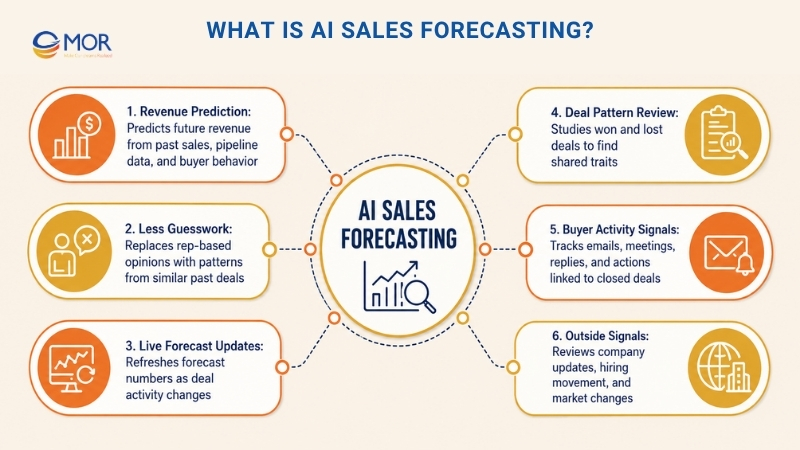
AI-powered sales forecasting cuts that guesswork by spotting signals your team may miss. The system refreshes its numbers as deals move forward, so your forecast shows current sales activity instead of old notes from last week.
The platform studies these signals to make predictions:
- Previous won and lost deals, plus the traits they shared
- Deal speed across each pipeline stage
- Buyer actions that often lead to closed deals
- Activity signals, including email replies and meeting volume
- Outside signals, including company updates or hiring movement
How AI Sales Forecasting Is Different From Traditional Forecasting
Predictive sales forecasting used to depend on manual review and personal judgment. That approach worked for many years, but it can fall short when sales data changes quickly. Sales forecasting using AI helps teams work with live data, richer signals, and faster updates.
Aspect | Traditional Sales Forecasting | AI Sales Forecasting |
Data review | Uses information sets used in machine learning that people update by hand, then checks them through manual review. | Reads richer live data from CRM systems, market changes, buyer actions, and outside signals like economic trends. |
Forecast coverage | Often serves one product, market, or use case. Teams may need to change or rebuild models when conditions shift. | Handles new data and changing business needs with less manual work, helping teams forecast across products, regions, or units. |
Workload handling | Needs people to clean data, follow trends, and prepare reports. | Handles many forecasting tasks, including data cleanup, trend discovery, report creation, and forecast refreshes. |
Hidden signal reading | Relies on human judgment and analyst skill, so some weak signals can be missed. | Finds complex links across large datasets, including links between campaigns and buying behavior by region. |
Unusual change alerts | Sudden sales jumps or drops may be found late, or only after someone checks the numbers. | Flags strange changes early, so teams can act on risks or sales chances faster. |
Speed and change response | Can move slowly when data volume grows or market activity changes fast. | Gives teams faster and more flexible forecasts as customer and market data shifts. |
How AI Sales Forecasting Works
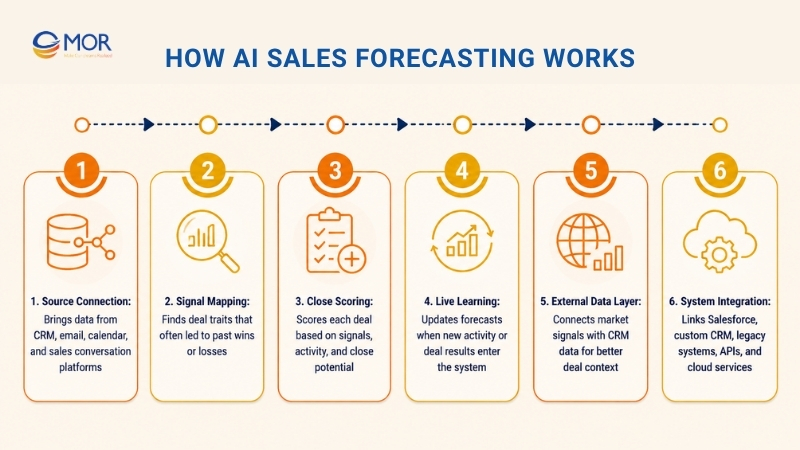
AI for sales forecasting gathers data from the systems your revenue team already uses. The tool connects with your CRM, email, calendar, call records, and employee engagement platforms to understand each deal better. It does not only check the deal stage. It reviews the actions and talks that moved the deal to that point.
The smart part comes from pattern reading. The model studies thousands of closed deals to learn which signs often led to wins or losses. Deals with three active stakeholders may close more often than deals with one contact. Deals that stay quiet for more than 10 days may rarely recover. The model reads these patterns, then applies them to your open pipeline.
The system usually follows this flow:
- Source connection: Brings data from CRM, email automation CRM, calendar, and sales conversation platforms
- Signal mapping: Finds the deal traits that often led to past wins or losses
- Close scoring: Gives each deal a close chance based on several signals
- Live learning: Updates the forecast when new activity or deal results enter the system
Stronger systems join internal records with outside market signals. A deal can look healthy inside your CRM, yet a new buyer-side leader may have a long history with a rival vendor. That signal matters. MOR Software can help build this data layer by connecting Salesforce, custom salesforce development platforms, legacy systems, and outside data sources through APIs, ETL flows, and cloud services.
Core AI Technologies Changing Sales Forecasting
AI sales forecasting now depends on three main technologies that help businesses predict sales results in 2026. Each one plays a different role, and together they make forecast systems more accurate, more responsive, and easier to update.
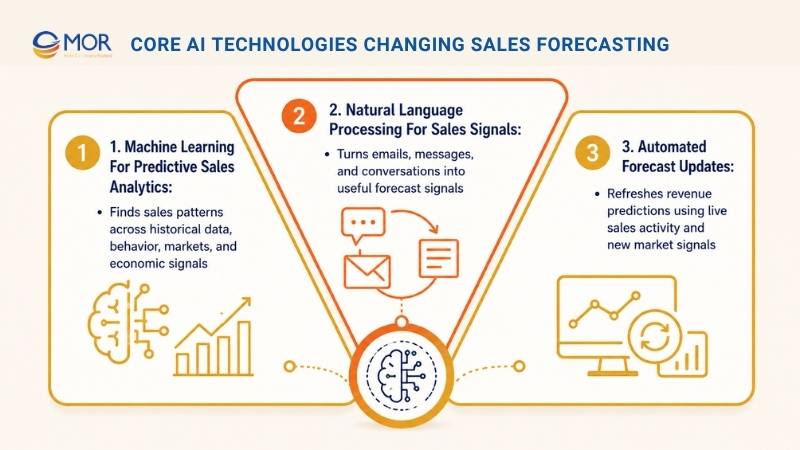
Predictive analytics and NLP set the base, but automation moves sales forecasting into a new stage. The big shift in 2026 is the move from fixed monthly forecasts to self-updating revenue predictions. These systems read live sales activity, outside market signals, and new results without waiting for manual changes.
Companies using reinforcement learning for these updates have reported forecast accuracy gains of up to 10%. The model learns from earlier misses, then adjusts itself as it receives more data.
Automation does more than refresh numbers. It can notice major market shifts and tell teams when an old forecasting model may no longer fit. A person can still review those cases, but the system keeps producing the best possible forecast from current data.
For B2B companies, this means forecasts can stay useful all month. They can adjust to seasonality, economic movement, and competitive changes in real time. That helps sales leaders plan people, budget, and revenue targets with more confidence.
MOR Software can build this kind of connected forecasting setup by combining predictive analytics, NLP signals, predictive scoring, CRM dashboards, and automated workflow alerts. For sales teams, that means cleaner pipeline data, faster follow-up, and more reliable B2B revenue planning.
What Data Feeds AI Sales Forecasting?
Your forecast depends on the data behind it. More useful data gives the model a clearer view. Scattered data creates scattered forecasts that miss key parts of the sales story.
CRM data is the starting point. Deal stage, deal value, expected close date, and logged activity show what sits in the pipeline and where each opportunity stands. Engagement data adds another layer. Email opens, reply rates, meeting count, and stakeholder activity show whether buyers are truly interested or just staying polite.
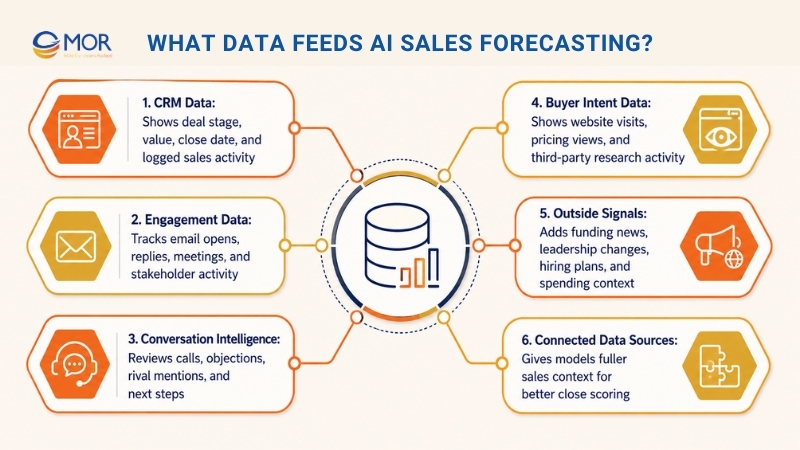
Conversation intelligence records what happens in calls and meetings. The platform reviews call mood, rival mentions, common objections, and whether clear next steps were booked. A rep may mark a deal as 'commit,' but if recent calls show price pushback and rival comparisons, the forecast should treat that deal with care.
Buyer intent data shows what prospects check before they speak with your team:
- Website content they read
- Competitor or comparison pages they open
- Pricing pages they view
- Research activity on third-party sites
Outside signals complete the view. Funding news, leadership changes, and hiring plans can show whether a company is growing or cutting spend. A buyer that just raised Series B looks very different from a buyer that recently cut 20% of its team.
When these data sources connect, the model gains the sales context it needs. Two deals may look the same in your CRM, but one buyer may show strong intent while the other has been silent for two weeks. Those deals should not get the same close score.
Key Benefits Of AI Sales Forecasting
AI sales forecasting helps sales teams make clearer business calls from the data they already own. Predictive analytics can support companies of many sizes and sectors because it links sales goals, buyer activity, and revenue outcomes in one view.
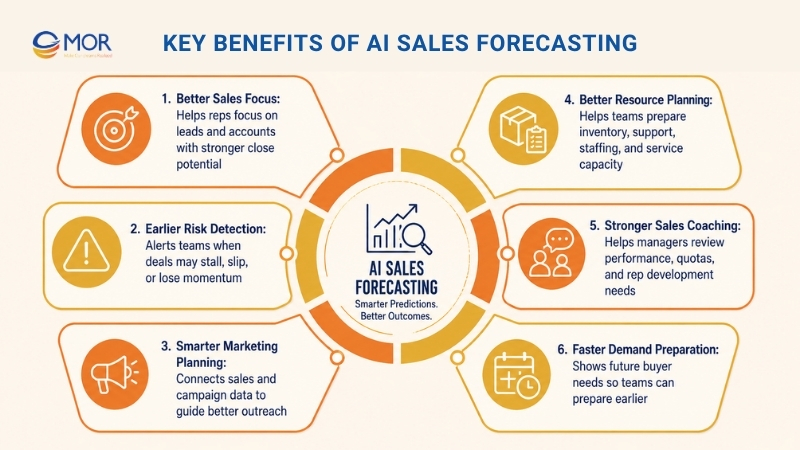
Better Sales Focus
This may sound simple, but it still matters: better forecasts help sales teams perform better. AI-powered sales forecasting is built so your team does not need to spend hours checking every deal by hand. Once sales analytics and forecasting are connected to your CRM, the system can handle much of the background work, so reps can spend more time on leads and accounts with stronger close potential.
Earlier Risk Detection
Deals may slow down, buyers may stop replying, and leads may lose interest before a team notices the problem. An AI sales forecasting error solution helps reduce these blind spots with alerts when a deal looks likely to stall or slip. MOR Software can build custom alerts inside CRM or sales dashboards, so teams know when to follow up, review deal risk, or adjust next steps.
Smarter Marketing Planning
It can be hard to decide where your marketing team should focus when the pipeline has many possible buyers. Predictive analytics and forecasting help marketers see which funnel stage needs more attention. MOR Software can also help connect sales data, campaign data, and customer behavior, so teams can plan content and outreach around real buyer signals.
Talk to MOR Software about custom sales forecasting dashboards.
Better Resource Planning
AI sales forecasting can help you plan ahead and check whether your team has the right resources ready at the right time. If the forecast shows higher future sales, you can prepare inventory, sales support, delivery teams, or customer service staff before demand rises.
Stronger Sales Coaching
According to Monday CRM’s state of sales tech 2025 report, 80% of 500 surveyed sales leaders said AI helped raise productivity. Reliable analytics and sales forecasting tools can also help managers review team and rep performance. You can compare current results with quotas, see who is on track or falling behind, and use the data to coach junior reps or pair them with senior team members.
Faster Demand Preparation
For new and returning customers, accurate forecasting gives your team early notice about future needs. AI demand forecasting can show when more buyers are likely to purchase within a set period, so your team can prepare demos, stock, product knowledge, and training before demand arrives.
Business-Specific Use Cases And Examples Of AI Sales Forecasting
When companies connect AI with their data and workflows, they can use the technology for many business needs. These AI sales forecasting use cases show how the system can speed up work and reveal useful sales signals.
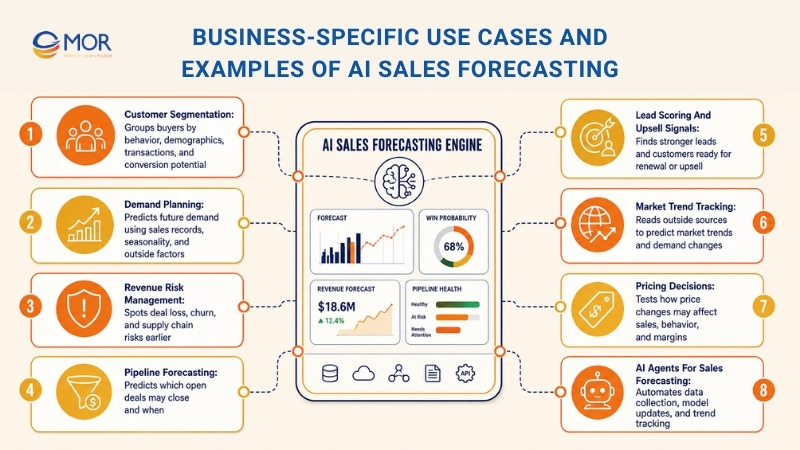
Customer Segmentation
AI models can estimate results for different customer groups through behavioral, demographic, and transaction data. The system works by finding clusters that show which buyers are more likely to convert, spend more, or stop buying. Better segmentation helps sales teams shape outreach, focus on high-value leads, and match offers to each audience.
Business case:
In retail, AI can group shoppers into loyal fans, price-sensitive buyers, and casual customers, then predict how each group may react to different offers. These findings help teams shape campaigns for each audience group.
Demand Planning
AI improves demand planning by joining past sales records, seasonal trends, and outside factors like weather or economic changes. With AI demand forecasting in supply chain planning, sales teams can predict future demand across regions and channels, then adjust stock and logistics plans. This helps protect product availability, avoid excess stock or shortages, and support more reliable sales promises.
Business case:
A beverage company uses AI sales forecasting software to predict higher energy drink demand after news of a major sports event. The system reads social media activity and local interest, then predicts stronger demand among certain buyer groups, helping the company prepare stock and distribution near event areas.
Revenue Risk Management
AI sales forecasting can spot revenue risks, including deal loss, customer churn, or supply chain trouble, through buyer behavior, pipeline data, and outside conditions. These predictive signals help teams step in sooner, focus on risky accounts, and take action that protects revenue and customer trust.
Business case:
A B2B software company uses AI to find early churn signs among large clients through product usage and support ticket data. Account managers can then reach out earlier and run focused retention plans to keep those customers.
Pipeline Forecasting
AI in sales pipeline forecasting changes how teams judge open opportunities by reading CRM records, rep activity, buyer engagement, and past deal outcomes. The system predicts which deals may close and when they may close. This helps sales teams focus on stronger opportunities, plan resources better, and set revenue targets with more confidence.
Business case:
A SaaS company uses AI to estimate monthly revenue from open pipeline deals. Leaders set more realistic targets, and reps spend more time on opportunities with better close chances.
Lead Scoring And Upsell Signals
AI reviews buyer actions, demographic details, and purchase history to help reps score new leads and find current customers who may be ready for renewal or upsell. Sales teams can then act on revenue chances that might be missed in manual review.
Business case:
For subscription businesses, AI models can identify new leads through engagement activity and flag existing customers who may upgrade. Reps can then focus on accounts with stronger conversion or growth potential.
Market Trend Tracking
AI sales forecasting can use Natural Language Processing to read outside sources like social media, news, and customer reviews, then find new market trends and predict how they may affect demand. Sales teams can stay closer to market movement, pitch products that fit current needs, and respond faster when buyer preferences change.
Business case:
A cosmetics brand finds growing interest in natural ingredients through AI-based trend tracking. The company can prepare a timely product push and marketing campaign before demand peaks.
Pricing Decisions
AI models can test how price changes may affect buyer behavior and sales results by reviewing past performance, competitor prices, and market sensitivity. This helps sales teams set more competitive prices, win more deals, and protect margins.
Business case:
A consumer electronics retailer uses intelligent forecasting systems to review past sales, competitor prices, and seasonal demand. The model predicts that lowering the price of a midrange smartphone before a holiday weekend can raise unit sales without hurting total profit.
AI Agents For Sales Forecasting
AI agents are self-running applications that work together to handle complex business tasks. They can support key forecasting work, including data collection, model updates, and metric tracking for changing trends. AI tools for sales forecasting and pipeline accuracy can also learn from past cases to improve predictive sales forecasting results over time.
Business case:
In manufacturing, groups of AI agents gather data from CRM, ERP, and outside market sources to predict quarterly sales by product line. They spot early demand changes, test the effect of price moves, and warn sales managers about possible revenue gaps.
AI Sales Forecasting Models And Methods
Different AI methods fit different sales setups. The right sales forecasting AI model depends on your sales cycle, deal size, pipeline shape, and the amount of past data you can use.
Model Type | How It Works | Best For |
Sales pattern analysis | Uses past sales movement and seasonal trends to project future results | Stable sales cycles with repeat buying patterns |
Variable-based models | Finds which factors affect sales outcomes and gives each factor a weight | Sales processes with several clear deal drivers |
Machine learning forecast models | Finds hidden patterns across large and complex datasets | Long B2B sales cycles with many signals |
Blended model methods | Combines several models to lower the risk of forecast error | Enterprise forecasts that need high accuracy |
Sales pattern analysis studies your sales history and extends those patterns forward. If your company often sells more in Q4, the model includes that seasonal behavior. Variable-based models identify which inputs matter most. Deal value, engaged contacts, and days since the last activity may all affect close chance, and the model gives weight to each one.
Machine learning models can detect patterns that people may never notice. A demo-led deal may close faster than a discovery-led deal, but only in certain industries or deal sizes. Blended model methods use several approaches together, which helps improve accuracy and limit the errors that one model may create.
Most modern forecasting platforms now combine these methods rather than depend on a single model.
Future Trends In AI Sales Forecasting
AI in sales forecasting is moving quickly. It no longer only predicts how much your team may sell. It is also changing how businesses read demand, understand buyers, and react to market movement in near real time.
As more companies bring AI into sales operations, several clear trends are shaping the next stage of this technology.
Let’s look at what is happening now in predictive analytics for sales forecasting.
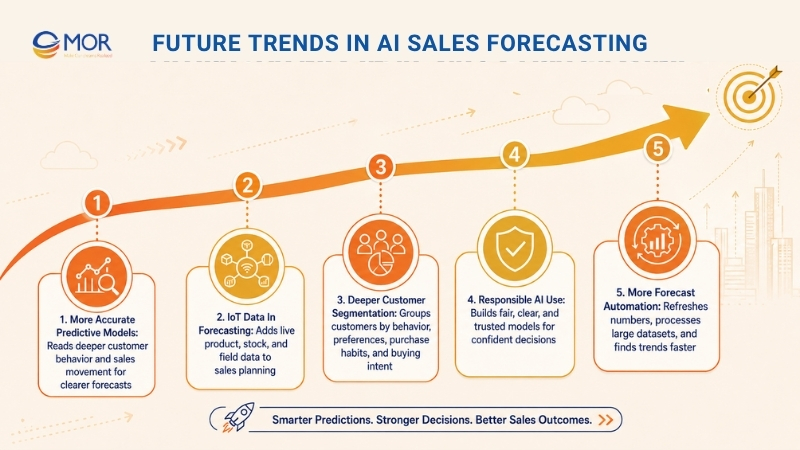
More Accurate Predictive Models
AI-based sales forecasting for enterprises is becoming more detailed, with models that can read customer behavior and sales movement at a deeper level. These tools give leaders clearer views of what may happen next.
This helps companies use newer forecast methods that are more reliable than older manual approaches. These models can also detect demand changes earlier, so businesses can prepare instead of reacting late.
IoT Data In Forecasting
IoT devices now create a steady stream of useful data. That data can move into AI sales forecasting systems and give teams a live view of product use, stock levels, and field activity.
This matters a lot for manufacturing and retail because teams can see what is happening in operations as it happens. When AI forecasting connects with CRM data, sales plans can follow real demand signals instead of rough guesses.
Deeper Customer Segmentation
More companies now use AI to group customers by behavior, preferences, purchase habits, and buying intent. This supports lead scoring and helps predict which prospects may turn into customers.
AI demand forecasting in retail also helps sales teams focus on high-value buyers instead of chasing weak leads. Smarter segmentation means the right offer can reach the right customer at the right time.
Responsible AI Use
As AI becomes more common in forecasting, responsible use matters more. Teams need clear models, fair data, and results they can trust.
Custom AI solutions must avoid biased predictions and give decision-makers enough clarity to act with confidence. This turns AI from a black box into a useful planning tool.
More Forecast Automation
Automation will keep growing in sales planning. It saves time, cuts manual effort, and helps teams produce more accurate forecasts. AI-powered forecasting systems can process large datasets, refresh numbers when data changes, and find trends that people may miss during manual review.
Software as a service companies can gain strong value from this trend. An AI sales forecast can help them predict renewals, spot churn risk, and estimate revenue growth with far less manual work.
AI is changing how revenue planning works. It gives teams better accuracy, live signals, and systems that can grow with the business. Companies that use AI-based forecasting for enterprise operations can make smarter decisions, manage inventory with more control, and react faster when the market shifts. That is a real edge. The results are already visible across industries, including better sales performance, stronger resource planning, and clearer revenue decisions.
How MOR Software Helps Businesses Build AI Sales Forecasting Systems
AI sales forecasting works best when it fits the real sales process, not a perfect version of it on paper. Many companies already have useful data, but it sits across CRM tools, Salesforce, ERP platforms, email threads, website forms, sales reports, and internal systems.
That is where MOR Software can help. We help businesses turn scattered sales data into connected forecasting systems that support clearer revenue planning, faster deal reviews, and better sales decisions.
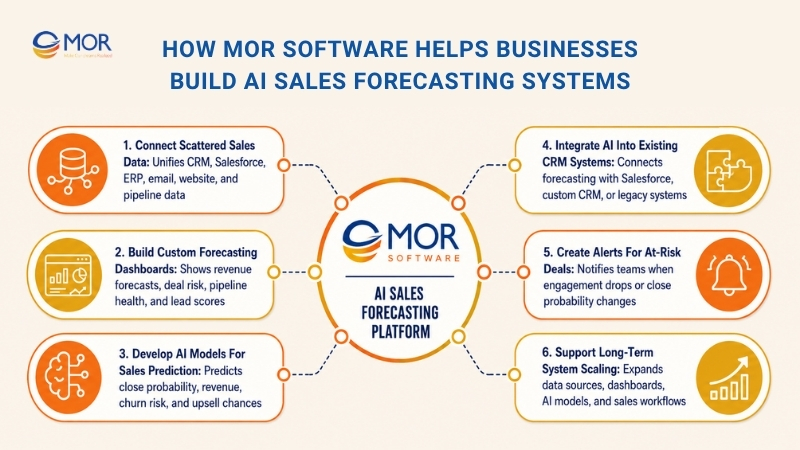
Connect scattered sales data
MOR Software helps bring sales data from CRM, Salesforce, ERP, email, website, sales pipeline optimization, and internal systems into one connected data flow. This gives sales leaders a fuller view of deal movement, buyer activity, and revenue signals.
Build custom forecasting dashboards
Our team can build dashboards for revenue forecasts, deal risk, pipeline health, lead scores, and sales targets. Teams can see what is likely to close, where deals are stuck, and which accounts need attention.
Develop AI models for sales prediction
MOR Software can build multimodal AI models based on historical sales data, deal behavior, customer intent, and market signals. These models help predict close probability, future revenue, churn risk, and upsell chances.
Integrate AI into existing CRM systems
Businesses do not always need to replace their current sales tools. MOR Software can connect AI sales forecasting with Salesforce, custom CRM platforms, or legacy sales systems, so teams can work inside tools they already know.
Create alerts for at-risk deals
MOR Software can set up alert systems that notify sales teams when a deal stalls, buyer engagement drops, or close probability changes. This helps reps act earlier, before a deal goes cold.
Support long-term system scaling
As sales data grows, markets shift, or sales teams expand, forecasting systems need room to grow. MOR Software can help build a setup that supports new data sources, new dashboards, new AI models, and changing sales workflows.
For businesses still relying on spreadsheets or disconnected CRM reports, ai sales forecasting can bring much-needed clarity. MOR Software helps companies build the data foundation, AI layer, and CRM connection needed to make forecasting part of daily sales work.
Conclusion
AI sales forecasting works best when it sits close to your real sales data and daily workflow. It helps teams spot risk, plan demand, coach reps, and build clearer revenue plans without chasing updates across spreadsheets. If your sales data is split across CRM, Salesforce, ERP, emails, and internal reports, MOR Software can help connect it, build AI models, and turn forecasting into a practical sales tool. Contact MOR Software to discuss your project.
"Evolution is not a destination, it is a disciplined journey of innovation."
Phung Van Tu


CEO MOR AI
MOR SOFTWARE
Frequently Asked Questions (FAQs)
What is AI sales forecasting?
AI sales forecasting uses artificial intelligence to predict future sales based on past sales data, current pipeline activity, buyer behavior, and market signals. It helps sales teams move away from guesswork and make decisions based on data.
How does AI make sales forecasts more accurate?
AI studies patterns across many deals, such as deal stage, buyer engagement, sales activity, and past win rates. It can spot signals that humans may miss, then update predictions when new data appears.
What data does an AI forecast tool need?
It needs clean and connected sales data. Common sources include CRM records, deal history, email activity, meeting data, website visits, lead behavior, customer profiles, and external business signals.
Can small businesses use AI sales forecasting?
Yes. Small businesses can start with simple use cases, such as lead scoring, monthly revenue forecasts, or deal risk alerts. They do not need a large AI system at the start.
Will AI replace sales managers?
No. AI can support sales managers, but it should not replace human judgment. Managers still need to review deal context, coach reps, check unusual patterns, and make final decisions.
How can AI help detect sales reps overcommitting forecasts?
AI can compare each rep’s forecast with real deal signals, such as buyer engagement, deal age, stage movement, past close rates, and activity history. If a rep commits too much revenue without enough supporting data, AI can flag the forecast as risky for managers to review.
How accurate can AI-based sales forecasts be?
Accuracy depends on data quality, sales process consistency, model design, and how often the system is updated. Clean data and clear sales stages usually lead to better forecast results.
What are the main benefits of AI sales forecasting?
The main benefits include better revenue planning, earlier deal risk detection, stronger pipeline visibility, smarter resource planning, and faster sales decisions.
What are common problems when using AI for sales forecasts?
Common problems include poor CRM data, missing deal updates, disconnected systems, biased data, and hard-to-read forecast reports. These issues can make predictions less useful.
How long does it take to set up an AI-based forecast system?
The timeline depends on data readiness, system complexity, and integration needs. A simple dashboard may take less time, but a custom model connected to CRM, ERP, and sales tools usually needs more planning.
How can a company start using AI for sales forecasting?
Start by reviewing current forecast gaps, cleaning CRM data, defining clear sales stages, and choosing one use case. Good starting points include revenue prediction, lead scoring, or alerts for stalled deals.
Share


Make Our-Dreams Realized


© 2023 . MOR Software. All Rights Reserved
Sitemap
Privacy Policy
Terms of Use

Rate this article
0
over 5.0 based on 0 reviews
Your rating on this news:
Name
*Email
*Write your comment
*Send your comment
1