


Building An AI Native Engineering Team In 2026 [Definitive Guide]
Software teams are moving faster, but many still struggle with messy specs, slow reviews, weak test coverage, and unclear AI ownership. Building an AI native engineering team helps companies turn AI agents into real delivery partners, not random coding tools. In this guide, MOR Software will show you how an AI native engineering team works and what leaders should prepare in 2026.
Key Takeaways
- Building an AI native engineering team changes how software teams plan, code, test, review, document, and maintain products. AI supports first-pass work, while engineers keep control over direction, quality, and release decisions.
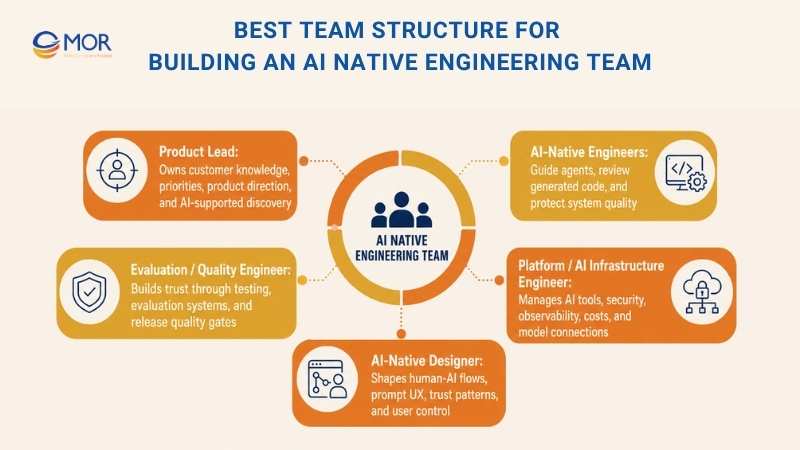
- A strong AI engineering team needs clear roles, including Product Lead, AI-Native Engineers, Evaluation / Quality Engineer, Platform / AI Infrastructure Engineer, and AI-Native Designer.
- The best results come from clear specs, strong verification, living documentation, built-in security checks, and small pods that own delivery from idea to production.
What Building An AI Native Engineering Team Really Means
An AI native engineering team is different from a standard software group that only adds AI agents framework to daily coding work. It is a software team where AI takes part across the full software development lifecycle, including planning, design, coding, testing, review, documentation, and operations.
That difference is worth noting. In an AI-assisted setup, engineers often keep the same work pattern. They create tickets, build functions, ask AI for small code ideas, prepare tests, open pull requests, and wait for feedback. AI supports several steps, but the team model does not change much.
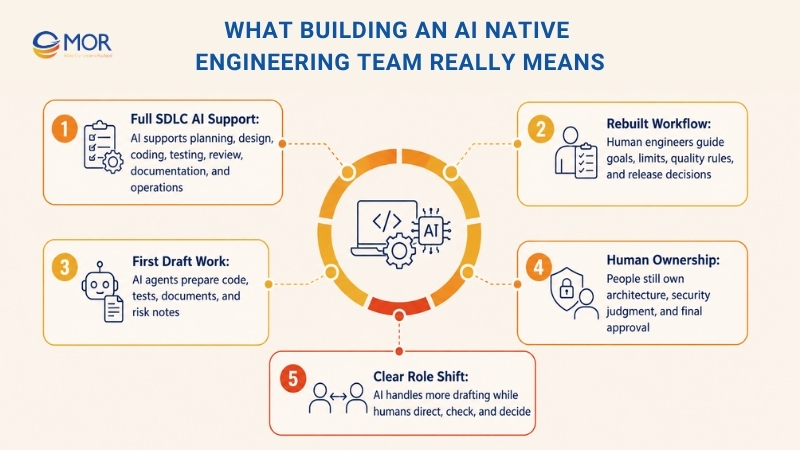
In an AI-native team, the whole workflow is rebuilt. Human engineers set the goal, limits, product behavior, quality rules, and acceptance standards. AI agents prepare build options, write draft code, create test cases, refresh documents, and point out likely risks. People still check the work, make architecture calls, judge security, and decide when something can go live.
The idea is easy to grasp, but hard to run well: AI automation takes more of the first draft work, and humans stay responsible for direction, checking, and final ownership.
Building An AI Native Engineering Team Vs Traditional Engineering Workflows
As AI becomes part of the SDLC, software teams now need to rethink how work is scoped, built, tested, and supported. Standard workflows depend on human effort at nearly every step, but AI-native workflows treat agents as active work partners that help teams move faster and cut repeat tasks. AI for engineering teams changes the daily flow in the ways shown in this comparison.
Area | Traditional Engineering Workflow | AI-Native Engineering Workflow |
Planning | Engineers manually gather requirements and analyze systems | AI agents assist with research, dependency analysis, and requirement breakdown |
Design | Human-led design with limited automation | AI supports prototyping, architecture exploration, and design validation |
Coding | Developers write most code manually | AI agents generate first-pass implementations and repetitive code |
Testing | QA and developers create tests manually | AI generates test cases, identifies edge cases, and supports automated validation |
Code Review | Review focuses on human-written code quality | Review focuses on correctness, security, architecture, and AI-generated outputs |
Documentation | Often created after development and easily becomes outdated | Generated continuously alongside development and maintained automatically |
Knowledge Sharing | Relies on meetings, documentation, and onboarding sessions | AI agents provide contextual knowledge and project memory on demand |
Developer Role | Primary code producer | System designer, reviewer, orchestrator, and decision-maker |
Delivery Speed | Sequential and often slower | Parallelized workflows with faster iteration cycles |
Quality Assurance | Human-driven verification processes | Human oversight combined with AI-assisted testing and evaluation |
Scalability | Growth requires adding more engineering capacity | Teams scale output through human-agent collaboration |
Governance | Focused on coding standards and reviews | Includes AI usage policies, evaluation frameworks, security controls, and verification processes |
Teams that make this model work do not push people out of engineering. They change each person’s focus so humans spend more time on judgment, direction, and ownership, while AI handles heavy first-pass work. This mix helps teams ship faster, keep quality high, and deal better with rising product complexity.
Why AI-Native Engineering Is Becoming The New Software Delivery Model
Research base: The reference draft uses AI engineering trend sources and software delivery materials, while this rewrite also aligns the discussion with MOR Software service strengths in AI outsourcing, AI development, Agile delivery, testing, and long-term maintenance.
AI-native engineering is gaining ground because software teams face pressure to release faster without letting quality drop. AI agents are no longer limited to code suggestions. They can read repositories, create full files, set up project structures, run tools, repair errors, write tests, and help developers understand codebases they do not know yet.
This changes what matters most in software work. Before, delivery speed often depended on how fast offshore AI developers could write and connect code. Now, it depends more on how clearly teams explain the task, how much project knowledge they give to agents, and how well they check the output.
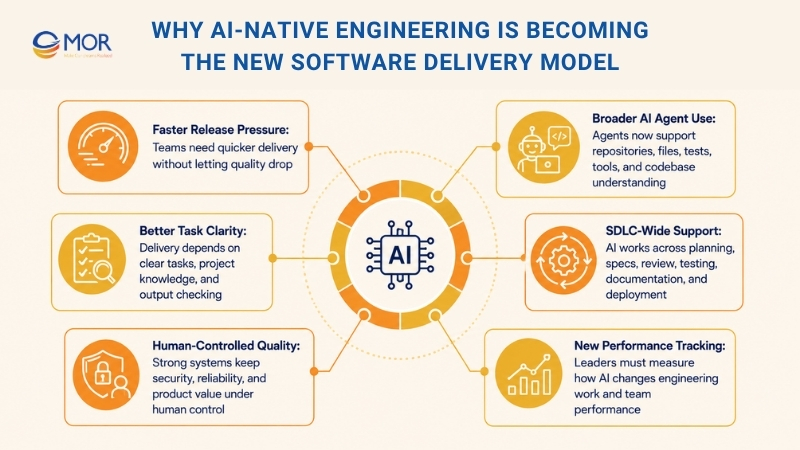
Building an AI native engineering team fits this shift because AI can sit across the SDLC while developers move away from pure code production. Their work becomes more about orchestration, problem solving, and system design. LLM-based applications and agents are also becoming part of engineering strategy, so teams need training, safe rules, and platform support.
For business leaders, AI-native engineering reaches far beyond productivity. It changes:
- How teams shape work plans
- How engineers prepare specs
- How code review needs to work
- How test coverage gets built
- How documentation stays fresh
- How deployment and incident response run
- How engineering performance gets tracked
- How teams hire and train engineers
The best results do not come from teams that ask AI to write the most code. They come from teams that create strong systems around AI-created work, so quality, security, reliability, and product value remain under human control.
Best Team Structure For Building An AI Native Engineering Team
Building an AI native engineering team does not mean copying the shape of a large AI research lab. For a startup with 5 to 15 people, the group should stay small, quick, and cross-functional. The main change is that each role uses AI agents as part of normal work, not as an extra tool on the side.
Rather than splitting product, engineering, QA, infrastructure, and design into slow handoff steps, this model brings the roles closer together. The product lead uses AI to improve discovery work. Engineers use agents to plan, build, refactor, and review. Quality engineers focus on evaluation systems. Platform engineers keep the AI stack safe, visible, and cost-aware. Designers shape the human-AI flow so users can understand and control what the product does.
Product Lead
The Product Lead owns customer knowledge, priority setting, product direction, and AI-supported discovery. This person links the team’s technical work with the real problems customers need solved.
In a traditional team, product discovery often relies on interviews, hand research, support tickets, analytics dashboards, and several feedback rounds with engineers. In an AI-native team, the Product Lead can move faster with AI-supported work. They can sum up customer calls, group support issues, study user behavior, compare market products, and turn rough ideas into clearer requirements.
The Product Lead does not have to work like an engineer, but they need enough technical understanding to work with AI-native engineers and know what agents can realistically build. Their work is to decide which problems are worth solving, which ideas should enter development, and which AI-created suggestions need more human review.
A strong Product Lead in this setup owns:
- Customer knowledge
- Priority setting
- Product direction
- AI-supported discovery and research
- Scope planning with engineering input
- Success measures for AI-powered product work
This role matters more when AI can create many ideas at high speed. Without clear product direction, a team can move quickly toward the wrong target. The Product Lead keeps the group focused on customer value instead of chasing every possible automation idea.
AI-Native Engineers
AI-Native Engineers are the center of this team model. For a startup with 5 to 15 people, two to six engineers may be enough to build a strong product if the workflows and tools are set up well.
Their work looks different from the old software engineer role. They still need solid engineering skill, but their daily tasks change. They no longer have to write every line of code by hand. Much of the work now centers on guiding autonomous AI agents, checking generated code, improving system design, weighing trade-offs, and making sure the final output is safe, reliable, and easy to maintain.
AI-Native Engineers usually own:
- Architecture
- Agent direction
- Product function development
- Code review
- Review of AI-created code
- Refactoring and system upgrades
- Connection between AI parts and core product systems
This role needs strong judgment. AI agents can draft code, suggest architecture, create tests, and scan for bugs, but engineers still decide whether the output fits the system. A strong AI-native software engineer knows how to split work into clear tasks, give agents the right project knowledge, question assumptions, and check the final result before release.
In daily work, the job moves from “writing code” toward “directing software creation.” Engineers spend more time planning the path, setting rules, checking outputs, and improving the workflow. The role of AI native engineer is not passive tool use. It is closer to technical direction, where engineers know when automation can be trusted, when they must step in, and when the work should be rewritten.
Evaluation / Quality Engineer
The Evaluation / Quality Engineer owns the trust layer of the AI-native team. This role creates one of the clearest gaps between a traditional software group and an AI-native one.
In a traditional setup, QA often centers on test cases, regression checks, bug reports, and release validation. These tasks still matter, but AI-native teams need a stronger evaluation role. When agents create code, product logic, tests, documents, or user-facing responses, the team needs a way to judge whether those outputs are right, stable, safe, and useful.
The Evaluation / Quality Engineer owns:
- Test creation
- Evaluation systems
- Reliability measures
- Agent behavior tracking
- Regression checks for AI-supported workflows
- Quality gates before release
This role helps the team answer direct questions: Did the agent complete the task correctly? Did it add hidden bugs? Did it follow code rules? Did the new workflow raise speed without hurting reliability? Did a model change create risky behavior?
Many AI-native teams put more effort into evaluation than old QA work because trust becomes the main bottleneck. AI can create work fast, but every output still needs proof. Without evaluation systems, teams may move quickly at the start, then slow down because nobody knows which agent outputs are safe to release.
A strong Evaluation Engineer helps the team trust the process. They build repeatable checks, set quality thresholds, watch agent behavior, and turn vague AI performance into clear engineering signals.
Platform / AI Infrastructure Engineer
The Platform / AI Infrastructure Engineer owns the technical base that lets the team use AI in a safe and practical way. In smaller startups, a senior engineer may cover this role first. As the product grows, the role often becomes dedicated.
This person runs the systems behind AI-native development, including model access, agent tools, observability, security, cost controls, and deployment flows. Their work keeps AI from turning into a messy set of disconnected tools.
The Platform / AI Infrastructure Engineer owns:
- LLM infrastructure
- Observability
- Security
- Cost control
- Agent tools
- Internal developer workflows
- Model and API connections
This role becomes more important once a team starts using agents across planning, development, testing, documentation, and support. Without strong platform ownership, costs can rise fast, prompts and workflows can drift, and teams can lose sight of what agents are doing.
A good platform setup gives engineers clear safety rails. It may include approved tools, shared prompt libraries, safe codebase access, action logs for agents, usage dashboards, cost alerts, and review flows. This makes AI adoption safer and easier to grow across the team.
The Platform / AI Infrastructure Engineer also works with security and engineering leads to lower risk. AI agents may need access to repositories, tickets, logs, documents, or customer data. That access needs tight control so the team can move fast without exposing sensitive systems.
AI-Native Designer
The AI-Native Designer owns more than visual design in this team. They shape how people work with AI systems, how users give instructions, how agents show progress, and how the product handles uncertainty.
When AI becomes part of the product experience, UX design has to answer new questions. What should users see while an agent is working? How much control should they have? When should the system ask for approval? How should the product explain an AI decision? What should happen when the AI is unsure?
An AI-Native Designer owns:
- UX
- Human-AI interaction flows
- Prompt UX
- Agent experiences
- Feedback loops
- Trust and control patterns
This role is especially useful for products where users work directly with AI agents. A strong AI function can still fail if users do not know how to guide it, check its output, or fix mistakes. Good AI-native design makes the system feel clear, guided, and useful instead of random.
The designer also works closely with the Product Lead and AI-Native Engineers to turn technical ability into a product flow people can use. They help decide where automation belongs, where users should keep control, and how the interface should support review, correction, and teamwork.
How Roles Change When Building An AI Native Engineering Team
AI-native teams keep the familiar roles, but the daily work behind those roles changes. Engineers, QA teams, writers, DevOps specialists, and managers still own the core parts of delivery. The main shift is that their focus moves toward agent direction, output checking, system evaluation, and workflow control.
Traditional Role | AI-Native Version |
Software Engineer | AI-Native Engineer |
QA Engineer | Evaluation Engineer |
Technical Writer | AI-Assisted Documentation Owner |
DevOps Engineer | Platform And Agent Operations |
Engineering Manager | Human And Agent Workflow Orchestrator |
This change matters because AI reshapes how engineering time gets used. Software engineers no longer spend most of their day writing every line from scratch. They guide agents, review architecture choices, and improve the final output. QA engineers move away from mostly manual checks and take charge of evaluation systems, reliability signals, and quality gates. Technical writers can use AI to draft and refresh documents, but they still control accuracy, structure, and tone. DevOps engineers take on agent operations, cost tracking, system visibility, and AI infrastructure. Engineering managers coordinate people, agents, reviews, and delivery flow across the software development lifecycle.
In smaller teams, one person may carry more than one responsibility. A senior engineer might manage platform setup. A product lead may also run AI-supported discovery. A designer might handle prompt UX and user testing. This is common when a startup is still proving the product and keeping the team lean.
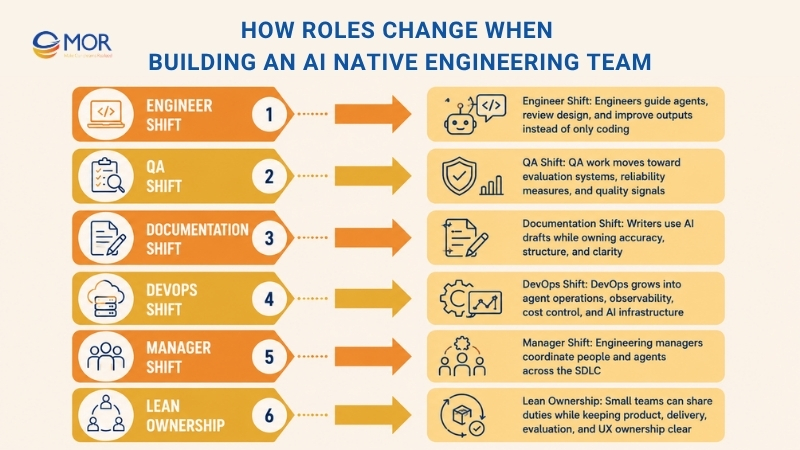
The point is not to hire every AI role from day one. The point is to cover the work that cannot be ignored. As the product grows, the team can bring in more focused roles, including ML engineers, data engineers, AI governance specialists, prompt engineers, or model operations owners. Strong AI-native teams often begin small, but they make ownership clear across product direction, engineering delivery, evaluation, infrastructure, and user experience.
Search interest around AI native software engineer accenture also shows that leaders are studying how large service firms describe these new roles. For MOR Software, the better question is practical: which roles must your product team cover now, and which ones can grow later through a dedicated or offshore development model?
Core Principles For Building An AI Native Engineering Team
The best AI-native teams follow clear work rules. If you want to build an AI native team, these rules matter because agents can create more code, but they can also create more defects, more review pressure, and more security risk.

Start With Specs Before Code
AI agents work better when requirements are clear. Engineers should define the problem, acceptance rules, limits, edge cases, and expected system behavior before asking agents to build.
A useful spec should include:
- What the function should do
- What the function should avoid
- User roles and access rights
- Inputs and outputs
- Data rules
- Performance needs
- Security limits
- Failure cases
- Definition of done
Treat Verification As The Real Bottleneck
Code generation keeps getting faster and cheaper. Checking the work is still costly.
This means AI-native teams should focus on:
- Automated tests
- Security scans
- Static analysis
- Linters
- Evaluation pipelines
- Human review rules
- Production monitoring
- Incident tracking
The strongest teams are not the ones with the largest amount of AI-written code. They are the teams that can prove the code works.
Turn Documentation Into Team Memory
AI agents need clear project knowledge. Teams should treat documentation as part of the product system, not as late admin work.
Useful documentation includes:
- Product specs
- Architecture decision records
- System maps
- Runbooks
- Agent instructions
- API contracts
- Security rules
- Coding standards
- Deployment notes
This documentation becomes a shared memory layer for people and AI agents. The more ordered the knowledge is, the easier it becomes for agents to work safely.
Put Security Checks Inside The Workflow
AI-created code can contain unsafe patterns, weak dependencies, or logic that looks fine but breaks under pressure. When building an AI native engineering team, security checks should run before code reaches human review.
An AI-native security process should include:
- Static analysis on each commit
- Dependency checks
- Approved package lists
- Security-focused agent rules
- Required senior review for sensitive code
- Clear limits on what agents can edit
- Logs for AI-created changes
Use Small Pods Instead Of Heavy Handoffs
AI-native teams perform best when a small group owns the full result. A pod of 3 to 5 people can move faster than a larger team with many handoffs, as long as ownership and review discipline stay strong.
The pod should own the work item from spec to production. That includes planning, implementation, testing, documentation, deployment, and monitoring.
AI-Native Engineering Workflow
Building an AI native engineering team changes the way each SDLC phase is planned, built, checked, and supported with coding agents. The stages below show you how work runs inside an AI-native engineering setup and what your team can do to move from simple AI-assisted development to a real AI-native operating model.
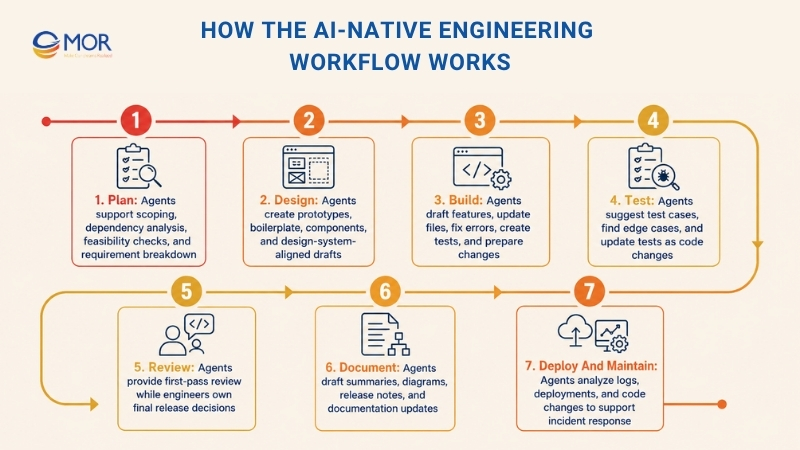
Plan
Across most companies, teams still look to engineers to judge whether a function can be built, how much time it may take, and which systems or teams may be affected. Anyone can write a first draft of a spec, but a reliable plan usually needs deep codebase knowledge and several rounds with engineering to find missing details, clear up edge cases, and agree on what is realistic.
Where coding agents add value
AI coding assistant agents can give teams fast, code-aware support during planning and scoping. A team may connect agents to issue-tracking tools so the agent can read a feature spec, compare it with the codebase, flag unclear points, split work into smaller parts, or judge task difficulty.
Coding agents can also follow code paths right away to show which services a feature may touch, a task that used to take many hours, or even days, of manual codebase review.
Where engineers focus
Teams can spend more time on core product work because agents bring up the context that once required long scoping meetings. Key build details, dependencies, and edge cases appear earlier, which helps teams make faster calls with fewer meetings.
Hand Off | Check | Own |
AI agents can prepare the first view of feasibility and architecture. They read a spec, connect it to the codebase, find dependencies, and point out unclear items or edge cases that need more detail. | Teams check the agent’s output for accuracy, missing context, and real technical limits. Story points, effort estimates, and hidden risks still need human judgment. | People still lead major choices, including priority, long-term direction, order of work, and trade-offs. Teams may ask the agent for options or next steps, but product planning and final direction remain human-owned. |
Practical starting checklist
- Find repeated workflows where product ideas must connect with source code. Common cases include feature scoping and ticket creation.
- Start with simple workflows, like tagging and grouping repeated issues or feature requests.
- Try stronger workflows later, like creating sub-tasks from a first feature note. You can also start an agent run when a ticket reaches a set stage so the description gets more useful detail.
Design
Design work often slows down because teams first need to handle setup work. Engineers spend a lot of time preparing boilerplate, connecting design systems, and tuning UI components or user flows. When mockups do not match implementation, teams face rework and long feedback loops, and limited time to test other ideas can delay design checks.
Where coding agents add value
AI coding tools can speed up prototypes by creating boilerplate code, setting up project structures, and applying design tokens or style rules right away. Engineers can describe a function or UI layout in plain language and get prototype code or component drafts that follow team standards.
Agents can also turn designs into code, suggest accessibility fixes, and study the codebase for user paths or edge cases. This lets teams test several prototypes within hours rather than days, and it helps them create high-fidelity prototypes earlier so decisions and user tests can happen sooner.
Where engineers focus
When agents handle routine setup and translation work, teams can spend more attention on the parts that need judgment. Engineers refine core logic, set scalable architecture patterns, and make sure components meet quality and reliability rules. Designers can spend more time checking user flows and testing different concepts. The shared work moves away from setup tasks and closer to the real product experience.
Hand Off | Check | Own |
Agents can take the first build pass by setting up projects, writing boilerplate, turning mockups into components, and applying design tokens or style guides. | The team checks whether the output follows design rules, meets quality and accessibility needs, and connects well with existing systems. | The team owns the full design system, UX patterns, architecture choices, and final user experience direction. |
Practical starting checklist
- Use a multi-modal coding agent that can read text and image input.
- Connect design tools to coding agents through MCP.
- Expose component libraries through MCP and connect them to your coding model.
- Create workflows that turn designs into components, then turn those components into working code.
- Use typed languages, like TypeScript, to define valid props and subcomponents for the agent.
Build
The build stage is where teams often feel the most drag, and it is also where coding agents can help the most. Engineers spend a lot of time turning specs into code structures, connecting services, repeating patterns across the codebase, and filling in boilerplate, so even small functions can require hours of low-value work.
As products grow, this drag gets worse. Large monorepos gather patterns, rules, and old quirks that slow new contributors. Engineers may spend as much time finding the accepted way to build something as they spend writing the function itself. Switching between specs, code search, build errors, test failures, and dependency work also adds mental load. Long tasks can lose momentum when interruptions break focus and push delivery back.
Where coding agents add value
Coding agents inside the IDE and CLI can speed up building because they can handle larger tasks with several steps. Rather than writing only one function or file, they can build a full feature flow, including data models, APIs, UI components, tests, and documentation, in one planned run. Since they can reason across the full codebase for longer tasks, they can make choices that once required engineers to trace files by hand.
For longer work items, agents can:
- Create full feature drafts from a written spec.
- Search and update code across many files while keeping patterns aligned.
- Write boilerplate that follows team rules, including error handling, telemetry, security wrappers, or style patterns.
- Fix build errors when they appear instead of stopping for manual help.
- Create tests during implementation as part of the same workflow.
- Prepare diff-ready changes that follow internal rules and include pull request notes.
In daily work, this moves much of the mechanical build load away from engineers and into agents. The agent handles the first implementation pass, while the engineer reviews, edits, and gives direction.
Where engineers focus
When agents can complete multi-step build work with enough reliability, engineers can spend more time on higher-level tasks:
- Clear up product behavior, edge cases, and specs before coding starts.
- Review the architecture effect of AI-created code instead of doing repeated wiring.
- Improve business logic and performance-sensitive paths that need deep domain knowledge.
- Design patterns, safety rails, and coding rules that guide agent output.
- Work with PMs and designers to refine feature intent instead of boilerplate.
Engineers no longer need to turn every feature spec into code line by line. They focus on correctness, consistency, maintainability, and long-term quality, where human context still matters most.
Hand Off | Check | Own |
Agents can draft the first build pass for clear features, including scaffolding, CRUD logic, wiring, refactors, and tests. As long-run reasoning improves, this can cover full feature builds rather than small code snippets. | Engineers check design choices, performance, security, migration risk, and domain fit while fixing small issues that the agent may miss. They shape AI-created code instead of doing all the mechanical work. | Engineers keep ownership of work that needs deep system sense, including new abstractions, broad architecture changes, unclear product needs, and long-term maintainability trade-offs. As agents handle longer tasks, engineering moves from line-by-line work to guided review. |
Example:
At MOR Software, engineers, product owners, designers, and QA teams can use AI-supported workflows to turn clear specs into working software across web, mobile, Salesforce offshore development projects. This helps remove slow build tasks from the delivery flow and gives the team more space to test ideas, prepare features, and move faster with better control.
Practical starting checklist
- Start with tasks that have clear specs.
- Let the agent use a planning tool through MCP, or ask it to write a PLAN.md file that is saved in the codebase.
- Check that the commands the agent tries to run are working.
- Keep improving an AGENTS.md file so agents can run useful loops, like tests and linters, and learn from the results.
Test
Developers often find it hard to keep enough test coverage because strong tests take time, require task switching, and need a good grasp of edge cases. Teams often have to choose between speed and careful testing. When deadlines get tight, test coverage is often the first area that gets cut.
Even after tests exist, they still need care as the code changes. Tests may become fragile, fail for unclear reasons, and need large refactors when the product changes. Strong tests help teams release faster with more trust in the result.
Where coding agents add value
AI coding tools can help developers write better tests in several useful ways. First, they can read a requirements document and the feature logic, then suggest test cases. Models can be good at finding edge cases and failure paths that a developer may miss, especially when that developer has been focused on the feature for a long time and needs a second view.
Models can also help update tests as code changes, which makes refactoring less painful and lowers the chance of stale tests becoming flaky. Since coding agents can handle basic test-writing details and surface edge cases, they make test development faster.
Where engineers focus
AI-assisted test writing does not remove the need for developers to think deeply about testing. In an AI-native workflow, tests matter more because agents can treat them as a source of truth for how the application should behave. Since agents can run the test suite and improve output based on the result, high-quality tests often become the first step before an agent can build a feature well.
Developers can then focus more on broad test coverage patterns, and they can question or improve the model’s suggested test cases. Faster test writing helps developers ship functions sooner and work on more ambitious product ideas.
Hand Off | Check | Own |
Engineers can let agents create the first set of test cases from feature specs. They can also ask the model to draft tests first. It is often useful to have the model write tests in a separate session before feature implementation starts. | Engineers still need to review model-created tests with care so the model does not take shortcuts or create stub tests. They also check that agents can run the tests, have the right permissions, and understand which test suites are available. | Engineers own the match between test coverage, feature specs, and user experience needs. Adversarial thinking, creative edge-case mapping, and a clear focus on test intent still matter a lot. |
Practical starting checklist
- Guide the model to create tests as a separate step, then confirm that new tests fail before moving into feature work.
- Add test coverage rules to your AGENTS.md file.
- Give the agent clear examples of code coverage tools it can call to understand test coverage.
Review
Developers often spend 2 to 5 hours each week on code reviews. Teams may need to choose between a careful review that takes time and a quick “good enough” check for changes that look small. When the wrong choice is made, bugs can reach production, hurt users, and create costly rework.
Where coding agents add value
Coding agents can help code review scale so every pull request gets a stable first layer of attention. Traditional static analysis tools usually depend on patterns and fixed rules, but AI reviewers can run parts of the code, read runtime behavior, and follow logic across files and services. To work well, models need training around P0 and P1 bugs, plus tuning so feedback stays short and useful. Long, noisy feedback gets ignored just like low-value lint warnings.
Where engineers focus
At MOR Software, AI-assisted code review can help delivery teams feel more confident before production releases. In many cases, review tools can catch issues that the contributor fixes before asking another engineer to join. This does not always make the pull request process shorter, especially when real bugs appear, but it can help avoid defects and outages.
Hand off vs check vs own
Even when AI supports code review, engineers still own the decision that code is ready for release. In practice, this means they must read the change and understand its effect. Engineers can let an agent do the first review, but they still own the final review and merge choice.
Hand Off | Check | Own |
Engineers can send the first code review pass to agents. This may happen several times before a pull request is ready for another teammate. | Engineers still review pull requests, but they focus more on architecture fit: whether patterns are composable, whether team standards are followed, and whether the function matches requirements. | Engineers own the code that reaches production. They must make sure it works, stays reliable, and delivers the intended behavior. |
Example:
In MOR Software delivery teams, AI-assisted review can be useful for race conditions, database relations, hidden hard-coding, and future scaling concerns. These are the kinds of issues that busy reviewers may miss when project speed is high.
Practical starting checklist
- Collect strong examples of engineer-led pull request reviews, including code changes and review comments. Keep them as an evaluation set for comparing review tools.
- Choose a tool with a model trained for code review. General ml models often nitpick and create too much noise.
- Define how your team will judge review quality. PR comment reactions can be a simple way to mark helpful and weak reviews.
- Start with a small scope, then expand fast once the team trusts the review output.
Document
Most engineering teams know their documentation is behind, but catching up takes time. Important knowledge often stays with individuals instead of being stored in searchable knowledge bases, and current docs become stale because updates pull engineers away from product work. Even documentation sprints usually become one-time efforts that start to decay once the system changes.
Where coding agents add value
Coding agents can summarize product behavior after reading codebases. They can explain how different parts of the code work, and they can create system diagrams in formats like Mermaid. As developers build features with agents, they can update docs with a direct prompt. With AGENTS.md, teams can add standing instructions so documentation updates happen more consistently with each prompt.
Since coding agents can run through SDKs, teams can also add them to release workflows. A team may ask an agent to read the commits in a release and summarize the main changes. Documentation then becomes part of the delivery pipeline, so it is faster to create, easier to keep current, and less dependent on someone finding spare time.
Where engineers focus
Engineers move away from writing every document manually and toward shaping the documentation system. They decide how docs should be grouped, add the “why” behind key choices, create rules and templates for agents, and review important or customer-facing pages. Their job is to make sure documentation stays clear, correct, and connected to delivery instead of doing all the typing alone.
Hand Off | Check | Own |
Low-risk, repeated work can go to the agent, including first-pass summaries of files and modules, simple input and output notes, dependency lists, and short pull request summaries. | Engineers review and edit important docs drafted by agents, including core service overviews, public API and SDK docs, runbooks, and architecture pages, before publication. | Engineers stay responsible for documentation strategy, structure, standards, templates, and any external or safety-sensitive docs with legal, regulatory, or brand risk. |
Practical starting checklist
- Try documentation generation with direct prompts to the coding agent.
- Add documentation rules to your AGENTS.md file.
- Find workflows, like release cycles, where documentation can be created automatically.
- Review generated content for quality, accuracy, and focus.
Deploy And Maintain
Good application logging is a key part of software reliability. During an incident, engineers check logs, code deployments, and infrastructure changes to find the root cause. This work is often more manual than expected, and developers may need to switch between many systems, which costs valuable minutes during high-pressure incidents.
Where coding agents add value
With AI coding tools, your team can connect logging tools through MCP servers and pair that with codebase context. This gives developers one workflow where they can ask the model to review errors for a certain endpoint, then let the model use that context to move through the codebase and find likely bugs or performance issues. Since coding agents can also use command-line tools, they can review git history and find changes that may match issues found in logs.
Where engineers focus
When AI handles the slow parts of log analysis and incident triage, engineers can spend more time on deeper troubleshooting and system improvement. Instead of manually matching logs, commits, and infrastructure changes, they can check AI-created root cause notes, design stronger fixes, and create preventive steps. This shift cuts time spent on reactive fire drills and gives teams more room for reliability work and architecture upgrades.
Hand Off | Check | Own |
Agents can handle many operations tasks, including reading logs, finding unusual metrics, pointing to likely code changes, and suggesting hotfixes. | Engineers check and refine AI-created diagnostics, confirm accuracy, and approve fix steps. They make sure fixes meet reliability, security, and compliance rules. | High-stakes choices stay with engineers, mainly for new incident types, sensitive production changes, or cases where model confidence is low. People still own judgment and final approval. |
Example:
MOR Software’s DevOps, maintenance, QA, and cloud delivery teams can bring logs, code changes, and deployment data into one investigation flow. This helps engineers trace issues faster, reduce manual triage, and focus on checking fixes and improving system reliability.
Practical starting checklist
- Link AI automation tools with logs and deployments: Connect Codex CLI or similar tools with MCP servers and log aggregators.
- Set access rules and permission limits: Give agents access to needed logs, repositories, and deployment histories while keeping security rules strict.
- Create reusable prompt patterns: Prepare prompts for common operations questions, like “Check errors for endpoint X” or “Review log spikes after deployment.”
- Run incident drills: Test the workflow with simulated incidents so AI can surface the right context, trace code well, and suggest useful diagnostics.
- Improve the workflow over time: Use feedback from real incidents, tune prompt patterns, and grow agent capabilities as systems and processes change.
Tooling Stack For Building An AI Native Engineering Team
Safe tooling is a must when building an AI native engineering team. An IDE coding assistant can help, but it is only one piece. AI-native teams need connected systems that let agents work with code, tests, docs, internal tools, and deployment data.
A practical stack may include:
Layer | Purpose |
Coding agent | Creates code, edits files, and runs commands |
AGENTS.md or agent rules | Sets commands, limits, test runners, and coding standards |
MCP or tool connectors | Links agents with internal tools, repositories, design systems, and databases |
Evaluation pipeline | Tracks quality, regressions, test pass rates, and model behavior |
Observability tools | Watches logs, errors, latency, incidents, and agent performance |
Security tools | Runs static checks, dependency reviews, and permission control |
Documentation system | Stores specs, ADRs, runbooks, and agent instructions |
CI/CD pipeline | Runs automated checks before merge and deployment |
Context engineering becomes a core practice too. Teams must decide what context agents can access, when they should access it, and how much detail is enough. Too little context creates weak output. Too much context can confuse the model or raise cost.
A strong setup gives agents access to:
- The right files
- The right docs
- The right commands
- The right test suites
- The right permissions
- The right tool connections
- The right feedback loops
This setup lets agents work with more freedom while humans keep control. It also helps leaders compare AI software engineering consultants vs in house teams, since tool ownership, security rules, and delivery controls will differ across each model.
Metrics To Track When Building An AI Native Engineering Team
Reference base: The source material points to SDLC changes, team bottlenecks, productivity, and verification. This rewrite connects those ideas with MOR Software’s delivery focus across Agile development, QA, testing, maintenance, and offshore team models.
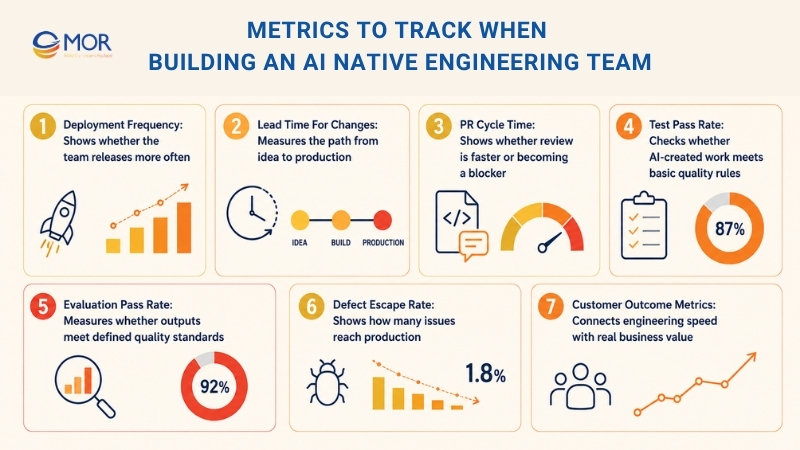
Old engineering metrics do not fit AI-native teams well. Lines of code, coding hours, and raw story points can mislead leaders because AI can create a large amount of code very quickly.
Better AI engineering team ROI metrics include:
Metric | Why It Matters |
Deployment frequency | Shows whether the team releases more often |
Lead time for changes | Measures the path from idea to production |
PR cycle time | Shows whether review is getting faster or becoming a blocker |
Test pass rate | Checks whether AI-created work meets basic quality rules |
Evaluation pass rate | Measures whether outputs meet defined quality standards |
Defect escape rate | Shows how many issues reach production |
Production incidents | Tracks the effect on reliability |
Onboarding ramp time | Shows whether new engineers become useful faster |
Agent usage quality | Measures whether agents support meaningful work instead of shallow tasks |
Customer outcome metrics | Links engineering speed with business value |
AI can make strong systems stronger and weak systems weaker. A team with clear specs, tests, and review rules may move much faster. A team with weak controls may only ship bugs faster. That is why system-level measures matter more than individual productivity numbers.
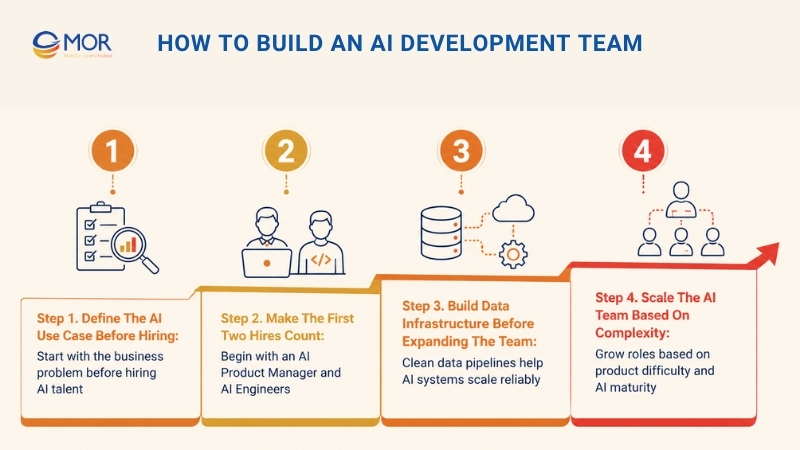
How To Build An AI Development Team In 2026
Building an AI native engineering team in 2026 starts with a clear business goal, not a long hiring list. For companies comparing the best nearshore AI engineering teams for US companies, the same rule applies: define the use case first, then choose the team model that helps you validate and scale safely.
Step 1. Define The AI Use Case Before Hiring
This is where many companies make the first wrong turn. They try to apply many forms of AI across the business at the same time. Resources then get spread across ideas that do not move the business forward. Start with the business problem you want to solve, then hire AI talent around that problem.
Step 2. Make The First Two Hires Count
Start with an AI Product Manager and one or two AI Engineers.
Many companies start with a Data Scientist or AI Researcher. Yet most AI product work needs delivery before research. Mature AI platforms and open-source tools now let teams build AI functions quickly. For more complex work, you may also need an AI Solution Architect to shape the full architecture.
This is where AI development outsourcing can work well. You can keep the AI product manager in-house and bring in an outside AI engineer to validate the agentic use cases faster. You can also outsource both roles when speed matters. MOR Software supports businesses with dedicated development teams, AI development services, QA, DevOps, and long-term software maintenance.
Step 3. Build Data Infrastructure Before Expanding The Team
Gartner has noted poor data quality as a serious issue that can weaken GenAI results. At first, teams can move quickly with existing models and tools like Claude or systems like LangChain. Once you want to scale AI, though, your data must be ready. That is why the next hire should often be a Data Engineer who can build clean and reliable data pipelines.
Step 4. Scale The AI Team Based On Complexity
As your AI development team grows, the team structure should change with product complexity. Use the model below to scale the team based on the difficulty of the AI work.
Level 1. AI Function (One Use Case, One Model)
Team:
- 1 AI Product Manager
- 1-2 AI Engineers
- 1 Data Engineer (part-time or shared)
Total: 3-4 people
Level 2. AI Workflow Automation (One Department)
Team:
- 1 AI Product Manager
- 2-3 AI Engineers
- 1 Data Scientist (experimentation and model tuning)
- 1-2 Data Engineers
- 1 DevOps / MLOps (shared or part-time)
Total: 6-8 people
Level 3. AI Copilot Across Departments
Team:
- 1 AI/Product Leader (Head of AI or CTO oversight)
- 1 AI Product Manager
- 2-4 AI Engineers
- 1-2 Data Engineers
- 1 Data Scientist
- 1 MLOps Engineer
- Domain expert(s)
If you work in a regulated industry, like finance, add an AI Compliance Specialist.
Total: 8-12 people
Level 4. AI-Native Product
At this level, AI becomes the main value of the product. The team now needs full lifecycle ownership.
Team:
- AI/Product Leader
- 1-2 AI Product Managers
- 3-5 AI Engineers
- 1-2 Data Scientists
- 2 Data Engineers
- 1 MLOps Engineer
- 1 DevOps Engineer
- Domain experts
- AI Compliance / Ethics (for regulated industries)
Total: 10-15+ people
Remember that AI team roles usually appear in this order, not the other way around:
- AI Product Manager
- AI Engineer
- Data Engineer
- MLOps
- Data Scientist
- Governance and Compliance
Based on delivery experience, a practical AI team timeline often looks like this.
Timeline | Actions |
Month 1-3 | Define the use case. Hire a Product Manager and AI Engineer. Build an AI MVP and validate feasibility. Consider outstaffing support with AI experts. |
Month 4-6 | Add a Data Engineer. Build production infrastructure. Deliver product-ready AI. |
Month 7-12 | Add 1-2 Data Scientists. Add MLOps if models need to scale. Choose the right AI team structure. |
Month 12+ | Scale based on complexity. Consider a hybrid model with an internal team and AI outsourcing. |
Roadmap to building an AI development team
Note: Companies that win usually start small, with 2-3 AI talents, then scale with care. The market will not wait. In some cases, an external AI partner like MOR Software can help validate an AI MVP in 4-6 weeks before you commit to a full AI product development team.
Mistakes To Avoid When Building An AI Native Engineering Team
Reference base: The source material highlights common failure points around AI-native delivery, weak systems, anti-patterns, and product risk. This rewrite applies those ideas to practical engineering teams and MOR Software-style delivery models.
Many teams struggle with AI-native engineering because they rush into code generation before changing the systems around it.
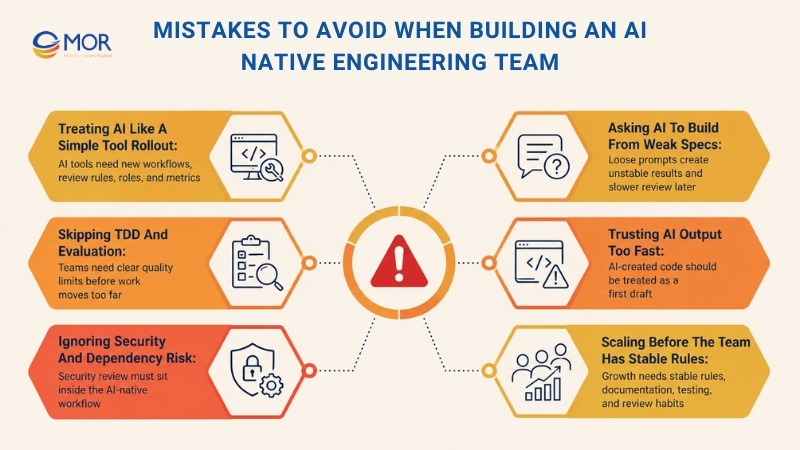
Treating AI Like A Simple Tool Rollout
Giving every developer an AI coding tool does not mean the company has an AI-native team. Workflows, review rules, team roles, and metrics must also change.
Asking AI To Build From Weak Specs
Loose prompts create weak and unstable results. Teams should spend more time on specs so implementation and review can move faster later.
Skipping TDD And Evaluation
AI agents need clear quality limits. Without TDD and evaluation, the team may only find issues after the work has already moved too far.
Trusting AI Output Too Fast
AI-created code should be treated as a first draft. It needs to meet the same quality bar as human-written code.
Ignoring Security And Dependency Risk
Agents may add packages or patterns that look helpful but bring risk. Security review needs to sit inside the workflow.
Scaling Before The Team Has Stable Rules
Building an AI native engineering team should grow only after the team has stable rules, documentation, test processes, and review habits.
Why Choose MOR Software To Build An AI-Native Engineering Team
MOR Software supports businesses with flexible cooperation models based on team size, product stage, and delivery goals. Instead of forcing one fixed setup, we help you choose the right model for your AI roadmap.
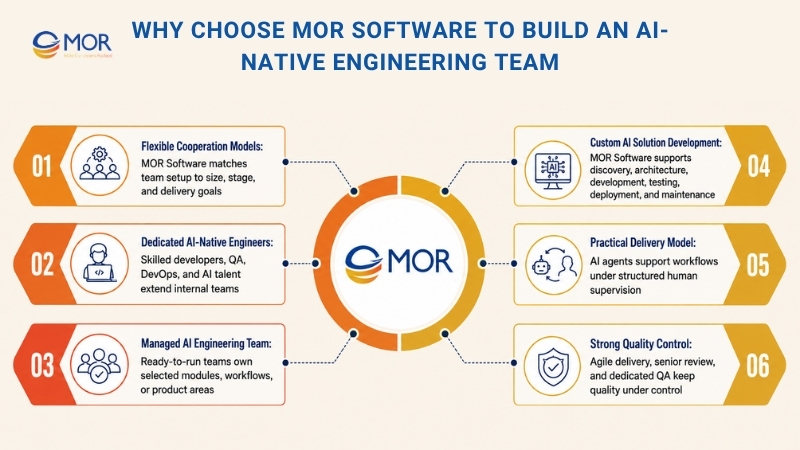
- Dedicated AI-Native Engineers extend your internal team with skilled developers, QA specialists, DevOps engineers, and AI-focused talent who work directly with your workflow, tools, and delivery standards.
- Managed AI Engineering Team gives your business a ready-to-run team that owns selected modules, workflows, or product areas. MOR Software handles team setup, daily delivery, quality control, and technical coordination.
- Custom AI Solution Development covers the full product journey, from discovery and architecture to development, testing, deployment, and maintenance. This model works well when your business needs a complete AI product, AI-powered platform, or AI feature built around clear business outcomes.
What makes MOR Software different is our mix of practical engineering, offshore delivery experience, and strong quality control. We do not treat AI as a quick tool rollout. We help businesses build a working delivery model where AI CRM integration services support planning, coding, testing, review, documentation, and release workflows under human supervision.
Businesses work with MOR Software because we:
- Build AI-native delivery teams that match real business goals, not generic hiring plans.
- Help companies move from AI experiments to working software with clear specs, test rules, review standards, and release processes.
- Provide flexible team setup for startups, SMEs, and enterprises that need more delivery capacity without overloading internal teams.
- Bring experience across web development, mobile development, Salesforce, offshore development, software outsourcing, QC and testing, cloud, and new technologies.
- Support long-term product growth with development, integration, maintenance, and team scaling from Vietnam and Japan-based offices.
- Keep quality under control through structured workflows, agile delivery, senior review, and dedicated QA support.
For software leaders, building an AI native engineering team with AI automation agencies is a business move, not just a technical upgrade. The right team can shorten delivery cycles, improve product quality, and help internal engineers focus on higher-value work.
If your business wants to adopt AI-native engineering but needs the right people, process, and technical base, MOR Software can help you build a team that moves fast without losing control.
Conclusion
Building an AI native engineering team gives software leaders a practical way to move faster without losing control over quality, security, and product direction. The shift works best when AI agents support clear workflows, and humans still own judgment. If your business needs the right people, process, and technical base for AI-native software delivery, MOR Software can help. Contact us to build a team that fits your roadmap and delivery goals.
"Evolution is not a destination, it is a disciplined journey of innovation."
Phung Van Tu


CEO MOR AI
MOR SOFTWARE
Frequently Asked Questions (FAQs)
How is an AI-native engineering team different from a normal software team?
A normal team may use AI tools for code suggestions or small tasks. An AI-native team builds AI into the full delivery process. Specs, tests, code review, documentation, and deployment all change. The team spends less time on repeatable work and more time on design choices, review, and product value.
What roles should an AI-native software team have?
A lean team often needs a product lead, AI-native engineers, a quality or evaluation engineer, a platform engineer, and a designer who understands human-AI workflows. Smaller teams can combine roles at first. As the product grows, teams may add data engineers, MLOps engineers, or AI governance support.
Do AI-native teams still need software engineers?
Yes. Engineers become even more valuable because they guide the agents, review code, check architecture, and handle hard tradeoffs. AI can draft code quickly, but it cannot own accountability. Engineers decide what is safe, maintainable, and ready for production.
What skills do AI-native engineers need?
They need strong software fundamentals, system design skills, testing knowledge, and good judgment. They also need to know how to write clear specs, break work into agent-friendly tasks, review AI-generated code, and spot weak logic. Prompting helps, but engineering skill matters more.
How can a company start with AI-native development?
Start with one or two clear workflows. Good starting points include test generation, code review support, documentation updates, or small feature scaffolding. Once the team has working rules, quality checks, and review habits, it can expand AI use across more parts of the SDLC.
What are the biggest risks of using AI agents in engineering?
The main risks are weak specs, shallow tests, unsafe dependencies, poor code review, and overtrusting AI output. AI can move fast, but fast output is not always correct output. Teams need tests, security checks, access limits, and clear review rules before AI-generated work reaches production.
How should teams review AI-generated code?
Treat AI-generated code like a first draft. Engineers should review logic, security, performance, architecture fit, edge cases, and maintainability. AI can help with the first review pass, but human engineers should own the final decision before merge and release.
What metrics show whether an AI-native team is working well?
Useful metrics include deployment frequency, lead time for changes, pull request cycle time, test pass rate, defect escape rate, production incidents, onboarding time, and customer outcome metrics. The goal is not more code. The goal is better delivery with fewer avoidable problems.
When should a business invest in building an ai native engineering team?
A business should invest when software delivery is slowing down, engineers spend too much time on repeatable tasks, or product teams need faster experiments without weaker quality control. It also makes sense when the company already has clear engineering standards and wants AI to support a more scalable delivery model.
What does building an ai native engineering team mean?
Building an ai native engineering team means setting up a software team where AI agents support daily work across planning, coding, testing, review, documentation, and release. Engineers still make the final calls. AI helps with execution, but people stay in charge of product logic, architecture, security, and quality.
Share


Make Our-Dreams Realized


© 2023 . MOR Software. All Rights Reserved
Sitemap
Privacy Policy
Terms of Use

Rate this article
0
over 5.0 based on 0 reviews
Your rating on this news:
Name
*Email
*Write your comment
*Send your comment
1