


Top 15 Custom Healthcare Software Development Companies in USA (2026)
Choosing a healthcare software partner takes more than checking a portfolio and an hourly rate. HIPAA, PHI security, clinical workflows, EHR connectivity, and delivery proof all affect project risk. In this guide, MOR Software will evaluate 15 custom healthcare software development companies in USA, covering US-headquartered firms and global teams serving American healthcare buyers. You’ll see pricing, healthcare focus, real project evidence, technical strengths, and the project types each company fits best.
Key Takeaways
- Healthcare buyers should compare vendors on healthcare delivery records, HIPAA readiness, HL7/FHIR knowledge, EHR integration, medical-device work, engineering depth, pricing, and long-term support. A healthcare logo on a portfolio page tells you very little on its own.
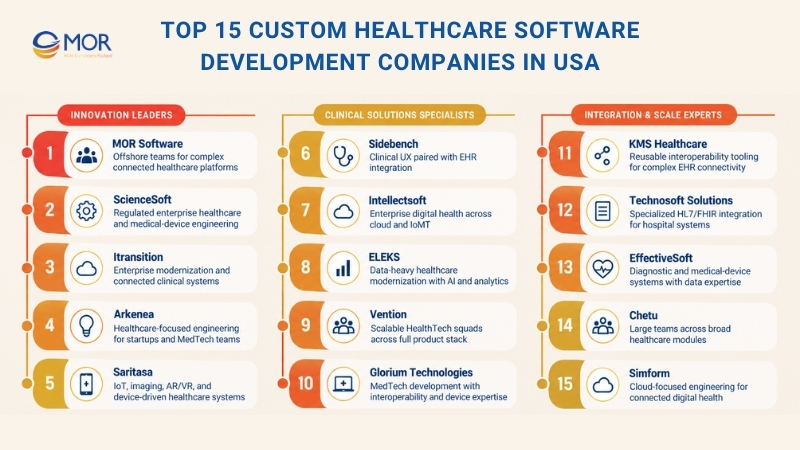
- Our 15-company shortlist covers MOR Software, ScienceSoft, Itransition, Arkenea, Saritasa, Sidebench, Intellectsoft, ELEKS, Vention, Glorium Technologies, KMS Healthcare, Technosoft Solutions, EffectiveSoft, Chetu, and Simform.
- Project fit changes the ranking. A startup building a patient app needs a different partner than a hospital group connecting Epic, medical devices, billing systems, and clinical data across several facilities.
The Growing U.S. Healthcare Software Market
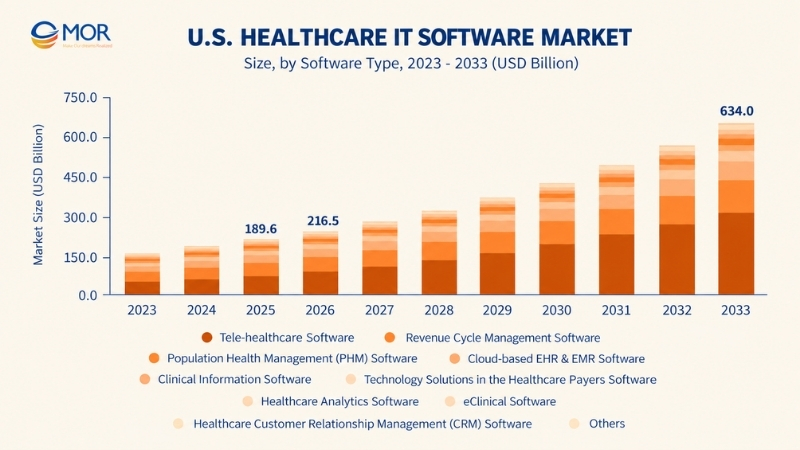
Healthcare software spending in the U.S. keeps rising as providers connect more care, administrative work, and patient services to software. The demand now covers EHR/EMR systems, revenue cycle management, virtual care, clinical software, analytics, and patient-facing applications.
Grand View Research valued the U.S. healthcare IT software market at $189.6 billion in 2025. Its August 2026 research puts the market at $216.5 billion in 2026 and forecasts $634.0 billion by 2033, equal to a 16.6% CAGR between 2026 and 2033.
- EHR and EMR investment keeps integration work active: Healthcare organizations already rely heavily on electronic medical records. New patient portals, clinical tools, payer systems, and analytics products often need APIs, data migration, workflow changes, and bidirectional links to those records.
- Cloud and AI are creating new software requirements: Healthcare teams are moving workloads to AWS, Microsoft Azure, and Google Cloud while adding AI to scheduling, documentation, analytics, patient communication, and care workflows. MOR Software's guide to AI solutions for healthcare providers covers practical uses and technical considerations in more detail.
- Interoperability raises the engineering bar: Healthcare software may exchange data among EHRs, labs, pharmacies, payers, mobile apps, and medical devices. FHIR, HL7 v2, DICOM, SMART on FHIR, API security, and clinical terminology become real engineering requirements.
- Standard products still leave operational gaps: A hospital may have an EHR yet need a custom workflow for device data, specialty care, staff coordination, billing, or patient engagement. Those gaps keep demand strong for custom healthcare software development companies in USA that can work around existing infrastructure.
The market is growing, but growth also creates more vendor noise. Buyers now need to separate healthcare engineering evidence from broad claims about general software capability.
Top 15 Custom Healthcare Software Development Companies in USA
We selected these firms based on healthcare project evidence, technical scope, interoperability knowledge, regulatory exposure, commercial fit, and delivery capacity. The term 'USA' in this guide covers companies headquartered in the U.S. plus international engineering firms with established delivery for American healthcare buyers.
The numbering is a reading order, not a universal quality score. For buyers comparing top custom healthcare software development companies 2026, the practical move is to use the table to narrow the list to three to five vendors, then test each one against your actual workflow and integration scope. For a broader market view beyond the U.S. angle, see our guide to top custom healthcare software development companies.
Healthcare Software Companies Comparison
Company | Main Office | Company Size | Typical Project Budget | Estimated Hourly Rate | Healthcare Focus | Ideal For |
MOR Software | Ho Chi Minh City, Vietnam | 250-999 | $5,000+ minimum listed; no public typical-project range | $25-$49/hr | Telehealth, hospital and clinic systems, medical data, device integration | Complex custom healthcare platforms and offshore product teams |
ScienceSoft | McKinney, Texas, USA | 250-999 | $50,000-$199,999 | $50-$99/hr | EHR/EMR, telemedicine, SaMD, medical devices, analytics, HL7/FHIR | Regulated enterprise healthcare and medical-device software |
Itransition | Decatur, Georgia, USA | 1,000-9,999 | $50,000-$199,999 | $25-$49/hr | EHR/EMR, analytics, RPM, medical imaging, DICOM | Enterprise modernization and connected health platforms |
Arkenea | Cary, North Carolina, USA | 10-49 | $50,000-$199,999 | $50-$99/hr | Healthcare-only development, EHR, telehealth, HealthTech SaaS, AI | HealthTech startups and physician-led products |
Saritasa | Newport Beach, California, USA | 50-249 | $50,000-$199,999 | $100-$149/hr | EHR/EMR, medical devices, healthcare apps, IoT, imaging, AR/VR | Custom healthcare systems with IoT or immersive tech |
Sidebench | Los Angeles, California, USA | 50-249 | $50,000-$199,999 | $50-$99/hr | Patient/provider apps, EHR/FHIR, product strategy, healthcare UX | Patient-facing products and product strategy |
Intellectsoft | New York, New York, USA; Clutch lists Miami as a profile location | 50-249 | $200,000-$999,999 | $50-$99/hr | EHR/EMR, telehealth, HIS, patient data, IoMT | Enterprise digital health and connected systems |
ELEKS | Tallinn, Estonia | 1,000-9,999 | $200,000-$999,999 | $50-$99/hr | EHR/EMR, data science, ML, analytics, system integration | Data-heavy healthcare programs |
Vention | New York, New York, USA | 1,000-9,999 | $50,000-$199,999 | $50-$99/hr | HealthTech engineering, telemedicine, EHR/EMR, medical devices, IoMT | HealthTech companies scaling engineering capacity |
Glorium Technologies | Houston, Texas, USA | 50-249 | $50,000-$199,999 | $50-$99/hr | MedTech, EHR/EMR, telehealth, RPM, HL7/FHIR, AI | Startups and growth-stage MedTech firms |
KMS Healthcare | Atlanta, Georgia, USA | 501-1,000* | Not publicly disclosed | Not publicly disclosed | FHIR, SMART on FHIR, interoperability, QA, healthcare engineering | Integration-heavy HealthTech, payer, and provider platforms |
Technosoft Solutions | Branford, Connecticut, USA | 10-49 | $50,000-$199,999** | $25-$49/hr | HL7/FHIR, EHR, hospital software, SMART on FHIR, AI | Clinical data exchange and hospital integrations |
EffectiveSoft | San Diego, California, USA | 250-999 | Under $50,000 | $50-$99/hr | Healthcare platforms, SaMD, medical devices, AI/ML, FHIR/HL7/DICOM | Mid-market and enterprise healthcare modernization |
Chetu | Sunrise, Florida, USA | 1,000-9,999 | Under $50,000 | Not publicly disclosed | EHR/EMR, RCM, billing, telehealth, HIE, Epic/Cerner integration | Large outsourced healthcare builds |
Simform | Orlando, Florida, USA | 1,000-9,999 | Under $50,000 | $25-$49/hr | Telehealth, EMR/EHR, medical IoT, clinical decision support | Cloud and data-heavy digital health products |
The table also shows why custom healthcare software development companies in USA shouldn't be compared on hourly rate alone. A $25-$49 engineering rate can sit beside a larger integration program, while a $100-$149 specialist team may make sense for a smaller project with unusual technical needs.
1. MOR Software
- Main Office: Ho Chi Minh City, Vietnam
- Established: 2016
- Company Size: 250-999
- Typical Project Budget: $1,000+ minimum listed; no reliable public typical-project range
- Estimated Hourly Rate: $25-$49/hr
- Healthcare Focus: Hospital systems, telehealth, medical data management, health monitoring, medical-device integration
- Healthcare Development Services: Web and custom mobile software development, backend engineering, system integration, UI/UX, QA, cloud engineering, dedicated teams, maintenance
Company Profile
MOR Software is a Vietnam-based software engineering company with delivery operations in Vietnam and Japan. Clutch lists MOR at 250-500 employees, a $25-$49 per hour. Our company supports project-based delivery and offshore development teams for clients that need a stable engineering unit over a longer product cycle.
Healthcare work at MOR spans more than mobile apps. We have built hospital operations software, virtual consultation products, healthcare data systems, medical test applications, and platforms that connect external medical equipment.
One example is I-Medisync, a hospital and clinic management system developed over 24 months by a 12-person team. The system captures data from medical devices, manages clinics, physicians, staff, and patients, and automates billing. Java Spring, ReactJS, and AWS formed the main technical stack.
Another project, Procuratio, handles healthcare data collection, processing, analysis, reporting, and user-controlled sharing under CDISC standards. MOR used C#, Java, NodeJS, ReactJS, and React Native across the system.
Healthcare Delivery Evidence
- Relevant Healthcare Projects: Our portfolio includes an online healthcare consultation platform case study for a Japanese clinic, plus a secure healthcare management system we built for hospital and clinic operations.
- Technical Capabilities: MOR has used Swift, Kotlin, React Native, ReactJS, NodeJS, Java, C#, Python, and AWS across healthcare work. A Shuttle Walking Test app also connects peripheral medical devices and receives patient measurements in real time.
- Delivery Track Record: Projects cover business analysis, UI/UX, frontend and backend development, system integration, testing, cloud infrastructure, and continued product work. E-Medical, for example, connects patient mobile users with doctors, clinics, pharmacies, and administrators.
Why This Company Stands Out
- Healthcare project variety: Our work covers clinical operations, teleconsultation, healthcare data, hospital reviews, medical testing, dental management, and connected devices.
- Offshore team model: Clients can form a dedicated team while MOR handles recruitment, payroll, operations, and staffing changes.
- Technical breadth: Healthcare products can draw on mobile, web, cloud, AI, backend, integration, and QA skills within one delivery organization.
Ideal For: Healthcare providers and HealthTech companies that need a long-term engineering partner for custom platforms, connected medical systems, cloud products, or dedicated offshore teams.
2. ScienceSoft
- Main Office: McKinney, Texas, USA
- Established: 1989
- Company Size: 250-999 on Clutch; ScienceSoft reports 750+ IT specialists
- Typical Project Budget: $50,000-$199,999
- Estimated Hourly Rate: $50-$99/hr
- Healthcare Focus: EHR/EMR, telemedicine, HIE, SaMD, medical-device software, analytics
- Healthcare Development Services: Custom healthcare software, healthcare IT consulting, integration, cybersecurity, modernization, data analytics, support
Company Profile
ScienceSoft has worked in healthcare IT since 2005 and reports more than 150 healthcare projects. Its healthcare practice covers providers, HealthTech vendors, life sciences organizations, and medical-device companies. Clutch currently lists 42 reviews, a $50-$99 hourly band, and $50,000-$199,999 as the most common project size.
Its regulatory profile stands out for buyers working near medical-device or clinical software rules. ScienceSoft reports ISO 13485, ISO 27001, and ISO 9001 certifications, plus experience with HIPAA, FDA requirements, the 21st Century Cures Act, HL7, FHIR, DICOM, XDS, and clinical terminology.
The company's work includes EHR modules, HIE systems, patient apps, telemedicine, RPM, lab systems, imaging software, and SaMD. That range suits programs where a new application must connect to established healthcare infrastructure instead of operating as an isolated product.
A useful real-world example comes from an NYC healthcare provider. ScienceSoft built a web and mobile telehealth portal linked to athenahealth EHR, and the product attracted more than 1,500 patients within three months of launch.
Healthcare Delivery Evidence
- Relevant Healthcare Projects: EHR-connected telehealth, medical-device systems, lab software, RPM, imaging, and care-management products.
- Technical Capabilities: HL7, FHIR, DICOM, CCDA, XDS/XDS-I, cloud platforms, mobile, AI, analytics, and cybersecurity.
- Delivery Track Record: The healthcare practice combines software engineering with regulatory consultants and healthcare-focused QA.
Why This Company Stands Out
- Medical-device readiness: ISO 13485 and SaMD experience give regulated projects a stronger starting point.
- Interoperability breadth: ScienceSoft works across several clinical data standards rather than FHIR alone.
- Long healthcare tenure: Healthcare delivery dates back to 2005.
Ideal For: Hospitals, healthcare enterprises, and MedTech companies that need documented quality processes, EHR interoperability, or medical-device software engineering.
3. Itransition
- Main Office: Decatur, Georgia, USA
- Established: 1998
- Company Size: 1,000-9,999
- Typical Project Budget: $50,000-$199,999
- Estimated Hourly Rate: $25-$49/hr
- Healthcare Focus: EHR/EMR, healthcare analytics, RPM, medical imaging, clinical data exchange
- Healthcare Development Services: Enterprise software, healthcare platforms, modernization, telemedicine, analytics, integration, data engineering
Company Profile
Itransition combines a large engineering organization with a long history of custom software delivery. Its current Clutch profile lists more than 1,000 employees, a $25-$49 hourly range, and $50,000-$199,999 as the most common reviewed project band.
Healthcare work covers EHR/EMR, patient-facing products, telemedicine, RPM, medical equipment management, clinical data exchange, analytics, and healthcare staffing systems. The company is a stronger fit when the scope reaches several products, data sources, or enterprise workflows.
Its healthcare portfolio provides useful proof. An FDA and IEC 62304-aligned medical equipment system is used by 400 blood centers, and a clinical data exchange proof of concept helped its client gain more than 30 healthcare institution customers.
The technical value sits in integration and enterprise engineering. Itransition works across data platforms, cloud infrastructure, mobile systems, business applications, APIs, and healthcare standards, which suits modernization work where a hospital can't simply replace every legacy component at once.
Healthcare Delivery Evidence
- Relevant Healthcare Projects: Telemedicine-ready EHR, blood-transfusion device software, clinical data exchange, healthcare staffing, and sample-management systems.
- Technical Capabilities: EHR integration, DICOM, mobile, cloud, analytics, data engineering, enterprise applications, and medical equipment connectivity.
- Delivery Track Record: Delivery ranges from focused proofs of concept to long-running enterprise programs.
Why This Company Stands Out
- Enterprise scale: Large teams can support broad modernization programs.
- Healthcare data depth: The portfolio includes high-volume clinical information and analytics work.
- Cost position: Its public hourly band sits below many US-headquartered firms in this list.
Ideal For: Health systems, software vendors, and healthcare groups planning enterprise modernization, analytics platforms, or connected clinical systems.
4. Arkenea
- Main Office: Cary, North Carolina, USA
- Established: 2011
- Company Size: 10-49 on Clutch
- Typical Project Budget: $50,000-$199,999
- Estimated Hourly Rate: $50-$99/hr
- Healthcare Focus: Healthcare-only product development, EHR, telehealth, MedTech, HealthTech SaaS
- Healthcare Development Services: Web, mobile, EHR integration, FHIR/HL7 integration, AI, medical-device software, product development
Company Profile
Arkenea differs from many general software firms because it has focused on healthcare since 2011. It works with physician entrepreneurs, HealthTech startups, medical organizations, life sciences companies, and established healthcare businesses.
Clutch lists a 10-49 employee band, $50-$99 hourly pricing, and a $50,000 minimum project size. Reviewed engagements most often fall in the $50,000-$199,999 band.
Arkenea's technical scope covers FHIR, HL7, Epic, Oracle Health/Cerner, athenahealth, DICOM, and third-party healthcare APIs. Its published process also addresses HIPAA, HITRUST, IEC 62304, FDA 21 CFR Part 820, and other standards when they apply to the product.
Its portfolio includes ORLink surgical workflow software, work for Novo Nordisk, and NPHub. That last product grew past $1.6 million in revenue during its first 18 months, giving buyers a concrete signal that Arkenea has worked beyond prototype-stage healthcare products.
Healthcare Delivery Evidence
- Relevant Healthcare Projects: Surgical workflows, nurse recruitment, pharmaceutical applications, telehealth, EHR products, and clinical software.
- Technical Capabilities: FHIR, HL7, DICOM, EHR APIs, mobile and web development, AI, cloud software, and device-related workflows.
- Delivery Track Record: Projects cover product discovery, engineering, launch, and continued scaling.
Why This Company Stands Out
- Healthcare-only positioning: Domain work isn't a small vertical inside a broad agency portfolio.
- Startup fit: Its case mix includes physician founders and funded HealthTech products.
- Regulatory literacy: Medical-device and interoperability requirements appear directly in its delivery material.
Ideal For: HealthTech startups, physician-led businesses, and MedTech teams seeking a smaller healthcare-focused engineering partner.
5. Saritasa
- Main Office: Newport Beach, California, USA
- Established: 2005
- Company Size: 50-249 on Clutch
- Typical Project Budget: $50,000-$199,999
- Estimated Hourly Rate: $100-$149/hr
- Healthcare Focus: Custom healthcare software, IoT, medical imaging, AR/VR, mobile
- Healthcare Development Services: Mobile apps, healthcare websites, legacy modernization, cloud, AI/ML, medical-device integration, databases, AR/VR
Company Profile
Saritasa brings a broader engineering base than healthcare-only boutiques. The company was founded in 2005, and Clutch lists Newport Beach as its primary location, 50-249 employees, and a $100-$149 hourly range. Its most common reviewed project band is $50,000-$199,999.
Healthcare accounts for one part of a larger custom software practice. Saritasa's healthcare services include patient and provider applications, HIPAA-aligned websites, legacy software modernization, data systems, medical-device connections, and cloud products.
Its strongest differentiator is the mix of software with physical or immersive technology. Saritasa publishes healthcare capability across IoT wearables, medical imaging, AR, VR, ML, and cloud systems.
That breadth matters for projects where a normal web stack won't cover the scope. A rehabilitation product may need wearable data and VR. A diagnostic workflow may depend on imaging analysis plus a clinician dashboard.
Healthcare Delivery Evidence
- Relevant Healthcare Projects: Medical applications, healthcare data products, connected devices, immersive healthcare tools, and legacy modernization.
- Technical Capabilities: IoT, AR/VR, ML, cloud, mobile, web, databases, DevOps, and medical imaging.
- Delivery Track Record: Saritasa states 14 years of healthcare experience and more than 100 healthcare projects on its current healthcare page.
Why This Company Stands Out
- Hardware-software mix: IoT and connected-device skills suit products beyond standard SaaS.
- Immersive development: AR and VR create a distinct fit for training, therapy, and rehabilitation.
- US coverage: Offices span several major American time zones.
Ideal For: Healthcare organizations that need custom workflows linked to IoT, medical imaging, AR/VR, or complex device-driven systems.
6. Sidebench
- Main Office: Los Angeles, California, USA
- Established: 2012
- Company Size: 50-249
- Typical Project Budget: $50,000-$199,999
- Estimated Hourly Rate: $50-$99/hr
- Healthcare Focus: Patient and provider products, clinical UX, EHR integration, healthcare product strategy
- Healthcare Development Services: Product strategy, UX research, mobile/web engineering, AI, FHIR/HL7 integration, data engineering
Company Profile
Sidebench sits between a product studio and a healthcare engineering consultancy. Clutch lists the Los Angeles company at 50-249 employees, $50-$99 per hour, and a $50,000 minimum project size. The most common reviewed project falls in the $50,000-$199,999 range.
Its healthcare work puts strong weight on product research and clinical usability. Sidebench has worked with Children's Hospital Los Angeles, Inland Empire Health Plan, Cortica, NOCD, and other healthcare organizations.
The engineering side covers HL7, FHIR, SMART on FHIR, EHR/EMR connections, data migration, AI, analytics, and secure PHI access.
Patient adoption gives this work a different test than back-office enterprise software. Baby Steps LA, developed with Children's Hospital Los Angeles, has supported 17,000 families and recorded more than 30,000 downloads.
For buyers searching for a custom healthcare software development company near California, Sidebench provides a Los Angeles-based option with direct experience in patient experience and clinical workflow design.
Healthcare Delivery Evidence
- Relevant Healthcare Projects: NICU family support, neurological-care scheduling, payer member applications, and digital OCD treatment.
- Technical Capabilities: FHIR, HL7, SMART on FHIR, EHR integration, mobile apps, AI, data engineering, cloud, and UX research.
- Delivery Track Record: Sidebench reports more than 60 healthcare implementations across its healthcare practice.
Why This Company Stands Out
- Clinical UX: Research and product design sit close to engineering.
- Healthcare client mix: Work covers providers, payers, startups, and patient products.
- Integration skills: The team combines user-facing design with EHR and clinical data work.
Ideal For: Healthcare teams where adoption, patient experience, clinician workflows, and product strategy carry the same weight as software engineering.
7. Intellectsoft
- Main Office: New York, New York, USA; Clutch lists Miami as a profile location
- Established: 2007
- Company Size: 50-249
- Typical Project Budget: $200,000-$999,999
- Estimated Hourly Rate: $50-$99/hr
- Healthcare Focus: EHR, telehealth, hospital information systems, IoMT, patient information
- Healthcare Development Services: Custom software, mobile, AI/ML, cloud, data engineering, IT staff augmentation, healthcare platforms
Company Profile
Intellectsoft works with mid-market and enterprise clients across several industries. Its healthcare practice covers patient information management, EHRs, telehealth, hospital systems, connected medical devices, remote patient care, and wellness applications.
Clutch lists 50-249 employees, a $50-$99 hourly rate, and a $50,000 minimum engagement. The most common reviewed project band is much higher at $200,000-$999,999, which fits its enterprise-oriented positioning.
Its engineering stack reaches web, mobile, Java, .NET, Python, React, Flutter, AWS, Azure, GCP, Kubernetes, data platforms, and AI/ML. That gives the company room to support healthcare programs that span infrastructure, applications, analytics, and connected-device layers.
Intellectsoft's healthcare material also identifies HIPAA-related delivery and IoMT as established areas. For a large organization, that breadth can be useful when the project touches clinical systems plus non-clinical enterprise infrastructure.
Healthcare Delivery Evidence
- Relevant Healthcare Projects: Patient information systems, EHR products, telehealth applications, remote-care software, and IoMT.
- Technical Capabilities: Cloud, mobile, AI/ML, data engineering, backend development, DevOps, and connected-device software.
- Delivery Track Record: Clutch currently records 46 reviews across the wider company portfolio.
Why This Company Stands Out
- Enterprise project scale: Reviewed engagements commonly sit above $200,000.
- IoMT capability: Connected medical systems are part of its healthcare service mix.
- Broad engineering bench: Data, cloud, AI, mobile, and application engineering can sit under one vendor.
Ideal For: Enterprises planning larger digital-health programs that combine custom applications, cloud infrastructure, data, and connected healthcare systems.
8. ELEKS
- Main Office: Tallinn, Estonia
- Established: 1991
- Company Size: 1,000-9,999
- Typical Project Budget: $200,000-$999,999
- Estimated Hourly Rate: $50-$99/hr
- Healthcare Focus: EHR/EMR, healthcare data, ML, analytics, integration
- Healthcare Development Services: Custom software, EHR/EMR, data science, AI, cloud, cybersecurity, product design, system integration
Company Profile
ELEKS is one of the larger international firms on this list. Clutch reports more than 1,000 employees, a Tallinn headquarters, $50-$99 hourly pricing, and $200,000-$999,999 as its most common reviewed project size.
Healthcare capabilities include EHR/EMR engineering, medical data systems, analytics, machine learning, cloud infrastructure, cybersecurity, and third-party integration. ELEKS also works with clinical sensors, wearables, and other medical systems.
Its case history helps show the type of buyer it fits. For US healthcare provider Fleming-AOD, ELEKS rebuilt a patient assessment product so regulatory updates could be delivered remotely. The client received a major update in four weeks instead of four months, according to the case study.
Data-heavy healthcare products are a natural match for ELEKS. The company maintains separate practices around AI, analytics, cloud, cybersecurity, and application engineering, so a project can draw from deeper specialties as requirements expand.
Healthcare Delivery Evidence
- Relevant Healthcare Projects: EHR products, patient assessment software, healthcare platforms, and clinical data systems.
- Technical Capabilities: AI/ML, analytics, cloud, security, EHR integration, mobile, product design, and connected devices.
- Delivery Track Record: ELEKS reports more than 1,000 end-to-end projects across industries and has operated since 1991.
Why This Company Stands Out
- Data engineering strength: Healthcare analytics and ML fit naturally into its wider data practice.
- Program scale: The organization can support large, long-running programs.
- Cross-functional capability: Product design, engineering, data, security, and cloud teams can work on the same initiative.
Ideal For: Healthcare enterprises that need data-heavy modernization, AI/ML, analytics, EHR integration, or larger cross-functional engineering teams.
9. Vention
- Main Office: New York, New York, USA
- Established: 2002
- Company Size: 1,000-9,999
- Typical Project Budget: $50,000-$199,999
- Estimated Hourly Rate: $50-$99/hr
- Healthcare Focus: HealthTech products, EHR/EMR, telemedicine, medical devices, IoMT
- Healthcare Development Services: Product engineering, dedicated engineers, web/mobile, QA, cloud, DevOps, AI, medical software
Company Profile
Vention combines software product delivery with a large distributed engineering network. Current Clutch data lists 1,000-9,999 employees, New York as its main location, $50-$99 hourly pricing, and $50,000-$199,999 as the most common project size.
Its HealthTech practice covers custom healthcare software, mobile medical applications, telemedicine, EHR/EMR, medical-device software, AI, and IoMT. The company also supports staff expansion when an internal product team needs more engineering capacity.
Vention's healthcare portfolio includes Thirty Madison, Dialogue, and Healthera. Its work for Healthera included mobile architecture, QA automation, containerized infrastructure, accessibility, and prescription management; the platform later served 1,500 pharmacy partners.
For HealthTech companies under pressure to grow a team quickly, that staffing depth can carry as much value as a fixed project model. Buyers still need strong product ownership, since a larger resource pool doesn't replace clear clinical requirements.
Healthcare Delivery Evidence
- Relevant Healthcare Projects: Virtual clinics, prescription applications, digital chronic-care products, telemedicine, and healthcare mobile apps.
- Technical Capabilities: EHR/EMR, AI, IoMT, mobile, backend, DevOps, cloud, QA, and infrastructure engineering.
- Delivery Track Record: Vention states that its healthcare practice has completed more than 200 HealthTech projects.
Why This Company Stands Out
- Team scalability: The large talent network can fill several engineering roles.
- HealthTech startup experience: Portfolio work spans startup growth stages.
- Full product stack: Web, mobile, backend, cloud, QA, and DevOps are available in-house.
Ideal For: HealthTech firms that need additional engineers, a full product squad, or technical depth across several parts of a growing healthcare platform.
10. Glorium Technologies
- Main Office: Houston, Texas, USA
- Established: 2010
- Company Size: 50-249
- Typical Project Budget: $50,000-$199,999
- Estimated Hourly Rate: $50-$99/hr
- Healthcare Focus: MedTech, telemedicine, EHR/EMR, RPM, medical devices, HL7/FHIR
- Healthcare Development Services: Healthcare product development, web/mobile, AI, medical-device software, patient portals, interoperability, QA
Company Profile
Glorium Technologies has a defined healthcare and MedTech practice rather than a general software page with healthcare added to the industry menu. Clutch lists Houston as its main location, 50-249 employees, $50-$99 hourly pricing, and $50,000-$199,999 as its most common reviewed project size.
Its medical software scope covers telemedicine, EHR/EMR, remote patient monitoring, patient portals, HIE, HL7/FHIR integration, medical billing, PACS/DICOM, medical devices, and IoT.
Glorium also reports ISO 9001, ISO 13485, and ISO 27001 certifications. Those credentials make the firm worth examining for MedTech projects where software quality management and information security need formal controls.
Its case library includes patient platforms, medical imaging, complex health monitoring, radiology systems, hospital management, medical-device projects, teledentistry, and diagnostic products. The variety gives buyers more material to check during due diligence.
Healthcare Delivery Evidence
- Relevant Healthcare Projects: Imaging, patient platforms, hospital management, health monitoring, teledentistry, IoT, and medical devices.
- Technical Capabilities: .NET, C#, React, Node.js, Python, Java, mobile stacks, AWS, Azure, AI, HL7/FHIR, and DICOM.
- Delivery Track Record: The public healthcare case archive spans US and international projects.
Why This Company Stands Out
- MedTech alignment: ISO 13485 supports its medical-device positioning.
- Broad healthcare portfolio: Case material covers many healthcare product categories.
- Mid-sized delivery model: Buyers get more scale than a boutique without moving into a very large global integrator.
Ideal For: HealthTech startups and growth-stage MedTech companies building patient products, connected medical software, telehealth, or interoperability-heavy systems.
11. KMS Healthcare
- Main Office: Atlanta, Georgia, USA
- Established: 2022 as a standalone healthcare business
- Company Size: 501-1,000 based on third-party estimates
- Typical Project Budget: Not publicly disclosed
- Estimated Hourly Rate: Not publicly disclosed
- Healthcare Focus: Interoperability, HealthTech product engineering, QA, clinical data exchange
- Healthcare Development Services: Software engineering, EHR integration, FHIR/HL7, SMART on FHIR, QA automation, technology consulting
Company Profile
KMS Healthcare was launched as a dedicated healthcare business in 2022 after KMS Technology had already spent years serving healthcare software clients. CB Insights lists the company in Atlanta and describes its services across software engineering, consulting, mobile development, healthcare data, life sciences, and clinical trial software.
The company stands out most for CONNECT, its healthcare interoperability platform. CONNECT provides configurable FHIR APIs across major EHRs, an HL7 conversion engine, webhooks, and support for custom API work and SMART on FHIR applications.
The platform targets a costly part of HealthTech engineering: rebuilding connections separately for Epic, Oracle Health/Cerner, athenahealth, MEDITECH, eClinicalWorks, NextGen, and other systems. The product also converts HL7 v2 events including ADT, ORM, and ORU into FHIR resources.
KMS doesn't publish a dependable standard hourly rate or project band, so buyers need a direct quote. That lack of public price data is worth recording rather than replacing it with an estimate.
Healthcare Delivery Evidence
- Relevant Healthcare Projects: EHR connectivity, remote-care integrations, HealthTech product engineering, and clinical data exchange.
- Technical Capabilities: FHIR, HL7 v2, SMART on FHIR, APIs, test automation, webhooks, cloud systems, and product engineering.
- Delivery Track Record: CONNECT has been used to connect healthcare products to major EHR families, including through the CareTrack partnership.
Why This Company Stands Out
- Reusable interoperability tooling: CONNECT gives development teams pre-built clinical integration components.
- Healthcare-only business unit: Its positioning centers on providers, payers, life sciences, and HealthTech.
- US plus Vietnam delivery: KMS combines Atlanta leadership with engineering capacity in Vietnam.
Ideal For: Healthcare software vendors and provider platforms where EHR connectivity, FHIR, HL7, and repeated integration work create the largest technical risk.
12. Technosoft Solutions
- Main Office: Branford, Connecticut, USA
- Established: 2002
- Company Size: 10-49
- Typical Project Budget: $50,000-$199,999 based on three Clutch reviews
- Estimated Hourly Rate: $25-$49/hr
- Healthcare Focus: HL7/FHIR, EHR integration, hospital software, clinical decision support, mHealth
- Healthcare Development Services: Custom healthcare software, integrations, mobile, medical devices, AI, EDI/CMS, radiology and DICOM
Company Profile
Technosoft Solutions is smaller than most firms in this ranking, but its healthcare focus runs deep. Clutch lists 10-49 employees, a $25-$49 hourly rate, and three verified reviews.
Its own healthcare portfolio says Technosoft software is deployed in more than 1,000 hospitals and clinics across the United States. One mHealth application has more than 150,000 users.
The project library gets very technical. Topics and implementations include HL7 ADT flows, Quest Diagnostics lab integration, SMART on FHIR, clinical decision support, sepsis risk assessment, radiology, DICOM, secure video, EHR links, and device integration.
That specialization makes Technosoft worth comparing against larger general engineering vendors. A hospital integration program may need a team that understands ADT, ORM, ORU, lab interfaces, and clinical messaging in production more than it needs several hundred general developers.
Healthcare Delivery Evidence
- Relevant Healthcare Projects: Hospital integrations, laboratory data exchange, clinical decision support, mHealth, secure video, and EHR interfaces.
- Technical Capabilities: HL7, FHIR, SMART on FHIR, Mirth, DICOM, WebRTC, C#, .NET, Java, Node.js, mobile, and AI.
- Delivery Track Record: Technosoft reports more than 60 healthcare clients and deployments across more than 1,000 US hospitals.
Why This Company Stands Out
- Interoperability specialization: Clinical messaging and EHR connectivity sit at the center of its portfolio.
- Hospital footprint: Deployment evidence extends across a large number of US healthcare facilities.
- Smaller team structure: Buyers may prefer this setup when they want direct access to specialists.
Ideal For: Hospitals, HealthTech vendors, and clinical software teams that need focused HL7/FHIR work, EHR integration, or clinical data exchange.
13. EffectiveSoft
- Main Office: San Diego, California, USA
- Established: 2003
- Company Size: 250-999
- Typical Project Budget: Under $50,000, based on current Clutch review distribution
- Estimated Hourly Rate: $50-$99/hr
- Healthcare Focus: Medical devices, healthcare analytics, custom platforms, AI/ML, interoperability
- Healthcare Development Services: Custom software, data analytics, AI, medical-device software, cloud, integration, support
Company Profile
EffectiveSoft is a mid-sized engineering company with offices in the US and several international delivery locations. Current Clutch data lists a $50-$99 hourly range and under $50,000 as its most common reviewed project band, based on 15 reviews.
Its healthcare work spans custom operational systems, medical data analytics, patient applications, AI, and device software. The medical-device practice includes DICOM imaging, wearables, diagnostic hardware interfaces, biosensors, and healthcare data connections.
EffectiveSoft works with HL7, FHIR, DICOM, ICD-10, and CPT across healthcare projects. Its public material also covers HIPAA and ISO 27001 controls, which supports buyers dealing with PHI and connected clinical systems.
The portfolio includes PCR test software, a DICOM viewer, an optical diagnostic instrument console, and dental endoscopy software. That gives the company a good fit for systems sitting close to diagnostic equipment or medical data.
Healthcare Delivery Evidence
- Relevant Healthcare Projects: Urgent-care management, offline EMR, diagnostic systems, DICOM imaging, and medical data applications.
- Technical Capabilities: FHIR, HL7, DICOM, AI/ML, cloud, IoMT, mobile, C++, Java, .NET, and data engineering.
- Delivery Track Record: EffectiveSoft reports more than 19 years of healthcare software work through its current medical-device practice.
Why This Company Stands Out
- Medical-device depth: Diagnostic equipment and imaging appear repeatedly in its project material.
- Data capability: Analytics and AI can sit alongside the operational product.
- Mid-market fit: Clutch data shows a wider spread of smaller engagements than many large vendors here.
Ideal For: Mid-market and enterprise healthcare organizations building diagnostic, medical-device, analytics, or modernization products.
14. Chetu
- Main Office: Sunrise, Florida, USA
- Established: 2000
- Company Size: 1,000-9,999
- Typical Project Budget: Under $50,000
- Estimated Hourly Rate: Not publicly disclosed
- Healthcare Focus: EHR/EMR, medical billing, RCM, telehealth, HIE, practice management
- Healthcare Development Services: Custom healthcare software, EHR integrations, billing systems, mobile/web, staff augmentation, APIs
Company Profile
Chetu is one of the larger US-headquartered development providers in this comparison. The company states that its headquarters are in Sunrise, Florida, and Clutch lists more than 1,000 employees, a $10,000 minimum project size, and an undisclosed hourly rate.
Its healthcare practice covers EHR/EMR customization, HIE, patient management, medical billing, revenue cycle management, telehealth, pharmacy-related systems, and healthcare APIs. Published integrations include Epic, OpenEMR, Allscripts, athenahealth, and Oracle Health/Cerner.
Scale is Chetu's main commercial advantage. A buyer can source developers across web, mobile, APIs, enterprise applications, and healthcare-specific modules without assembling several small vendors.
The review record is mixed enough that procurement teams should read individual cases instead of relying only on the aggregate score. Clutch currently shows 82 reviews and a 4.3 overall rating, including strong projects and some negative delivery experiences.
Healthcare Delivery Evidence
- Relevant Healthcare Projects: Claims software, provider applications, EHR/EMR, RCM, billing, telehealth, HIE, and clinical integrations.
- Technical Capabilities: HL7, EHR APIs, DICOM/PACS, web/mobile engineering, healthcare billing, integrations, and staff augmentation.
- Delivery Track Record: Engagement sizes on Clutch range from smaller builds to projects exceeding $1 million.
Why This Company Stands Out
- Large resource base: Chetu can staff broad programs across many technology roles.
- Healthcare module coverage: Billing, claims, EHR, HIE, telehealth, and practice systems sit under one provider.
- US headquarters: It suits buyers that want a domestic commercial relationship combined with a large distributed team.
Ideal For: Providers, payers, labs, and healthcare businesses that need broad development capacity across several operational or clinical modules.
15. Simform
- Main Office: Orlando, Florida, USA
- Established: 2010
- Company Size: 1,000-9,999
- Typical Project Budget: Under $50,000
- Estimated Hourly Rate: $25-$49/hr
- Healthcare Focus: Cloud healthcare systems, telehealth, EMR/EHR, medical IoT, clinical decision support
- Healthcare Development Services: Product engineering, cloud, AI, data, mobile, EMR/EHR, IoT, application modernization
Company Profile
Simform is a large digital engineering firm with a healthcare and life sciences practice. Clutch lists 1,000-9,999 employees, Orlando as its main location, and $25-$49 hourly pricing. Its most common reviewed project size falls below $50,000.
Healthcare capabilities include real-time telehealth, EMR/EHR development, medical IoT, and clinical decision support. The company also brings broader cloud, data, AI, mobile, and platform engineering skills.
That combination suits digital health companies whose main concern is technical scale. A connected health product may begin with device ingestion and a patient app, then add cloud processing, machine learning, clinician dashboards, and new EHR connections.
Simform also works across HIPAA-focused data protection and healthcare interoperability requirements. Buyers should still check project-level healthcare evidence for the exact systems they plan to connect, especially when an Epic or Oracle Health implementation sits in the scope.
Healthcare Delivery Evidence
- Relevant Healthcare Projects: Connected health products, telehealth, medical IoT, healthcare data products, and patient applications.
- Technical Capabilities: Cloud engineering, data platforms, AI/ML, mobile, DevOps, EMR/EHR, IoT, HL7, and DICOM.
- Delivery Track Record: Clutch currently records 86 reviews and notes projects ranging from $6,000 to $300,000 across the wider company portfolio.
Why This Company Stands Out
- Cloud depth: Simform has a large practice around cloud and platform engineering.
- Cost band: Its published hourly range sits below many US firms on this list.
- Engineering scale: A large distributed team supports products that need several skill sets.
Ideal For: Digital-health companies scaling cloud platforms, connected-device products, data systems, and larger software engineering teams.
How to Choose the Right Healthcare Software Partner
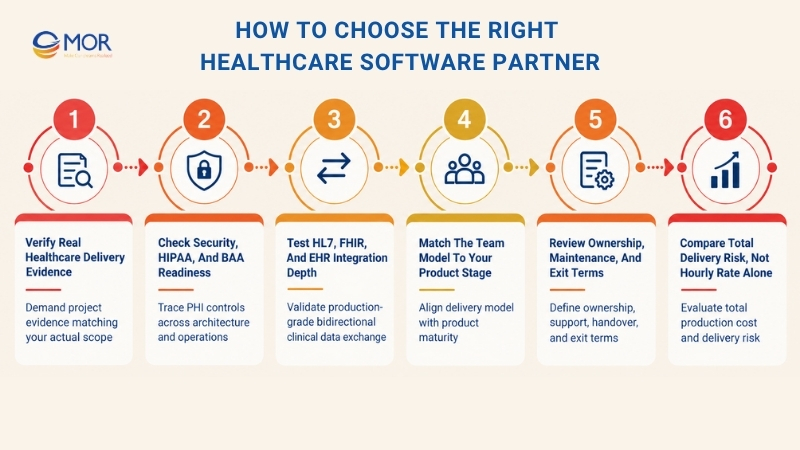
Selecting among custom healthcare software development companies in USA gets easier once you compare evidence against your own product rather than a generic vendor checklist. The best custom software development companies for healthcare solutions should match the system you need to build, the regulations around it, and the systems it must connect to.
Verify Real Healthcare Delivery Evidence
Ask for projects that resemble your own scope. A hospital-management case tells you more about a vendor's clinical operations experience than a healthcare logo sitting in a client carousel.
Look for concrete details: team size, development period, user roles, architecture, EHR connections, devices, data volume, and measurable outcomes. If the vendor claims deep telehealth experience, ask which video stack, EHR, identity flow, scheduling workflow, and production environment it handled.
Pay attention to who did the actual work. A company may have participated in a project but only supplied two frontend engineers, which differs greatly from owning architecture, backend, security, QA, and deployment.
Check Security, HIPAA, and BAA Readiness
HIPAA readiness should show up in architecture decisions. Ask the vendor to map where PHI enters the system, where it travels, who can access it, how it is logged, and where backups live.
Check encryption at rest and in transit, RBAC, audit trails, session controls, incident response, environment separation, and the Business Associate Agreement process. SOC 2, HITRUST, ISO 27001, or ISO 13485 may add evidence where the project calls for them, but a certificate doesn't replace application-level security.
Cloud design needs the same scrutiny as the codebase. Healthcare software can move PHI through managed databases, object storage, APIs, queues, analytics services, and backup systems. Our guide to cloud computing in healthcare explains the main deployment models, security controls, and healthcare use cases.
Test HL7, FHIR, and EHR Integration Depth
Ask a deceptively simple question: 'Did your last EHR integration only read data, or could it write back safely?' Many vendors can call a sandbox API. Far fewer have handled production-grade bidirectional clinical data exchange.
The distinction matters because FHIR R4, HL7 v2, SMART on FHIR, DICOM, terminology mapping, rate limits, identity, consent, and error handling behave differently once the integration reaches a hospital environment.
The US market is already far down this road. ONC reports that in 2024, about 9 in 10 hospitals enabled patient access through an API, and 7 in 10 used standards-based APIs such as FHIR.
Ask which Epic, Oracle Health/Cerner, athenahealth, MEDITECH, eClinicalWorks, or other environments the vendor has connected to. Then ask what happened after go-live.
Match the Team Model to Your Product Stage
A six-month MVP rarely needs the same commercial setup as a three-year hospital platform. Match the contract to the product stage.
Project-based delivery fits a stable scope. Time and materials fits a backlog that changes often. Staff augmentation works when your own technical leaders can direct external engineers, and a dedicated team fits long-running product work.
An offshore development center can make sense once you need a persistent team across backend, frontend, mobile, QA, DevOps, and analysis. MOR's own ODC model lets clients choose the team composition while we handle recruitment, payroll, staffing, and operational work.
Review Ownership, Maintenance, and Exit Terms
Get ownership terms in writing before the first sprint. Your contract should cover source code, repositories, infrastructure accounts, deployment pipelines, architecture documents, credentials, data exports, licenses, and third-party services.
The exit clause deserves equal attention. Ask what happens if you switch vendors in 18 months. A clean handover should include documentation, environment access, data schema notes, open risks, deployment instructions, and knowledge-transfer sessions.
Maintenance also needs a defined service level. Ask for incident priority rules, response times, security-patch procedures, backup responsibility, monitoring, and support hours.
Compare Total Delivery Risk, Not Hourly Rate Alone
A $30 engineer isn't cheaper if the project needs to be rewritten. Integration mistakes, missed security controls, weak automated tests, and poor documentation can erase the initial rate difference quickly.
Compare the total cost of getting the product into production and keeping it there. Include discovery, architecture, development, QA, security work, integration, cloud costs, project management, maintenance, and vendor transition.
The top healthcare software development companies tend to make these assumptions visible early. For your shortlist, ask each vendor to price the same scope and state what isn't included. That gives you a useful comparison instead of five quotes built on five different assumptions.
Healthcare Development Costs and Engagement Models
Pricing among custom healthcare software development companies in USA changes sharply based on delivery model, location, seniority, clinical integration, and regulatory scope. One useful benchmark comes from Clutch: reviewed custom software projects average $132,480.29, and US development companies commonly charge $50-$99 per hour.
The table below gives planning ranges, not fixed quotes.
Engagement Model | Works Best For | Pricing Structure | Typical 2026 Cost (USD) | Main Trade-Off |
Fixed/project-based | Defined MVP, portal, integration, or module | Fixed estimate | $30,000-$180,000+ per project | Changes after scope approval usually add cost |
Time and materials | Products with changing requirements or integration scope | Actual hours x agreed rate | $50-$99/hr is a common US custom software band; specialist healthcare work can cost more | Final spend needs close backlog control |
Dedicated team | Long-running healthcare products | Monthly team fee | $12,000-$40,000/month offshore or $60,000-$130,000/month onshore for a 3-5 person pod | Works best when the roadmap can support a longer commitment |
Staff augmentation | Filling FHIR, QA, cloud, AI, DevOps, or mobile skill gaps | Per engineer, monthly or hourly | Around $4,800-$9,600/month for a senior offshore engineer and $17,600-$28,800/month for a US senior engineer | Your managers retain more delivery responsibility |
Offshore development center | Multi-year platforms needing stable external capacity | Monthly dedicated capacity | A 5-person ODC runs about $12,000-$25,000/month; Vietnam benchmarks sit around $11,000-$16,000/month | Strong documentation and distributed-team management are needed |
Project structure changes these figures quickly. A patient intake tool with one role and one EHR link sits at a very different price point than a multi-facility platform serving physicians, nurses, pharmacists, patients, administrators, and payers.
EHR integrations raise the workload. Epic, Oracle Health/Cerner, athenahealth, HL7 v2, FHIR, SMART on FHIR, laboratory feeds, and imaging systems require mapping, testing, error handling, access control, and production support.
Medical devices add another engineering layer. Bluetooth devices, diagnostic equipment, wearables, and IoMT systems need reliable data capture, device-state handling, security, and clinical validation.
Regulated software can change the budget most sharply. FDA-related SaMD work may add formal design controls, traceability, risk management, verification, documentation, and submission support. One 2026 healthcare software cost analysis places the SaMD design-control and validation add-on at $120,000-$400,000.
AI, historical data migration, cloud infrastructure, penetration testing, performance testing, accessibility, disaster recovery, and post-launch support also need budget. Ask vendors to price those items separately when the quote doesn't make them visible.
Questions to Ask Before You Shortlist a Vendor
A polished sales deck can hide gaps in clinical experience. To list the best custom healthcare software development companies for your project, use questions that force each vendor to describe how it works in production.
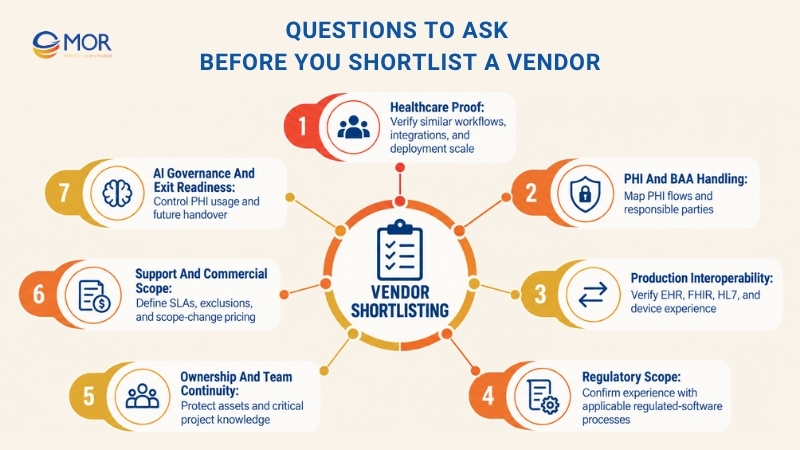
- Healthcare proof: Can you show a healthcare project close to our user roles, clinical workflow, integrations, and deployment scale?
- PHI handling: Where will PHI enter, move, persist, appear in logs, and get backed up?
- BAA process: Which vendor, cloud service, or subcontractor will handle PHI, and which parties need a Business Associate Agreement?
- Interoperability: Which EHR platforms, FHIR APIs, HL7 feeds, laboratory systems, HIEs, and medical devices have you connected in production?
- Write access: Have you built bidirectional integrations that safely write data into an EHR, or has your work been read-only?
- Regulatory scope: Which FDA SaMD, IEC 62304, ISO 13485, or other regulated-software processes have you supported when they applied?
- Ownership: Who owns the source code, repositories, cloud accounts, CI/CD pipelines, technical documents, and credentials?
- Team continuity: What happens if the architect, lead developer, or domain analyst leaves during the project?
- Support: Which SLA governs outages, security patches, integration failures, and production incidents after launch?
- Commercial assumptions: Which work sits outside the quote, and how are scope changes priced?
- AI governance: Can PHI reach an external AI model, and what controls prevent unauthorized training, retention, or disclosure?
- Exit readiness: Could another engineering team take over the platform without rebuilding major parts of it?
The answers should be concrete. 'We follow best practices' isn't enough for a healthcare product carrying sensitive data and clinical dependencies.
Conclusion
The best custom healthcare software development companies in USA combine healthcare delivery proof, secure engineering, interoperability skills, and a commercial model that fits your product stage. Compare real projects before comparing sales claims. MOR Software brings healthcare experience across telehealth, hospital systems, medical data, connected devices, cloud, and dedicated engineering teams.
If you're planning a healthcare platform or need extra product capacity, contact MOR Software to discuss the scope, team structure, and delivery plan.
MOR SOFTWARE
Frequently Asked Questions (FAQs)
What is a custom healthcare software development company?
A custom healthcare software development company builds software around healthcare workflows, data, and regulatory needs. Its work may cover EHR/EMR systems, telehealth, patient portals, billing, medical devices, and clinical integrations, with added focus on PHI security, HL7, FHIR, and healthcare operations.
How much does custom healthcare software development cost in the USA?
Custom healthcare software in the USA often costs $30,000 to $180,000, while large EHR, hospital, or regulated systems can cost several hundred thousand dollars or more. Pricing depends on scope, integrations, user roles, medical devices, AI, security controls, cloud infrastructure, and team location.
What makes a healthcare software company HIPAA-ready?
A HIPAA-ready vendor should understand PHI data flows, encryption, access control, audit logs, backups, incident response, and BAA requirements. Buyers should review the actual security process and architecture rather than rely on a simple 'HIPAA-certified' claim.
Should a vendor have HL7 and FHIR integration experience?
Yes, if your software exchanges clinical data with EHRs, labs, HIEs, payers, or other healthcare systems. Look for production experience with HL7 v2, FHIR, authentication, data mapping, error handling, and secure read-and-write integrations.
Which healthcare projects need FDA SaMD expertise?
FDA SaMD expertise is relevant when software performs or supports a medical function, including diagnosis, treatment, monitoring, or certain clinical decisions. The FDA reported more than 1,300 authorized AI-enabled medical devices by the end of 2025, showing the growing role of regulated software in healthcare.
What should I ask a healthcare software vendor before signing?
Ask about comparable healthcare projects, PHI handling, HIPAA processes, EHR integrations, security, QA, team structure, ownership, pricing assumptions, and post-launch support. Project documents and references can also show how mature the vendor's delivery process is.
Is a US-based team required for a US healthcare project?
No. A custom healthcare software development company in USA can provide easier time-zone alignment, but offshore teams can also serve US healthcare projects when they understand regulations, security, communication, contracts, and clinical workflows.
How do offshore, nearshore, and US-based vendors compare?
US vendors usually provide stronger working-hour overlap but charge higher rates. Nearshore teams balance cost and time-zone coverage, while offshore teams in countries like Vietnam can lower development costs and expand talent access but require stronger documentation and remote management.
What post-launch support should a healthcare partner provide?
Post-launch support should cover bug fixes, security updates, integration monitoring, cloud infrastructure, backups, performance, incident response, and release management. Your SLA should also define response times, ownership, documentation, and handover procedures.
How long does a custom healthcare software project take?
A healthcare MVP often takes 3 to 6 months, while a production platform may need 6 to 12 months or longer. Large modernization or regulated medical software projects can take more time due to EHR access, validation, security reviews, and regulatory work.
Share


Make Our-Dreams Realized


© 2023 . MOR Software. All Rights Reserved
Sitemap
Privacy Policy
Terms of Use

Rate this article
0
over 5.0 based on 0 reviews
Your rating on this news:
Name
*Email
*Write your comment
*Send your comment
1