


TOP 10 Dataset for Sentiment Analysis: Selection Guide 2026
A dataset for sentiment analysis project starts with one decision that shapes everything after it: which data actually matches the task? A sentiment analysis dataset contains labeled text, or sometimes multimodal content, for training, fine-tuning, validation, or benchmarking. IMDb, SST, Sentiment140, Yelp, GoEmotions, and MELD measure different units and label types. In this MOR Software guide, we’ll compare ten options by domain, scale, labels, annotation method, and real use.
Key Takeaways
- Dataset size is only one selection factor. Domain match, prediction unit, label meaning, annotation method, language, and access rules determine whether benchmark results transfer to your real data.
- The top 10 choices cover long movie reviews, phrase-level sentiment, social posts, local-business reviews, product feedback, emotion labels, dialogue, and small teaching datasets.
- Public benchmarks work well for baselines and repeatable tests. Production projects still need target-domain validation, careful splits, and well-checked labels before a model goes live.
Benefits of Using Dataset Sentiment Analysis
A well-matched dataset sentiment analysis resource gives your team labeled examples for training, testing, comparing, and refining NLP models. The practical value comes from matching the language and labels to the data your model will see after deployment.
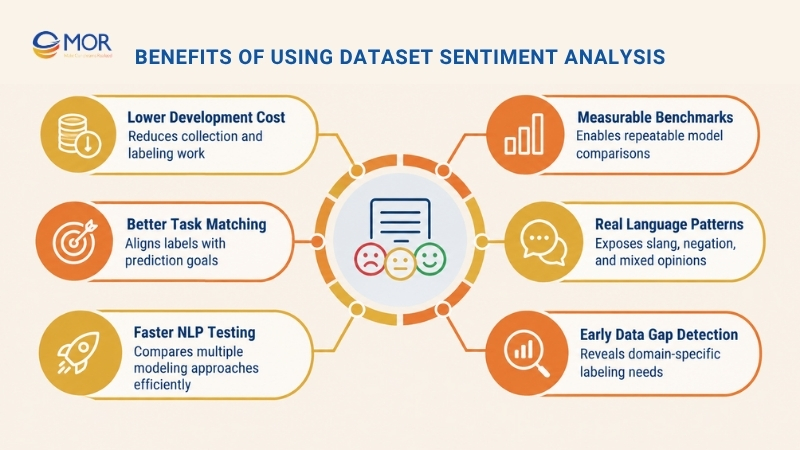
Lower early development cost
Public datasets remove much of the collection and labeling work needed for a first experiment. For example, Stanford's IMDb benchmark provides 50,000 labeled reviews split evenly between training and test sets, giving teams enough data for a serious baseline without collecting a new corpus first.
Create measurable benchmarks
Standard train, validation, and test splits make model comparisons easier to repeat. Accuracy, F1, precision, and recall become more meaningful when each candidate model sees the same held-out samples. Teams can also tell whether a code change improved the model or merely changed the test setup.
Match the model to the task
IMDb targets document-level polarity, SST tests sentence and phrase composition, and MELD brings dialogue history into the task. The dataset decides what the model learns to classify, so label design deserves as much attention as model design. A three-way classifier also needs neutral examples rather than a binary corpus with labels renamed later.
Expose real language patterns
Reviews and social posts carry negation, slang, misspellings, emoji, mixed opinions, and uneven text length. A useful sentiment dataset lets engineers find failure cases early instead of learning about them after launch.
Test different NLP approaches faster
The same benchmark can compare classic machine learning, transformer models, and other natural language processing tools. That makes model choice evidence-based rather than driven by the newest architecture.
Find data gaps before production
Public corpora may prove that a task is technically workable, yet your own language can still differ sharply. data labeling outsourcing and professional annotation services become useful when domain text needs custom labels or tighter annotation rules.
These benefits depend on fit. A popular benchmark can still mislead you when the text source, label taxonomy, or prediction unit differs from the production task. Treat public data as a controlled starting point, then confirm model behavior on samples that resemble your own users and workflows.
10 Best Dataset for Sentiment Analysis in 2026
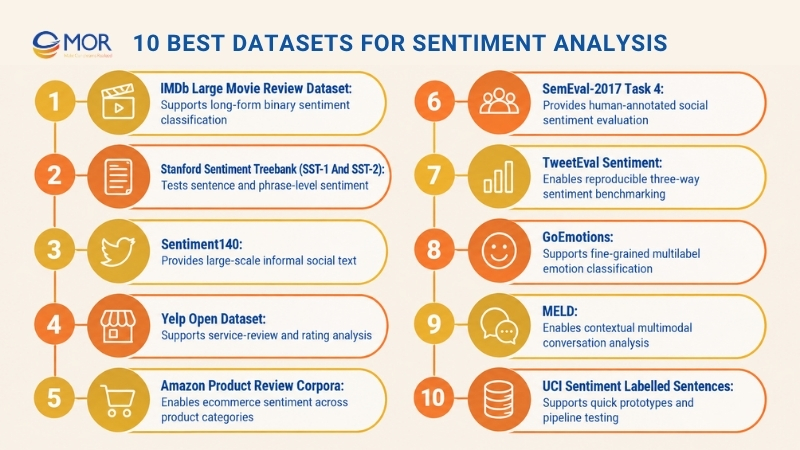
Choosing a dataset for sentiment analysis gets easier once the options are compared on the same criteria. The table below gives a fast view before we examine each dataset in detail.
Dataset | Data Domain | Approx. Scale | Label Type | Best Fit | Primary Limitation |
IMDb Large Movie Review Dataset | Long-form movie reviews | 50,000 reviews | Binary positive/negative | Document-level sentiment classification | Limited to movie-review language |
Stanford Sentiment Treebank (SST) | Movie-review sentences and phrases | 11,855 sentences; 215K+ phrases | Binary or 5-level sentiment | Negation, compositionality, sentence-level analysis | Domain-specific and sensitive to split leakage |
Sentiment140 | Twitter-style social posts | ~1.6M tweets | Binary, distant supervision | Large-scale informal-text training | Noisy emoticon-derived labels |
Yelp Open Dataset | Local-business and service reviews | Varies by release | Star ratings | Customer-review and rating analysis | Ratings are indirect sentiment labels |
Amazon Review Corpora | Ecommerce product reviews | Varies by corpus | Ratings, binary mappings, metadata | Product sentiment and cross-category analysis | Versions and label conventions differ |
SemEval-2017 Task 4 | Twitter posts | Varies by subtask | 3-way and ordinal sentiment tasks | Human-annotated social sentiment evaluation | Older data and access constraints |
TweetEval Sentiment | Twitter-style text | Fixed benchmark splits | Positive/neutral/negative | Reproducible model benchmarking | Inherits limitations of Twitter source data |
GoEmotions | Reddit comments | ~58,000 comments | 27 emotions + Neutral | Fine-grained emotion and multilabel modeling | Emotion labels are not the same as sentiment polarity |
MELD | Multi-party dialogue | ~13,000 utterances | 3 sentiment + 7 emotion classes | Conversational and multimodal sentiment analysis | Scripted dialogue may differ from real conversations |
UCI Sentiment Labelled Sentences | IMDb, Amazon, and Yelp sentences | 3,000 sentences | Binary positive/negative | Teaching, prototypes, and pipeline tests | Too small for production-level generalization |
The rule is simple: dataset sentiment analysis selection should start with domain, prediction target, and annotation quality before benchmark popularity. A famous dataset can still produce a strong score that says little about your own production text.
1. IMDb Large Movie Review Dataset
IMDb is a binary movie-review benchmark for document-level sentiment classification. It contains long reviews labeled positive or negative, making it a practical starting point when the model must judge the overall tone of a complete document.
Ideal Use Cases: Choose IMDb for binary text classification, long-form review sentiment, baseline model comparisons, and research where a full review maps to one overall polarity label.
Dataset Snapshot
- Data Volume: 50,000 labeled reviews split evenly between training and test sets.
- Label Structure: Positive and negative only, with neutral reviews excluded.
- Text Domain: English movie reviews collected from IMDb.
- Prediction Unit: A label for the review rather than each sentence or aspect.
Where It Performs Well
- Long-Text Evaluation: Models must combine clues across several sentences before assigning one label.
- Clear Benchmarking: Binary classes keep baseline metrics easy to interpret.
What To Watch For
- Domain Bias: Movie-review vocabulary may transfer poorly to support tickets, financial text, or employee feedback.
- No Aspect Labels: One review can praise acting and criticize pacing, yet the dataset still assigns one overall label.
- Historical Language: Older reviews don’t represent every current phrase or platform habit.
When To Choose It: Use IMDb when your dataset sentiment analysis goal is overall positive or negative classification on relatively long documents. Pick another corpus when sentence-level, aspect-level, or neutral sentiment is part of the target.
2. Stanford Sentiment Treebank (SST-1 and SST-2)
The Stanford Sentiment Treebank focuses on sentences and the phrases inside their parse trees. SST-1 supports fine-grained sentiment, and SST-2 turns the task into binary sentence classification, which makes the family useful for studying negation and composition.
Ideal Use Cases: SST suits sentence sentiment, phrase-level analysis, syntax-aware experiments, and models that need to learn how words change meaning when they combine.
Dataset Snapshot
- Data Volume: 11,855 sentences and 215,154 phrase-level annotations.
- Label Structure: Five sentiment levels in the fine-grained setup; SST-2 uses binary polarity.
- Text Domain: Movie-review snippets derived from Rotten Tomatoes material.
- Annotation Method: Human sentiment judgments at sentence and phrase levels.
The corpus contains 215,154 labeled phrases across 11,855 sentences. That phrase-level depth is what separates SST from a standard sentence-only sentiment analysis database and makes it useful for compositional sentiment research.
Where It Performs Well
- Compositional Sentiment: Phrase labels expose how local meaning contributes to a sentence-level result.
- Negation Testing: Sentences with structures like 'not good' or 'not entirely bad' reveal whether a model handles polarity shifts.
What To Watch For
- Movie-Domain Origin: The source still reflects review language rather than every business domain.
- Nested Phrase Leakage: Closely related phrases can make evaluation look stronger if splits are handled poorly.
- Split Discipline: Keep official splits when comparing against published baselines.
When To Choose It: Select SST when the research question centers on how sentiment changes across phrases and sentences. For document-level review classification, IMDb is a cleaner fit.
3. Sentiment140
Sentiment140 is a large social-text corpus built from Twitter posts using distant supervision. Positive and negative emoticons acted as weak label signals, so the dataset trades annotation precision for scale.
Ideal Use Cases: It fits large social-text experiments, short informal language, weak-supervision research, and projects where volume matters more than hand-labeled precision. A social media sentiments analysis dataset of this size can also expose models to hashtags, mentions, abbreviations, and casual spelling.
Dataset Snapshot
- Data Volume: About 1.6 million training tweets.
- Label Structure: Positive and negative in the training corpus.
- Text Domain: English Twitter posts.
- Annotation Method: Distant supervision based on positive and negative emoticons.
The original Stanford report states that the training set used 800,000 tweets with positive emoticons and 800,000 with negative emoticons, for 1.6 million total training tweets. That scale is useful, but the label method explains why the data should not be treated like gold-standard human annotation.
Where It Performs Well
- Dataset Scale: Large training volume supports experiments that need many short texts.
- Informal Language: Tweets contain slang, shortened forms, mentions, links, and social conventions.
What To Watch For
- Noisy Labels: An emoticon can signal mood without representing the full meaning of the tweet.
- Temporal Drift: Social language from 2009 differs from present-day platform language.
- Platform Access: Historical tweet availability and platform policies can affect reproducibility.
When To Choose It: Sentiment140 fits a dataset sentiment analysis experiment where scale and informal social language matter more than annotation precision. Use human-labeled social data for a stricter final benchmark.
4. Yelp Open Dataset
Yelp provides review text, star ratings, and business metadata tied to local services. That combination makes it useful for customer-experience work where sentiment can be studied beside business category, location, or rating behavior.
Ideal Use Cases: Yelp suits restaurant and service reviews, rating prediction, customer-experience analytics, and projects that need metadata beside review text. A customer sentiment analysis dataset based on your own service records can later use Yelp as a baseline rather than a direct substitute.
Dataset Snapshot
- Data Volume: Varies across public releases and snapshots.
- Label Structure: Star ratings can be mapped to polarity or kept as an ordinal target.
- Text Domain: Local-business and service reviews.
- Metadata: Business and review attributes allow segmented analysis.
Where It Performs Well
- Service-Domain Language: Reviews cover concrete experiences with local businesses.
- Metadata Segmentation: Teams can compare patterns by business type or other available fields.
- Ordinal Tasks: Star ratings support experiments beyond simple binary classification.
What To Watch For
- Weak Label Mapping: A five-star score and a sentence-level sentiment label represent different targets.
- Mixed Opinions: One review can praise staff and criticize price at the same time.
- Snapshot Differences: Dataset size and fields can change across releases.
When To Choose It: Pick Yelp when your project analyzes local-business or service-review language. Define how middle ratings map to labels before training, especially when neutral sentiment matters.
5. Amazon Product Review Corpora
'Amazon reviews' refers to several corpora and releases rather than one single fixed benchmark. Most contain review text, ratings, product categories, and metadata, which makes them useful for ecommerce sentiment and cross-category research.
Ideal Use Cases: Amazon review corpora fit ecommerce analysis, product-rating prediction, category transfer, aspect-focused research, and multilingual work when the selected release supports the required language. A product sentiment analysis dataset is most useful when its product mix resembles the catalog you need to analyze.
Dataset Snapshot
- Data Volume: Varies widely by corpus, year, category, and release.
- Label Structure: Star ratings, binary mappings, or other targets created for a given experiment.
- Text Domain: Product reviews across many ecommerce categories.
- Metadata: Product, rating, category, and other fields depend on the selected corpus.
Where It Performs Well
- Product-Domain Coverage: Categories expose models to different vocabulary and review patterns.
- Cross-Category Testing: Teams can train on one category and test transfer to another.
- Rating Prediction: Native rating fields support ordinal or mapped classification tasks.
What To Watch For
- Corpus Version Differences: Record the exact source, date, and subset before comparing results.
- Star Ratings As Weak Labels: Rating-to-polarity rules can hide mixed opinions in the review text.
- Label QA: If you derive sentiment classes from ratings, use data labeling quality assurance tools to audit mappings and edge cases.
When To Choose It: Use an Amazon corpus when your production target is ecommerce or product-review sentiment. Dataset sentiment analysis results are more useful when the selected categories and rating rules mirror the real catalog.
6. SemEval-2017 Task 4
SemEval-2017 Task 4 is a shared-task benchmark built around sentiment in Twitter data. It includes message-level and topic-level tasks, so researchers can test more focused targets than simple review polarity.
Ideal Use Cases: SemEval fits human-annotated social sentiment, topic-based polarity, ordinal sentiment, and standardized research comparisons where label quality carries more weight than raw volume.
Dataset Snapshot
- Data Domain: Twitter posts collected for shared-task evaluation.
- Label Structure: Includes positive, neutral, and negative message polarity, plus topic-focused ordinal tasks.
- Annotation Method: Human annotation rather than emoticon-based distant supervision.
- Evaluation Design: Shared-task definitions and scoring rules support controlled comparisons.
Where It Performs Well
- Human Annotation: Labels reflect annotator judgments instead of automatic proxy rules.
- Target-Aware Sentiment: Topic-based tasks ask how a message feels about a particular subject.
- Standardized Evaluation: Shared-task settings make published model comparisons easier to interpret.
What To Watch For
- Older Social Data: Platform language and user habits have changed since collection.
- Task Definitions: Each subtask has its own target, so results should not be mixed across settings.
- Tweet Availability: Historical post access can affect exact data reconstruction.
When To Choose It: Prefer SemEval when human labels and defined evaluation tasks matter more than training scale. It is a better fit than Sentiment140 when label quality is the priority.
7. TweetEval Sentiment
TweetEval packages Twitter-related NLP tasks into a consistent benchmark suite. Its sentiment task uses positive, neutral, and negative labels with fixed train, validation, and test splits, which supports repeatable model checks.
Ideal Use Cases: Use it for standardized three-way Twitter sentiment, regression tests, model comparisons, and experiments where fixed splits are more useful than assembling a new corpus.
Dataset Snapshot
- Label Structure: Positive, neutral, and negative.
- Evaluation Setup: Fixed benchmark splits.
- Text Domain: Twitter-style short social text.
- Dataset Lineage: The sentiment task is based on established Twitter sentiment resources rather than a wholly separate new source.
A sentiment analysis dataset positive, negative, neutral setup is often easier to map to monitoring dashboards than a binary benchmark. Neutral still needs a clear business definition, especially when mixed or factual text sits near the class boundary.
Where It Performs Well
- Reproducible Evaluation: Fixed splits limit accidental benchmark drift.
- Consistent Task Format: The suite makes it easier to compare experiments under one data interface.
- Regression Testing: Teams can rerun the same test after changing preprocessing or model code.
What To Watch For
- Twitter Domain: Short-post language may transfer poorly to longer reviews or support conversations.
- Inherited Constraints: Source-data limits carry into the benchmark.
When To Choose It: TweetEval works well when dataset sentiment analysis needs a standard social-text benchmark with stable splits. Use a separate in-domain set before making production claims.
8. GoEmotions
GoEmotions moves beyond classic positive, neutral, and negative polarity. Google Research built it for fine-grained emotion classification, so it fits projects that need labels like admiration, anger, gratitude, fear, joy, or remorse.
Ideal Use Cases: GoEmotions suits multilabel affect modeling, support-emotion analysis, conversational NLP, and taxonomy design. An employee sentiment analysis dataset may borrow ideas from its fine-grained taxonomy, but workplace labels should come from workplace data rather than Reddit alone.
Dataset Snapshot
- Data Volume: About 58,000 English Reddit comments.
- Label Structure: 27 emotion categories plus Neutral.
- Annotation Method: Human annotation.
- Task Style: Fine-grained and potentially multilabel emotion classification.
Google Research describes GoEmotions as 58,000 manually annotated English Reddit comments labeled for 27 emotion categories or Neutral. That richer label space supports affect analysis and demands careful class-level evaluation.
Where It Performs Well
- Fine-Grained Affect: Teams can distinguish emotions that a polarity score would collapse together.
- Multilabel Classification: One comment can express more than one emotion.
What To Watch For
- Emotion Is Not Polarity: Joy, gratitude, approval, and relief should not be treated as interchangeable positive labels.
- Reddit Domain Bias: Community language and user mix may differ from enterprise text.
- Label Imbalance: Fine-grained classes rarely appear at equal rates.
When To Choose It: Use GoEmotions when three-way polarity is too coarse. For a standard positive-versus-negative benchmark, another dataset will be easier to interpret.
9. MELD
MELD adds dialogue history, speaker turns, audio, and visual signals to sentiment and emotion analysis. It is built for multi-party conversations, so the model can use what happened before the current utterance rather than judging each line alone.
Ideal Use Cases: MELD fits conversational sentiment, emotion recognition, speaker-aware modeling, and multimodal research where text alone misses tone or facial cues.
Dataset Snapshot
- Data Volume: About 13,000 utterances across 1,433 dialogues.
- Label Structure: Sentiment and emotion labels.
- Available Modalities: Text, audio, and visual data.
- Source Domain: Dialogue from the TV series Friends.
The ACL paper reports about 13,000 utterances from 1,433 dialogues, with audio, visual, and textual modalities attached to each utterance. That structure makes MELD useful when conversation history changes the meaning of a short reply.
Where It Performs Well
- Dialogue History: Previous turns can explain a response that looks neutral in isolation.
- Speaker-Aware Modeling: Multi-party dialogue supports work on who said what and when.
- Multimodal Evaluation: Audio and visual cues allow experiments beyond text-only sentiment.
What To Watch For
- Scripted Dialogue: TV dialogue differs from real support calls, meetings, and interviews.
- Real-World Transfer: Production speech may contain noise, interruptions, or accents missing from scripted scenes.
When To Choose It: MELD fits dataset sentiment analysis where previous turns, speaker identity, voice, or visual cues shape the label. Text-only review datasets cannot test that problem well.
10. UCI Sentiment Labelled Sentences
UCI Sentiment Labelled Sentences is the small, easy-entry option in this list. It combines 3,000 labeled sentences from IMDb, Amazon, and Yelp, split evenly across those three sources.
Ideal Use Cases: Use it for classroom demonstrations, proof-of-concept scripts, pipeline smoke tests, and simple baseline classifiers where setup speed matters more than production realism.
Dataset Snapshot
- Data Volume: 3,000 sentences, with 1,000 from each source domain.
- Label Structure: Binary positive and negative.
- Text Domain: Movie, product, and local-business review sentences.
- Data Shape: Small text-label pairs that are easy to load and inspect.
Where It Performs Well
- Fast Experimentation: Small files make training and debugging quick.
- Simple Structure: The format is friendly for beginner Python and scikit-learn pipelines.
- Classroom Use: Students can inspect most of the data without special infrastructure.
What To Watch For
- Small Scale: A few thousand examples cannot represent the full variety of production language.
- Clear Polarity: Short labeled sentences may make the task cleaner than real mixed reviews.
- Limited Generalization: A high score here should not be treated as evidence of production readiness.
When To Choose It: Pick UCI when you need a proof of concept or teaching corpus. A larger sentiment benchmark should follow once the pipeline works.
How to Choose the Right Dataset Sentiment Analysis
A dataset sentiment analysis decision should follow the task definition, not the leaderboard. We recommend locking down the prediction unit, label target, domain, annotation method, access rules, and evaluation metric before comparing model scores.
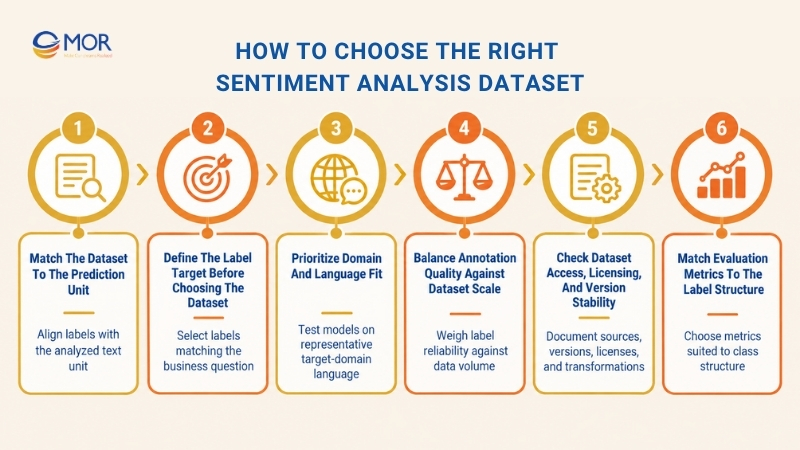
Match the Dataset to the Prediction Unit
Start with the object that receives a label. A movie review is a document, SST can label a phrase or sentence, a tweet is a short post, and MELD labels conversational utterances tied to dialogue history.
A sentence benchmark does not prove that a model can summarize sentiment across a 500-word review. The reverse also holds: a document classifier may miss local polarity shifts that matter in aspect-level or phrase-level work. Write the prediction unit into the task specification before you download data so the training target stays stable across experiments and teams in practice.
Define the Label Target Before Choosing the Dataset
Binary polarity, three-way polarity, five-level sentiment, star ratings, topic sentiment, and emotion labels answer different questions. Treating them as interchangeable creates label noise before training even starts.
For example, a five-star product review can contain a negative sentence about delivery. Decide whether the target is overall satisfaction, sentence polarity, an aspect, or an emotion before you select sentiment analysis data. This choice also determines how annotators handle mixed opinions and borderline neutral cases.
Prioritize Domain and Language Fit
Domain words change the meaning of sentiment cues. 'Sick' can be praise in casual text, 'volatile' may be descriptive in finance, and a support ticket can sound negative without expressing dislike of the product itself.
Use public benchmarks to check model behavior, then test on labeled target-domain samples. In a Hugging Face discussion on benchmark choice, SST-2 is presented as a general reference, with the caveat that domain-specific work still needs domain-aware evaluation.
Information sets used in machine learning also need to reflect the data distribution the model will meet after release. A public benchmark and an in-domain holdout answer different questions, so keep both in the evaluation plan.
Balance Annotation Quality Against Dataset Scale
Human labels usually carry more direct judgment than star ratings or emoticon proxies, but hand labeling costs more and often produces smaller corpora. Weak labels scale faster, yet they can encode rules that do not match the real target.
When custom labels become necessary, compare managed data labeling outsourcing, professional annotation services, and freelance AI data annotation platforms. For dataset sentiment analysis, annotation instructions and reviewer agreement can matter more than adding another large batch of weak labels.
Check Dataset Access, Licensing, and Version Stability
Record the source, release date, subset, license, and any transformation applied before training. Social datasets deserve extra care because post availability, platform rules, and historical mirrors can change.
The same dataset name can also hide different versions. Amazon corpora are a good example: category coverage, fields, languages, and rating mappings depend on the release you chose. Store a dataset card or experiment note so another engineer can recreate the exact training set later.
Match Evaluation Metrics to the Label Structure
Accuracy works as a simple starting metric for balanced binary tasks. Macro F1 becomes more useful when classes are uneven, and per-class precision and recall show which labels the model is missing.
Ordinal ratings need metrics that respect class distance. A model confusing four stars with five stars has made a different error from confusing one star with five, so one generic 'best score' cannot compare unrelated tasks fairly. Review the confusion matrix as well, since a single headline metric can hide systematic errors in one class.
How to Prepare a Sentiment Dataset for Model Training
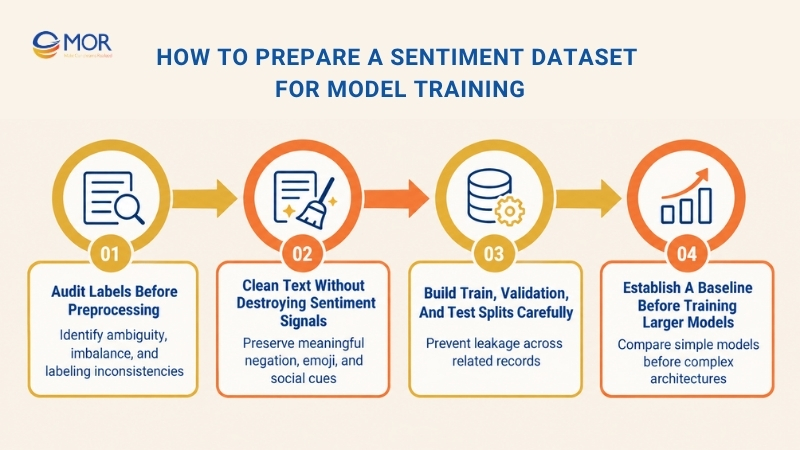
Good training starts before the model sees a batch. A dataset for NLP sentiment analysis needs label checks, selective cleaning, safe data splits, and a baseline that can reveal data problems before larger models hide them.
Audit Labels Before Preprocessing
Look at the labels before changing the text. Mixed opinions, sarcasm, duplicate samples, weak rating mappings, and inconsistent annotator rules can distort training long before model tuning begins.
- Check Class Balance: Count examples per label and inspect minority classes separately.
- Review Ambiguous Samples: Flag mixed, sarcastic, or dialogue-dependent text rather than forcing uncertain labels silently.
- Test Annotation Consistency: Use data labeling quality assurance tools to inspect agreement, rule violations, and repeated errors.
- Separate Weak Labels: Keep star-based or proxy labels distinguishable from human-reviewed ground truth.
Clean Text Without Destroying Sentiment Signals
Cleaning should remove noise that has no modeling value, not every unusual character. Emoji, repeated punctuation, casing, negation, hashtags, and stretched words can carry the sentiment signal itself.
- Preserve Negation: Removing 'not' can reverse the class meaning.
- Keep Useful Social Cues: Emoji and repeated characters may carry strong affect in social text.
- Save Raw Copies: Maintain original and processed versions so experiments remain traceable.
- Apply Domain Rules: Follow data preprocessing in machine learning based on the source rather than one universal cleaning recipe.
Build Train, Validation, and Test Splits Carefully
Use official benchmark splits when available. Custom corpora need grouping rules that keep duplicates, related users, product families, businesses, or conversation turns from crossing split boundaries.
- Block Near-Duplicates: Similar text in train and test sets can inflate results.
- Group Related Records: Keep one conversation, user, business, or product group together when leakage is possible.
- Preserve Label Ratios: Stratification can keep class distributions workable across splits.
- Freeze the Test Set: Avoid repeated tuning against the final holdout. Create a separate development set for threshold choices and error analysis.
Establish a Baseline Before Training Larger Models
A simple baseline gives you a reference point and often exposes dataset faults faster than a large transformer. Start with majority-class performance, then test TF-IDF plus logistic regression before adding heavier architectures.
- Measure the Floor: Majority-class accuracy tells you whether a model beats a trivial prediction rule.
- Train a Simple Classifier: TF-IDF and logistic regression provide a fast text baseline.
- Add a Transformer Baseline: Compare gains against the simpler model under the same split.
- Inspect Errors: A dataset sentiment analysis python workflow should log false positives, false negatives, and per-class metrics. Group errors by label, text length, and domain so recurring data faults become visible. Our guide to python for machine learning covers the wider implementation path.
Dataset Issues That Can Distort Sentiment Model Results
Strong benchmark scores can still hide weak data design. Dataset sentiment analysis results become unreliable when label meaning, domains, time periods, or split boundaries do not match the claim you want to make.
Label Semantics Are Not Interchangeable
A one-star rating, a human 'negative' label, a sad emoji, and an anger label all represent different supervision signals. Mapping them into one class may be practical, but the mapping must be documented as a modeling choice.
This distinction matters when teams merge sources. A sentimental analysis dataset built from several label systems needs a shared taxonomy and a review process before the samples can live in one training set.
Domain Shift Can Inflate Benchmark Confidence
A model can score well on movie reviews and fail on ecommerce complaints because the vocabulary, sentence structure, and target meaning have changed. The benchmark proves performance on that benchmark distribution, not on every downstream domain.
Hold back representative production samples for a second evaluation. That extra set often tells you more about launch readiness than another small gain on a familiar public test split. Keep its label rules identical to the production decision you plan to automate.
Temporal Drift Changes Language and User Behavior
Social language, product names, platform conventions, and slang move over time. Historical datasets remain useful for reproducible research, yet current production text can include patterns that never existed in the original corpus.
Track model performance on newer labeled samples after deployment. If error types start clustering around new phrases or products, refresh the evaluation set before retraining.
Data Leakage Can Make Results Look Better Than They Are
Leakage happens when information from training appears in validation or test data. Duplicate reviews are the obvious case, but related phrases, the same user, the same product family, or turns from one conversation can create subtler leakage.
Group-aware splits help when records share a source entity. SST also deserves care because nested phrases from the same sentence are highly related and should not be scattered carelessly across custom splits.
Benchmark Accuracy Does Not Equal Production Readiness
Production text includes minority classes, ambiguity, sarcasm, code-switching, mixed sentiment, and inputs that sit outside the training domain. A benchmark can miss those cases because its collection process was built for a narrower research task.
Add a target-domain holdout and report per-class errors. That practice turns the evaluation process into a product test rather than a leaderboard exercise.
Which Sentiment Analysis Dataset Should You Start With?
Start with the dataset closest to your real text and real label definition. The largest corpus is rarely the safest choice when its domain or supervision method differs from the problem you need to solve. Start with fit, then compare scale and convenience.
Your Goal | Start With | Why |
Beginner binary classifier | IMDb | Clear document-level positive/negative benchmark |
Phrase or negation research | SST | Phrase-level labels expose composition and negation |
Large social-text training | Sentiment140 | Very large informal-text corpus |
Human-annotated Twitter benchmark | SemEval-2017 Task 4 | Human labels and defined shared-task targets |
Standardized Twitter benchmark | TweetEval | Fixed splits support repeatable testing |
Local-business reviews | Yelp | Reviews plus ratings and business metadata |
Product or ecommerce reviews | Amazon review corpora | Category-rich product feedback and rating signals |
Fine-grained emotion | GoEmotions | 27 emotion categories plus Neutral |
Conversational or multimodal sentiment | MELD | Dialogue, speaker, audio, visual, and text signals |
Classroom or demo project | UCI Sentiment Labelled Sentences | Small, simple, quick to load and test |
Treat this table as a starting filter, not the final validation plan. Shortlist one public benchmark, then create a separately labeled target-domain test set before deployment. That second set lets dataset sentiment analysis performance reflect the users, language, and labels your system will meet in practice rather than the quirks of a research corpus.
Turn Sentiment Data Into Production AI With MOR Software
Public benchmarks can get a model experiment moving, but production work often needs private data, custom labels, data pipelines, model training, and deployment engineering. MOR Software's AI services address that gap for companies that need to turn a benchmark into an operational NLP system.
- Validate the data before model investment: We list Feasibility Assessment as an AI service, covering data-infrastructure audits and KPI definition. That fits teams unsure whether IMDb, Yelp, Amazon, or another public corpus matches their real text and business target.
- Prepare domain data for training: Its Data Engineering service covers data acquisition, cleaning, and annotation. These steps map directly to the label inconsistency, domain shift, and raw-text problems that can weaken dataset sentiment analysis results.
- Develop models around business logic: MOR Software provides a Custom Model Service for bespoke deep-learning models. This fits domain NLP work where a generic positive, neutral, or negative classifier does not match the label rules or workflow.
- Move models into production infrastructure: The AI materials list TensorFlow, OpenCV, Amazon SageMaker, Docker, Kubernetes, FastAPI, Databricks, LLM technologies, and Qdrant in the tech stack. Edge and cloud deployment includes production deployment through Docker and Kubernetes.
- Select a delivery model that fits the project: Our process runs through Audit, Strategy, Development, and Integration, including requirement analysis, data audit, modeling, training, UAT, and production deployment. Engagement options include Staff Augmentation, Fixed-Price Model, and Dedicated Team.
- Check applied NLP work: MOR Software's AI-Powered Semantic Search Transformation project used NLP for a leading Japanese enterprise, showing applied work on language understanding and search rather than a generic software example.
MOR Software's AI materials also list 20+ AI engineers, 5+ years of market presence, and 50+ projects delivered. Companies in manufacturing, retail, fintech, or other data-heavy sectors are a practical fit when they need data engineering, custom model work, or a dedicated AI team rather than a public benchmark alone. This setup also fits teams that already have internal data but lack the ML engineering capacity to move through labeling, training, UAT, and deployment.
If your project needs domain text, custom labeling rules, model training, or production AI integration, share the data source, target labels, expected outputs, current stack, and deployment needs with MOR Software. A focused data audit can show whether the project needs more labeling, a new model, or a cleaner production path.
Conclusion
The right dataset sentiment analysis choice depends on domain fit, prediction unit, label design, annotation quality, and evaluation rules first. IMDb, SST, Sentiment140, Yelp, Amazon, SemEval, TweetEval, GoEmotions, MELD, and UCI each answer a different modeling need. If public benchmarks no longer reflect your production data, MOR Software can support data engineering, custom AI model development, testing, and deployment.
Share your data and target labels, then contact us to plan the right project path.
"Evolution is not a destination, it is a disciplined journey of innovation."
Phung Van Tu


CEO MOR AI
MOR SOFTWARE
Frequently Asked Questions (FAQs)
What is a dataset for sentiment analysis?
It is a collection of text, and sometimes audio or visual data, paired with sentiment labels. Teams use it for training, fine-tuning, validation, or benchmarking. Labels may represent binary polarity, three-way sentiment, ratings, topics, or emotions.
Which dataset is best for sentiment analysis beginners?
IMDb is a strong beginner choice for a meaningful binary text-classification benchmark. UCI Sentiment Labelled Sentences is easier for a classroom demo because it contains only 3,000 short labeled sentences.
Is SST-2 a good benchmark for sentiment analysis?
Yes. SST-2 is widely used for sentence-level binary sentiment and gives researchers a stable benchmark. It should not replace domain evaluation. A model that performs well on movie-review sentences still needs testing on your own customer, finance, support, or social text.
What is the difference between IMDb and SST-2?
IMDb labels complete movie reviews, so the model infers the overall polarity of a longer document. SST-2 labels sentences from the Stanford Sentiment Treebank. Pick IMDb for document-level classification and SST-2 when sentence-level composition is closer to your task.
Can Amazon or Yelp star ratings be used as sentiment labels?
Yes, but the mapping is a modeling decision rather than ground truth. Teams often map low ratings to negative and high ratings to positive. Middle ratings need an explicit rule, and mixed review text may not match one star score.
Is Sentiment140 still useful for sentiment analysis?
Yes, mainly for large-scale experiments on short informal social text and weak supervision. Its 1.6 million training tweets provide broad exposure to social language. The labels come from emoticons, so current human-labeled social text should support final evaluation.
Is GoEmotions a sentiment analysis dataset?
GoEmotions is primarily an emotion-classification dataset rather than a classic polarity benchmark. Its 27 emotion categories plus Neutral capture more detail than positive, neutral, and negative. Mapping those emotions into polarity removes information from the original labels.
How large should a sentiment analysis dataset be?
There is no universal minimum. Size depends on label count, class balance, text diversity, model type, and domain complexity. A smaller human-labeled corpus can be more useful than a larger weakly labeled one when its labels match production needs.
Can I combine several sentiment analysis datasets?
Yes, after reconciling label definitions, domains, preprocessing rules, duplicates, licensing terms, and class distributions. Mixing movie polarity labels with star-rated product reviews without a shared rule can create hidden noise. Keep source metadata so errors remain traceable.
Should I use a public dataset or create a custom sentiment dataset?
Use a public benchmark for fast baselines and repeatable comparisons. Create custom labeled data when production language or label rules differ from public corpora. Many teams use both: a public benchmark, then professional annotation services for an in-domain final test set.
Share


Make Our-Dreams Realized


© 2023 . MOR Software. All Rights Reserved
Sitemap
Privacy Policy
Terms of Use

Rate this article
0
over 5.0 based on 0 reviews
Your rating on this news:
Name
*Email
*Write your comment
*Send your comment
1