


Enterprise Data Security: How to Protect Business Data at Scale
Business data now moves across cloud platforms, SaaS tools, remote devices, and AI applications. Each connection creates another point that attackers can target. IBM's 2026 Cost of a Data Breach Report puts the global average breach cost at $4.99 million. Strong enterprise data security depends on clear policies, technical controls, and constant oversight. This MOR Software guide will explain the main risks, protection methods, and steps for building a safer data environment.
Key Takeaways
- Enterprise data security protects sensitive business information through data classification, access controls, encryption, threat monitoring, and recovery planning.
- Cloud expansion, ransomware, weak credentials, third-party access, and AI tools create data risks that demand coordinated security measures.
- A practical security plan starts with identifying sensitive information, fixing high-risk gaps, selecting suitable tools, and testing controls regularly.
What Is Enterprise Data Security?
Enterprise data security refers to the policies, technologies, and processes organizations use to protect sensitive information against unauthorized access, disclosure, alteration, and loss. It covers business data stored in company servers, cloud platforms, SaaS applications, databases, and employee devices.
The main goal is to maintain three security principles, known as the CIA triad: confidentiality, integrity, and availability. Confidentiality limits access to approved users. Integrity keeps information accurate and protected against unauthorized changes, and availability keeps data accessible when legitimate users need it.
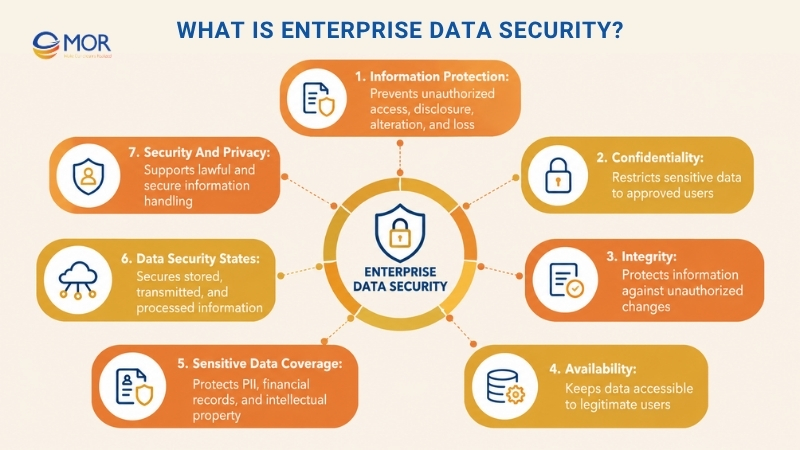
An enterprise security program protects many types of information, including personally identifiable information (PII), intellectual property, financial records, employee files, and confidential business documents.
Protection must cover three data states. Data at rest sits in storage systems, data in transit moves between systems, and data in use is being processed by applications or users. Each state brings different security needs.
Enterprise data security also connects with broader cybersecurity practices. Network security protects communication paths and infrastructure, and enterprise data security focuses on the information those systems store and process. Data privacy governs the lawful and appropriate use of personal information, while security controls help protect it.
Why Is Enterprise Data Security Important?
Large organizations rely on data to run daily operations, serve customers, and make business decisions. One security incident can interrupt these activities, expose private records, and create lasting financial problems.
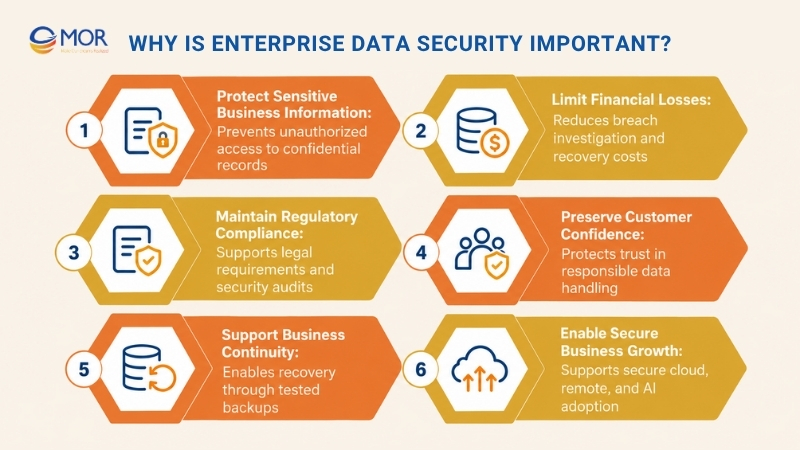
A strong enterprise data security strategy supports several business goals:
- Protect sensitive business information: Keep customer records, financial documents, internal plans, and intellectual property away from unauthorized users. Proper access controls also limit accidental exposure between departments.
- Limit financial losses: Data breaches create costs related to investigation, system recovery, business interruption, and legal claims. Early detection and containment help control the damage.
- Maintain regulatory compliance: Protect personal, healthcare, and payment data according to applicable laws and industry standards. Documented security controls also support audits.
- Preserve customer confidence: Customers and business partners expect responsible data handling. Security failures can weaken relationships and affect future contracts.
- Support business continuity: Keep essential information available during ransomware incidents, system failures, and other disruptions. Tested backups give teams a safer recovery path.
- Enable secure business growth: Support cloud migration, remote collaboration, and AI projects without losing visibility over sensitive data or access permissions.
Good security planning also gives teams clearer responsibility for the information they manage. This becomes increasingly useful as business systems grow and more departments share the same data.
How Does Enterprise Data Security Work?
Enterprise data security applies different controls throughout the information lifecycle. A single security product can't protect every stage, so organizations combine data governance, access management, encryption, and monitoring.
Data lifecycle stage | Security objectives | Core protective measures |
Data creation and collection | Limit unnecessary sensitive information | Data minimization, classification policies |
Data storage | Prevent unauthorized access and exposure | Encryption, IAM, storage security |
Data processing and use | Restrict unauthorized operations | RBAC, least privilege, data masking |
Data sharing and transfer | Control information movement | DLP, secure APIs, TLS |
Data retention and archiving | Protect records throughout their retention period | Retention policies, encrypted backups |
Data deletion and disposal | Prevent exposure of discarded information | Secure deletion, verified disposal |
Data discovery connects these stages. Security teams identify where information resides, assign sensitivity levels, and determine the protection each dataset needs. A public product catalog, for instance, requires different access rules than employee payroll records.
Monitoring continues throughout the lifecycle. Access logs record user activity, security tools flag unusual behavior, and incident response procedures guide teams when a threat appears.
Modern protection also follows a data-centric model. The NIST Zero Trust Architecture recommends evaluating access to individual resources instead of trusting users simply because they're connected to an internal network.
This approach fits organizations that operate across office networks, cloud services, and remote locations. Your security policies follow the information and its users rather than depending entirely on network boundaries.
What Threatens Enterprise Data Security Today?
Enterprise data often passes through systems that different teams own and manage. Security gaps can appear when an organization lacks a clear view of those systems or applies inconsistent controls.
The main enterprise data security risks involve technical weaknesses, human actions, and external access.
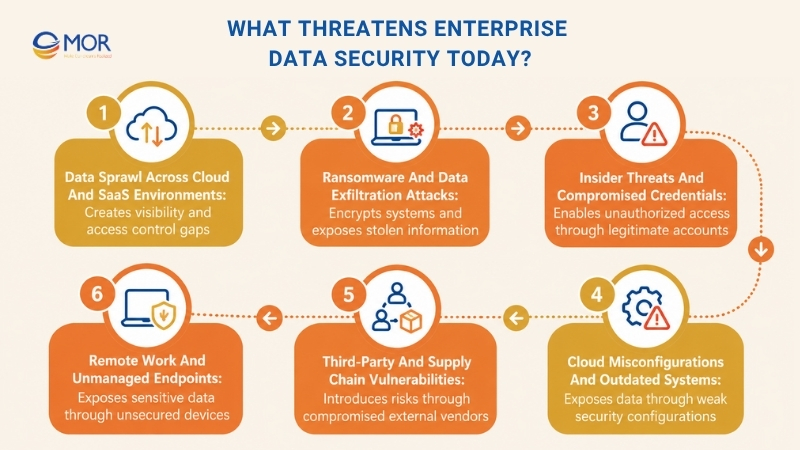
Data Sprawl Across Cloud and SaaS Environments
Sensitive information can spread across AWS storage, Microsoft 365, shared drives, collaboration tools, and unapproved applications. Security teams may struggle to identify every copy, its owner, and the users allowed to access it.
This problem becomes harder when companies operate several cloud environments. A documented hybrid cloud strategy helps teams map where information lives and which controls apply across different systems.
The choice between on premise software vs cloud also changes who manages infrastructure, storage, and access settings.
Ransomware and Data Exfiltration Attacks
Ransomware can encrypt important files, stop business applications, and disrupt access to company records. Attackers may also steal information before locking systems and threaten to publish it unless they receive payment.
Backups support recovery, but stolen data creates a separate problem. Security teams must detect suspicious transfers early and prepare procedures for containment, restoration, and breach reporting.
Insider Threats and Compromised Credentials
Employees and contractors sometimes expose information through incorrect permissions, unsafe file sharing, or phishing attacks. Malicious insiders may also copy confidential records for personal gain.
Compromised credentials make these incidents harder to identify because attackers can appear to be legitimate users. Access reviews and activity monitoring help teams notice behavior that doesn't match an account's normal responsibilities.
Cloud Misconfigurations and Outdated Systems
Incorrect storage permissions can expose sensitive databases or files to unauthorized users. Weak identity policies, public-facing services, and unsecured APIs create similar problems.
Older enterprise applications introduce another concern. Some lack modern authentication options or depend on software that no longer receives security updates. These weaknesses require careful assessment before teams connect legacy systems to newer platforms.
Third-Party and Supply Chain Vulnerabilities
External vendors often receive access to internal applications, customer information, or connected services. A compromised supplier can become an entry point into a larger enterprise system.
Verizon's 2026 Data Breach Investigations Report found that third parties were involved in 48% of breaches in its dataset, following a 60% increase in third-party involvement from the prior year.
Vendor reviews must address data permissions, API security, incident reporting, and contractual responsibilities. Organizations planning external engineering work should also assess the risks of outsourcing software development.
Remote Work and Unmanaged Endpoints
Remote employees access enterprise systems through laptops, smartphones, and home networks. Personal devices may lack company-approved protection, leaving sensitive files exposed when devices are lost or compromised.
Security teams need controls that protect business information without requiring access to unrelated personal content. Device policies, secure application access, and the practices covered in mobile apps and security all support this goal.
Core Pillars of Enterprise Data Security
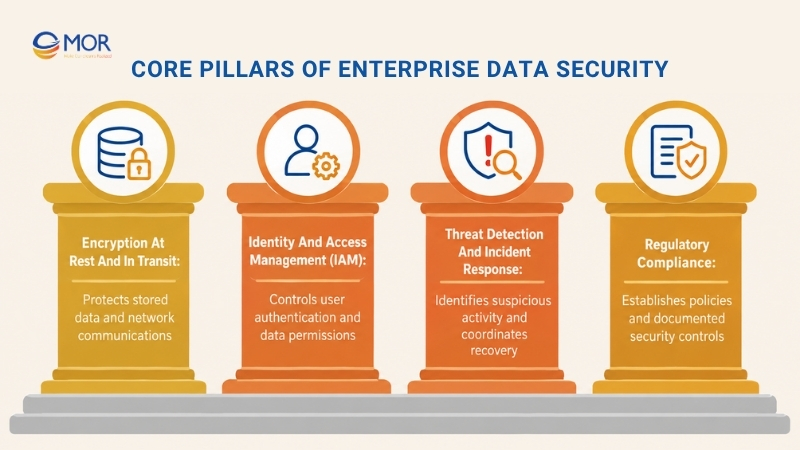
Four main pillars support enterprise data security across applications, databases, cloud systems, and internal networks. They address different parts of the security process and work together to protect business information.
Encryption at Rest and in Transit
Encryption converts readable information into a protected form that unauthorized parties can't easily interpret. Organizations apply it to databases, storage volumes, backups, and files on employee devices.
Encryption in transit protects information moving between systems. Transport Layer Security (TLS) secures communication between web applications, APIs, and other network services when configured correctly.
Encryption also depends on key management. If attackers obtain valid encryption keys, they may gain access to protected information. Enterprises should store keys securely, restrict access, and establish appropriate rotation procedures.
The 2026 Thales Data Threat Report found that organizations classified an average of 51% of their cloud data as sensitive, yet encrypted only 47% of that sensitive information.
Identity and Access Management (IAM)
Identity and Access Management controls who can reach enterprise information and what actions they can perform. IAM systems handle authentication, permissions, account management, and user access reviews.
Role-based access control (RBAC) grants access according to job responsibilities. Multi-factor authentication (MFA) adds another verification step, and least-privilege policies limit permissions to necessary business tasks.
Access rights also need regular reviews. Employees change positions, contractors finish projects, and service accounts become inactive. Outdated permissions can leave sensitive records available to people who no longer need them.
Organizations researching identity management with blockchain should assess it against their existing IAM needs, identity standards, and operational requirements.
Threat Detection and Incident Response
Threat detection tools monitor systems for suspicious access, unusual transfers, and signs of compromise. Security Information and Event Management (SIEM) collects and correlates events, and Endpoint Detection and Response (EDR) helps teams investigate threats involving devices.
Detection must connect to a clear response plan. Security teams need procedures for reviewing alerts, isolating affected systems, protecting evidence, and restoring services.
Regular incident exercises help teams confirm that their procedures work. They also identify gaps in escalation, communication, and recovery responsibilities before a real attack occurs.
Regulatory Compliance
Data protection laws and security standards shape how organizations collect, store, share, and maintain business information. Requirements depend on the data involved, the company's activities, and the jurisdictions where it operates.
Security policies should define data ownership, access approval, retention periods, and incident reporting responsibilities. Audit logs and documented controls provide evidence that teams follow these rules.
Compliance also requires regular review. New applications, cloud migrations, vendor relationships, and regulatory updates can change an organization's obligations.
How to Build an Enterprise Data Security Roadmap
A useful way to decide how to secure enterprise data is to assess what your organization owns, where the biggest risks exist, and which controls already work. The roadmap should turn those findings into clear tasks and measurable results.
Implementation phase | Key activities | Expected deliverable |
Assess the current environment | Review data assets, access rights, security tools, and infrastructure weaknesses | Security baseline |
Identify high-priority risks | Assess information sensitivity, business exposure, and compliance needs | Prioritized risk register |
Establish security governance | Define data owners, access policies, retention rules, and responsibilities | Data security policy |
Implement priority controls | Address missing protections and correct weak configurations | Risk-based security improvements |
Connect monitoring and response | Integrate security logs, alerts, recovery plans, and response procedures | Coordinated security operations |
Measure and improve | Review access findings, incidents, control coverage, and recovery results | Continuous improvement plan |
The NIST Cybersecurity Framework 2.0 provides a useful structure for this work. Its six functions are Govern, Identify, Protect, Detect, Respond, and Recover.
An enterprise data security framework should also identify accountable owners. IT teams may manage systems, but business departments must approve how their information is classified, accessed, and retained.
Start with assets that would cause the greatest harm if exposed or lost. Customer databases, financial records, and systems supporting daily operations commonly deserve early attention. Teams can address lower-risk environments after resolving the most serious gaps.
Measure progress through a small set of useful indicators:
- Sensitive-data discovery coverage across approved systems
- Open findings involving excessive access permissions
- Time needed to resolve high-risk security weaknesses
- Completion rates for scheduled access reviews
- Backup restoration success and tested recovery times
An enterprise data security platform can support asset discovery, policy monitoring, and reporting, depending on its capabilities. Organizations evaluating end to end cybersecurity solutions should confirm that their tools connect with existing applications and address documented risks.
A roadmap works best when each task has an owner, deadline, and acceptance criteria. Regular reviews keep the plan aligned with system changes and business priorities.
Which Compliance Standards Apply to Enterprise Data Security?
Enterprise data security requirements vary across industries and locations. Some organizations must follow specific laws, while others adopt recognized standards to manage security risk or meet customer expectations.
Regulation or standard | Relevant organizations | Data security focus |
GDPR | Organizations subject to EU data protection law | Personal data security, accountability, and lawful processing |
HIPAA | Covered US healthcare entities and business associates | Safeguards for protected health information |
PCI DSS | Organizations handling payment card data | Protection of cardholder information |
ISO/IEC 27001 | Organizations establishing an information security management system | Risk assessment, security controls, and ongoing improvement |
SOC 2 | Service organizations seeking independent assurance | Assessment of controls against applicable Trust Services Criteria |
NIST CSF 2.0 | Organizations adopting voluntary cybersecurity guidance | Security governance, identification, protection, detection, response, and recovery |
These requirements often overlap around data access, security monitoring, and recordkeeping. A well-maintained data inventory helps teams determine which rules apply to particular datasets.
Audit trails document who accessed information and which changes occurred. Policy records, risk assessments, and control tests also support security reviews.
Organizations should distinguish legal obligations from voluntary standards. ISO/IEC 27001 certification or a SOC 2 report can provide useful assurance, but neither automatically proves compliance with every privacy law.
9 Enterprise Data Security Best Practices
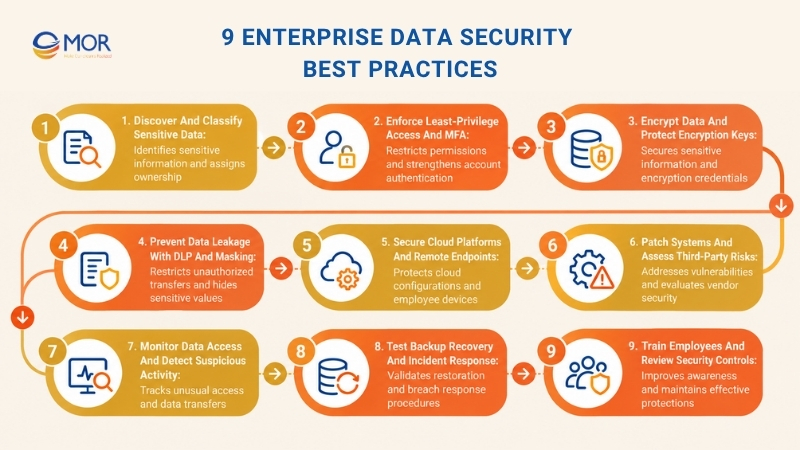
Effective enterprise data security depends on everyday controls that employees and technical teams can apply consistently. The following practices address common weaknesses and help organizations protect enterprise data across their systems.
Discover and Classify Sensitive Data
Start by locating information across databases, file shares, cloud storage, and SaaS platforms. Security teams need a reliable inventory before they can decide which records require stronger protection.
- Data discovery: Scan approved systems for structured and unstructured information. Record data locations, storage owners, and connected applications.
- Sensitivity classification: Label information according to business risk and legal obligations. Separate public material from confidential and restricted records.
- Data ownership: Assign accountable business owners who approve access and retention decisions. Keep ownership records current as systems change.
Enforce Least-Privilege Access and MFA
Employees should access the information required for their assigned work. Wide permissions increase the damage that a stolen account or mistaken action can cause.
- Role-based access control: Create permission groups based on job duties. Keep administrative privileges separate from everyday user accounts.
- Multi-factor authentication: Apply MFA to sensitive applications, remote access, and privileged accounts. Prefer phishing-resistant methods where supported.
- Permission reviews: Remove unused accounts and outdated rights. Review access when staff change roles or leave the organization.
Encrypt Data and Protect Encryption Keys
Encryption provides protection when attackers gain access to storage or intercept communication. The protection depends on suitable algorithms, secure configurations, and control over keys.
- Encryption at rest: Apply encryption to databases, storage systems, endpoint drives, and backups according to data sensitivity.
- Encryption in transit: Use properly configured TLS for network connections, external integrations, and application APIs.
- Key management: Restrict key access, maintain recovery procedures, and review rotation policies. Avoid storing encryption keys alongside the data they protect.
Prevent Data Leakage With DLP and Masking
Sensitive information often leaves approved systems through email, file uploads, or application exports. Data Loss Prevention (DLP) tools help identify and restrict transfers that break company policy.
- DLP controls: Monitor sensitive data movement across supported endpoints, email systems, and cloud services.
- Data masking: Replace private values in development, testing, or reporting environments when teams don't need the original records.
- Tokenization: Substitute sensitive identifiers with tokens and keep the original values in a protected system.
Among enterprise data security solutions, DLP works best when policies use accurate data classifications and clearly defined business exceptions.
Secure Cloud Platforms and Remote Endpoints
Cloud services and employee devices require separate checks because configuration errors can expose information without a direct attack against the main corporate network.
- Cloud configurations: Review storage permissions, public exposure, network rules, and administrative accounts.
- Endpoint protection: Maintain device encryption, endpoint monitoring, and approved software policies.
- Remote access: Apply identity verification and resource-level access rules to company applications used outside office networks.
Patch Systems and Assess Third-Party Risks
Attackers often target known software flaws and weak external connections. Vulnerability management should account for how exposed a system is and what information it handles.
- Vulnerability management: Scan systems, prioritize exploitable weaknesses, and confirm that fixes work.
- Software maintenance: Apply tested security updates to operating systems, libraries, and business applications. Teams using AI coding tools should also review vibe coding security before releasing generated code.
- Vendor reviews: Check data access, subcontractor arrangements, incident notification terms, and security evidence before approving integrations.
Monitor Data Access and Detect Suspicious Activity
Monitoring helps security teams identify events that normal access policies don't stop. Logs should capture meaningful activity without collecting unnecessary personal information.
- Security monitoring: Collect authentication, privileged access, configuration, and sensitive-data events.
- Anomaly detection: Flag unusual downloads, unfamiliar account activity, and unexpected transfers.
- Threat response: Connect alerts to investigation procedures and assign staff to review high-risk findings.
Test Backup Recovery and Incident Response
A backup only supports business recovery when teams can restore it successfully. Ransomware and destructive incidents make recovery testing especially valuable.
- Protected backups: Maintain isolated or immutable backup copies where appropriate.
- Recovery testing: Test restoration procedures against recovery time objectives (RTO) and recovery point objectives (RPO).
- Incident response: Document containment steps, internal contacts, legal reporting needs, and communication responsibilities.
Train Employees and Review Security Controls
Human mistakes continue to expose enterprise information. Training should match each employee's job and the systems they access.
Microsoft reported more than 145 million QR-code phishing attacks detected by Defender for Office 365 between July 2025 and June 2026 in its 2026 Digital Defense Report.
- Security awareness: Teach employees to recognize phishing attempts, unusual login requests, and unsafe sharing practices.
- Access reviews: Check sensitive permissions and investigate exceptions on a planned schedule.
- Continuous improvement: Update training and controls after incidents, audits, and changes to business systems.
Enterprise Data Security Use Cases Across Industries
Organizations face different security needs depending on the information they collect and how their teams use it. Healthcare providers, banks, retailers, and service companies must match their controls to business operations and applicable rules.
Industry or use case | Data security requirements | Relevant security measures |
Healthcare and patient records | Protect medical information and control access to health records | Encryption, RBAC, audit logging, secure APIs |
Banking and financial services | Secure financial transactions, account records, and payment details | MFA, encryption, transaction monitoring, access controls |
Retail and e-commerce | Protect customer details and payment information across online services | Tokenization, DLP, API security, access management |
Human resources management | Restrict access to employee files, payroll data, and confidential documents | RBAC, masking, access reviews, audit logs |
Hybrid cloud and SaaS environments | Maintain data visibility across distributed platforms | DSPM, IAM, cloud monitoring, encryption |
Third-party system integration | Control sensitive information shared between enterprise applications and partners | API authentication, TLS, least privilege, activity monitoring |
Healthcare systems often require careful controls over patient records and connections to medical devices. Banking platforms place greater emphasis on account access, transaction records, and suspicious financial activity.
Human resources applications face different exposure points. Payroll information, employee evaluations, and personal documents may be available to HR staff but should remain restricted to other departments.
The same principles apply across these sectors: classify information, assign permissions, monitor access, and prepare recovery procedures. The actual controls must reflect the system's risks and the rules that govern its data.
How to Secure Enterprise Data in AI-Powered Workflows
Generative AI applications, retrieval-augmented generation (RAG), and autonomous agents can access internal documents and business systems. Their ability to retrieve and process information creates additional risks when permissions, prompts, and connected tools lack proper controls.
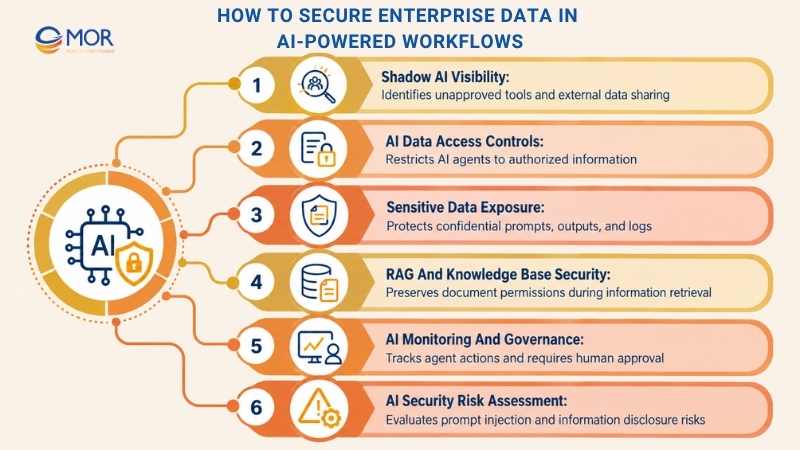
Security teams should assess these AI-specific exposure points:
- Shadow AI visibility: Identify unapproved AI applications and track which company datasets users send to external services. Establish approved tools and clear rules for sensitive information.
- AI data access controls: Apply identity checks and least-privilege permissions to copilots and agents. An enterprise data protection copilot should only retrieve records that its authorized user or service identity can access.
- Sensitive data exposure: Review how prompts, outputs, logs, and training pipelines handle private information. Mask or exclude confidential records when the task doesn't require them.
- RAG and knowledge base security: Preserve document-level permissions during retrieval. Search indexes and vector databases should respect the access rules applied to their source documents.
- AI monitoring and governance: Record relevant tool calls and data access events. Require human approval before agents perform sensitive actions, including transferring confidential files or changing permissions.
- AI security risk assessment: Follow the NIST AI Risk Management Framework and the OWASP Top 10 for LLM Applications when assessing prompt injection, sensitive information disclosure, and unsafe tool use.
Our articles on generative ai in cybersecurity and LLM vulnerabilities discuss related risks and defensive approaches.
Strengthen Enterprise Data Security with MOR Software
Disconnected applications, outdated systems, and sensitive data flows create security concerns during enterprise software projects. MOR Software JSC supports businesses through IT consulting, custom software development, system integration, and quality assurance services. Our teams work with organizations that need to build or modernize applications where secure data handling forms part of the technical requirements.
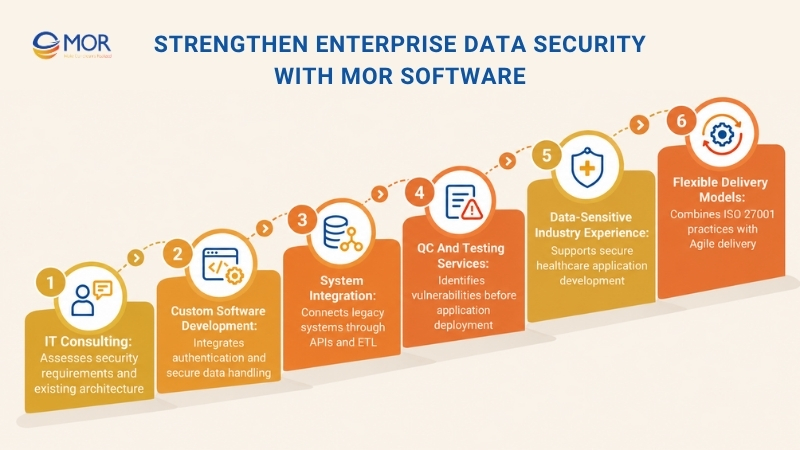
- Assess security needs through IT consulting: Our Business Analysis, Software Architecture Consulting, and Technology Consulting services help companies review existing systems, define requirements, and plan technical improvements. This is useful when legacy architecture or new integrations create concerns about data access and system reliability.
- Develop enterprise applications with security requirements in mind: MOR Software JSC builds custom web and enterprise applications using fastest programming languages including Java, .NET, Python, and ReactJS. Our development work can incorporate access permissions, authentication requirements, API controls, and protected data handling into the system design.
- Connect legacy systems and cloud platforms: We support enterprise integration and data migration through APIs and ETL workflows. In our Salesforce legacy system integration project, MOR Software connected a Japanese HRM company's existing time-attendance system to Salesforce using Apex, Lightning Web Components, AWS Lambda, and an API Gateway. The solution supported bidirectional data synchronization and more accurate record management.
- Test applications before deployment: Our QC & Testing Services cover security testing, functional testing, and performance testing. These processes help identify application weaknesses, verify expected behavior, and assess system reliability before release.
- Apply experience from data-sensitive industries: MOR developed the I-Medisync healthcare management system using Java Spring, ReactJS, and AWS. The project connected medical devices with patient and clinic management functions, automated billing, and incorporated security protocols for sensitive healthcare data.
- Choose a delivery model that fits the project: Our documented ISO/IEC 27001 information security management certification and Agile practices support structured software delivery. Businesses can work with us through project-based development or an Offshore Development Center (ODC) model for longer-term engineering needs.
These services suit organizations planning enterprise application modernization, cloud integration, healthcare software, or other projects involving confidential business information. Companies comparing top technology consulting firms can also review MOR Software's engineering experience and delivery options.
To discuss your architecture, data protection needs, and development plans, contact MOR Software for a project consultation.
Conclusion
Enterprise data security requires ongoing control over sensitive information, user permissions, encryption, and threat response. Start by identifying high-risk data, addressing access gaps, and testing security and recovery procedures regularly. MOR Software supports organizations building and modernizing applications that handle confidential business information.
If your project needs stronger data handling, secure integration, or technical planning, contact us at MOR Software to discuss a suitable development approach.
"Evolution is not a destination, it is a disciplined journey of innovation."
Phung Van Tu


CEO MOR AI
MOR SOFTWARE
Frequently Asked Questions (FAQs)
What Are the Three Principles of Enterprise Data Security?
The three principles are confidentiality, integrity, and availability. Confidentiality restricts unauthorized access, integrity protects information against improper changes, and availability keeps data accessible to approved users when business operations require it.
How Is Enterprise Data Security Different From Data Protection?
Enterprise data security focuses on preventing unauthorized access, disclosure, and alteration. Data protection has a broader scope that can include privacy, retention, backup, recovery, and lawful data handling. The two areas share many controls.
What Types of Enterprise Data Require the Strongest Security?
Sensitive personal information, patient records, financial details, authentication credentials, and intellectual property usually need stricter controls. Organizations should assess each dataset's sensitivity, legal obligations, and potential harm before assigning its protection level.
What Is Data Security Posture Management (DSPM)?
Data Security Posture Management identifies sensitive information across enterprise environments and assesses its exposure. DSPM tools help security teams locate risky permissions, unprotected records, and configuration weaknesses, particularly across cloud storage and connected data services.
Is Encryption Enough to Secure Enterprise Information?
No. Encryption protects data against unauthorized reading under certain conditions, but stolen credentials or exposed keys can weaken that protection. Organizations also need access controls, monitoring, secure configurations, backups, and incident response procedures.
How Does Zero Trust Support Enterprise Data Security?
Zero Trust requires users and devices to meet access conditions before reaching protected resources. It limits implicit trust based on network location and supports stronger identity checks, least-privilege permissions, and resource-level security policies.
What Security Tools Should a Growing Enterprise Prioritize?
Start with asset discovery, MFA, reliable backups, endpoint protection, and access management. Add centralized monitoring, DLP, or DSPM according to documented exposure risks. Tool selection should reflect existing infrastructure, business needs, and available security staff.
How Often Should Enterprises Audit Data Security?
Audit frequency depends on business risk, regulations, and system changes. Organizations should monitor important events continuously and schedule formal reviews at suitable intervals. Major infrastructure changes and security incidents may require additional assessments.
How Can Organizations Protect Data Accessed by AI Agents?
Assign AI agents restricted identities, apply source-document permissions, and monitor their tool activity. Sensitive actions should require approval when appropriate. Teams must also examine how prompts, outputs, logs, and connected services handle confidential information.
How Can Companies Measure Enterprise Data Security Effectiveness?
Track sensitive-data coverage, excessive permissions, unresolved vulnerabilities, detection and response times, and backup restoration results. Regular testing and risk reviews help teams determine whether controls work and where further improvements are needed.
Share


Make Our-Dreams Realized


© 2023 . MOR Software. All Rights Reserved
Sitemap
Privacy Policy
Terms of Use

Rate this article
0
over 5.0 based on 0 reviews
Your rating on this news:
Name
*Email
*Write your comment
*Send your comment
1