


Vibe Coding Security: Vulnerabilities, Risks, And Best Practices
AI tools can turn a prompt into a working app fast, but speed can hide weak access rules, leaked keys, and unsafe logic. Vibe coding security helps teams protect AI-generated code before it reaches real users and production data. This MOR Software guide will walk you through the main vibe coding security risks, real failures, and safe AI-generated code security practices.
Key Takeaways
- Vibe coding security starts with treating AI-written code as untrusted until it passes review, testing, dependency checks, access control checks, and production readiness review.
- The main risks include remote code execution, XSS, SQL injection, memory corruption, secrets exposure, data leakage, software supply chain risk, broken authentication and authorization, weak input validation outside SQL, poor logging and monitoring, loose production configuration, and business logic flaws.
- Enterprise teams face higher risk because AI-built apps may touch live databases, regulated data, internal tools, customer records, and long-term systems that need ownership, audit trails, and clear governance.
What Is Vibe Coding Security?
Vibe coding lets teams create software with plain language prompts. You explain what the app needs to do, then an LLM or coding assistant builds the code, logic, interface, APIs, database setup, or even the full product. The process feels quick because an idea can turn into a working prototype in a short time.
Vibe coding security means the reviews, controls, and safe habits used to protect AI-written code before it is merged or released. A good vibe coding security framework includes code checks, access rules, secret management, dependency review, database policies, testing, and release controls.
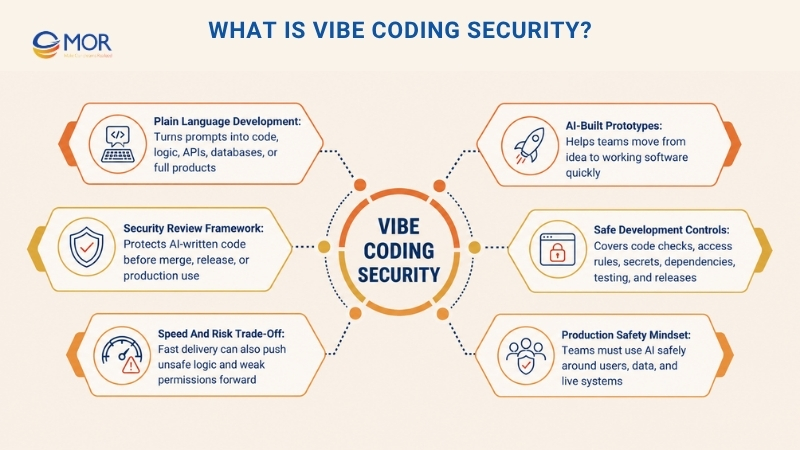
The trade-off is easy to see. Vibe coding can speed up software delivery, but it can also push unsafe logic, weak permissions, leaked credentials, and risky packages into a project faster. Teams do not need to ask whether they should use this development method. They need to ask how to use it safely when live users, private data, and production systems are part of the build.
Why Vibe Coding Security Becomes Hard In Real Software Projects
Vibe coding becomes risky because these tools are built for speed, not full production readiness. They can create a working prototype in minutes, but real software needs to be protected, reviewed, and supported for the long run.
Code Written By AI may behave correctly while still carrying hidden flaws. A generated SQL query can show the right test result but still leave room for injection attacks. An API connection may pass a demo but write private keys into logs. Since the app runs, it gives a false sense of safety. The weakness usually stays out of sight until the system fails or gets abused.
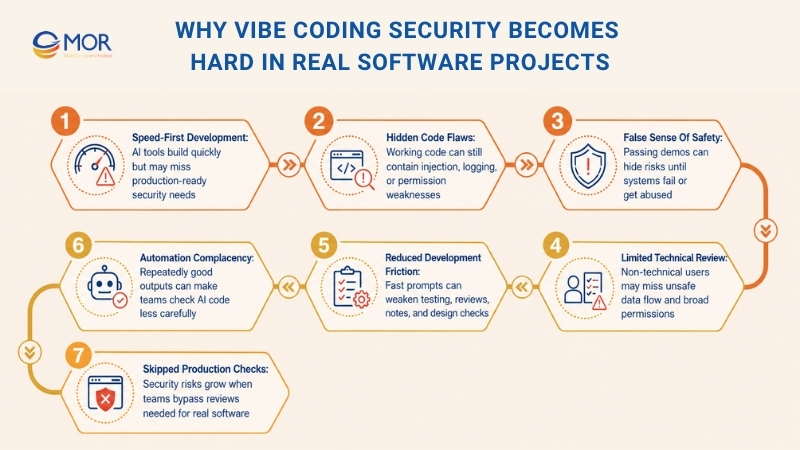
Non-technical users often miss these problems because they do not know how to spot injection bugs, broad permissions, or unsafe data flow in generated code.
But developers are not free from this risk either. Even skilled machine learning engineers can ship weaker code when they depend too much on AI code generator tools, not because every output is poor, but because speed cuts down time for review and careful thought.
When a prompt can rebuild a whole app, teams may feel less pressure to inspect every change. Normal software work has friction, including tests, reviews, notes, and design checks. Vibe coding removes much of that friction. Yet that friction exists for a reason. It is where many mistakes get caught.
There is also a known human behavior called automation complacency. When a tool gives good answers again and again, people begin to check it less. They trust the output because it worked before. That trust makes it easier to miss what the tool got wrong.
The speed of vibe coding turns into a weakness when teams start skipping the checks that production software needs, which is where the security risks of vibe coding become real.
What Current Data Says About AI-Generated Code Risk
Current research on vibe coding security points to one steady pattern: AI-written code often carries vibe coding security vulnerabilities at rates teams should not ignore.
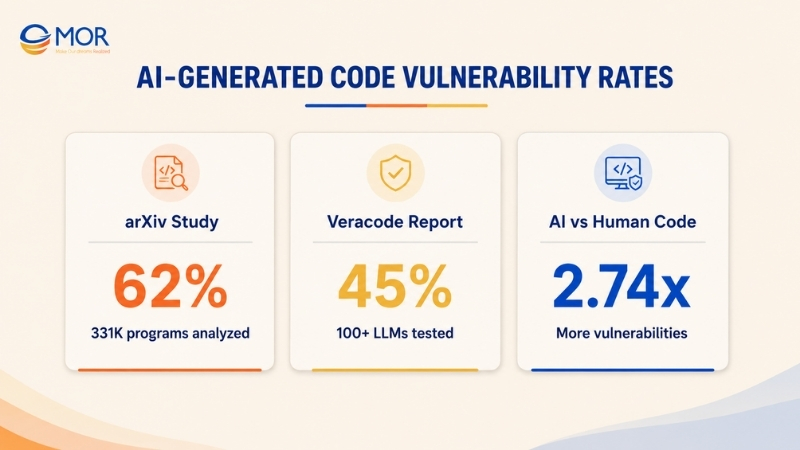
A broad study in Empirical Software Engineering compared major LLMs by reviewing 331,000 generated C programs from models such as GPT-4o-mini, Gemini Pro, and Code Llama. The finding was sharp: at least 62% of those programs had security flaws found through formal checks.
Veracode’s 2025 GenAI Code Security Report reviewed more than 100 LLMs across 80 coding tasks and found that 45% of generated code created OWASP Top 10 issues. Java showed the highest risk with a 72% failure rate, while Python and JavaScript sat between 38% and 45%.
Studies often place insecure AI-written code between 40% and 62%, and AI-created code has been found to produce flaws at 2.74 times the rate of human-written code.
This concern has now reached major security bodies. OWASP added a separate category to its 2025 Top 10, naming vibe coding as a risk pattern that software teams must manage.
The risk is scaling quickly. In 2026, AI creates 46% of all new code on GitHub, with forecasts pointing to 60% by the end of the year.
What Are Some Vibe Coding Security Risks?
Vibe coding moves at high speed, so the mistakes can change just as fast. These are eleven vibe coding security risks you may face when you trust AI-created code without proper review.
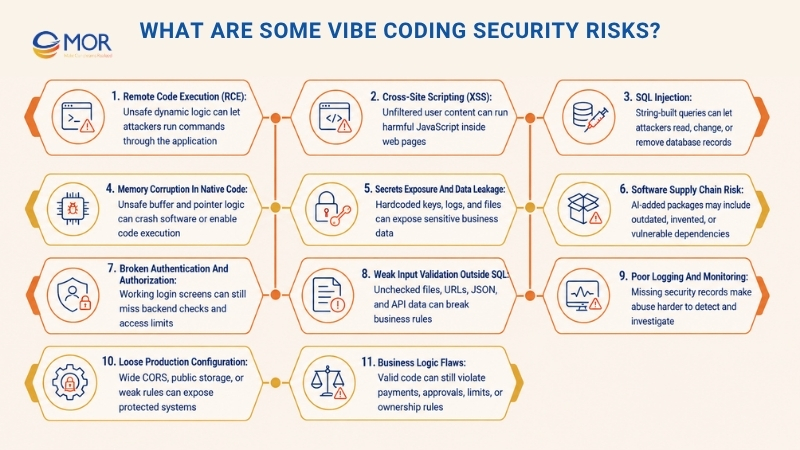
Remote Code Execution (RCE)
Remote Code Execution (RCE) allows an attacker to run commands through your application. AI coding assistants often suggest quick but unsafe patterns, including dynamic evaluation or unsafe handling of untrusted data. The generated code may look fine in a demo. Once a harmful payload reaches production, that quick shortcut can become a direct path into your system. An attacker may run commands on your server, container, or build runner, which can open the door to wider damage inside the business.
Cross-Site Scripting (XSS)
Cross-Site Scripting (XSS) happens when untrusted content is shown in a page without proper encoding and then runs as JavaScript. In AI-assisted coding workflow automation, generated UI logic and event handlers often miss consistent output filtering. A template that seems safe during testing can turn dangerous when real user input passes through it, leading to stolen sessions or harmful redirects.
SQL Injection
SQL injection occurs when user input changes the way a backend database query runs. AI coding assistants often create query logic with string joining instead of prepared statements or parameterized queries. For vibe coding security, this is risky because the code may compile, return data, and still be unsafe. A crafted input from an attacker can change the query during runtime, then read, alter, or remove data.
Memory Corruption In Native Code
Memory corruption issues, including buffer overflow and use-after-free bugs, can crash software and allow code execution in C/C++ or foreign function interface (FFI) paths. AI-generated code may create pointer logic or buffer handling that works with clean test data, but a malformed file or network packet with odd length values can corrupt memory, crash the process, or hand control to an attacker.
Secrets Exposure And Data Leakage
Secrets leak when private values appear in places they should never reach, including repositories, build output, or logs. These vibe coding security issues often involve hardcoded passwords, API keys pushed in .env files, or tokens printed during debugging. When an AI assistant adds debug logs to fix a problem, it can expose sensitive data without warning. The app may still work during development, but the damage grows as more systems, people, and environments can see the exposed values.
Software Supply Chain Risk
Each outside package adds risk to your application. That risk may come from old components with known CVEs, libraries that were patched after the model’s training cutoff, or packages the AI simply invented.
To make code run fast, AI often adds packages you did not choose or review. It may also bring in long dependency chains that carry their own flaws. Your app can still start and pass a demo, yet unsafe code may already sit inside its package tree. Some AI-suggested packages do not exist in public registries, which gives attackers a chance to publish those names with harmful code, a tactic known as slopsquatting.
Broken Authentication And Authorization
Broken authentication appears when an app fails to confirm a user’s identity or allowed actions. In AI-built apps, login code may look complete at first but still miss backend checks, session time limits, password reset safety, or rate limits. For vibe coding security, that gap matters because a working login page is not the same as a protected system. After launch, attackers can abuse weak checks, replay leaked tokens, or view records that belong to other users.
Weak Input Validation Outside SQL
Input validation problems are not limited to database queries. AI-written code may take form data, uploaded files, API requests, URLs, or JSON bodies without checking type, size, format, or purpose. During development, that can feel useful because nearly any input seems to work. But the same freedom becomes risky when bad input reaches backend logic, storage, or outside services. One unchecked field may break business rules, trigger odd file behavior, cause server-side request forgery, or start unsafe data handling.
Poor Logging And Monitoring
Poor logging means the app does not record enough security activity for teams to spot abuse. AI-generated apps often focus on making the function work, not on tracking failed logins, access changes, strange API calls, or unusual usage. So the app may stay exposed for weeks with no clear warning. Worse, AI may create messy debug logs that leak sensitive data but still fail to give a useful trail during a real incident.
Loose Production Configuration
Loose production settings often appear when developers relax rules to fix a problem fast. In vibe coding, AI may suggest wide CORS access, public storage buckets, open database reads, disabled security checks, weak Supabase RLS, or unsafe Firebase rules. The app works again, so the fix feels right. Behind the scenes, users, scripts, or outside domains may now reach data and services they should never touch.
Business Logic Flaws
Business logic flaws appear when code runs correctly but breaks the rules your company depends on. AI-generated code may approve a refund without checking order status, accept a negative payment, ignore usage limits, or let users perform tasks that should need manager approval. Basic tests may still pass because the syntax is valid and the normal path works.
This risk is hard to catch because scanners may miss it. The flaw lives inside the business rule, not only the code shape. For vibe-coded apps, teams need to test payment steps, role rules, limits, approvals, and account ownership with real business cases before release. If they skip that work, a working function can quietly turn into an expensive security hole.
Real-World Vibe Coding Security Failures
Vibe coding security becomes easier to understand when AI-generated code leaves the prototype stage and reaches production. In many cases, the product looks fine to users, but weak controls remain under the surface.
The same theme appears in vibe coding security reddit threads and public write-ups. These failures are often simple, not highly complex. They include leaked keys, weak login controls, unsafe data flow, missing checks, and open database rules.
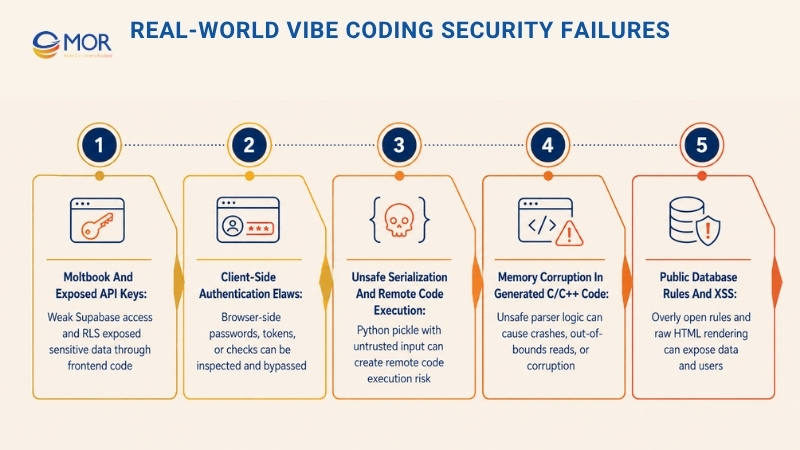
Moltbook And Exposed API Keys
Moltbook is a strong example of how security can fail when vibe-coded software moves too quickly. The platform was built fast with AI coding tools, but its Supabase setup exposed sensitive access through frontend code. The bigger problem was not only the exposed key. Missing or weak Row Level Security should have limited what the database allowed.
This case shows why a working app should never be treated as a safe app. AI-generated code can connect a frontend to a database and make the function behave as expected. Yet private data may become public when access rules are not checked. A simple release-readiness review could have found the issue before the product went live.
Client-Side Authentication Flaws
Another common failure is placing login checks inside the browser. Wiz found cases where passwords, tokens, or access checks lived inside client-side JavaScript. Users can inspect frontend code, so this makes the login process easy to read, change, or bypass.
This happens because AI productivity tools can create browser-side authentication quickly, and it is easy to show in a demo. Real authentication needs a trusted backend server. The frontend should collect credentials and send them safely. It should not hold the hidden logic that decides who can enter the app.
Unsafe Serialization And Remote Code Execution
Databricks reported a serious case from a vibe-coded multiplayer game. The game appeared to work, but the generated network code used Python’s pickle module to move game data. That created a remote code execution risk because pickle is unsafe when it reads untrusted input.
Vibe coding security can fail here because the feature looks normal. Players can join, send data, and use the game with no clear sign of danger. But a harmful serialized object may cause the app to run unwanted code. A safer build would use JSON, strict message checks, size limits, and clear validation before accepting network data.
Memory Corruption In Generated C/C++ Code
Databricks also tested AI-created C/C++ code after asking ChatGPT to build a parser for the GGUF binary format. The parser seemed usable, but it relied on unsafe memory logic, unchecked buffer reads, and pointer work based on untrusted file data.
This is a serious concern in memory-unsafe languages. A test file may look fine, but a malformed file can cause crashes, out-of-bounds reads, or memory corruption. Low-level vibe coding output should be reviewed, fuzz-tested, and checked against secure coding rules before it reaches production.
Public Database Rules And XSS
Towards Data Science points to two simple patterns that can cause real damage. First, AI agents framework may respond to a Supabase or Firebase “permission denied” error by opening database rules too far. The app starts working, but the database may become public.
Second, AI may tell developers to render raw HTML in a React app when showing AI-created content. That can create XSS risk if the output is not cleaned. These mistakes happen because AI tends to solve for speed and visible function. Every vibe-coded app still needs input checks, least privilege access, safe database rules, and output cleaning before release.
Most failures in this area can be avoided. A checklist, code review, automated scan, and configuration review can catch leaked keys, weak auth, unsafe serialization, public database rules, and XSS before they become live incidents.
Why Vibe Coding Security Risk Increase In Enterprises Environments
Enterprise systems make every weakness in vibe-coded apps more serious. More users, larger data sets, and stricter rules mean one flaw can do far more damage. Even the most secure vibe coding platforms for enterprise teams still need access control, review, and governance around the way teams build.
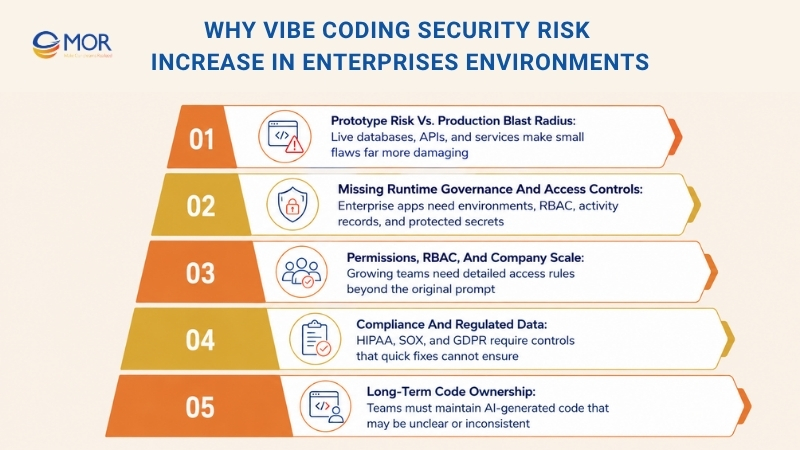
Prototype Risk Vs. Production Blast Radius
Hobby apps and internal enterprise tools carry very different levels of risk. A prototype that shows fake data has one kind of limit. An admin tool connected to customer records has a much larger one.
Production data changes everything. When a vibe-coded app connects to live databases, APIs, and services, any flaw can spread much farther. A SQL injection issue in a local demo has a small blast radius. The same flaw in a tool linked to your production Postgres database can become a breach waiting to happen.
Missing Runtime Governance And Access Controls
Enterprise teams need strong access rules, but many vibe coding tools lack governed runtime controls or treat them as optional. Traditional app platforms usually give teams:
- Separated environments so development changes do not touch live data by accident
- Role-based access rules to control who can view, change, or release apps
- Activity records to show who viewed which data and when
- Protected secret storage to keep credentials out of source code
Without these controls, AI-built apps may connect straight to production, place secrets in readable variables, or leave data access with no useful logs. Secure vibe coding needs these controls before the app reaches real users.
Permissions, RBAC, And Company Scale
Permissions and RBAC matter more as a company grows. An app made for one team may later move to another group with different access needs. Vibe-coded applications usually do not include detailed permission rules unless those needs were written into the prompt from the start.
Compliance And Regulated Data
Regulated data makes these risks impossible to ignore. If your software handles healthcare records under HIPAA, finance data under SOX, or personal data under GDPR, vibe coding security must include access control, audit trails, and safe data handling. Vibe-coded apps created without those needs will not become compliant through small fixes. They often need deeper architecture changes.
Long-Term Code Ownership
Long-term ownership is another enterprise risk. Code written today still needs to be read, changed, and fixed by engineers next month or next year. AI-generated code may have weak comments, odd patterns, or logic that does not match your team’s normal stack. When the app breaks, the team may need to debug code that no one fully understands.
How To Improve Vibe Coding Security In Practice
Companies do not have to choose between AI speed and safe software work. Vibe coding security works best when teams use guardrails that match how developers already build. A vibe coding security prompt can ask for safer patterns, but prompts alone cannot replace review, testing, and release control.
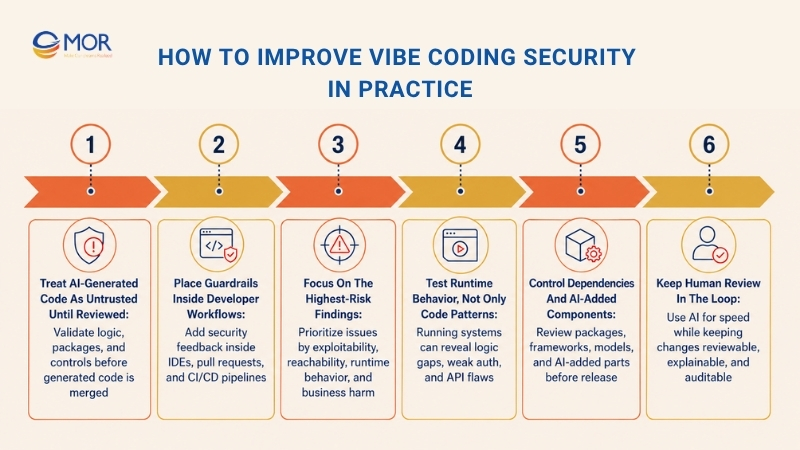
Treat AI-Generated Code As Untrusted Until Reviewed
Every AI-created change needs validation before it is merged. Teams should inspect the generated logic, review packages, and confirm that security controls still work in real use. A simple vibe coding security check before merge can stop many unsafe changes from moving forward.
Place Guardrails Inside Developer Workflows
Security works better when it appears where developers already spend time. Teams should receive security feedback inside the IDE, pull request, and CI/CD pipeline, not through separate tools that slow down the handoff.
Focus On The Highest-Risk Findings
Heavy AI-assisted development can create too many alerts. Teams need to rank findings based on exploitability, reachability, runtime behavior, business harm, and policy fit. That helps them spend time on the issues that lower real risk.
Test Runtime Behavior, Not Only Code Patterns
Static checks are useful, but they do not show the full story. Vibe coding security also needs runtime testing because AI-written code can create logic gaps, weak authentication, and API flaws that only appear when the app runs under real conditions.
Control Dependencies And AI-Added Components
AI-generated code security also depends on the packages, frameworks, models, and AI-related parts that coding tools add. Teams need clear visibility and rules for what can ship, so risky components do not enter production without review.
Keep Human Review In The Loop
AI can help teams triage and fix issues faster, but production changes must stay reviewable, explainable, and auditable. Strong security programs use AI to move faster without giving up control.
How Teams Can Mitigate Vibe Coding Security Risks
You can lower risk in vibe-coded work when you treat AI-written code with the same care as any production code. A vibe coding security assessment gives teams a clear view of what the code does, where it runs, and what data it can reach.
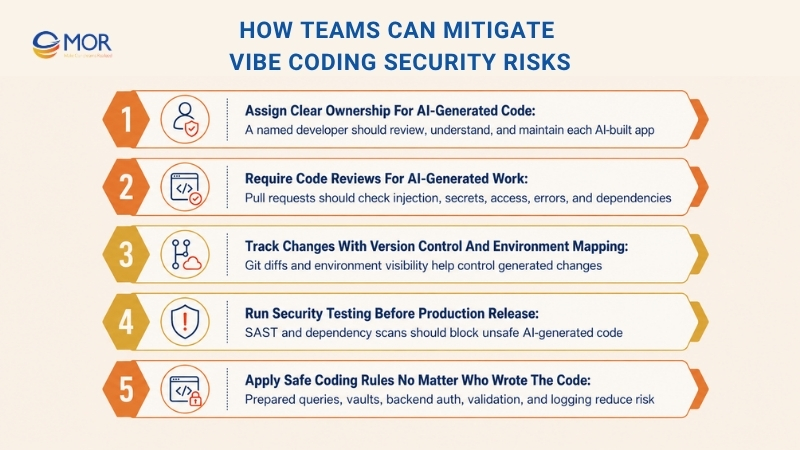
Assign Clear Ownership For AI-Generated Code
A named team member must understand, review, and maintain the code AI creates. When no one owns the code, no one owns the risk. Assign a developer to inspect each AI-generated app before it touches production systems or live data.
Require Code Reviews For AI-Generated Work
Pull requests help catch bugs, design gaps, and security flaws. AI-created code should go through the same review path. A vibe coding security audit should check for:
- Database injection and input validation gaps
- Hardcoded secrets or exposed API keys
- Access rules that are too broad
- Missing error handling
- Unsafe third-party packages
Track Changes With Version Control And Environment Mapping
Each version of an AI-built app should be stored in Git or a similar version control tool. Changes made between prompts should appear as clear diffs. This makes it easier to see what changed, undo bad updates, and understand how the codebase grew.
Environment mapping matters too. Teams need a clear view of development, staging, and production so they know where AI-generated code runs, what data it can access, and which version is live. Without that view, generated changes may reach production by mistake, or teams may lose track of which environment holds which build.
Run Security Testing Before Production Release
Static analysis tools like Snyk, dependency scanners, and SAST tools should check AI-generated code just like human-written code. Vibe coding security requires a simple rule: if the code fails security checks, it does not ship.
Apply Safe Coding Rules No Matter Who Wrote The Code
This means:
- Prepared queries instead of string-based query building
- Secrets in vaults instead of source code
- Backend-level authentication and authorization
- Input checks for all user-controlled data
- Security logging and monitoring for risky events
All these steps add back some friction that vibe coding removes. Production software needs that friction. The aim is not to make vibe coding slow. The aim is to keep speed from becoming a security cost.
Build Fast With Strong Vibe Coding Security
As AI-generated code becomes more widespread, vibe coding security risks will continue to increase. The data is hard to ignore: 40% to 62% of AI code contains flaws, CVE entries linked to AI tools are rising each month, and real AI use cases like Moltbook show what happens when teams skip security review. Founders do not need to avoid AI tools. They need engineering support that can catch what those tools miss.
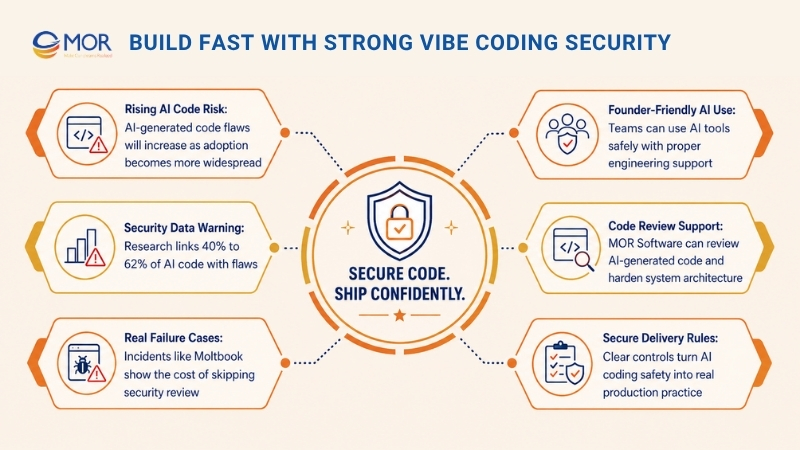
MOR Software can act as a vibe coding security vendor for teams that want AI speed without weak production control. Our engineers can review AI-generated code, harden architecture, test edge cases, and set clear delivery rules across web, mobile, cloud, and AI projects. That turns secure AI coding practices into real work, not a checklist teams read after damage is done.
Conclusion
Vibe coding can help teams build faster, but speed means little if the code leaks data, skips access checks, or breaks business rules. Strong vibe coding security needs code review, testing, dependency control, runtime checks, and human ownership before release. MOR Software helps businesses review, harden, and rebuild AI-generated applications for real production use. Contact MOR Software to turn fast AI-built ideas into safer, business-ready software.
"Evolution is not a destination, it is a disciplined journey of innovation."
Phung Van Tu


CEO MOR AI
MOR SOFTWARE
Frequently Asked Questions (FAQs)
What is vibe coding security?
Vibe coding security means reviewing, testing, and controlling AI-generated code before it reaches real users or production systems. It covers code quality, access control, secrets handling, database rules, dependency checks, and runtime behavior.
Is vibe coding safe for production software?
Vibe coding can support production work, but only when teams add proper review and testing. AI-generated code should never move straight from prompt to deployment without human review, security scanning, and staging checks.
What are the most common risks in vibe-coded apps?
Common risks include exposed API keys, weak authentication, SQL injection, cross-site scripting, unsafe dependencies, public database rules, and poor input validation. Many of these issues happen because AI focuses on making code run fast.
Why does AI-generated code often contain security flaws?
AI coding tools learn from large code datasets, which may include insecure patterns. They may also choose the shortest working answer instead of the safest design, especially when the prompt does not mention security rules.
Can non-developers safely use vibe coding tools?
Non-developers can use vibe coding tools for prototypes, mockups, and simple internal experiments. For apps that store user data, process payments, or connect to production systems, they should involve experienced developers before launch.
How can teams review AI-generated code?
Teams should check authentication, authorization, input validation, database access, API calls, logs, dependencies, and secrets. Code reviews should also confirm that the app works safely under real user behavior, not just clean test cases.
Do better prompts make vibe coding safer?
Better prompts help, but they do not replace review. A good prompt should tell the AI to avoid hardcoded secrets, validate all inputs, use server-side authentication, apply least privilege, and follow secure coding practices.
What tools help detect security issues in AI-generated code?
Useful tools include SAST scanners, dependency scanners, secret detection tools, code review platforms, runtime testing tools, and CI/CD security checks. These tools help catch issues before they reach production.
What should teams check before deploying a vibe-coded app?
Teams should test access control, database permissions, API security, environment variables, third-party packages, logging, error handling, and production configuration. A staging review is a must before real data is connected.
How can companies improve vibe coding security over time?
Companies can set clear AI coding rules, require pull request reviews, track all changes in version control, scan every build, and train teams on common AI-generated security risks. The goal is to keep AI speed without losing engineering control.
Share


Make Our-Dreams Realized


© 2023 . MOR Software. All Rights Reserved
Sitemap
Privacy Policy
Terms of Use

Rate this article
0
over 5.0 based on 0 reviews
Your rating on this news:
Name
*Email
*Write your comment
*Send your comment
1