


Global Payroll Management: The Complete Guide for Businesses 2026
Global payroll management gets harder when teams grow across borders. Different tax rules, currencies, benefits, payroll data, and provider models can turn payday into a messy monthly task. In this guide, MOR Software will explore how businesses can set up payroll operations, compare global payroll providers, and choose the right model for 2026.
Key Takeaways
- Global payroll management helps businesses pay international teams correctly while meeting local tax, labor, reporting, and data rules.
- Companies can run payroll in-house, outsource it, or use a hybrid model based on headcount, country coverage, and internal payroll skills.
- The right payroll outsourcing firm should match your hiring plan, support local compliance, protect employee data, and connect well with HR systems.
What Are Global Payroll Management?
Global payroll management means managing employee pay, payroll taxes, and compliance duties for staff working in different countries. This guide to global payroll management helps businesses see how pay rules change when teams work across borders.
Unlike domestic payroll, global payroll operations must deal with local employment laws, tax systems, currency shifts, and reporting rules. Local payroll often follows one fixed process, but payroll management across multiple regions needs a country-by-country setup.
Key Aspects Of Global Payroll Management
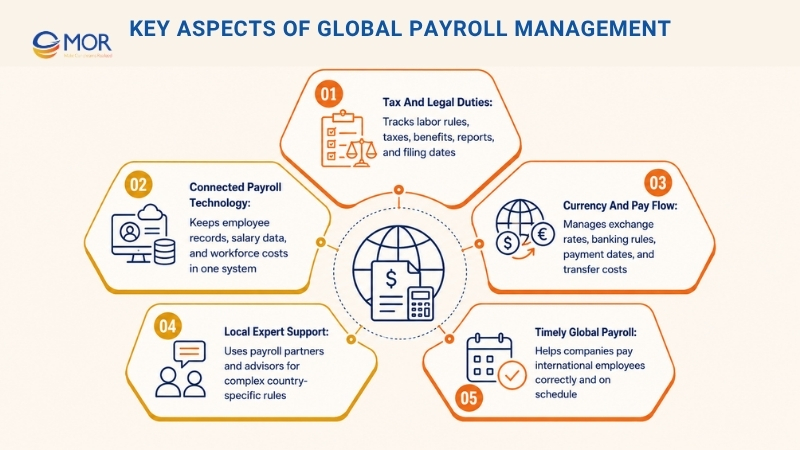
Global payroll management includes many connected tasks. A business may pay workers in five markets, yet every market has its own tax rules, labor laws, pay dates, currencies, and reporting needs. A strong setup turns these separate duties into one clear system.
Tax And Legal Duties
Where an employee works shapes how payroll must run. Companies have to monitor local labor rules, income tax, social security, benefits, required reports, and filing dates. One missed step can cause fines, payment delays, or trust problems with employees.
Connected Payroll Technology
Payroll teams need one system for employee records, salary data, tax information, benefits, and global workforce costs. A global payroll platform helps HR and finance teams review data faster, catch issues sooner, and avoid scattered spreadsheets across countries.
Currency And Pay Flow
International payroll also involves paying employees in different currencies. Businesses have to handle exchange rates, local banking rules, payment dates, and cross-border transfer costs. This area can become hard to control once teams grow across regions.
Local Expert Support
HRMS payroll software can cover many repeat tasks, but country rules can still be hard to read. Companies often use global payroll resources, in-country payroll partners, legal advisors, or Employer of Record providers to manage local details that software may not catch.
Good payroll operations across countries give companies a clearer way to pay global teams on time. This process also helps protect the business from tax mistakes, compliance gaps, and late payroll as headcount grows in new markets.
Main Benefits Of Global Payroll Management
Investing in global payroll management can support several parts of your business operations, especially when companies use global managed payroll to control cost, compliance, and employee pay across markets.
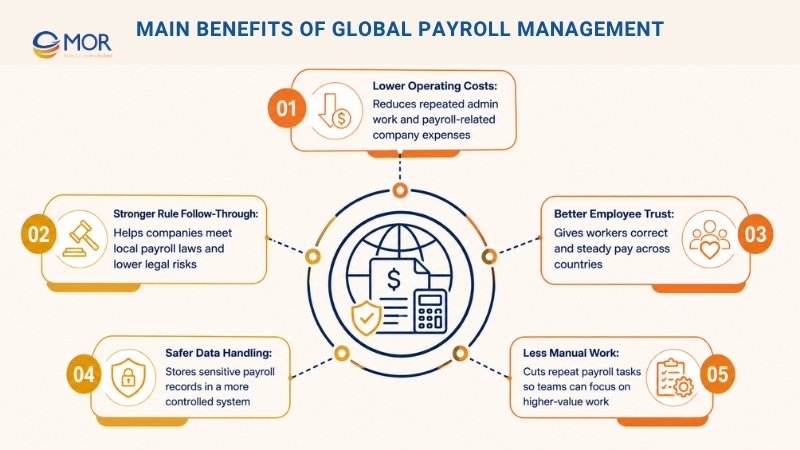
- Lower Operating Costs: Global payroll tools can make the whole process easier to manage, which helps reduce company expenses and cut repeated admin work.
- Stronger Rule Follow-Through: Meeting local laws and payroll rules helps businesses lower legal exposure and avoid compliance problems.
- Better Employee Trust: A global payroll setup helps employees receive correct and steady pay, no matter where they work, which builds trust and confidence.
- Safer Data Handling: Keeping global payroll inside one platform or system lowers the risk of data leaks and improves protection for sensitive records.
- Less Manual Work: A central payroll setup also reduces time spent on repeat payroll tasks and gives company teams more room for other work.
How To Build A Global Payroll Management Setup
Hiring employees legally and setting up global payroll management can take time, planning, and different types of expertise.
The easiest ways to manage global payroll start with these 10 steps, which companies should follow in each country where they plan to hire employees:
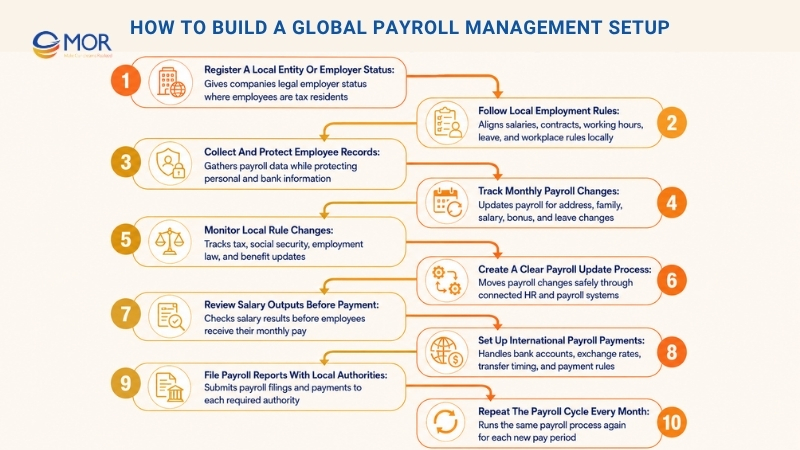
Register A Local Entity Or Employer Status
Your company must have employer status in the country where each employee is treated as a tax resident. This usually means working with a lawyer and an accountant.
In some EU countries, one business entity may support employment across several member states, as long as you register with the right tax and social security bodies.
In countries like Ireland and the UK, income tax and social security are handled through the same authority, such as The Revenue Commissioners and HMRC. In countries like Italy, Spain, and Portugal, two separate authorities may be involved, which makes monthly filings and notices harder to manage.
Employer social security costs also differ greatly by country. In South Africa, employers do not pay this charge, while many EU countries average around 21.2%, and France is often around 45% on average.
Follow Local Employment Rules
Every country has local regulations that apply as soon as you hire someone who is a tax resident there. Many of these rules affect payroll directly: salaries must match minimum wage rules, contracts need the right terms, and working hours plus paid leave must be set out properly.
There are also country rules for health and safety, workplace accidents, absence, and sick leave. These items can change the final payroll numbers each month.
Local payroll partners often have fixed ways of working, so you should learn early how they operate and whether their process matches your team’s needs.
Collect And Protect Employee Records
Before paying employees, you need to gather their information, including name, address, family status, social security number or local ID, date of birth, and bank details.
You also need details on required deductions, including payroll taxes, pay rate, pay cycle, normal earnings, overtime if needed, salary plans, bonus plans, commission plans, and benefits like pension payments, health insurance costs, and benefits-in-kind.
Good data protection practices include keeping personal records in one safe place, limiting duplicate files, and avoiding paper copies when possible. You also need to make sure personal data for EU citizens follows the General Data Protection Regulation (GDPR).
Track Monthly Payroll Changes
You must watch for changes in employee details and keep payroll records current. Employees may move home, change family status, have children, get a salary raise, switch between part-time and full-time work, receive bonuses, or add relatives to insurance plans.
Employees may also take sick leave or unpaid time off. All these updates can change that month’s pay.
Each country has local rules that apply from the moment you employ a tax resident there.
Monitor Local Rule Changes
Governments often adjust employment laws, and many updates happen when a new tax year begins. This means global payroll management system must track changes in every country where you hire staff and reflect updates, such as tax or social security rate changes, in the payroll setup.
Do not assume every country uses the same tax year. In the UK and many other places, the tax year runs from April to March, but Brazil follows the calendar year, and Australia runs from July to June.
You should also watch for sudden force majeure updates. The pandemic showed how fast governments can change support and benefit systems, but smaller local events can also shift country rules quickly.
Create A Clear Payroll Update Process
The way updates move to your payroll provider matters a lot. Many smaller firms still send payroll changes through email, which is a clumsy and unsafe method that raises the chance of mistakes. A better setup stores data in platforms and HR systems that can connect with payroll provider systems.
Whatever HR system you select, the best case is that it updates payroll data on its own. That gives the person in charge of payroll a much easier way to check whether the final output is right.
Review Salary Outputs Before Payment
Reviewing salary output for every employee in every country needs an internal check from someone on your payroll team. There are two common ways to do this:
- Match this month’s salary against the amount produced in the previous month.
- Build a sheet showing expected net pay from the employee’s gross salary, then compare that number with the payroll system result.
These checks should not show major gaps. If they do, a mistake may have happened, or a change may have been missed, such as a bonus. This review helps you find errors early and fix them before employees receive pay.
To make sure payments reach employee accounts on time, your company also needs a treasury process.
You may know payroll well in your home country, but that knowledge may not help much when hiring in a faraway market you do not know well.
Set Up International Payroll Payments
Begin with bank account needs. In theory, your company may pay an overseas salary from its current bank account, but some countries, including Denmark, require a local account for tax and social insurance payments. Even when it is not required, a local bank account can make local payroll and accounting easier.
You also need to think about exchange rate movement, which can change the amount your employee finally receives. Cross border payroll solutions like Wise, formerly TransferWise, can lower this risk by letting employers send a fixed amount in their own currency, but international transfers can still take time. Plan for a few days of processing, and check local bank holidays and cut-off times because they can delay transfers.
File Payroll Reports With Local Authorities
After payroll is complete, you must work with tax authorities, local offices, and other bodies that receive filings for your employees. You need to submit online information showing how much was taken from the employee’s gross salary and how much belongs to each authority. These bodies may collect the money in different ways, often through direct debit. Your company must have enough funds in the bank account when they collect it.
In the past, companies often paid withholding tax and social contributions monthly, then combined them in one yearly return. Now, more countries use real-time reporting. Once payroll closes, you may need to send an electronic filing with the required details. As with global employment in general, each country can ask for a different level of detail.
Repeat The Payroll Cycle Every Month
Once those steps are done, one monthly payroll cycle ends. Then the next month arrives, and the same process starts again.
>>> Let's highlight the top 10 most common payroll errors and share how to avoid them.
Core Responsibilities In Global Payroll Management
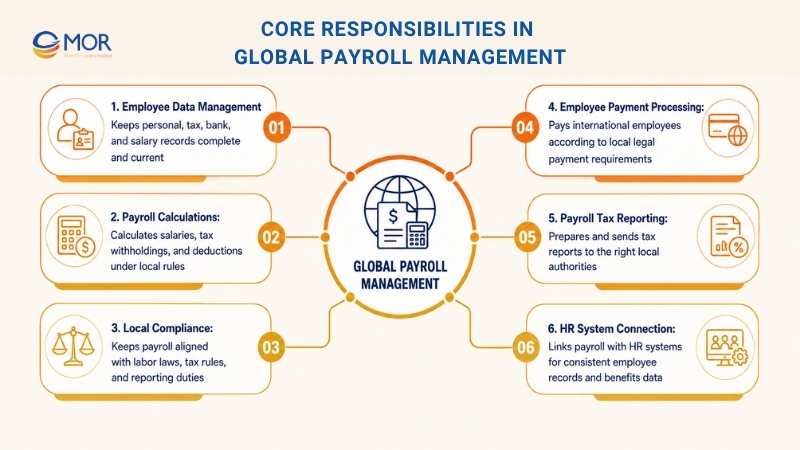
In plain terms, global payroll management should make sure employees are paid on time and in the right amount, no matter where they work, while also meeting local legal rules. This part gives a clear look at the main duties that sit inside global pay administration.
Employee Data Management
A key duty in global payroll processing is keeping employee records complete and current, including personal details, pay information, bank records, and tax data. Accurate records give payroll teams the base they need to run pay correctly.
Payroll Calculations
Payroll teams also need to calculate salaries, tax withholdings, and many types of payroll deductions correctly. These calculations must match local rates and country-level payroll rules.
Local Compliance
Global payroll management must keep every payroll step aligned with labor laws, tax rules, and reporting duties in each country where employees are based. Companies that process payroll outside local legal rules may face legal problems.
Employee Payment Processing
Global payroll also covers payments to employees working in other countries. An international payroll solution should match employee payment needs with the legal payment rules in each work location.
Payroll Tax Reporting
Payroll work also includes preparing and sending tax reports to the right authorities in each operating country. For correct tax reporting, companies need to follow the right forms, formats, and deadlines.
HR System Connection
Global payroll should connect with company HR systems so employee records stay consistent and easy to share. This link supports work such as benefits management, employee records, and related HR tasks.
Global Payroll Management Models Companies Can Use
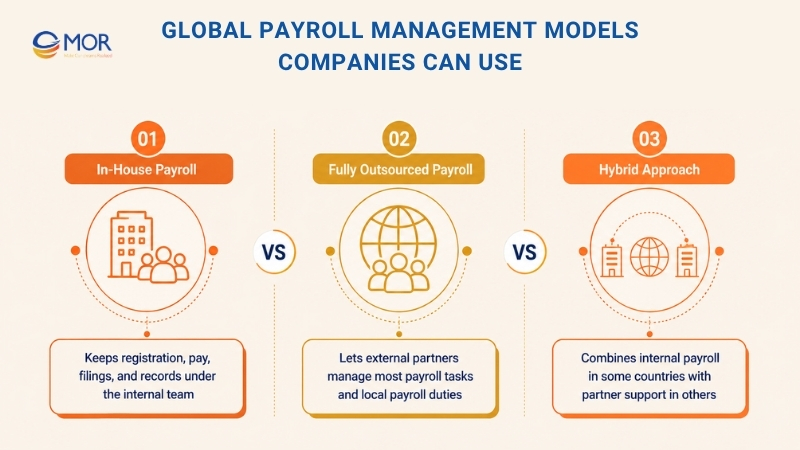
When companies decide who should run global payroll management, they usually choose from three main models, including managed global payroll, internal control, or a mixed setup:
In-House Payroll
Under the in-house model, your team manages everything from employee registration to monthly pay, filings, and payroll records. The first question is whether your team has enough local knowledge to manage each payroll step, including rules, deadlines, and reporting duties. You also need the right technical ability to connect, manage, and automate payroll data across several systems, like time tracking tools, benefits databases, and government portals.
The second point is whether your company should carry this work alone. For a small finance team growing across countries, in-house payroll can quickly take over too much time.
Fully Outsourced Payroll
External payroll partners can manage most key payroll tasks, so this model works well when your company lacks time, tools, or local payroll knowledge.
Fully outsourced payroll can ease the pressure of repeat monthly tasks, so your finance team does not face a heavy workload near every pay cycle. Still, your company remains responsible to employees and local authorities for correct and timely payroll. Most of all, you still need employer registration in every country where you employ people and must complete required tax filings for the business and staff.
A strong outsourcing setup depends on clear processes for sharing payroll data each month, so updates are sent early and clearly.
If you have chosen a skilled payroll partner, they can guide you on local market changes and rules that may affect your team. Still, multi country payroll outsourcing needs close coordination, so it is worth building a solid working relationship with your provider.
Hybrid Approach
Some companies do not want to hand over every monthly payroll duty, so they choose a hybrid setup. They may manage payroll internally in some countries, such as their home market, and use partners in others, such as new countries with only a few remote employees.
This model often suits fast-growing companies that keep entering new markets. Outside payroll partners can support expansion, and once headcount grows in one country, the company may decide to manage that payroll internally again.
>>> Let's highlight 10 top-rated HR outsourcing services in Vietnam for 2026, so you can find the one that fits your needs best.
Should Companies Outsource Global Payroll Management?
Every company has its own team structure, payroll needs, and growth plan, so there is no single correct answer for when or how to outsource. The main point is that outsourcing reduces heavy work, but it also means giving up some direct control over payroll operations. You need to trust every payroll partner that handles your data and pay process, especially when using managed global payroll services.
Let’s Start With The Clear-Cut Cases
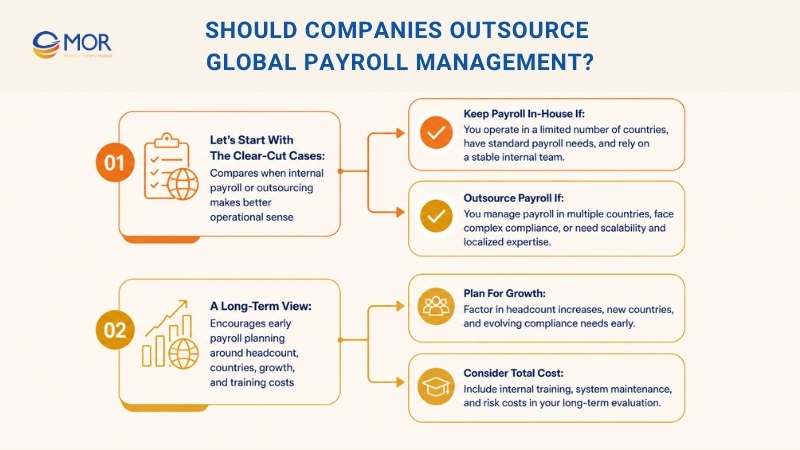
As a general rule, if your company has 250+ employees in one country, building an internal payroll team often makes more sense, especially when you already have a strong finance and accounting team. It can cost less and be easier to manage than keeping an outside partner updated on every detail for every employee.
In contrast, entering a new country for the first time takes serious effort because you need local knowledge to hire legally and pay employees every month. Outsourcing is often the better choice in this case, and a good payroll partner can grow with you as your in-country team expands.
Some cases sit outside this rule. Countries like the UK and Ireland have enough similarities that a company running payroll in one may find it easier to manage the other, even with employer registration and local payroll setup work.
If you choose outsourcing, the next decision is whether you should later bring payroll back inside the company. Each business is different, but once a company reaches 80+ employees in one country, internal payroll often starts to make sense from a cost and operation view.
A Long-Term View
Payroll may not always sit high on the list when companies plan growth and set future priorities. Yet it is smart to think about payroll early and build a clear plan for global pay administration.
These questions can help you get global managed payroll planning right:
- How many employees do you pay now, and across how many countries?
- How might your headcount change over the next 1-3 years?
- What does your global growth plan look like, and are you open to remote hires in countries where you do not yet operate?
- How much can you spend on payroll experts and their ongoing training?
Top Global Payroll Management Providers To Compare
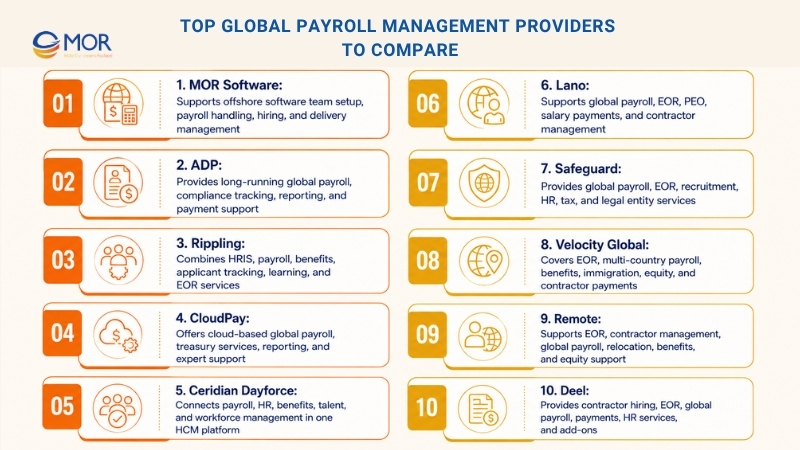
Choosing a provider for global payroll management depends on your country coverage, hiring model, payroll risks, and internal team capacity. The global payroll providers below support different needs, from software team setup to enterprise payroll, EOR, contractor payments, and workforce management.
Provider | Best Fit | Core Strengths | Possible Limits | Pricing Style |
MOR Software | Companies building offshore software teams in Vietnam or Asia | Recruitment support, payroll handling, team setup, delivery management, and software outsourcing | Not a standalone global payroll SaaS for every country | Custom pricing based on team size and project scope |
ADP | Large enterprises that need mature global payroll support | Long market history, compliance tracking, reporting, and payment support | Long onboarding and older technology in some areas | Not publicly disclosed |
Rippling | Companies wanting HR, IT, finance, and payroll in one system | Strong integrations, fast payroll payments, and wide workforce tools | Limited stand-alone options and compliance support | PEPM pricing for HR, IT, and integrations |
CloudPay | Enterprises needing payroll and treasury support | Cloud payroll, treasury services, reporting, and local currency funding | Large projects may take longer to launch | Not publicly disclosed |
Ceridian Dayforce | Companies already using HCM systems | Payroll, HR, benefits, talent, and workforce management in one cloud app | Multi-country payroll is an add-on | PEPM subscription plus activation fee |
Lano | Businesses hiring abroad through payroll, EOR, or contractor models | Global salary payments, API support, and contractor management | Limited currency support and fewer security certifications | Published pricing for EOR, contractors, and payroll |
Safeguard | Companies needing payroll, EOR, and HR support across many countries | Broad country coverage, recruitment, payroll, tax, and HR services | Limited data access and slower ICP responses | Not publicly disclosed |
Velocity Global | Companies hiring across the US, Latin America, and other supported markets | EOR, multi-country payroll, benefits, immigration, and contractor payments | Limited analytics and strict payroll cut-off dates | Not publicly disclosed |
Remote | Distributed teams needing EOR, contractor, and payroll support | Public pricing, EOR services, contractor tools, relocation, and equity support | Ticket-based support and limited local provider choice | Public pricing for EOR, contractors, and payroll |
Deel | Companies hiring employees and contractors across many countries | Fast onboarding, many payment methods, EOR, contractor, and HR services | Fragmented payroll process and limited local payroll depth | Tiered pricing, some services not publicly disclosed |
MOR Software
MOR Software is a Vietnam software development outsourcing and offshore development partner that helps companies set up, grow, and manage technical teams across borders. For companies hiring software engineers in Vietnam or Asia, MOR Software can support the people, project, and operation side of team growth, including recruitment support, AI in payroll handling, team setup, and daily delivery management.
MOR Software fits companies that need more than payroll tools. Its offshore development model helps clients create dedicated software teams with project managers, business analysts, developers, QA, QC, BrSE, and Comtor roles across the software development lifecycle. MOR also supports team operations, including salary payment, new hiring, feedback collection, and team growth.
MOR Software’s key features
- Offshore software development center setup for dedicated software teams
- Recruitment and candidate screening based on client requirements
- Team operation support, including salary payment and new member hiring
- Flexible team composition across PM, BA, developers, QA, QC, BrSE, and Comtor roles
- Web, mobile, Salesforce, outsourcing, QC and testing, IT consulting, AI, custom blockchain software development, IoT, and digital transformation services
- Experience across HRM, healthcare, finance, banking, telco, eCommerce, manufacturing, and logistics projects
- Office presence in Vietnam and Japan, including Ho Chi Minh, Ha Noi, Da Nang, Tokyo, and Osaka
MOR Software Strengths | MOR Software Limits |
Strong fit for companies building offshore software teams in Vietnam | Not a standalone global payroll SaaS platform |
Supports recruitment, payroll, and team operation for dedicated teams | Best for tech talent and software delivery, not general employee payroll in every country |
Flexible team setup across software development, testing, project management, and bridge roles | Companies that need payroll coverage in 100+ countries may still need a global payroll provider |
Wide service range across web, mobile, Salesforce, outsourcing, QC, testing, and IT consulting | Pricing usually needs a custom discussion based on team size and project scope |
Proven delivery work across 850+ projects and clients in 10+ nations | Less suitable for businesses that only want payroll processing without software team support |
Vietnam and Japan office network supports cross-border work | Requires clear scope and communication to build the right team |
Useful for companies that want one partner for tech talent, delivery control, and offshore operations |
|
ADP
ADP is a global payroll company with around 70 years in the market, which makes it one of the longest-running names in the space. Its services cover payroll data, compliance tracking, and payment support.
ADP does not share public pricing, but Forrester data from 2020 lists the following implementation and ongoing cost examples for a composite company:
ADP GlobalView Payroll: average 4,500 employees per country, $300K per country setup fee, and $3.55 PEPM on a processing basis.
ADP Celergo: average 150 employees per country, $12.5K per country setup fee, $495 PCPM, and $18 PEPM on a fully managed basis.
Key features:
- Global payroll
- Compliance monitoring
- Global reporting and analytics
- Employee self-service portal
- Time and attendance
- Payment support services
ADP Strengths | ADP Limits |
70+ years of market experience | Limited customer support access |
Strong self-service online community | Older technology in some areas |
| Long and complex onboarding process |
Rippling
Rippling is an HRIS company that provides payroll management, benefits administration, applicant tracking, learning management, and EOR services.
The company first focused on the US market, then launched its global workforce management product in late 2022.
For pricing, Rippling often charges $20-27 per employee per month for core HR tools, plus $5-10 PEPM for IT tools. Integration fees can range from US$ 2 to US$ 49 PEPM, depending on the app being connected.
The base price does not include the HR Help Desk module, which costs extra.
Key features:
- HR operations, such as payroll, EOR, talent acquisition, and benefits
- Financial operations, such as corporate cards and expense management
- IT operations, such as onboarding and offboarding
Rippling Strengths | Rippling Limits |
Quick global payroll payments | No integrations with HRIS/HCM platforms |
Many integrations with accounting, EMS, and ERP software | Hard to choose stand-alone services |
| No international payment licenses |
| Limited international compliance support |
CloudPay
CloudPay provides global payroll and treasury services. Its services run through one cloud-based system and cover around 130 countries.
CloudPay does not publish pricing, but global payroll contracts usually include a PEPM license fee, a country payslip fee, a one-time setup fee, and an initial fixed term of 3-5 years.
Key features:
- Global payroll services
- Global treasury services
- Global payroll analytics and reporting
- Access to global payroll experts
CloudPay Strengths | CloudPay Limits |
Strong integration capabilities | No shared public knowledge base |
Funding options in several local currencies | Larger and more complex projects can take longer to launch |
| Payment processing is outsourced, which can reduce control and visibility |
Ceridian Dayforce
Ceridian is a human capital management company. Ceridian Dayforce provides an enterprise HCM that brings payroll, HR, benefits, talent, and contingent workforce management into one cloud application.
Dayforce uses a per-employee, per-month subscription model, plus a one-time activation fee and an initial fixed term of 3-5 years, followed by ongoing renewal. Global payroll management services are available as an add-on. PEPM rates depend on the selected products and number of platform users.
Key features:
- Payroll and taxes
- Workforce management
- Benefits enrollment and administration
- Talent management and intelligence
Ceridian Dayforce Strengths | Ceridian Dayforce Limits |
One cloud HCM platform for payroll, HR, benefits, talent, and workforce management | Uses third-party vendors for payroll payments, which may reduce visibility and control |
Integrated global time and attendance tools | Multi-country payroll is an add-on |
| Long setup and adoption time |
Lano
Lano is a global payroll and HR software provider that helps companies hire and manage workers outside their home country.
Its website lists these prices:
EOR: From 550€ per employee per month
Contractor management: From 20€ per employee per month
Multi-Country Payroll: From 300€ per month for 1-5 employees and 30€ per employee per month for more than 5 employees
Key features:
- EOR and PEO services
- Global salary payments
- API and integration capabilities
- Contractor management
Lano Strengths | Lano Limits |
Free invoicing platform | Limited currency support |
Strong integrations with recruitment and employment apps | Does not include HCM or payroll integrations |
| Limited security certifications |
Safeguard
Safeguard offers global payroll and EOR services in more than 100 countries. The company also launched ChatSG, a tool that combines OpenAI’s ChatGPT architecture with Safeguard’s own data to answer global employment questions.
Safeguard does not publish pricing.
Key features:
- Global recruitment services
- EOR services
- International and local payroll services
- People analytics
- HR services
- Legal entity setup
- Outsourced accounting services
- Tax services
Safeguard Strengths | Safeguard Limits |
Strong access to customer support | No contractor solutions |
Wide country coverage | Limited data access |
| Long payment reconciliation |
| Slow responses from ICPs |
Velocity Global
Velocity Global (VG) is a global employment and payroll company with operations in the US and Latin America.
VG does not publish pricing, though some clients say it is expensive.
Key features
- EOR
- Multicountry payroll
- Benefits, immigration, equity, workspaces
- Payments through ACH or wire, not sold as a stand-alone service
- Agent of record for contractor hiring
- Contractor payments
VG Strengths | VG Limits |
Owned entities in several countries | Limited analytics tools |
Integrated time and attendance tracking with PTO | Tight payroll data deadlines and cut-off dates |
| No payroll re-runs |
| Limited global workforce platform tools |
Remote
Remote is a global workforce management platform that supports international EOR, contractor, and payroll services.
Remote lists these price points:
EOR: from US$ 599 PEPM
Contractor Management: from US$ 29 PCPM
Global payroll: $50 PEPM
Enterprise: price not shown publicly
Key features
- EOR services
- Contractor management
- Global payroll for countries where the company has entities
- Remote team relocation, where employees can move to one of 19 countries where Remote has
- entities
- Benefits administration
- Stock and equity support
Remote Limits | Remote Strengths |
Public pricing plans | Remote’s owned entity model gives client companies less choice over local providers |
Relocation support | Benefit administration is only offered for contractors and enterprise, not for global payroll |
| Customer support runs through tickets, which can slow the process |
| Some tools, services, and support levels are only for enterprise clients |
Deel
Deel operates as a global employment platform and HRIS integration provider. It supports contractor hiring, payments, EOR services, global payroll management, and HR services.
Its core service pricing is listed as follows:
EOR: Individual contracts start at $599, plus a one-month security deposit, and each contract is quoted separately.
Contractors: Standard starts at $49 USD PEPM. Premium costs an extra $50 USD PEPM.
Global Payroll: Not publicly listed. Pricing is tiered and depends on country, employee volume, number of payroll cycles, and needs like onboarding or offboarding.
Key features:
- EOR services
- Contractor services, including Standard, Premium with added misclassification protection, and Shield where Deel hires the worker
- Global Payroll, a managed payroll and payment service for global employees hired by the customer
- Add-on services, including benefits, immigration, background checks, equity, equipment, workspaces, and perks
Deel Strengths | Deel Limits |
Many payment methods and currency options | Fragmented global payroll process |
Fast onboarding for contractors, EORs, and global payroll | No dedicated CSM |
| Limited local payroll knowledge |
| Conflict of interest from several entities owned by Deel |
Best Practices For Global Payroll Management
Local payroll rules, working styles, and legal duties vary a lot from one country to another, and companies can run global payroll in several different ways.
No matter which model you choose, these best practices for managing global payroll can help you build a cleaner payroll process, support employees better, and stay aligned with local rules.
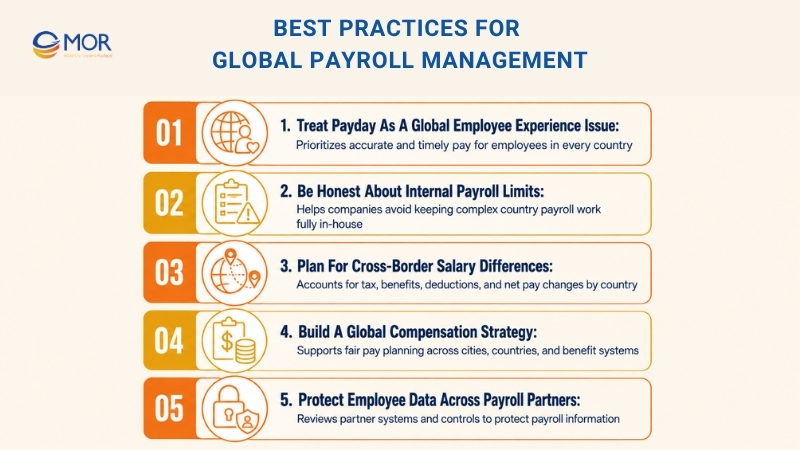
Treat Payday As A Global Employee Experience Issue
Employees pay close attention to payday. Many plan rent, bills, and family costs around it, so late or wrong pay can cause more than simple annoyance. Your local payroll may work well, but taking payroll across borders can bring new problems. Still, your people expect correct pay on time, wherever they work.
If you run payroll internally or work with a partner, employee experience should stay near the top of the list. Accuracy and timing must guide each payroll cycle.
Be Honest About Internal Payroll Limits
You may understand payroll well in your home market, but that skill may not carry over to a country on the other side of the globe.
Think carefully before keeping global payroll in-house. It usually takes more work than teams expect. If your company does not know local employment rules well, the workload can get out of hand quickly. Then you may rush to find a partner under pressure, instead of choosing one with care.
Plan For Cross-Border Salary Differences
The same gross pay can turn into very different net pay from country to country. Taxes, tax bands, allowances, benefits, contributions, and tax credits all change what employees and employers owe under global payroll management.
Cross-border salary planning is hard, as Global Payroll. It also creates a real payroll issue when employees move from one country to another.
A single British employee with no children, no mortgage, and a gross yearly salary of £50,000 may take home about £47,500 after tax. If that same employee moves to Ireland, her net pay may drop to about £34,900.
When your company hires people in different cities and countries for similar roles, remote pay becomes harder to set fairly.
Build A Global Compensation Strategy
When your company expands and hires people across many cities and countries for similar roles, remote compensation becomes harder to manage.
The issue is bigger than gross pay versus net pay. A salary may stretch much less in one of Europe’s most expensive cities than it would for someone working from a rural home. The best way to manage benefits in global payroll also depends on local benefit rules, since compensation may look weaker in a country with few required benefits, such as the US, compared with a country like Sweden.
Protect Employee Data Across Payroll Partners
If your company outsources payroll or uses a hybrid model, you need clear visibility across your partner network and strong controls for employee data.
Each payroll partner should be reviewed to confirm that its IT systems and data processes are strong enough, and that it protects local employee information properly. If this step is missed, your company and employees may face cyber attacks, data theft, legal costs, and financial losses after a breach.
You also need to understand how every payroll partner works. This matters even more when using a multi-country payroll partner. Does the provider have teams in every country it serves, or does it depend too much on outside partners? If outside partners are involved, you need to know how far employee data travels and whether it is stored and transferred safely.
Main Challenges In Global Payroll Management
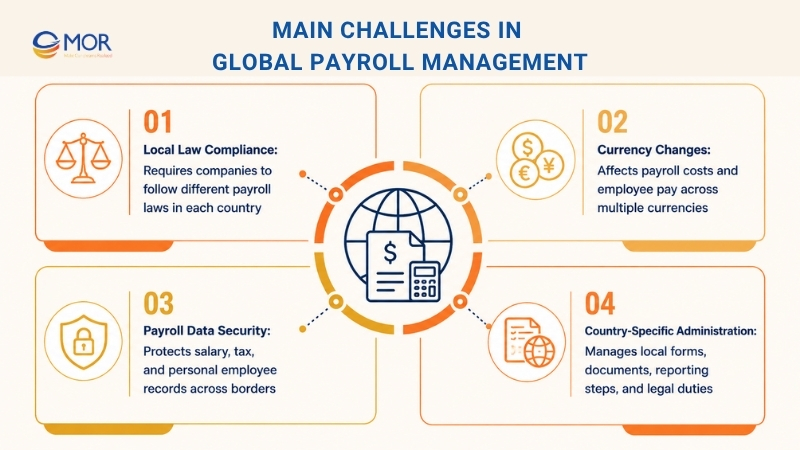
Global payroll management can create many issues that need close attention and the right skill set. When managing global payroll, employers often face the following problems across countries.
Local Law Compliance
Global payroll requires companies to follow each country’s laws and rules, and these can change a lot from one market to another. Companies need compliant payroll practices to avoid legal issues and damage to their name.
Currency Changes
Currency movement can affect payroll costs and change what employees receive in their local money. Payroll cost planning also becomes harder when several currencies are involved, which can create money-related uncertainty for the business and its staff.
Payroll Data Security
Global payroll work includes storing and moving private employee data, including personal details, salary information, and tax records across borders. For that reason, payroll teams must protect all payroll data from unwanted access, leaks, and misuse.
Country-Specific Administration
Each country can have its own admin rules, including forms, documents, and reporting steps. Handling these duties across many countries can take time, become complex, and create legal trouble if the data is wrong.
Conclusion
Global payroll management gives businesses a clearer way to pay teams across countries without losing control of taxes, records, and employee trust. The right setup depends on your hiring model, country coverage, payroll risks, and growth plan. For companies building software teams in Vietnam or Asia, MOR Software can support recruitment, payroll handling, offshore team setup, and delivery work. Contact us to discuss your global team setup and payroll support needs.
"Solutions Director at MOR Software, has extensive expertise in software development and management. He leads innovative projects and provides strategic solutions to enhance business operations, helping clients achieve digital transformation goals."
Pham Huu Canh


Solutions Director
MOR SOFTWARE
Frequently Asked Questions (FAQs)
What Is Global Payroll Management?
Global payroll management is the process of paying employees across different countries while handling taxes, benefits, deductions, and local payroll rules.
How Is Global Payroll Different From Domestic Payroll?
Domestic payroll follows one country’s rules. Global payroll deals with many laws, currencies, tax systems, deadlines, and employee data requireme
Why Is Global Payroll Management Important For International Companies?
It helps companies pay global teams on time, avoid legal risks, protect employee data, and keep payroll costs easier to track.
What Are The Biggest Global Payroll Challenges?
The main challenges include local tax compliance, changing labor laws, currency changes, data security, payroll accuracy, and reporting deadlines.
Should Companies Manage Global Payroll In-House Or Outsource It?
It depends on team size, country coverage, and internal payroll skills. Small global teams often outsource. Larger teams may use a hybrid model.
What Is The Difference Between Global Payroll, EOR, And Contractor Payments?
Global payroll pays employees hired through your own entities. An EOR hires employees for you. Contractor payments pay independent workers, not employees.
How can companies stay compliant with local payroll laws?
They should track local tax rules, update payroll data often, run audits, work with local experts, and use trusted payroll systems.
What should businesses look for in a global payroll provider?
Look for country coverage, compliance support, secure data handling, HR integration, clear reporting, local payroll experts, and strong customer support.
How does payroll and HR integration improve global workforce management?
It keeps employee data in one place, cuts manual entry, improves payroll accuracy, and gives HR and finance better workforce visibility.
How can global payroll management support international expansion?
It helps companies hire in new markets faster, manage payroll rules with less stress, and pay international employees correctly from day one.
Share


Make Our-Dreams Realized


© 2023 . MOR Software. All Rights Reserved
Sitemap
Privacy Policy
Terms of Use

Rate this article
0
over 5.0 based on 0 reviews
Your rating on this news:
Name
*Email
*Write your comment
*Send your comment
1