


Odoo Development vs Custom ERP: Which Fits Your Business in 2026?
Choosing between Odoo development vs custom ERP comes down to how closely the software fits your business processes and long-term budget. Standard Odoo supports common workflows, while custom ERP gives you greater control over system design. A third option combines Odoo with custom development. In this guide, MOR Software will compare all three approaches to help you choose the right ERP strategy for your business.
Key Takeaways
- Odoo development suits businesses with standard workflows, lower upfront budgets, and shorter implementation timelines.
- Custom ERP development fits organizations with unique processes, complex integrations, and strict system ownership requirements.
- A hybrid approach combines Odoo's existing business applications with custom-built functions, avoiding the cost of rebuilding common ERP capabilities.
What Is the Difference Between Odoo Development and Custom ERP?
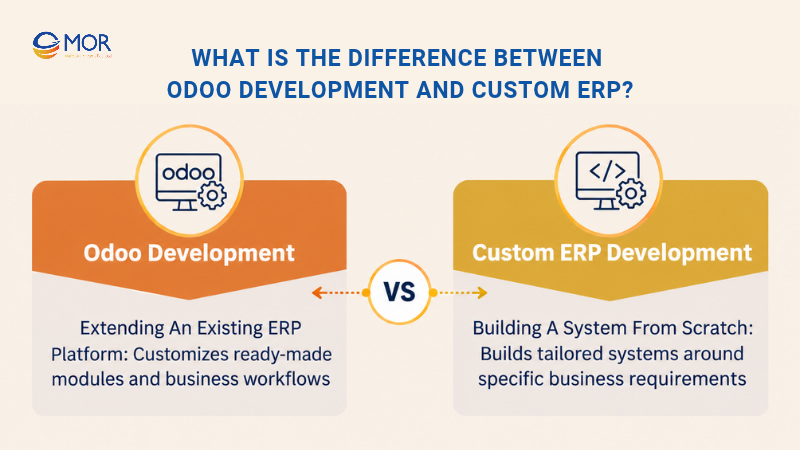
The main difference between Odoo development vs custom ERP software development lies in how the system is built. Odoo provides an existing platform that developers configure and extend, while custom ERP development starts with a system designed for your specific operations.
Odoo Development: Extending an Existing ERP Platform
Odoo development involves configuring, customizing, and integrating applications within the Odoo ERP platform. It includes ready-made modules for CRM, accounting, inventory, manufacturing, sales, purchasing, and human resources.
Developers use Python, PostgreSQL, and the Odoo Object-Relational Mapping (ORM) system to create custom modules and business logic. These tools let teams extend existing functions without rebuilding the entire application. Businesses can also create custom workflows, reports, and integrations through Odoo application development.
Odoo comes in two main editions. Community provides an open-source base, while Enterprise adds licensed applications, official support, and other business functions.
Custom ERP Development: Building a System From Scratch
Custom ERP development means creating enterprise software around a company's exact workflows and requirements. Developers design the application structure, database models, user interfaces, business rules, and integrations according to the project scope.
Unlike Odoo, a custom ERP doesn't come with an established set of business modules. Your development team must build or integrate each required function, including inventory management, financial reporting, purchasing, and user permissions.
This approach gives businesses greater freedom over architecture and functionality. Yet it also requires more development resources, testing, and long-term maintenance.
Companies planning large-scale systems can review the wider scope of enterprise software development before deciding which approach fits their needs.
Odoo Development vs Custom ERP: Side-by-Side Comparison
An Odoo development vs custom ERP comparison should examine technical flexibility, deployment costs, and long-term responsibilities. The two approaches differ in how quickly businesses can launch, how much they can customize, and who maintains the system after deployment.
Comparison Factor | Odoo Development | Custom ERP Development |
Initial investment | Lower for standard implementations | Higher due to development from scratch |
Implementation timeline | Faster when standard modules meet requirements | Longer due to design, coding, and testing |
Built-in ERP functionality | Existing CRM, accounting, inventory, and other modules | Each required module must be built or integrated |
Workflow customization | Configuration, Studio, and custom Python modules | Workflows designed around exact requirements |
System architecture | Built on Odoo's established architecture | Architecture selected for the project |
Integration flexibility | Odoo connectors, modules, and supported APIs | Custom APIs and integration architecture |
Licensing requirements | Free Community edition or paid Enterprise plans | No standard ERP per-user license, subject to component licenses |
Scalability | Supports business growth with suitable infrastructure | Depends on architecture and engineering quality |
Maintenance responsibilities | Odoo maintains standard components; teams maintain custom code | Development team maintains the entire system |
Software upgrades | Follows Odoo releases and compatibility requirements | Business controls its own release schedule |
Source-code ownership | Depends on edition, module licenses, and contracts | Custom code ownership depends on contracts |
Long-term support | Odoo ecosystem, partners, and internal teams | Original developers or a qualified replacement team |
Odoo provides a shorter development path when your operations match its existing applications. Custom ERP gives more architectural freedom, but the business takes greater responsibility for building and maintaining that freedom.
Neither approach guarantees better performance. System design, database structure, integration quality, and testing determine how reliably the software handles growing workloads.
Odoo Development vs Custom ERP: Cost and 5-Year TCO
The cost of Odoo development vs custom ERP includes more than the initial implementation quote. Total cost of ownership (TCO) covers licensing, development, infrastructure, integrations, staff training, maintenance, and future upgrades.
According to Odoo's official pricing, its regular annual-plan rates displayed in USD are $31.10 per user/month for Standard and $61.00 for Custom as of November 2026. Introductory discounts apply to initial users for the first 12 months. Implementation services, Odoo.sh hosting, and custom-code maintenance carry separate costs.
Odoo Community has no platform license fee, but businesses still pay for development, hosting, and support when required. Custom ERP avoids a standard per-user ERP subscription, although development and infrastructure costs remain.
Cost Component | Odoo Development | Custom ERP Development | Five-Year Cost Consideration |
Business analysis | Process mapping and fit-gap assessment | Full requirements and architecture planning | Complexity of workflows and exceptions |
Implementation | Configuration and module setup | Full application development | Initial project scope |
Subscription fees | Enterprise per-user fees or Community without license fees | No standard per-user ERP license | User growth and third-party licenses |
Custom development | Modules, reports, and workflows | Core functions and specialized processes | Scope changes and new requirements |
Hosting | Odoo Online, Odoo.sh, or private infrastructure | Cloud or on-premise infrastructure | Storage, processing, backups, monitoring |
Data migration | Import and mapping into Odoo models | Custom data mapping and migration | Legacy data quality |
Integrations | Connectors, APIs, and custom modules | Custom APIs and middleware | Number and complexity of systems |
QA and UAT | Module, workflow, and integration testing | Full application and system testing | Testing scope and release frequency |
Maintenance | Partner support and custom-code maintenance | Dedicated application maintenance | Staff costs and support contracts |
Upgrades | Platform updates and custom-module migration | Developer-managed releases | Frequency and complexity of changes |
Security and compliance | Configuration and extensions to existing capabilities | Security and compliance engineering | Regulatory changes and audits |
Internal resources | Process owners, training, and IT oversight | Product owners, technical teams, and training | Ongoing personnel involvement |
For a fair comparison, calculate the same expenses over five years:
5-Year TCO = Initial Investment + Five-Year Licensing + Hosting + Maintenance + Upgrades + Integration Costs + Internal Staff Costs
Consider an illustrative company with 40 paid ERP users. At Odoo Custom's regular rate of $61 per user/month, five years of subscriptions would total $146,400, assuming the user count and rate remain unchanged and excluding introductory discounts. Implementation, custom modules, and other expenses would increase that amount.
A fully custom ERP might receive a hypothetical development quote of $180,000, plus $25,000 in annual maintenance. Its five-year cost would reach $305,000 before infrastructure, integrations, and internal staffing. These figures illustrate cost modeling, not market price estimates.
Your actual break-even point depends on project requirements and vendor quotes. Businesses can examine custom software development rates to understand the factors behind bespoke development budgets.
What Are the Risks of Odoo and Custom ERP Development?
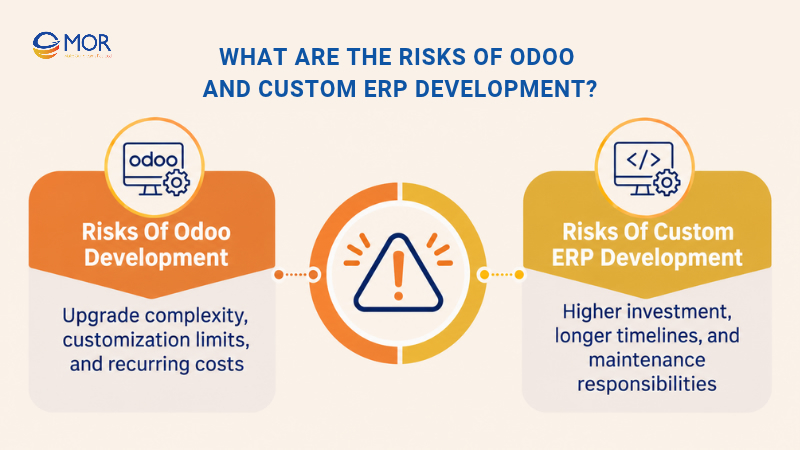
The risks of Odoo development vs custom ERP differ in their causes and long-term consequences. Odoo projects face platform-related limits and upgrade requirements, while custom ERP projects carry greater responsibility for development, security, and maintenance.
Risks of Odoo Development
Version upgrades create recurring technical work. Odoo releases major versions regularly, and custom Python modules must remain compatible with the target version. According to Odoo's support documentation, Odoo 20 was released in September 2026 and has standard support planned through September 2029.
A heavily customized installation may require code migration, regression testing, and workflow changes before upgrading. Complex modifications to core accounting or inventory processes can make these transitions particularly costly.
Customization also has practical limits. Odoo's existing data models and application structure suit many businesses, but deeply specialized workflows may require extensive development. Companies can accumulate technical debt when they repeatedly modify standard modules to accommodate unusual processes.
Enterprise subscriptions add recurring costs as paid user numbers increase. Dependence on Odoo's release cycle, partner availability, and supported hosting options can also restrict some technical decisions.
Integration quality deserves attention. Poorly written modules, slow database queries, and unreliable API connections can cause performance problems and inconsistent data across systems.
Risks of Custom ERP Development
Higher initial investment is the most visible risk of custom ERP development. Teams must design, build, test, and document functions that existing ERP products already provide.
Development timelines can also expand when business requirements change. A custom accounting module, for example, may need extra work for tax calculations, audit trails, approval rules, and financial reporting.
Budget overruns remain a concern across ERP projects. Panorama Consulting Group's 2026 ERP Report found that more than a quarter of surveyed organizations exceeded their project budgets, with unexpected technology needs among the leading causes.
Maintenance becomes the company's responsibility. Developers must handle security patches, application upgrades, database changes, and new business requirements. Limited documentation or dependence on a single developer makes this work harder.
Custom systems also require careful security and compliance planning. Businesses need reliable authentication, role-based access, audit logging, backups, and controls that meet relevant regulations.
Source-code ownership and hosting control should be defined before development begins. The comparison between custom software and SaaS explains how these responsibilities affect long-term software management.
When Should You Choose Odoo Development?
Choose Odoo development when your company needs a connected ERP system and most workflows already match standard business practices. In the Odoo development vs custom ERP decision, this option generally suits organizations that want to limit custom engineering and deploy core functions sooner.
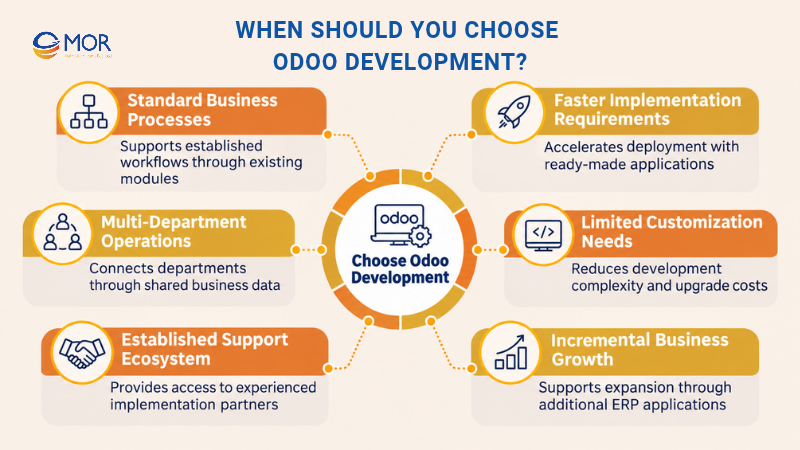
The following conditions point toward Odoo:
- Standard Business Processes: Your sales, procurement, inventory, and accounting activities follow established workflows. Odoo's existing applications can manage these tasks without rebuilding each function.
- Faster Implementation Requirements: Your business needs to replace spreadsheets or disconnected tools within a defined timeline. Standard modules allow phased deployment, starting with the most urgent departments.
- Multi-Department Operations: Teams need shared customer, product, financial, and inventory data. Odoo connects these activities through applications that use a common database.
- Limited Customization Needs: Most requirements can be handled through configuration, Odoo Studio, or a small number of custom modules. This keeps development and upgrade work manageable.
- Established Support Ecosystem: Your company prefers access to implementation partners and developers familiar with the platform. Odoo ERP support services can assist with maintenance, upgrades, and technical issues after deployment.
- Incremental Business Growth: Your organization expects to add departments, users, or business functions over time. Odoo supports this expansion through additional applications and planned customization.
For instance, a manufacturer with standard purchasing, production, and warehouse processes can start with Odoo for manufacturing. Specialized planning or quality-control functions can be added when business requirements justify them.
Companies focused mainly on customer management may also find the Odoo vs Salesforce comparison useful before selecting their broader business platform.
When Is Custom ERP Development the Better Choice?
Custom ERP development fits businesses whose core operations require technical capabilities that standard applications cannot reasonably support. In the Odoo development vs custom ERP comparison, these requirements often relate to proprietary processes, integration complexity, and long-term architectural control.
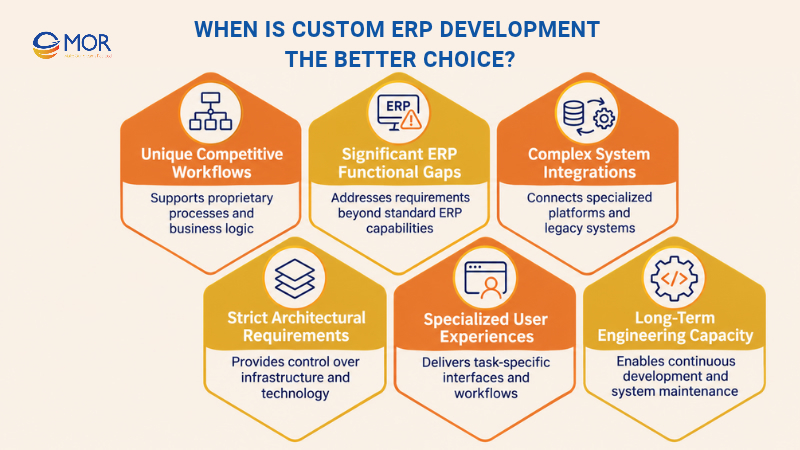
Consider a custom build when your organization faces these conditions:
- Unique Competitive Workflows: Your company uses proprietary pricing models, manufacturing methods, service processes, or logistics rules. These functions directly influence business results and require precise system behavior.
- Significant ERP Functional Gaps: A fit-gap assessment identifies extensive changes across core Odoo modules. The expected cost of building and maintaining these customizations may justify an independent application.
- Complex System Integrations: Your ERP must work closely with industrial machines, government platforms, legacy databases, or specialized business systems. Custom architecture can support unusual communication patterns and data requirements.
- Strict Architectural Requirements: Your organization requires control over its technology stack, infrastructure, deployment schedule, or data location. These conditions may limit the suitability of a standard ERP platform.
- Specialized User Experiences: Employees, suppliers, or customers need interfaces designed around specific tasks. A custom application can provide focused screens and workflows without exposing unnecessary ERP functions.
- Long-Term Engineering Capacity: Your business has technical leadership, development resources, and a maintenance budget. These resources support continued improvements after the initial system goes live.
Take a manufacturer that calculates prices through proprietary formulas involving materials, equipment, and contract conditions. If standard ERP modules require major changes across production, costing, and invoicing, custom development deserves serious consideration.
Still, a specialized process doesn't always justify a complete ERP rebuild. Businesses should first assess off the shelf software vs custom software and determine whether a focused custom application can solve the problem.
Can a Hybrid ERP Approach Offer a Better Fit?
A hybrid ERP approach combines Odoo's existing business applications with custom software built for specialized requirements. This creates a third path in the Odoo development vs custom ERP decision.
Instead of rebuilding accounting, purchasing, inventory, and user management, businesses can keep these functions inside Odoo. Developers then create specialized modules or standalone applications for workflows that require greater flexibility.
Hybrid Architecture | Odoo Responsibilities | Custom Development Scope | Best-Fit Scenario |
Odoo with custom manufacturing modules | Inventory, purchasing, accounting, and standard manufacturing | Specialized production rules, costing, and quality checks | Manufacturers with unique production workflows |
Odoo with a customer portal | CRM, sales orders, invoices, and customer records | Customer interface, account services, and self-service functions | Distributors and service providers |
Odoo with contract management software | Finance, procurement, and project data | Contract approvals, milestone tracking, and custom billing logic | Construction and project-based companies |
Odoo connected to a custom application | Standard back-office operations | Independent application logic, interfaces, and data models | Businesses with proprietary operational systems |
Two development methods support this structure. Custom Odoo modules extend the platform's existing models and screens, while independent applications communicate with Odoo through supported APIs.
The second approach keeps specialized business logic outside Odoo's codebase. Yet it introduces work involving authentication, data mapping, synchronization, monitoring, and error handling.
For example, a manufacturer may use Odoo for purchasing and accounting while operating a custom production-planning application. Approved production data can move between the systems through an integration layer.
A hybrid approach works best when responsibilities remain clear. Define which application owns each record, how updates move between systems, and who resolves synchronization failures before development starts.
How to Decide Between Odoo Development and Custom ERP
The right choice between Odoo development vs custom ERP depends on your actual processes, technical requirements, and operating costs. A structured assessment helps teams avoid unnecessary customization and identify functions that deserve dedicated development.
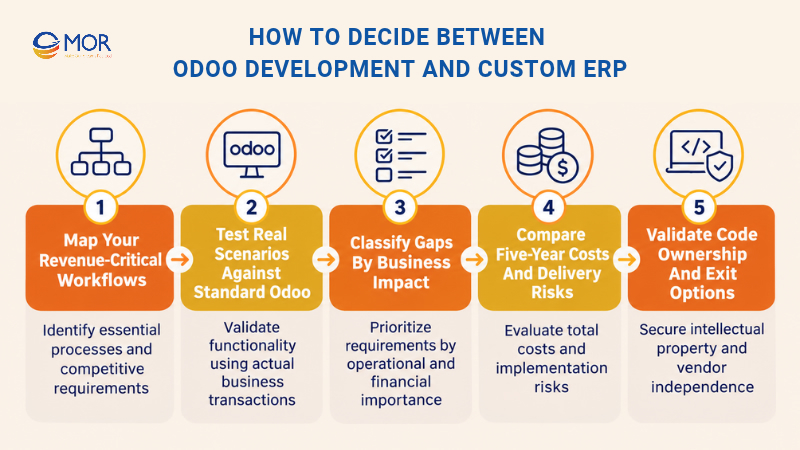
Map Your Revenue-Critical Workflows
Start with the business activities that affect revenue, inventory accuracy, procurement, financial controls, and customer service. Document the real steps employees follow, including exceptions that standard process diagrams often miss.
Record approval rules, user roles, integrations, and reporting needs. Separate workflows that create competitive value from routine processes that can adopt established ERP practices.
For example, standard invoice approval may fit Odoo without development. A proprietary pricing model tied to contract performance may need custom logic and additional testing.
Test Real Scenarios Against Standard Odoo
Run a fit-gap assessment using actual transactions and realistic sample data. Ask the implementation team to demonstrate purchasing, inventory movements, sales, reporting, and other priority workflows in a standard Odoo installation.
Document the results in four categories: supported without changes, supported through configuration, requiring custom development, or unsuitable for the platform.
Use operational exceptions during testing. A successful demo of a normal purchase order doesn't confirm that the system can handle unusual supplier settlements or complex stock ownership rules.
Classify Gaps by Business Impact
Evaluate each functional gap according to operational value, technical complexity, and financial risk. A missing report field has a different level of importance than a custom process affecting inventory valuation or financial posting.
Group requirements into simple configuration changes, custom Odoo modules, independent applications, and functions requiring a fully bespoke system.
This classification keeps the Odoo development vs custom ERP systems assessment tied to genuine business needs. It also prevents minor interface preferences from driving expensive architectural decisions.
Compare Five-Year Costs and Delivery Risks
Request proposals using the same scope, user numbers, integration requirements, and data migration assumptions. Compare implementation fees, licensing, infrastructure, development, testing, maintenance, and internal staffing.
Delivery risk also deserves attention. Check whether each vendor has sufficient engineers, a defined testing process, and a practical rollout schedule.
Gartner's ERP research predicts that more than 70% of recently implemented ERP initiatives will fail to meet their original business-case goals fully by 2027. The forecast reinforces the need for measurable business targets before committing to either approach.
Validate Code Ownership and Exit Options
Review the contract before choosing a vendor. Confirm ownership of custom code, access to repositories, database export options, technical documentation, and rights to use third-party components.
Determine who will maintain integrations, fix defects, and manage future upgrades. Your company should also know whether another engineering team can take over the project without extensive redevelopment.
For the final Odoo development vs custom ERP decision, define acceptance criteria and support obligations in writing. A clear handover plan protects operations when contracts, vendors, or internal teams change.
How MOR Software Supports Your ERP Development Strategy
Choosing between Odoo development vs custom ERP requires a clear understanding of your business processes, technical needs, and long-term costs. At MOR Software, we help businesses assess their ERP requirements and develop solutions that support daily operations and future growth.
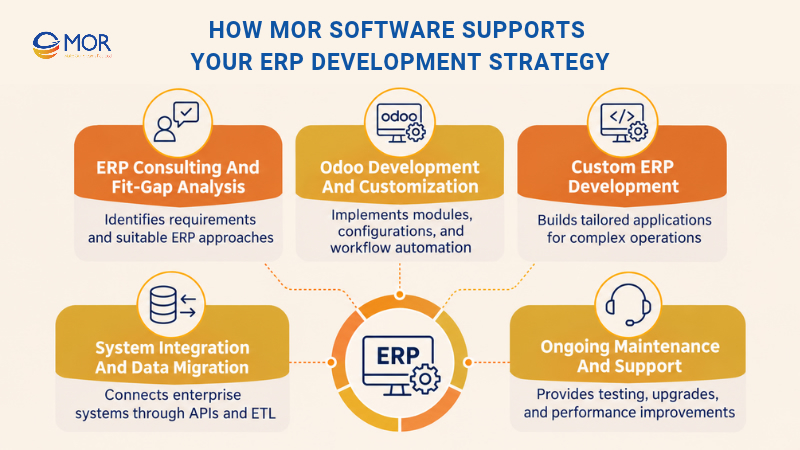
Founded in 2016, MOR Software has delivered 850+ projects across 10+ countries. Our ERP-related services cover several key areas:
- ERP Consulting and Fit-Gap Analysis: We assess existing workflows, identify functional gaps, and determine whether standard Odoo, customized modules, or a fully custom ERP system best meets your business needs.
- Odoo Development and Customization: Through our strategic partnership with Odoo, we provide Odoo development solutions covering implementation, custom modules, workflow automation, and system configuration.
- Custom ERP Development: Our engineering teams build tailored enterprise applications for businesses with complex processes, specialized workflows, and requirements that standard ERP platforms cannot fully address.
- System Integration and Data Migration: We connect enterprise applications with legacy systems, third-party platforms, and databases through APIs and structured ETL processes. For example, our Salesforce and legacy system integration project involved 18 engineers over 15 months, supporting bidirectional data synchronization and a custom HRM solution.
- Ongoing Maintenance and Support: Our teams provide software testing, performance improvements, system upgrades, and technical support to keep ERP solutions aligned with changing business needs.
Unsure which ERP approach fits your business? Contact MOR Software to discuss your requirements and explore a development strategy that balances functionality, cost, and long-term flexibility.
Conclusion
The Odoo development vs custom ERP decision depends on workflow complexity, development budgets, and long-term ownership requirements. Odoo fits standard operations, custom ERP supports specialized processes, and hybrid development combines existing ERP functions with tailored applications. MOR Software supports businesses through ERP consulting, Odoo customization, custom development, and ongoing maintenance.
"Mr. Cong’s guiding philosophy is simplicity, believing that the simplest solutions are often the most powerful. He sees trust, empowerment, and the opportunity to demonstrate one’s abilities as the key elements that set MOR apart from traditional IT companies."
Mac Tien Cong


Division Manager (Hanoi Branch)
MOR SOFTWARE
Frequently Asked Questions (FAQs)
What is the main difference between Odoo development and custom ERP development?
Odoo development uses an existing ERP platform with ready-made applications that developers can configure and extend. Custom ERP development builds a system around specific business requirements. Odoo generally requires less work for standard processes, while custom ERP provides more control over architecture, workflows, and application design.
Is Odoo development cheaper than building a custom ERP?
Odoo development generally has lower initial costs when standard modules meet most requirements. Custom ERP requires more upfront engineering but may avoid recurring per-user ERP subscription fees. The cheaper option over five years depends on user numbers, customization scope, hosting, maintenance, and upgrade costs.
Can Odoo handle complex industry-specific business workflows?
Yes. Odoo supports specialized workflows through configuration, Odoo Studio, and custom Python modules. Developers can extend data models, reports, approval rules, and integrations. Yet workflows requiring major changes to core accounting, inventory, or production logic may justify a separate custom application or a different ERP architecture.
When does Odoo customization become more expensive than custom ERP development?
Heavy customization becomes costly when developers repeatedly modify core Odoo modules, maintain numerous dependencies, and migrate substantial custom code during upgrades. The financial comparison depends on how much standard functionality remains useful. A fit-gap assessment and five-year TCO model help identify when independent development deserves consideration.
What is the difference between Odoo Community and Enterprise for development?
Odoo Community provides the free, open-source base for implementing and extending ERP functions. Enterprise requires a subscription and includes additional applications, commercial support, and other capabilities. Development costs depend on the required edition, hosting setup, custom modules, integration needs, and the people responsible for maintaining the system.
Can businesses deploy custom Python modules on Odoo Online?
No. Odoo's official hosting documentation states that Odoo Online doesn't support custom Python modules or third-party modules from the Odoo Apps Store. Businesses needing this level of development should consider Odoo.sh or an on-premise deployment, subject to their edition and subscription requirements.
What happens to custom Odoo modules during a major upgrade?
Custom modules must be updated and tested for compatibility with the target Odoo version. Standard database upgrades don't automatically maintain third-party or internally developed code. Your development team must review affected functions, migrate modules when required, and conduct regression testing before deploying the upgraded system.
Who owns the source code in Odoo and custom ERP projects?
Ownership depends on the software license and development contract. Odoo Community follows its open-source license, while Enterprise has separate licensing terms. Custom ERP contracts can transfer ownership of newly developed code to the client, but third-party libraries may retain their original licenses. Review all ownership terms before development starts.
Can Odoo integrate with a separately developed ERP application?
Yes. Odoo can exchange information with external applications through supported APIs and custom integration services. A hybrid setup may connect Odoo accounting or inventory data with a specialized production, logistics, or customer-facing system. Reliable integration requires clear data ownership, authentication, error handling, and synchronization rules.
How long does Odoo implementation take compared with custom ERP development?
Odoo implementation generally takes less time when businesses use standard applications and limited customization. Custom ERP development requires additional architecture, coding, and testing work. Actual timelines depend on project size, integrations, data quality, regulatory requirements, and user acceptance testing. A phased implementation can help either approach reach production sooner.
Share


Make Our-Dreams Realized


© 2023 . MOR Software. All Rights Reserved
Sitemap
Privacy Policy
Terms of Use

Rate this article
0
over 5.0 based on 0 reviews
Your rating on this news:
Name
*Email
*Write your comment
*Send your comment
1