


Outsource React JS Development in 2026: The Ultimate Guide
React expertise remains in demand, yet local hiring and growing frontend backlogs can slow product releases. The 2025 Stack Overflow Developer Survey found that 46.9% of professional developers had worked with React during the previous year. This MOR Software guide explains when to outsource React JS development, which delivery model fits your needs, what affects cost, and how to assess technical quality before signing a contract.
Key Takeaways
- Match the model to the work. Staff augmentation fits capacity gaps, dedicated teams suit long roadmaps, and managed projects cover full delivery ownership.
- Calculate total cost. Include discovery, design, engineering, QA, cloud work, project management, knowledge transfer, and post-launch care.
- Validate before committing. Review real React projects, interview engineers, inspect delivery practices, and run a paid pilot when the engagement carries high risk.
What Does It Mean To Outsource React JS Development?
React development outsourcing means hiring an external engineer, team, or software development company to build and manage part or all of a React application. The external team handles agreed technical work while your company keeps control over product goals, budgets, priorities, and release decisions.
The work may cover a new application, an existing frontend, one business module, or a long-term product roadmap. Some clients need two React engineers for a feature backlog. Others need a complete team that includes a business analyst, UI designer, QA engineer, DevOps consulting specialist, and project manager.
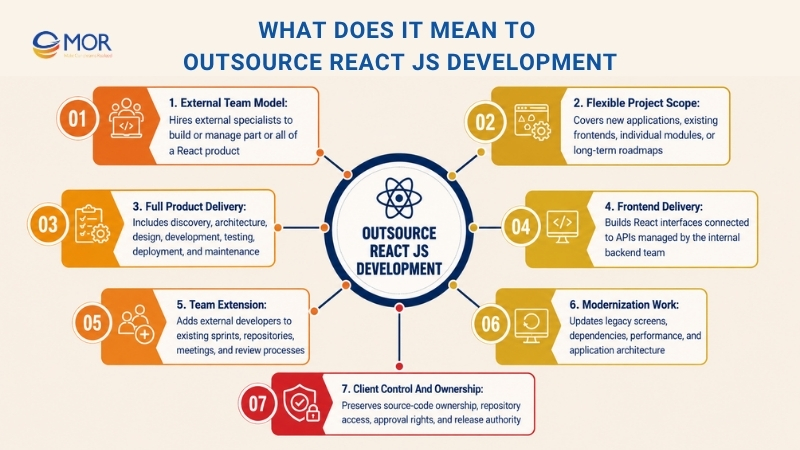
Common outsourcing arrangements include:
- Full product delivery: The vendor covers discovery, architecture, design, development, testing, deployment, and maintenance.
- Frontend delivery: React engineers build the interface and connect it to APIs managed by your internal backend team.
- Team extension: External developers join your current sprints, repositories, meetings, and review process.
- Modernization work: A specialist team replaces legacy screens, updates dependencies, fixes performance issues, or moves the application to a newer architecture.
Control does not disappear when you outsource React JS development. A sound contract gives your company source-code ownership, repository access, architecture approval rights, release authority, and clear acceptance rules.
React JS and React Native also serve different product needs. React builds browser-based user interfaces, while React Native applies React concepts to native mobile applications. A vendor may work with one or cover the web and mobile layers together, depending on its technical range.
React JS development outsourcing is the use of an external software team to build, extend, test, modernize, or maintain a React-based product under agreed technical, commercial, and ownership terms.
Why Businesses Outsource React JS Development
Companies usually turn to external React teams when hiring limits, skill gaps, or delivery pressure begin affecting the roadmap. The choice works best when it solves a defined capacity or technical problem.
The U.S. Bureau of Labor Statistics projects 15% employment growth for software developers, QA analysts, and testers between 2024 and 2034. It also expects about 129,200 job openings per year, which points to continued competition for skilled engineering staff.
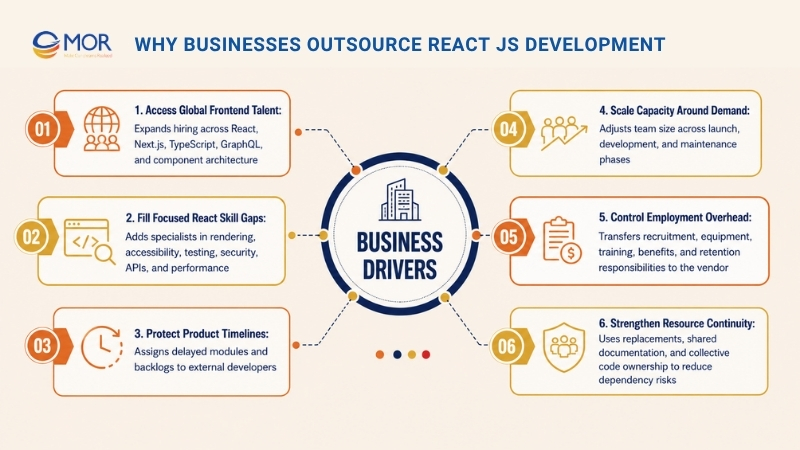
- Access global frontend talent: React.js developers outsourcing connects your company with engineers who work across React, Next.js, TypeScript, Redux Toolkit, GraphQL, and component-based architecture.. Your hiring pool extends beyond one city or country.
- Fill focused React skill gaps: A project may need server rendering, state management, accessibility, API work, automated testing, frontend security, or performance tuning. An experienced vendor can assign people who already work in those areas.
- Protect product timelines: External developers can take ownership of delayed UI modules, migration tasks, or feature backlogs. Internal engineers gain more room to handle the work that depends on company-specific knowledge.
- Scale capacity around demand: A product may need five developers before launch and two during maintenance. Outsourcing gives you room to change team size without creating permanent positions for short workload peaks.
- Control employment overhead: Permanent hiring includes salary, benefits, recruiter time, equipment, training, management, and retention costs. An software development outsourcing model places those staff-related duties under the vendor’s operation.
- Strengthen resource continuity: A vendor can assign a replacement when a team member becomes unavailable. Shared documentation and cross-team code ownership also prevent one engineer from becoming the only person who understands a key module.
These gains depend on vendor quality. Cheap access to developers means little when architecture, QA, documentation, and communication remain weak.
When Should You Outsource React JS Development?
The right time appears when an external team can remove a real barrier without creating greater management risk. Review your roadmap, current staff, budget, and technical ownership before choosing React JS development outsourcing.
Business Situation | Outsourcing Fit | Required Setup |
Frontend work keeps missing release dates | High | Stable backlog, product owner, sprint priorities |
Senior React skills are missing internally | High | Architecture goals, code review access, technical lead |
An MVP must reach users soon | High | Defined user problem, limited first release, decision-maker access |
A legacy frontend needs renewal | High | Code audit, migration plan, regression test scope |
Workload changes across project phases | High | Flexible contract and team-scaling rules |
The application serves a regulated field | Medium to high | Security, privacy, audit, and data-access requirements |
Local hiring exceeds the available budget | Medium to high | Total-cost comparison and delivery governance |
A current vendor lacks React capacity | Medium | Clear module boundaries and handover plan |
Your roadmap gives the strongest signal. When frontend tasks stay open for several sprints, the problem may sit in capacity, unclear ownership, or missing skill. An outsourced React team can take a defined workstream and return progress to a predictable rhythm.
Modernization is another common trigger. Old class components, outdated packages, weak test coverage, and heavy client-side bundles can make every new release harder. A technical audit should identify what can stay, what needs refactoring, and what requires replacement.
What Projects And Services Can An Outsourced React Team Handle?
React supports products ranging from internal dashboards to large customer platforms. W3Techs reported on July 23, 2026 that React was present on 6.1% of all websites and 7.8% of sites whose JavaScript library it could identify. The numbers show wide adoption, but project fit still depends on architecture, users, content needs, and long-term ownership.
Projects that require design, coding, API integration, testing, and post-launch care may use outsource React native app development services rather than hiring separate mobile specialists for each task.
Service | Common Business Need | Expected Deliverable | Typical Tools |
Custom web application | A product must match unique workflows | Responsive web platform | React, TypeScript, REST or GraphQL |
Single-page application | Users need fast in-app interaction | Browser app with client routing | React Router, Vite, state tools |
SaaS product | Teams need accounts, roles, billing, and reporting | Subscription-based platform | React, Next.js, API services |
Business dashboard | Users need operational data in one place | Charts, filters, tables, alerts | React, chart libraries, data APIs |
Progressive web application | Users need installable web access | Responsive PWA with selected offline use | React, service workers, web manifest |
eCommerce frontend | A store needs richer customer journeys | Search, product, cart, and account screens | React, Next.js, headless commerce APIs |
Legacy modernization | Old frontend code slows releases | Phased migration or full rebuild | React, TypeScript, modern build tools |
UI design system | Product screens lack consistency | Reusable component library | Storybook, design tokens, UI libraries |
API integration | The frontend must connect to business systems | Tested data and workflow connections | REST, GraphQL, OAuth |
Performance work | Pages load slowly or rerender too often | Smaller bundles and faster interaction | Profiling, lazy loading, caching |
QA and testing | Releases create repeated regressions | Test plans and automated suites | Jest, React Testing Library, Playwright |
Maintenance | The live product needs continued work | Fixes, upgrades, monitoring, and releases | CI/CD, logs, dependency tools |
A company may outsource react js development services for one row or combine several ones. A SaaS software development project, for example, may need product discovery, Next.js development, API integration, end-to-end testing, cloud deployment, and monthly maintenance.
Scope boundaries need special attention. Frontend teams depend on API contracts, authentication rules, design files, and test data. Confirm who owns each dependency before estimating time or cost.
Which React JS Outsourcing Model Fits Your Project?
The engagement model controls daily management, commercial risk, and your access to the team. Choose each React outsourcing model based on requirement stability and internal leadership rather than vendor preference.
Model | Best Fit | Client Control | Vendor Responsibility | Cost Structure |
Staff augmentation | Specific skill or capacity gaps | High | Staffing and operational support | Hourly or monthly |
Dedicated team | Long product roadmap | High to medium | Stable team and staff operation | Monthly team cost |
Managed project team | Full product or workstream delivery | Medium | Planning, coordination, engineering, and QA | Milestone or T&M |
Fixed-price project | Stable and documented scope | Medium | Delivery against agreed acceptance rules | Fixed contract |
Time and materials | Changing backlog or discovery-led work | High | Work completed against priorities | Time used |
Hybrid model | Internal leadership plus external delivery | High | Shared ownership by workstream | Mixed |
Staff Augmentation
Staff augmentation works when your engineering manager can direct the work. External React developers join internal meetings, follow company standards, and report through your existing technical structure.
This model fills a skill or bandwidth gap without transferring project management. Your company remains responsible for backlog quality, architecture decisions, task allocation, and final acceptance.
Dedicated Development Team
A dedicated team suits products that need stable knowledge over many months. Developers, QA engineers, and other assigned members stay focused on your roadmap instead of moving between short projects.
The model also supports team changes. You can add another frontend developer before a large release or decrease capacity once the product enters a quieter phase.
Managed Project Team
A managed team fits companies that need the vendor to coordinate delivery. The partner may handle discovery, sprint planning, architecture, development, QA, reporting, and release preparation.
Internal product ownership still matters. Your business must set goals, approve key decisions, review demos, and accept completed work.
Fixed Price Or Time And Materials
Fixed price suits defined deliverables with stable dependencies. Any unclear API, unfinished design, or changing workflow can weaken the original estimate and create a long change-request process.
Time and materials fits MVPs, product discovery, modernization, and changing roadmaps. You pay for completed effort and can reorder priorities as new information arrives.
A company planning to outsource React JS development should choose staff augmentation when internal leadership is strong, a dedicated team for a changing long-term backlog, and managed delivery when it needs one partner to coordinate the complete workstream.
Outsource React JS Development Pricing And Cost Breakdown
In 2026, a small React interface or proof of concept often costs $8,000 to $25,000. A mid-sized SaaS platform may require $40,000 to $120,000, while enterprise modernization can exceed $120,000 to $350,000.
Current market data supports these planning ranges. Clutch lists ReactJS agency rates at $25 to $49 per hour, while Upwork places typical React developer contracts at $51 to $75 per hour. Location, team structure, seniority, and product risk can push the final rate above these benchmarks.
These figures provide a starting point rather than a vendor quote. Your actual cost depends on the amount of work, technical condition, team mix, delivery model, and post-launch requirements.
Main Cost Drivers
Every product has a different cost profile. Review each driver separately before setting the budget, since one weak dependency can add weeks of engineering and QA work.
The estimates below use common 2026 React development rates of about $25 to $75 per hour. Specialist agencies and teams in higher-cost markets may charge more.
Cost Driver | Why It Changes The Budget | Estimated Cost Effect ($) |
Project size | More screens, user roles, workflows, and permissions require more development and testing. | $8,000 to $350,000+ total |
UI complexity | Animation, real-time updates, data tables, and responsive states require added frontend and QA hours. | +$3,000 to $25,000 |
Technical stack | Next.js, TypeScript, Server Components, legacy React, and server rendering require different skill levels. | +$5,000 to $30,000 |
Backend readiness | Missing APIs, unstable data models, or incomplete authentication can block frontend progress. | +$5,000 to $40,000 |
Third-party integrations | Payment gateway integrations, Salesforce, ERP, analytics, identity tools, and external APIs add development and test paths. | +$2,000 to $15,000 per integration |
Accessibility requirements | Keyboard control, semantic HTML, screen-reader testing, and WCAG checks add design and QA work. | +$3,000 to $15,000 |
Security requirements | Sensitive data calls for stricter permissions, audit logs, code reviews, and security testing. | +$5,000 to $30,000 |
Test coverage | Unit, integration, browser, and end-to-end tests require more early work but lower regression costs later. | +$4,000 to $25,000 |
Legacy migration quality | Poor documentation, outdated libraries, and tightly linked modules require added audit and refactoring work. | +$8,000 to $50,000 |
Team seniority | Architects, technical leads, and senior engineers carry higher rates than junior or mid-level developers. | +$4,000 to $16,000 per senior role each month |
Vendor location | Regional labour and operating costs shape the hourly rate. | Below $25 to $149 per hour |
Maintenance scope | Faster response times, monitoring, patching, and frequent releases require ongoing capacity. | $1,500 to $10,000 per month |
Clutch reports rates below $25 per hour in India, $25 to $49 in the Philippines, Ukraine, Spain, and Mexico, and $100 to $149 in the United States, Canada, and Australia. Poland commonly falls between $50 and $99 per hour.
A finished Figma screen may still hide a large amount of work. One data table can require role-based access, API pagination, filtering, exports, mobile layouts, loading states, error handling, and keyboard control.
Backend readiness also changes the estimate. A React team can’t complete integrations on schedule when API structures change each week or test environments remain unavailable.
Common Pricing Models
The software development contract model decides how you pay, who carries scope risk, and how easily priorities can change. Select it after the vendor reviews the requirements and technical dependencies.
- Fixed price, typically $10,000 to $150,000+: Best for stable scope, finished designs, known integrations, and written acceptance criteria.
- Time and materials, typically $25 to $99 per hour: Best for changing priorities, MVP delivery, technical discovery, and legacy modernization.
- Monthly dedicated team, typically $20,000 to $60,000: Best for long product roadmaps that need four to six stable team members and shared product knowledge.
- Staff augmentation, typically $4,000 to $16,000 per developer each month: Best for adding named React engineers under your internal technical management.
- Milestone-based contract: Best when the project can be split into accepted releases. The full budget may range from $20,000 to $200,000+, divided across agreed milestones.
- Paid discovery, typically $3,000 to $15,000: Best when architecture, scope, API readiness, or legacy code quality remains unclear.
Fixed pricing provides budget certainty, but every assumption must be written down. Time and materials gives your team more room to change the backlog when user feedback or technical findings affect the original plan.
Total Cost Of Ownership
Development rates cover only part of the final budget. A complete cost plan must include the work required before coding, during delivery, and after production launch.
Include:
- Product discovery and requirement analysis
- UI and UX design
- Frontend and backend engineering
- API and third-party system work
- QA and test automation
- DevOps and cloud configuration
- Project management
- Security reviews
- Documentation
- Knowledge transfer
- Production monitoring
- Dependency upgrades
- Post-launch maintenance
Hidden fees often appear around cloud environments, licences, project meetings, deployment, handover, and late scope changes. Request a written breakdown of included work, exclusions, assumptions, support rates, and change fees before signing the contract.
Three Practical Project Profiles
Use project profiles to set an early budget before requesting detailed proposals. These ranges reflect common team structures and 2026 market rates, but architecture and integration risks can move the final figure.
Project Profile | Likely Roles | Typical Timeline | Estimated Cost ($) | Suitable Pricing |
Small React interface or proof of concept | One React developer, part-time designer, and QA engineer | 4 to 8 weeks | $8,000 to $25,000 | Fixed price or T&M |
Mid-sized SaaS platform or customer portal | Two React developers, backend engineer, QA engineer, PM, and designer | 3 to 6 months | $40,000 to $120,000 | T&M or dedicated team |
Enterprise modernization | Architect, React team, QA automation, DevOps, BA, and PM | 6 to 12+ months | $120,000 to $350,000+ | Dedicated or managed team |
Clutch’s 2026 client review data places the average web development agency project at about $66,499, with an average delivery period of nine months. That benchmark sits within the mid-sized and early enterprise project ranges above.
Before you outsource React JS development, compare the full cost against delivery speed, staff continuity, technical quality, and long-term maintenance. A low hourly rate can lead to a higher final bill when the project requires repeated fixes, weak handover, or a full rebuild.
How The React JS Outsourcing Process Works
A sound process gives the client visibility without forcing it to manage every technical task. Each stage in React development outsourcing should produce a clear output that supports the following work.
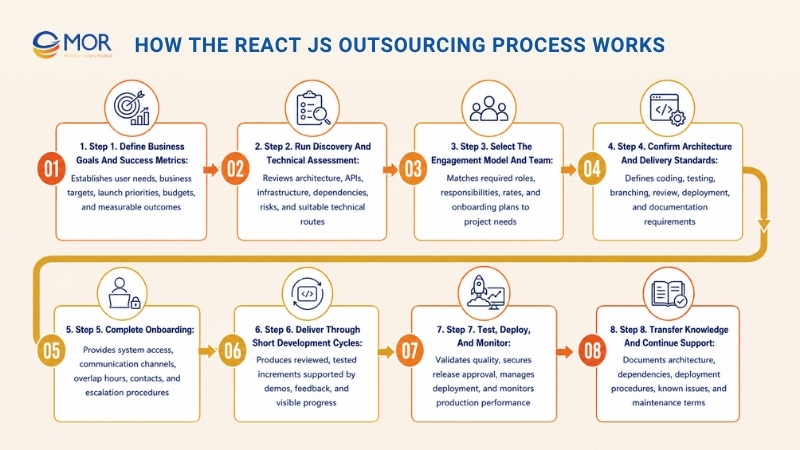
Step 1. Define Business Goals And Success Metrics
Start with the user problem, business target, release date, and expected traffic. Record the functions required for launch and move lower-priority requests into a later roadmap.
Metrics should match the product. A customer portal may track task completion, support volume, and account use. An internal system may focus on processing time, data accuracy, and staff adoption.
Client input: Business rules, user groups, goals, budget, and deadlines.
Vendor output: Initial scope, assumptions, risks, and success measures.
Step 2. Run Discovery And Technical Assessment
The vendor studies the codebase, architecture, APIs, data flows, infrastructure, security limits, and current delivery process. This work tests whether React, Next.js, a phased migration, or another route fits the goal.
Discovery is especially useful for legacy applications. Quick estimates based only on screen count often miss hidden dependencies and weak code quality.
Client input: Repository, documents, system access, and technical contacts.
Vendor output: Architecture proposal, work breakdown, estimate, and risk register.
Step 3. Select The Engagement Model And Team
Match roles to the actual work. A common setup may include React developers, a QA engineer, a project manager, and part-time UI or DevOps support.
Complex products may also need a business analyst, solution architect, backend engineers, or a security specialist. A RACI matrix can record who makes, reviews, approves, and receives each decision.
Client input: Management preference and internal capacity.
Vendor output: Team plan, role ownership, rates, and onboarding schedule.
Step 4. Confirm Architecture And Delivery Standards
Agree on component structure, state tools, API patterns, TypeScript rules, naming, test coverage, branching, review steps, and deployment controls. These decisions prevent each engineer from creating a different coding style.
The vendor should record choices and explain trade-offs. Architecture needs a reason tied to product scale, team ability, and maintenance plans.
Client input: Existing standards and technical limits.
Vendor output: Engineering guide, architecture record, and quality plan.
Step 5. Complete Onboarding
Grant access according to role. The team may need repositories, design files, test environments, API documents, project boards, and communication channels.
Set overlap hours and response expectations early. A clear escalation path stops blocked decisions from sitting untouched for days.
Client input: Access, documents, and internal contacts.
Vendor output: Ready team, confirmed tools, and working cadence.
Step 6. Deliver Through Short Development Cycles
Teams usually plan small batches of work, write code, review pull requests, test functions, and present completed screens. Feedback then shapes the following priorities.
Shared boards and repositories keep progress visible. Accepted work should link to user stories, tests, and agreed completion rules.
Client input: Priority decisions and sprint feedback.
Vendor output: Tested increments, demos, status reports, and updated forecasts.
Step 7. Test, Deploy, And Monitor
Testing should cover functions, integrations, browsers, responsive behaviour, accessibility, security, and performance. Staging review gives business users a final check before release.
Production deployment needs rollback steps, environment controls, and monitoring. Logs and alerts help the team find failures before they spread across users.
Client input: UAT feedback and release approval.
Vendor output: Release package, test results, deployment records, and monitoring setup.
Step 8. Transfer Knowledge And Continue Support
Handover starts during development, not on the last contract day. Internal engineers should see architecture decisions, reviews, test suites, and deployment steps as the product grows.
The final package should include setup notes, dependency records, known issues, runbooks, and maintenance terms. Good documentation keeps the client in control after the external team changes.
What Technical Standards Should A React Partner Meet In 2026?
A vendor’s portfolio proves past delivery. Technical due diligence checks whether its current methods fit modern React work.
React’s official version page lists React 19.2 as the current release line, first published in October 2025. React 19.2 added Activity, useEffectEvent, performance tracks, partial pre-rendering work, and server-rendering changes.
Area | Expected Standard | Proof To Request | Warning Sign |
Current React knowledge | Hooks, Suspense, error boundaries, Server Components, component composition | Architecture example and technical interview | Team relies mainly on old class patterns |
Version management | Planned upgrades and patch tracking | Dependency policy and recent upgrade record | No named owner for packages |
Build approach | Tool choice based on routing, rendering, data, and deployment needs | Written reason for Next.js, Vite, or another setup | Default tool chosen without analysis |
TypeScript | Strict settings, shared models, safe API contracts | Code sample and tsconfig | Heavy use of any without reason |
State and data | Tool selected around data flow and product size | State diagram or code sample | Every state placed in one global store |
Architecture | Clear module and component boundaries | Folder structure and decision record | Duplicate components across screens |
Testing | Unit, integration, and browser tests based on risk | Test plan and sample reports | Testing starts only before launch |
Performance | Bundle review, caching, lazy loading, render checks | Lighthouse or profiler report | No performance budget |
Accessibility | Semantic HTML, keyboard use, screen-reader checks | Accessibility test example | Accessibility treated as visual review |
SEO | Suitable rendering, metadata, crawl control, structured data | Sample implementation | Client-only rendering used without reason |
Security | Dependency scans, access limits, input handling, patch process | Security checklist and response policy | Shared production credentials |
DevOps | CI/CD, environment control, logs, rollback, approvals | Pipeline diagram and release record | Manual production changes without record |
Modern Build Choices
The React team deprecated Create React App for new projects in February 2025. It now directs teams toward production frameworks or current build tools including Vite, Parcel, and Rsbuild. A partner should explain its choice based on routing, data fetching, rendering, code splitting, and hosting needs.
A framework does not fit every interface. Internal tools may work well with a smaller Vite setup, while content-heavy platforms may need server rendering and integrated routing.
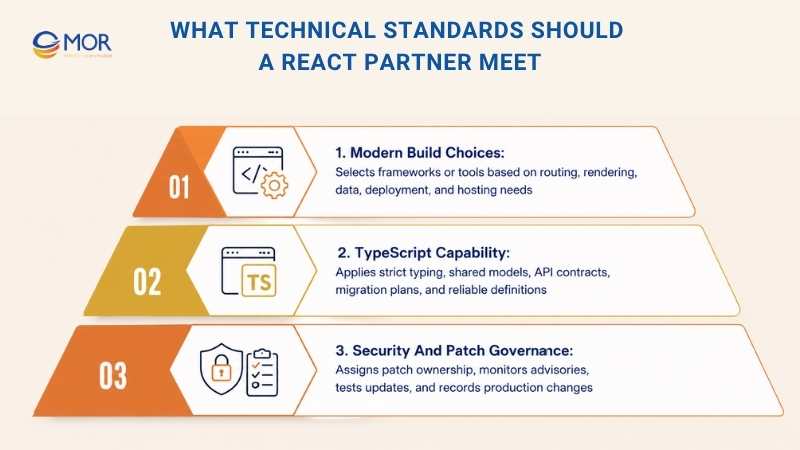
TypeScript Capability
GitHub’s 2025 Octoverse report found that TypeScript became its most-used language in August 2025. It grew by more than one million contributors, up 66% year over year, and moved ahead of Python and JavaScript under GitHub’s contributor-count method.
Ask how the team manages strict typing, shared data models, generated API types, gradual JavaScript migration, and third-party definitions. TypeScript alone does not create safe code, but weak typing removes much of its value.
Security And Patch Governance
React disclosed a CVSS 10.0 React Server Components vulnerability in December 2025. The first fix reached versions 19.0.1, 19.1.2, and 19.2.1, followed by later fixes for related denial-of-service and source exposure issues.
That incident gives buyers a useful question: Who owns package monitoring and urgent patches? A vendor should name the owner, review advisories, test updates, and document production changes.
What Risks Can Derail React JS Outsourcing?
Most outsourcing failures begin with unclear ownership, weak information, or poor delivery control. Record each risk beside a practical prevention and recovery step.
No. | React JS Outsourcing Risk | How To Prevent Or Recover |
1 | Unclear requirements: Vague user flows and acceptance rules cause rework and disputes. | Document user stories, technical needs, and acceptance criteria. Review them at each planning session. |
2 | UI and UX interpretation gaps: Built screens may differ from approved designs. | Share complete Figma files, breakpoints, interaction notes, and design-system rules. Review UI work during each sprint. |
3 | Inconsistent component architecture: Different patterns create duplicate code and high maintenance work. | Agree on component structure, naming, state rules, and architecture records before implementation. |
4 | Weak API documentation: Missing payloads and error rules block frontend work. | Supply endpoint details, sample data, authentication rules, mocks, and error responses. |
5 | Scope creep: Informal requests increase cost and extend delivery. | Use a written change process that records effort, budget, priority, and schedule effects. |
6 | Limited time-zone overlap: Slow answers delay feedback and technical choices. | Set shared work hours, response targets, escalation contacts, and async update rules. |
7 | Poor code review: Security, performance, and maintenance issues build up. | Require pull-request reviews, automated checks, branch rules, and shared repository access. |
8 | Insufficient test coverage: New releases break existing behaviour. | Set unit, integration, browser, and responsive test targets. Run them through CI. |
9 | IP disputes: Weak contracts create uncertainty around source ownership. | Add NDA, IP transfer, third-party code, and repository ownership terms. |
10 | Excessive access: Developers receive more data or system access than their role needs. | Apply least-privilege permissions, separate environments, logs, and regular access reviews. |
11 | Vendor dependency: Internal staff cannot maintain the product after handover. | Keep internal engineers in reviews and request ongoing documentation and knowledge sessions. |
12 | Hidden costs: Extra fees appear for management, environments, deployment, or support. | Request a full cost breakdown with assumptions, exclusions, licences, and support rates. |
13 | Unexpected staff turnover: Delivery slows when knowledge sits with one engineer. | Require backup staff, shared ownership, current documents, and replacement terms. |
Risk control should begin before you outsource React JS development. Contracts can settle commercial issues, but daily practices protect code quality and continuity.
Keep your repository under company access. Review progress through working software, not status reports alone. Record architecture choices as they happen rather than rebuilding the project history before handover.
How To Choose And Validate A React JS Outsourcing Partner
A polished sales presentation says little about daily delivery. Score each outsource React JS development company against evidence tied to your own project.
Vendor Scorecard
Evaluation Area | Weight | What To Examine |
React technical depth | 20% | Architecture, TypeScript, testing, performance, and security |
Relevant project evidence | 15% | Similar product type, scale, integrations, or field |
Team quality | 15% | Seniority, interviews, communication, and role coverage |
Delivery process | 15% | Planning, demos, reports, acceptance, and escalation |
Code quality and QA | 10% | Reviews, automated tests, metrics, and documentation |
Security and IP protection | 10% | NDA, permissions, development controls, and source ownership |
Commercial clarity | 10% | Rates, assumptions, exclusions, change rules, and payment |
Handover and maintenance | 5% | Documents, replacement, continued care, and exit plan |
Weights can change around your risk. A regulated healthcare system may place more weight on security and domain work. An early MVP may place more weight on team speed and product thinking.
Evidence To Request
Ask each shortlisted company for material that shows how it works:
- React case studies tied to a clear business problem
- Architecture samples with reasons behind key choices
- An anonymized code sample
- Test plan and sample test report
- Sample sprint or project status report
- CVs for proposed team members
- Security and access process
- Client references for related work
- Maintenance response terms
- Knowledge-transfer plan
Case studies need more than a technology list. Look for scope, constraints, team size, delivery length, technical choices, and business results.
Technical interviews also help. Let your engineering lead speak with the proposed developer or architect instead of meeting only an account manager.
Red Flags
Treat these signs as reasons for deeper review:
- The proposal repeats generic React benefits but barely mentions your application.
- The vendor cannot explain why it selected a tool or architecture.
- QA, project management, cloud work, or deployment sits outside the quoted price without clear notice.
- You cannot interview proposed team members before contract signing.
- Case studies contain no challenge, delivery detail, or result.
- Estimates arrive before the vendor reviews dependencies.
- Source-code access remains under vendor control.
- The contract lacks staff replacement and exit terms.
Run A Paid Pilot
A paid pilot can test the working relationship before a large commitment. Choose an isolated function, technical audit, design-system component, or discovery task that produces usable output.
Measure estimate accuracy, code quality, communication, test work, documentation, and response to feedback. A short pilot often reveals more than another sales call.
Avoid unpaid production tests. They attract rushed work, weaken accountability, and create unclear ownership.
Drive Better Outcomes For React JS Development Outsourcing With MOR Software
MOR Software works with companies that need more React capacity, full web delivery, system integration, QA, or a stable offshore IT outsourcing team. Its service range connects frontend work to the analysis, backend, cloud, testing, and maintenance tasks that shape the final product.
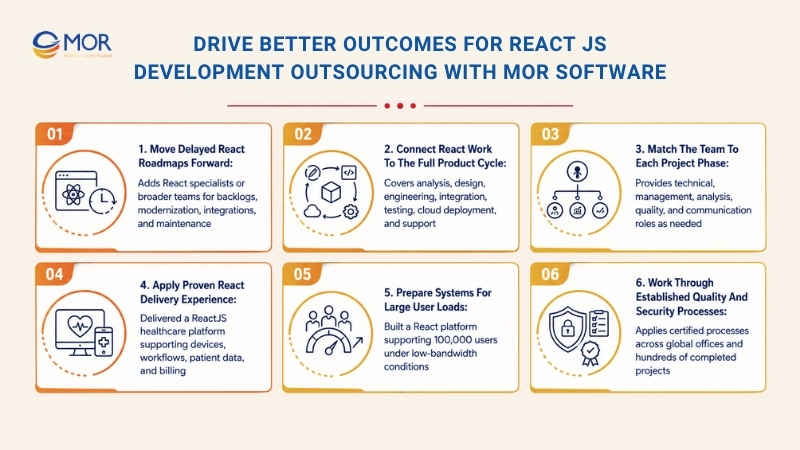
- Move delayed React roadmaps forward: MOR Software can assign React engineers to an existing team or form a broader project group. This setup fits delayed frontend backlogs, missing technical skills, legacy renewal, complex API work, and continued product care.
- Connect React work to the full product cycle: MOR Software covers business analysis, UI and UX design, frontend and backend engineering, integration, testing, cloud deployment, and maintenance. Its documented stack includes React.js, Vue.js, Angular, Node.js, Python, Java, .NET, PHP, Go, AWS, Google Cloud, and Microsoft Azure.
- Match the team to each project phase: MOR Software’s offshore software outsourcing model supports project managers, business analysts, software architects, developers, QA and QC engineers, BrSEs, and Comtors. The setup covers requirements, proposal work, candidate review, onboarding, staff operation, feedback, and team changes.
- Apply proven React delivery experience: MOR Software built the I-Medisync custom healthcare software development system through a 24-month project with 12 team members. ReactJS, Java Spring, and AWS supported medical-device connections, hospital workflows, patient data, and automated billing.
- Prepare systems for large user loads: The KPOP entertainment solution used ReactJS, React Native, and NodeJS across a 16-month project with 26 team members. It was built to serve up to 100,000 users under low-bandwidth conditions.
- Work through established quality and security processes: MOR Software materials report ISO 9001:2015 and ISO 27001:2013 certification, more than 850 completed projects across over 10 nations, and offices in Ho Chi Minh City, Ha Noi, Da Nang, Tokyo, and Osaka.
MOR Software fits startups, SMEs, and enterprises that need a custom React application, added frontend capacity, an offshore team, cloud-connected delivery, API work, QA, or long-term maintenance.
Share your current architecture, product roadmap, feature backlog, integration needs, staff gaps, and target launch date. MOR Software can map the right team structure, technical route, and delivery model for your project.
Conclusion
Choosing to outsource React JS development works best when the team, contract, and technical process match a defined business need. Compare total cost, inspect real project evidence, confirm source ownership, and test the working model before making a long commitment. MOR Software provides React development, full-cycle web services, offshore teams, cloud integration, QA, and maintenance. Contact MOR Software to discuss your roadmap, technical gaps, and target release.
MOR SOFTWARE
Frequently Asked Questions (FAQs)
What does it mean to outsource React JS development?
It means hiring an external developer or software team to build, extend, test, modernize, or maintain a React application. Your company can retain product direction, source-code ownership, architecture approvals, repository access, and release authority under the contract.
When should a company outsource React development instead of hiring internally?
Outsourcing fits urgent roadmaps, temporary workload peaks, specialist skill gaps, MVP delivery, legacy renewal, and projects that need several roles. Internal hiring fits stable, permanent work where deep company knowledge and long-term engineering ownership need to remain inside the business.
How much does it cost to outsource React JS development?
Cost depends on project size, UI complexity, team seniority, integrations, backend readiness, test coverage, security needs, vendor location, and contract model. Ask for a breakdown covering discovery, design, development, QA, cloud work, management, handover, and maintenance.
Which outsourcing model works best for a React project?
Staff augmentation works for a defined capacity or skill gap. A dedicated team suits long product roadmaps. Managed delivery fits companies that need full project coordination. Fixed price fits stable scope, while time and materials suits changing requirements.
How long does it take to onboard an outsourced React team?
Timing depends on staff availability, security checks, system access, and project complexity. Onboarding moves faster when requirements, repositories, API documents, design files, coding rules, communication channels, and decision-makers are ready before the team starts.
How can I assess the skills of outsourced React developers?
Review related case studies, interview the proposed engineers, inspect anonymized code, and ask them to explain architecture trade-offs. Check current React knowledge, TypeScript, state management, API work, testing, accessibility, performance, security, and version-management practices.
How do outsourcing companies protect source code and intellectual property?
Protection should come through an NDA, IP transfer clauses, client-controlled repositories, role-based access, separate environments, activity logs, and restrictions on code reuse. The contract should also cover third-party packages, staff departure, data handling, and final handover.
Can an outsourced React team work with our existing backend and internal developers?
Yes. External React engineers can join internal sprints, repositories, review rules, and communication channels. Clear API contracts, ownership boundaries, shared coding standards, overlap hours, and named technical contacts help the frontend and backend teams work as one delivery group.
How can we maintain code quality across different locations and time zones?
Set one engineering guide for component structure, TypeScript, testing, branches, and reviews. Use shared repositories, automated checks, CI pipelines, sprint demos, architecture records, and fixed overlap hours. Quality should remain visible through code and tests.
What support should a React outsourcing partner provide after launch?
Post-launch work may include defect fixes, dependency updates, security patches, performance checks, monitoring, small improvements, and planned releases. Confirm response targets, included hours, escalation rules, ownership, support rates, and documentation before production launch.
How do you maintain cost and quality when outsourcing React JS development?
Start with a clear scope and realistic acceptance rules. Track completed work through demos, tests, and repository activity. Use formal change control, review architecture early, keep QA active throughout development, and request a cost breakdown that includes management, deployment, and maintenance.
What are the benefits of outsourcing react js development team vs in-house hiring?
Outsourcing gives companies faster access to React specialists, flexible team scaling, and lower recruitment overhead. In-house hiring provides stronger long-term knowledge retention and direct control, but it usually requires more time, fixed employment costs, and ongoing staff management.
Share


Make Our-Dreams Realized


© 2023 . MOR Software. All Rights Reserved
Sitemap
Privacy Policy
Terms of Use

Rate this article
0
over 5.0 based on 0 reviews
Your rating on this news:
Name
*Email
*Write your comment
*Send your comment
1