


10 Key 2027 Outsourcing Trend Shifts Transforming Global Markets

The defining 2027 outsourcing trend is a shift toward AI-enabled development, specialized engineering skills, and measurable business results. Companies are reassessing outsourcing costs, delivery quality, cybersecurity, and vendor accountability as AI changes how software gets built. Hybrid sourcing and legacy system modernization are also gaining attention. In this guide, MOR Software will explore ten outsourcing trends shaping the industry in 2027 and help you make informed outsourcing decisions.
Key Takeaways
- AI-assisted development, agentic AI, and specialized engineering teams are changing how businesses outsource software projects and assess vendor performance.
- Outsourcing costs increasingly depend on engineering productivity, contract terms, security requirements, and long-term operational value rather than hourly rates alone.
- Businesses preparing for 2027 should review their sourcing models, establish measurable delivery targets, and assess vendors' technical skills, AI governance, and risk controls.
2027 Outsourcing Trend Outlook at a Glance
The 2027 outsourcing trend outlook points to changes in engineering practices, commercial agreements, and global delivery models. The following table summarizes ten developments expected to influence IT outsourcing decisions.
2027 Outsourcing Trend | Expected Business Impact | What Buyers Should Prioritize |
AI-Assisted Software Delivery | Faster coding and testing, with greater attention to code quality | Verified productivity metrics |
Agentic AI Services | New opportunities for workflow automation and enterprise integration | Human oversight and governance |
Outcome-Based Outsourcing | Greater focus on measurable project results | Clear KPIs and contract terms |
Smaller, Senior-Led Teams | Greater demand for experienced engineers and technical leaders | Skills, team structure, and output |
Security-First Outsourcing | Stronger controls for data, code, and third-party systems | Security practices and compliance |
Cloud and Legacy Modernization | Greater need for modern infrastructure and connected systems | Architecture and integration skills |
Hybrid and Multi-Shore Delivery | Flexible access to talent across different regions | Communication and delivery continuity |
GCCs and Co-Sourcing Models | Greater business control over external engineering teams | Ownership and management structure |
Specialized Engineering Providers | Higher demand for expertise in complex technologies | Relevant project experience |
Vendor Resilience and Flexibility | Greater attention to supplier dependence and operational risk | Knowledge transfer and exit planning |
These trends represent forward-looking assessments based on developments through 2026, not confirmed outcomes for 2027. Their relevance will vary according to your industry, technology needs, and existing outsourcing arrangements.
What Is Changing in Outsourcing in 2027?
Outsourcing is increasingly becoming a way to access technical capabilities that companies struggle to build internally. For businesses planning outsourcing in 2027, engineering expertise, AI readiness, delivery control, and measurable results are gaining weight alongside cost savings.
Research published in 2026 points to several changes already underway.
2026 Research Signal | Source | Implication for 2027 |
Companies are combining external providers with internal engineering teams and global capability centers. | Deloitte | Sourcing decisions will increasingly consider control, ownership, and access to specialist skills. |
AI is changing service delivery, but reliable operations still require human oversight. | KPMG Sourcing Trend Radar 2026 | Vendors will need to demonstrate how they manage AI-driven work. |
Outsourcing buyers are placing greater attention on engineering results and AI-related costs. | Brights | Contracts and pricing discussions will place greater weight on accepted deliverables. |
Cybersecurity, data sovereignty, and supplier resilience are influencing sourcing strategies. | KPMG Sourcing Trend Radar 2026 | Security controls and vendor dependence will receive closer review during procurement. |
The change in sourcing strategy is already measurable. Deloitte's April 2026 analysis found that 70% of surveyed organizations had brought previously outsourced work in-house during the preceding five years. This doesn't mean companies are abandoning outsourcing. Many are retaining core knowledge internally and using external partners for specialized work.
The main 2027 outsourcing trend for buyers is greater control over how engineering work gets delivered. Companies need to know who owns the code, how teams use AI, what performance they can measure, and what happens when a vendor relationship ends.
2027 Outsourcing Trend Forecast: Top 10 Trends to Watch
The following 2027 outsourcing trends reflect changes in software engineering, commercial models, and enterprise technology priorities. Each trend affects how businesses plan projects, select development partners, and manage delivery risks.
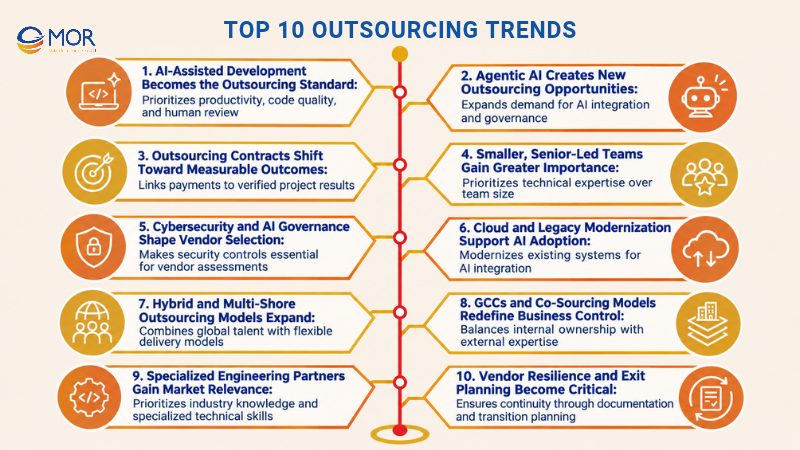
AI-Assisted Development Becomes the Outsourcing Standard
AI-assisted coding is becoming part of everyday software development. Developers use tools to generate code, prepare tests, review changes, and create documentation, allowing teams to spend more time on architecture and complex engineering problems.
The adoption rate is already high. The 2026 Stack Overflow Developer Survey reported that 80% of respondents used AI for at least one hour per day. AI adoption is now a practical consideration when evaluating engineering teams.
Yet AI-generated code still requires testing and human review. A development partner that uses AI tools without checking output can introduce defects, security issues, and additional maintenance work.
The leading 2027 outsourcing trend in AI-assisted delivery will be a greater focus on proven engineering results. Vendors will need to show what their tools achieve rather than simply advertise AI capabilities.
Businesses should compare providers using development lead time, code review practices, defect rates, and testing coverage. Request evidence from completed projects or a short technical assessment before making AI productivity part of your outsourcing budget.
For more background on changing engineering practices, see MOR Software's guide to software development trends.
Agentic AI Creates New Outsourcing Opportunities
Agentic AI is opening new areas of work for technology outsourcing providers. Unlike basic automation, AI agents can coordinate tasks, make decisions within defined limits, and interact with business applications to complete multi-step processes.
Enterprise demand is creating opportunities across agent development, system integration, monitoring, and ongoing support.
According to Boston Consulting Group's February 2026 research, agentic AI could create up to $200 billion in additional technology-services demand over the following five years. The estimate includes new implementation work, data services, and governance needs.
For example, a company could connect an AI agent to Salesforce to process customer requests, check account information, and prepare service actions. Human approval would still govern sensitive transactions or decisions outside the agent's permitted scope.
This 2027 outsourcing trend will create demand for teams that understand AI models, APIs, enterprise data, and business processes. Businesses also need controls for operating costs, access permissions, and system behavior.
A practical starting point is a limited workflow with clear success measures. Companies considering AI development outsourcing should assess the provider's ability to connect AI to existing applications and maintain reliable operations after deployment.
Outsourcing Contracts Shift Toward Measurable Outcomes
Traditional outsourcing agreements often charge clients according to developer hours or team size. As AI changes engineering productivity, buyers are placing greater attention on the work completed and the value delivered.
Outcome-based contracts connect commercial terms to agreed results. These may include project milestones, completed system migrations, service availability, or measurable changes in business performance.
For instance, a company migrating its CRM could agree on data accuracy, completed integrations, and user acceptance testing (UAT) as payment milestones. The contract would specify how each result is checked before approval.
Yet outcome-based pricing requires a defined scope. Vendors may include additional risk costs when requirements remain uncertain or depend heavily on the client's internal operations.
This 2027 outsourcing trend will likely encourage more flexible agreements rather than eliminate hourly pricing.
Fixed-price and outcome-linked models suit projects with stable requirements and measurable acceptance criteria. Time-and-materials contracts remain useful when teams need to test ideas, change priorities, or work through technical uncertainty.
Before signing, define the deliverables, quality standards, approval process, and responsibilities of each party. Contract terms should also explain how scope changes affect pricing and delivery schedules.
Smaller, Senior-Led Teams Gain Greater Importance
AI-assisted engineering is changing the skills needed to deliver software projects. Routine coding tasks can take less time, but system architecture, business analysis, and technical decision-making still require experienced professionals.
For outsourcing buyers, team structure may become more valuable than team size.
A smaller group of senior engineers can handle complex development work when supported by suitable tools and clear requirements. Yet a senior-heavy team isn't automatically the best choice for every project. Large systems may still require developers, testers, DevOps specialists, and business analysts across different skill levels.
The 2027 outsourcing trend toward smaller teams reflects a greater emphasis on engineering productivity and technical leadership.
Consider a company replacing part of an existing ERP system. Senior architects must understand data relationships and integration risks before developers begin implementation. Poor decisions at this stage can create rework that cancels out savings from faster coding.
Businesses should assess the experience of assigned engineers, their technical responsibilities, and the team's ability to solve problems independently.
The distinction between staff augmentation vs outsourcing also becomes relevant. Staff augmentation provides people who work under your internal management, whereas project outsourcing assigns a defined delivery scope to an external provider.
Cybersecurity and AI Governance Shape Vendor Selection
Cybersecurity is becoming a stronger requirement in outsourcing procurement. External development teams often access source code, customer records, cloud infrastructure, and internal business applications. AI tools introduce further questions about data sharing and system permissions.
Security investment expectations reflect these concerns. PwC's 2027 Global Digital Trust Insights survey found that 84% of surveyed security and finance leaders expected their cybersecurity budgets to increase.
The security-related 2027 outsourcing trend extends to how vendors develop software and manage access to client resources.
Businesses should review the provider's security management practices, including identity controls, incident reporting, code repositories, and software supply-chain security.
AI governance requires similar attention. Contracts should define which AI tools developers may use, where prompts and data are processed, and who reviews AI-generated code or automated decisions.
ISO/IEC 27001 can support vendor assessments, but certification alone doesn't prove compliance with every client requirement. Businesses serving European customers must also consider applicable obligations under GDPR, the EU AI Act, and other relevant regulations.
Request documented security controls and confirm how the provider applies them throughout development, testing, deployment, and support.
Cloud and Legacy Modernization Support AI Adoption
Many businesses want to introduce AI into existing systems, but outdated applications and disconnected databases create integration problems. Legacy software may lack reliable APIs, consistent data structures, or the computing capacity required for new workloads.
These limitations are increasing the demand for outsourced modernization services.
Modernization can involve moving applications to AWS or Azure, updating backend systems, building API connections, or preparing business data for AI applications.
Full system replacement isn't always necessary. Companies can modernize selected components and retain stable business functions during the transition.
For example, MOR Software integrated Salesforce with a Japanese company's legacy attendance management system. Our engineers used API Gateway and ETL processes to connect existing records with Salesforce and support bidirectional data synchronization.
This project demonstrates how enterprise integration can extend the value of existing software.
For the 2027 outsourcing trend in modernization, businesses should prioritize technical assessment before development begins. Review system dependencies, identify data quality problems, and decide which components need replacement or integration.
A staged approach also makes testing and rollback planning more manageable when older applications remain central to daily operations.
Hybrid and Multi-Shore Outsourcing Models Expand
Companies are reassessing where engineering teams should work and how different locations can support the same project. Hybrid sourcing combines internal staff with external teams, while multi-shore delivery distributes work across onshore, nearshore, and offshore locations.
These models allow businesses to match technical tasks with available skills, collaboration needs, and budget limits.
For example, a US technology company might retain product leadership locally, work with nearshore engineers during business hours, and assign selected development tasks to a team in Vietnam.
Time-zone differences can support planned handoffs. They also create delays when teams need immediate decisions or daily technical reviews.
The geographic 2027 outsourcing trend will depend on more than labor rates. Buyers need to consider language skills, technical expertise, legal requirements, infrastructure, and operational continuity.
Vietnam remains relevant for offshore software engineering, particularly for businesses seeking additional development capacity in Asia. Eastern Europe and Latin America also serve different market needs based on regional access and working-hour overlap.
Businesses comparing the best countries to outsource software development should assess their actual project requirements before selecting a location.
Shared coding standards, regular sprint reviews, and agreed communication hours can keep distributed engineering teams working toward the same delivery goals.
GCCs and Co-Sourcing Models Redefine Business Control
Global capability centers (GCCs) are gaining attention among businesses that want greater ownership of technical operations outside their home markets. A GCC generally operates as part of the company's internal organization, with management and business processes controlled directly by the parent company.
Co-sourcing provides another approach. Internal employees and external providers share defined responsibilities under a coordinated operating model.
A related option is build-operate-transfer (BOT), where an external partner establishes and initially operates a team before transferring ownership according to the agreement.
These structures address a common outsourcing concern: how much control should remain with the client?
The 2027 outsourcing trend toward blended sourcing models reflects the need to retain product knowledge while gaining access to specialized engineering skills.
A business developing a long-term SaaS platform may want its architects and product owners to remain internal. External engineers can then contribute additional development capacity or specialist expertise under shared technical standards.
The dedicated development team model can fit this arrangement when clients want direct control over priorities without managing every recruitment and payroll task.
Before choosing a model, compare setup costs, management duties, intellectual property ownership, staff retention, and long-term operating plans. GCCs require more internal resources, while co-sourcing and dedicated teams provide different levels of external operational support.
Specialized Engineering Partners Gain Market Relevance
General software development capacity remains useful, but complex projects often require knowledge that extends beyond programming languages.
Businesses increasingly need engineers familiar with AI systems, cloud architecture, cybersecurity, enterprise platforms, and industry-specific operations.
A healthcare application, for example, requires careful handling of patient information and integration with medical systems. A financial platform may need strict access rules, reliable transaction processing, and detailed audit records.
These requirements influence architecture, testing, and delivery decisions.
The specialist-focused 2027 outsourcing trend is likely to increase attention on domain experience during vendor selection.
A provider experienced in Salesforce customization may be suitable for a CRM modernization project. Another team with skills in Java, React, AWS, and medical device integration may be better suited to healthcare software.
Buyers should ask for project examples that match their requirements. Review the technologies used, problems solved, team responsibilities, and documented results.
Relevant experience can also improve early technical discussions. Engineers familiar with the industry can identify integration problems, data access needs, and testing requirements before development work becomes expensive.
Specialized outsourcing works best when the provider understands the system's business purpose and has the technical skills required to deliver it.
Vendor Resilience and Exit Planning Become Critical
Vendor dependence creates business risk when external teams control key systems, documentation, or technical knowledge. Changes in supplier pricing, staffing, ownership, or operating conditions can disrupt ongoing software projects.
AI projects introduce further concerns when solutions depend on proprietary tools or undocumented agent workflows.
Gartner's September 2026 research on forward-deployed engineering predicts that 70% of enterprises will abandon agentic AI built through vendor forward-deployed engineering by 2028. The forecast points to high costs and limited internal ability to maintain these systems.
That prediction applies to this particular AI delivery model, not all outsourced AI projects.
The vendor resilience 2027 outsourcing trend will place greater attention on ownership, portability, and service continuity.
Businesses should define source-code access, intellectual property rights, documentation standards, and transition responsibilities before development begins.
A knowledge transfer plan should cover system architecture, deployment procedures, dependencies, and operational instructions. Regular documentation reviews can prevent the loss of technical knowledge when developers leave a project.
Companies planning a vendor change can also review MOR Software's guide to vendor transition solution planning.
Exit arrangements work best when teams prepare them at the start of the engagement rather than after problems arise.
What Will 2027 Outsourcing Trend Mean for Costs and ROI?
The 2027 outsourcing trend toward measurable results is changing how businesses assess development spending. Hourly rates remain relevant, but they provide an incomplete view of project value.
A lower-priced team may require more supervision, rework, or maintenance. A higher-priced specialist team may finish a defined project with fewer defects and less internal management effort.
Businesses should compare the full cost of delivery against measurable financial and operational results.
Cost or ROI Factor | What to Measure | Potential Risk | Recommended Action |
Engineering Productivity | Time needed to complete accepted work | Inflated AI productivity claims | Compare delivery results against a baseline |
Software Quality | Defect rates, failed tests, and rework | Faster coding with unreliable output | Review testing and release quality |
AI Operating Costs | Tool fees, model usage, hosting, and monitoring | Unexpected recurring charges | Set usage limits and budget controls |
Contract Performance | Accepted deliverables and agreed KPIs | Unclear ownership of results | Define acceptance criteria before delivery |
Knowledge Retention | Documentation and internal technical ownership | Vendor lock-in | Require regular knowledge transfer |
Total Cost of Ownership | Development, integration, support, and maintenance | Hidden long-term spending | Compare costs across the software lifecycle |
ROI calculations should account for direct vendor payments and related costs. These include internal project management, onboarding, cloud services, security reviews, and maintenance.
For example, an outsourced development project may finish earlier than an internal build. Yet the final ROI depends on how much the company spends after launch and whether the software meets its business targets.
Track indicators that reflect your project's purpose. A customer platform may prioritize user adoption and revenue, whereas an internal ERP integration may focus on data accuracy, manual processing time, and system reliability.
How to Choose an Outsourcing Partner in 2027
Selecting an outsourcing partner requires a closer review of technical skills, security practices, and commercial accountability. The 2027 outsourcing trend toward specialized delivery means that general claims about experience or low costs carry less weight without supporting evidence.
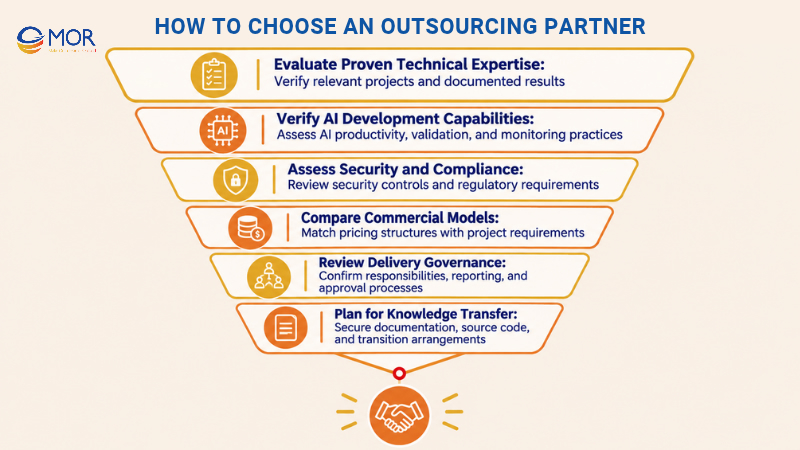
A structured assessment should cover the following areas.
- Evaluate Proven Technical Expertise: Review completed projects that match your industry, architecture, and technology requirements. Ask which engineers were involved, what problems they solved, and which outcomes were documented. Relevant experience is more useful than a long list of programming languages.
- Verify AI Development Capabilities: Ask vendors how their engineers use AI tools, check generated code, and protect confidential information. Request examples of measurable productivity changes and technical validation. For agentic AI projects, review model monitoring, access permissions, and human approval processes.
- Assess Security and Compliance: Examine information security policies, relevant certifications, code access procedures, and incident response plans. Check how the provider handles client data and third-party services. Regulatory duties should be mapped to the actual project rather than assumed from a certificate.
- Compare Commercial Models: Review fixed-price, time-and-materials, dedicated team, and outcome-linked agreements. Match pricing to the stability of your requirements. Confirm which services, tools, change requests, and maintenance tasks are included in the proposed cost.
- Examine Delivery Governance: Identify the project manager, technical lead, approval process, and reporting schedule. Ask how teams track development work through Jira or similar systems and how they respond when milestones slip. Clear responsibilities make delivery problems easier to resolve.
- Plan for Knowledge Transfer: Confirm source-code ownership, documentation requirements, deployment access, and exit terms. A provider should explain how your internal team or a replacement vendor can maintain the software after the engagement.
The most suitable partner is the one whose technical capabilities, delivery practices, and contractual commitments match your project requirements. Price becomes easier to compare once those expectations are defined.
How MOR Software Helps Businesses Adapt to 2027 Outsourcing Trend
Adapting to 2027 outsourcing trends requires businesses to reassess how they develop software, manage costs, and work with external teams. At MOR Software, we help clients turn these changes into practical development plans based on their existing systems, technical needs, and business priorities.
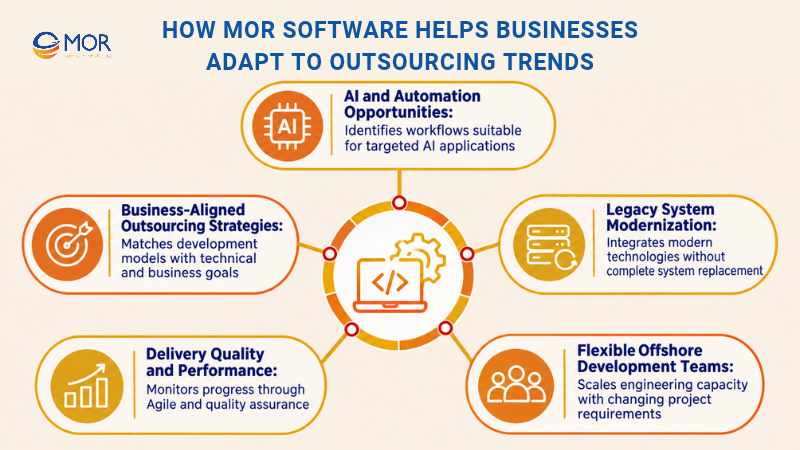
Our software outsourcing services focus on four areas:
- Identify Opportunities for AI and Automation: We assess existing workflows to find tasks where AI can limit manual work and improve accuracy. For example, our team developed AI-based spam detection for a Japanese healthcare employment platform, helping filter irrelevant reviews and maintain data quality. This experience demonstrates how businesses can start with targeted AI applications before expanding automation.
- Modernize Existing Systems Without Full Replacement: Businesses can adopt new technologies without rebuilding their entire infrastructure. MOR Software helped a Japanese company integrate Salesforce with its legacy attendance management system through API Gateway and ETL processes. The integration supported bidirectional data synchronization and continued use of existing business records.
- Build Flexible Offshore Development Teams: Instead of committing to a fixed workforce, businesses can adjust engineering capacity as project requirements change. Through our offshore development services, we manage recruitment and team operations while clients control development priorities. Our long-term PEOPLE project in Japan involved nearly 100 MOR engineers as the HRM platform expanded.
- Measure Delivery Quality and Performance: We apply Agile development, sprint reviews, and quality assurance practices to help clients monitor progress and address technical risks. Our KCON entertainment application project, designed to support up to 100,000 users, demonstrates our experience planning scalable systems for demanding operating conditions.
Businesses preparing their outsourcing strategy for 2027 can contact MOR Software to assess technical requirements, identify suitable development opportunities, and select an outsourcing model aligned with their goals.
Conclusion
The 2027 outsourcing trend outlook points toward AI-enabled engineering, specialized talent, stronger security, and contracts tied to measurable results. Businesses should review their development needs, compare sourcing models, and establish clear delivery standards before selecting partners. MOR Software supports these decisions through software development, offshore teams, enterprise integration, and quality assurance.
If you're planning a new project or reassessing your current vendor, contact us to discuss your requirements and identify a suitable delivery approach.
"Learn from the past, embrace the present, and look forward to the future. The key is to never stop questioning."
Le Manh Hung


CTO MOR Software
MOR SOFTWARE
Frequently Asked Questions (FAQs)
What is the biggest 2027 outsourcing trend?
The biggest 2027 outsourcing trend is the shift toward AI-enabled development and measurable business results. Companies are increasingly evaluating outsourcing partners based on technical expertise, delivery quality, and productivity. AI governance, specialized engineering skills, and flexible sourcing models are also expected to influence vendor selection.
How will AI change IT outsourcing in 2027?
AI will change IT outsourcing through automated coding, testing, documentation, and business workflows. Agentic AI will also create new work involving system integration and ongoing management. Development teams will need stronger technical review practices, AI governance, and skills for maintaining systems that use automated decisions.
Will AI replace software outsourcing companies?
AI is unlikely to eliminate software outsourcing companies. It can automate parts of routine development, but businesses still need engineers for architecture, enterprise integration, security, and complex problem-solving. Providers will need to demonstrate how their teams use AI to improve delivery quality and business outcomes.
Are outcome-based outsourcing contracts better than hourly rates?
Outcome-based contracts work well when project requirements and results can be defined clearly. They connect payments to agreed deliverables or performance targets. Hourly agreements remain suitable for projects with changing requirements. Businesses should compare contract flexibility, risk allocation, and the cost of managing scope changes.
How will outsourcing costs change in 2027?
Outsourcing costs will depend on engineering skills, location, AI usage, security requirements, and contract structure. AI may shorten certain development tasks, but specialist expertise and ongoing system management still carry costs. Businesses should compare total project spending rather than assume AI will automatically lower vendor prices.
What are the main risks of outsourcing in 2027?
Major IT outsourcing risks include data breaches, poor software quality, unclear intellectual property rights, vendor dependence, and communication problems. AI-related risks include unauthorized data sharing and unreliable automated decisions. Businesses should address these issues through documented controls, technical testing, clear contracts, and planned knowledge transfer.
Is nearshore or offshore outsourcing better in 2027?
Nearshore outsourcing often suits projects that require frequent collaboration during shared business hours. Offshore outsourcing can provide access to broader engineering talent pools and different cost structures. The better choice depends on your budget, technical requirements, management capacity, and ability to coordinate distributed development teams.
Which IT skills will be most in demand for outsourcing?
AI engineering, cloud architecture, cybersecurity, data engineering, enterprise integration, and legacy system modernization are likely to remain sought-after outsourcing capabilities. Businesses also need experienced software architects, DevOps engineers, and quality assurance specialists who can manage complex systems and review AI-assisted development work.
How can businesses evaluate AI outsourcing providers?
Businesses should review completed AI projects, engineering skills, security practices, and delivery results. Ask vendors how they test AI-generated code, manage model access, monitor performance, and handle system failures. A short pilot with agreed technical and business targets can help verify the provider's capabilities.
Why is Vietnam relevant for software outsourcing in 2027?
Vietnam remains an option for companies seeking offshore software development teams with experience in web, mobile, cloud, and enterprise applications. Its relevance also extends to AI engineering, as discussed in MOR Software's article on Vietnam as Southeast Asia’s AI development hub. Companies reviewing promising IT outsourcing destinations in Asia should compare technical skills, delivery costs, communication, and project fit.
Share


Make Our-Dreams Realized


© 2023 . MOR Software. All Rights Reserved
Sitemap
Privacy Policy
Terms of Use

Rate this article
0
over 5.0 based on 0 reviews
Your rating on this news:
Name
*Email
*Write your comment
*Send your comment
1