


Custom Web App Development Services: Comprehensive Guide 2026
Many businesses start with a website, then hit a wall when orders, approvals, reports, and customer data spread across too many tools. Custom web app development services solve that problem with browser-based software built around real workflows. This MOR Software’s guide will walk you through custom web app development, costs, technologies, benefits, and how to choose the right partner.
Key Takeaways
- Custom web apps turn daily work into clear digital flows. They help teams manage data, roles, approvals, reports, and customer actions in one shared system.
- The right development scope goes beyond coding. Strong projects include business analysis, UX/UI design, frontend, backend, integrations, cloud setup, testing, and long-term support.
- Partner choice shapes the final result. Look for technical skills, security standards, proven case studies, clear communication, and post-launch care before signing.
What Is Custom Web App Development?
Custom web app development means building a browser-based application around your real business needs, not forcing your team into a ready template. The app runs in a web browser like Chrome or Safari. Your team does not need a complex setup to open it from a laptop or phone. Think of it like workwear made to measure. It feels right because it is built for daily use.
A business can build this kind of online tool for staff, customers, or both groups. For internal teams, it can handle orders, stock, predictive lead scoring, requests, and approvals. For customers, it can support bookings, payments, tracking, and account access. The idea is easy to grasp. People stop doing the same task twice because the software follows the way they already work.
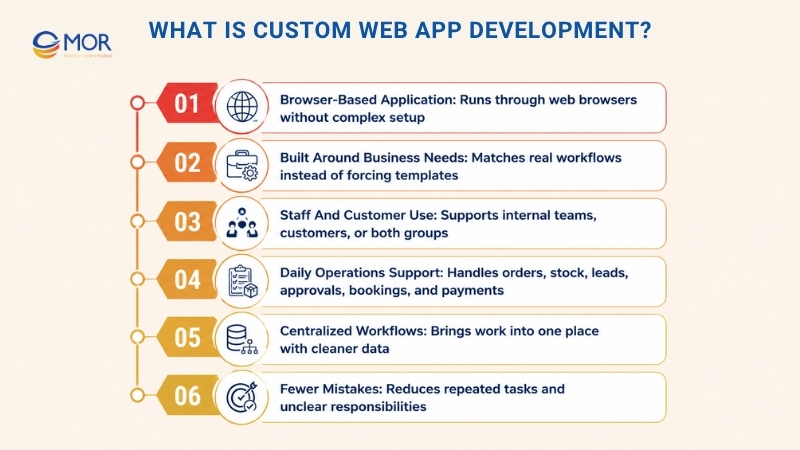
Many companies start with spreadsheets and a basic website. That setup may work in the early days. As the team grows, small gaps turn into daily stress. A custom web application brings work into one place with cleaner data, clearer roles, and fewer mistakes. This custom web app development guide helps explain when that shift makes sense.
What’s Included In Custom Web App Development Services?
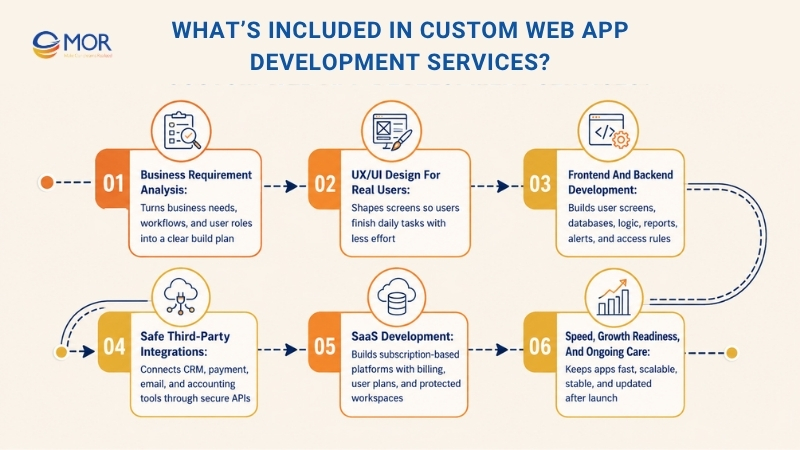
Tailored web application development goes far beyond visual design and code. A trusted team first studies how your business works, then shapes the application around those daily tasks. This is why custom web app development solutions can feel simple for users, even when the rules behind the system are complex. The full scope also covers testing, security, launch, and care after release.
Business Requirement Analysis
This step turns business needs into a clear build plan. The team maps how orders move, how approvals happen, and where data should live. They also define user groups, including managers, staff, vendors, and customers. Custom web app development consultants help cut confusion here because everyone agrees on the same product scope before coding starts.
UX/UI Design For Real Users
This is where the application screens are shaped around real people. Layouts, buttons, and forms are planned so users can finish tasks with less effort. In custom web app development services, simple paths matter because users should not feel lost inside the product. Good design is not about looking expensive. It is about making the app clear enough for everyday work.
Frontend And Backend Development
The frontend is the part users touch and see on the screen. The backend handles the database, rules, and logic behind that screen. Together, they support logins, dashboards, reports, alerts, and role-based access. Clean code and a structure that can grow are also part of custom web applications development.
Safe Third-Party Integrations
Most companies already depend on tools like CRM systems, payment services, email platforms, or accounting software. Integrations link those tools with your web app so data can move without manual updates. A safe plan for custom web app development services also checks each connection, since one weak link can expose customer data. Secure APIs, access rules, and data controls all matter here.
SaaS Development
SaaS software development builds web applications for many users, teams, or companies under a subscription model. This often includes account setup, user plans, billing, access levels, admin dashboards, and cloud hosting. MOR Software can also structure the product so each customer gets a protected workspace with proper data separation. This fits businesses that want to launch a software product, turn an internal tool into a public platform, or build a digital service that can grow.
Speed, Growth Readiness, And Ongoing Care
Speed matters, even when the app is only for internal teams. If a system feels slow, people avoid it and return to old habits. Growth readiness means the app still runs well as users, orders, and records increase. Ongoing care covers bug fixes, updates, and small product changes after launch. A web app does not stop needing work on release day. It needs regular upkeep to stay stable.
Custom Web Apps Vs Traditional Websites: What’s The Differences?
A website is mostly built for reading and browsing. Visitors open pages, learn about the business, and take simple actions like filling out a contact form. A web app is built for action. Users log in, finish tasks, edit records, and work with data. The difference becomes more serious as a company grows.
Traditional websites are a good fit for marketing and brand trust. They help people find your business on Google, understand your services, and contact your team. But they are not made for complex work. Dashboards, live updates, user roles, and approval steps are not built in from the start. Plugins can add some of this, but too many plugins can create new problems later.
The difference between web development and app custom web development comes down to control over work and data. MOR Software’s team can build login systems, admin areas, reports, and integrations that follow your real process. That is why custom web app development services feel more like business software than a normal website.
Area | Traditional Website | Custom Web App |
Main Goal | Present information and build trust | Help users complete real tasks |
Common Users | Public visitors | Logged-in staff, partners, or customers |
Login And Roles | Rarely needed | Often built with role-based access |
Data Work | Displays page content | Saves, updates, and processes business data |
Workflow Support | Mostly limited to forms | Built for approvals, tracking, reports, and task steps |
Tool Connections | Basic or plugin-based | Secure API links with CRM, payment, and ERP tools |
Updates | Content edits are simple | Planned releases and testing are needed |
Growth Needs | Mostly website traffic | Traffic, users, data, and workflows grow together |
Best Use | Blogs, company sites, service pages | Dashboards, portals, SaaS products, and internal tools |
Long-Term Control | Often limited by platforms and plugins | Strong control through tailored web application design |
Why Businesses Move From Websites To Custom Web App Development Services
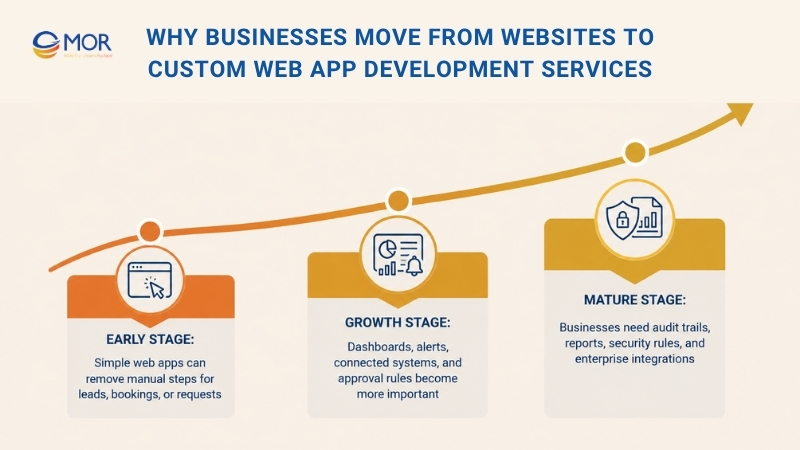
A website works well when the task is simple. It can show services, collect leads, and share contact details. But many companies later find that their website works like a nice poster. It looks fine, yet it does not help the team get work done. That is when custom web app development services become a better fit.
This change often starts when daily work becomes hard to track. Orders sit in one spreadsheet, support requests stay in another tool, and reports move through email. Small errors build up over time. Staff also lose time asking, “Which file is right?” or “Who approved this?” A custom website application can bring tasks, users, and data into one system.
Tailored web application development also helps when teams need clear access rules. Customers should only see their own data, managers should approve key actions, and staff should only view assigned tasks. Ready-made tools may handle part of this, but they may not match your process. That is why more teams move toward custom-built web systems as operations grow.
Early Stage
In the early phase, speed often matters more than a perfect setup. A simple website with a few support tools can be enough. Still, a small team may need one focused web app for lead tracking, booking, or internal requests. At this point, a custom system removes manual steps so the team can move faster.
Growth Stage
Growth is where hidden cracks start to show. More customers bring more orders, messages, updates, and follow-ups. Teams begin to need dashboards, alerts, and connected systems. User roles and approval rules also become harder to manage. MOR Software often builds web apps at this stage to keep work clear and reduce daily disorder.
Mature Stage
At the mature stage, control and stability become the main focus. The business may need audit trails, deeper reports, security rules, and strong links with CRM, ERP, or finance tools. Performance also matters more because many users may work inside the platform at the same time. Strong custom web app development capabilities keep everything inside one system without constant patch fixes.
Common Types Of Custom Web App Development Services
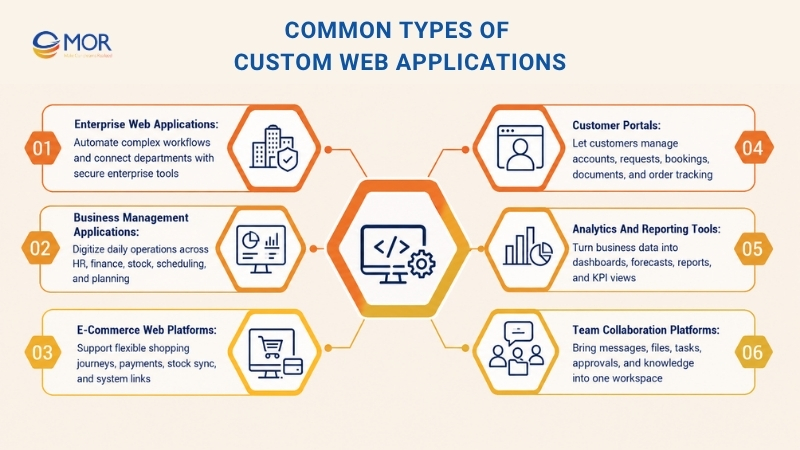
Every business has its own goals, users, and technical needs. That is why custom web app development services are built around real use cases instead of a one-size product. Enterprise systems, customer portals, analytics tools, e-commerce platforms, and custom web and mobile applications all solve different business problems. They also help teams work better and support long-term digital growth.
Enterprise Web Applications
Enterprise web applications support large companies with complex work across many departments. MOR Software can build systems that automate workflows, gather business data in one place, and connect with ERP, CRM software, accounting, and other core tools. These applications also need strong security, role-based access, and enough capacity for large user groups.
Business Management Applications
Business management applications replace manual daily work with digital flows. These systems can cover project tracking, stock control, HR, buying, finance, scheduling, and resource planning. When several tasks sit inside one platform, teams work together more easily, spend less time on admin, and get a clearer view of company performance.
E-Commerce Web Platforms
Custom e-commerce platforms give businesses more control than ready-made store builders. They can include personal shopping journeys, flexible pricing, AI productivity tools, stock sync, multi-vendor selling, secure payment flows, loyalty programs, and links with ERP, CRM, and marketplace tools. Custom web app development services also help these platforms support better customer journeys and future growth.
Customer Portals
Customer portals give users a safe self-service space. They can manage accounts, track orders, open documents, send support requests, booking platform, and contact your business at any time. A well-built portal can make customers happier, lower support workload, and give users faster access to the details they need.
Analytics And Reporting Tools
Analytics and reporting tools turn large sets of business data into clear views. They can include live dashboards, real-time reports, forecast tools, and custom charts. Leaders can track KPIs, spot trends, plan ahead, and make faster decisions across departments.
Team Collaboration Platforms
Team collaboration platforms match the way your company shares work, files, and updates. They can bring messaging, file sharing, shared documents, task boards, video meetings, approval steps, and knowledge bases into one safe workspace. Custom access rules and strong security also help remote teams work together while protecting sensitive business data.
Top Benefits Of Custom Web App Development Services
custom web app development services help companies leave scattered tools and manual steps behind. Instead of one spreadsheet for orders, one app for support, chat tools for updates, and email for approvals, a custom web app brings your workflow into one place. Teams get clearer steps, better roles, and stronger data visibility.
For growing firms, the main value is not just having another digital tool. The real gain comes from software built around how the business already runs. MOR Software’s team can help remove repeated work, connect tools that do not talk to each other, improve reports, and support growth with a system that fits your team.
These custom web app development solutions bring several clear gains for business teams.
Centralized Business Workflows
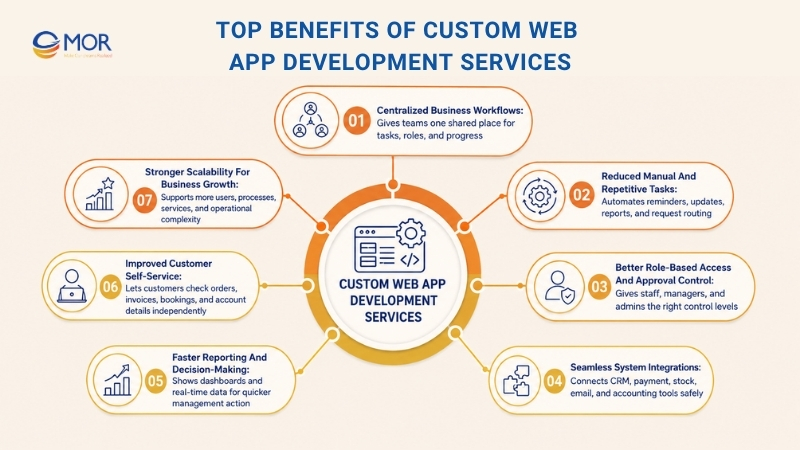
A custom web app gives your team one shared place to handle daily tasks. Staff no longer need to jump between spreadsheets, email threads, chat apps, and separate tools. Everyone can follow the same process in the same system. This lowers confusion, improves task ownership, and makes progress easier to check.
Reduced Manual And Repetitive Tasks
Copying and pasting data by hand wastes time and often creates mistakes. A tailored web application can handle repeated jobs like reminders, order status updates, report creation, and request routing. Staff can then spend more time on useful work instead of routine admin tasks.
Better Role-Based Access And Approval Control
Many companies need clear approval paths for discounts, refunds, price changes, reports, or internal requests. Ready tools may not follow those rules in the right way. MOR Software can build role-based access so staff, managers, and admins each get the right level of control.
Seamless System Integrations
When CRM, payment, stock, email, and accounting tools do not connect, staff must update the same data again and again. That can create wrong records and missed follow-ups. custom web app development services connect these tools through safe integrations so data can move across the business with less manual work.
Faster Reporting And Decision-Making
When weekly reports take hours to prepare, the system is holding the business back. A custom web app can show live dashboards, scheduled reports, and real-time performance data. Owners and managers can act faster because they do not need to wait for updates from separate teams.
Improved Customer Self-Service
Customers often contact support teams to ask about order status, invoices, bookings, or account details. A customer portal can let them handle those actions on their own. This improves the customer experience and gives support teams more time for harder issues.
Stronger Scalability For Business Growth
A basic website can support marketing, but it cannot manage complex flows, roles, live data, and daily operations for long. As the company grows, a custom web app becomes more useful because the business gets software that can grow with new users, new processes, and new service needs.
Key Technologies In Custom Web App Development Services
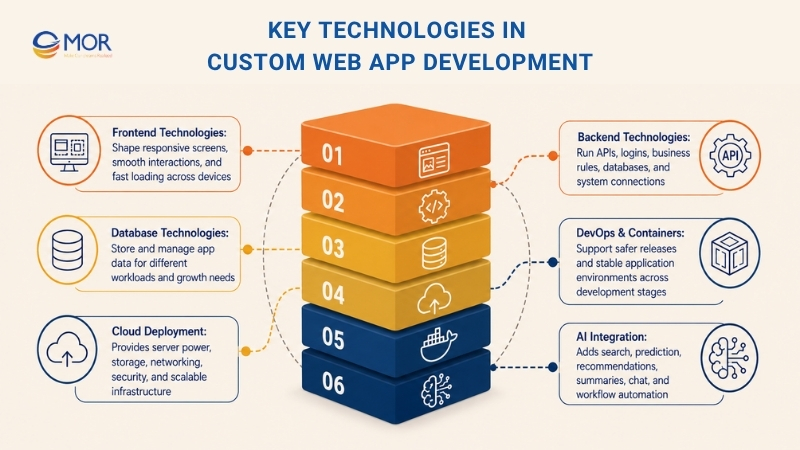
The quality of a web app depends on more than its functions. The technology behind it shapes speed, security, growth, and long-term maintenance. In custom web app development services, the project team chooses frontend tools, backend platforms, databases, cloud services, and support tools based on business goals, user traffic, and security needs. Many modern web apps use the technologies below.
Frontend Technologies
Frontend technologies shape what users see and how they use the app. They support responsive screens, smooth user actions, and fast page loading across browsers and devices.
Technology | Best Fit | Main Strengths |
React | Interactive web apps and SaaS platforms | Component-based structure, reusable UI parts, wide ecosystem, fast rendering with Virtual DOM |
Vue.js | Startups, SMEs, and quick product builds | Light structure, simple learning path, easy integration, strong performance |
Angular | Enterprise web applications | Full development structure, TypeScript support, built-in security tools, large-scale app design |
Next.js | SEO-focused sites and web apps | Server-side rendering, static site generation, better search visibility, strong Core Web Vitals support |
Backend Technologies
The backend runs business rules, APIs, login flows, database calls, and system links. The right backend tool affects how well the app can grow, how easy it is to maintain, and how fast it runs.
Technology | Best Fit | Main Strengths |
Node.js | Real-time apps, APIs, and SaaS products | Strong speed, non-blocking structure, full-stack JavaScript use |
Python | AI apps, analytics tools, and business systems | Quick build speed, clean syntax, strong data science support |
.NET Core | Enterprise apps and Microsoft-based systems | Strong security, high speed, Azure support, long-term platform backing |
Ruby on Rails | MVPs and startup products | Fast build cycles, clear rules, rich library support |
Java Spring Boot | Large enterprise platforms | High reliability, strong scale, mature security tools, proven enterprise use |
Database Technologies
The database stores and manages app data. Each database type fits different data shapes, workloads, and growth needs.
Database | Best Fit | Main Strengths |
PostgreSQL | Enterprise apps and finance systems | Strong SQL functions, ACID support, reliability, good growth capacity |
MongoDB | Content platforms, IoT apps, and changing product data | Flexible document model, horizontal scaling, quick data structure changes |
Redis | Caching, sessions, and real-time apps | Very fast in-memory speed, low delay, useful for high-traffic systems |
MySQL | Business apps and e-commerce websites | Proven stability, large community, good speed, simple management |
Cloud Deployment
Cloud deployment gives web apps the server power, storage, and network base they need to run well. In custom web app development services, cloud choices often depend on traffic, security rules, budget, and the systems the business already uses.
Platform | Best Fit | Main Strengths |
Amazon Web Services | High-traffic apps and complex cloud systems | Wide service range, strong scale, global data centers, mature security tools |
Microsoft Azure | Enterprise apps and Microsoft-based workflows | Strong fit with .NET, Active Directory, and enterprise cloud needs |
Google Cloud Platform | Data-heavy apps, AI work, and analytics tools | Strong data tools, machine learning support, reliable cloud infrastructure |
DevOps & Containers
DevOps tools help teams release updates with less risk and better control. Containers keep applications stable across development, testing, and production spaces.
Technology | Best Fit | Main Strengths |
Docker | Packaging apps and services | Same app setup across machines, easier testing, simpler deployment |
Kubernetes | Large container-based systems | Service scaling, auto recovery, container management, workload control |
CI/CD Pipelines | Frequent and safe releases | Automated builds, tests, and deployments with clearer release tracking |
AI Integration
AI integration adds smarter functions to web applications. These can include search, text generation, prediction, recommendations, spam checks, document summaries, and workflow support.
Technology | Best Fit | Main Strengths |
OpenAI API | AI chat, content tools, search, and workflow assistants | Strong language ability, fast setup, useful for business automation |
TensorFlow | Machine learning models and data-heavy AI systems | Model training, prediction, image analysis, and custom AI use cases |
Custom LLM Fine-Tuning | Domain-specific AI assistants | Better answers for company data, internal terms, and special workflows |
Top Custom Web App Development Services Providers In 2026
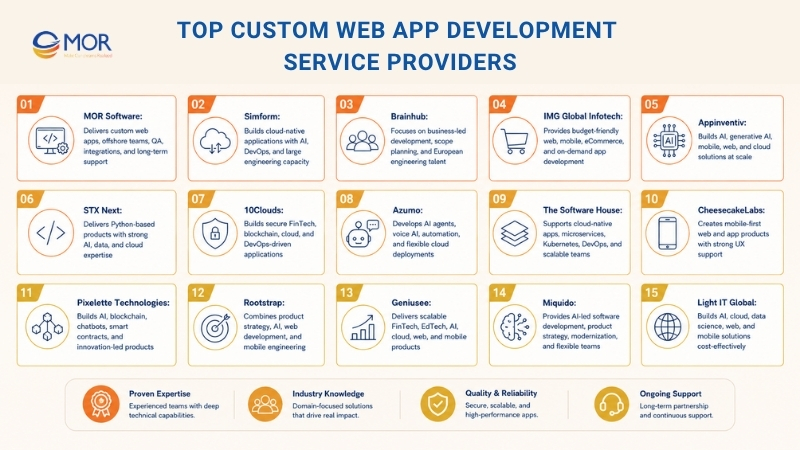
Choosing a partner for custom web app development services takes more than scanning a vendor list. Each company brings a different mix of price, delivery model, technical focus, and domain fit. The table below gives a clear view of leading providers for custom web app development outsourcing in 2026.
No | Company Name | Clutch Rating | Pricing (Hourly Rate) | Primary Location | Key Strength |
1 | MOR Software | 4.9/5 | $25-$49/hr | Vietnam, Japan | Custom Web App Development and Offshore Delivery |
2 | Simform | 4.8/5 | $25-$49/hr | USA, India | Cloud and AI Expertise |
3 | Brainhub | 4.9/5 | $50-$99/hr | Poland | Business-Driven Development |
4 | IMG Global Infotech | 4.9/5 | $25-$49/hr | India | Cost-Effective eCommerce App Development |
5 | Appinventiv | 4.7/5 | $25-$49/hr | India, USA | Generative AI Solutions |
6 | STX Next | 4.7/5 | $50-$99/hr | Poland, Mexico | AI and Data Solutions |
7 | 10Clouds | 4.9/5 | $50-$99/hr | Poland | Blockchain and FinTech |
8 | Azumo | 4.8/5 | $25-$49/hr | USA | AI Agent Development |
9 | The Software House | 4.8/5 | $50-$99/hr | Poland | DevOps and Cloud |
10 | CheesecakeLabs | 4.9/5 | $50-$99/hr | USA, Brazil | Mobile-First Development |
11 | Pixelette Technologies | 4.8/5 | $25-$49/hr | UK, USA | Blockchain and AI |
12 | Rootstrap | 4.8/5 | $50-$99/hr | USA | Strategy-Driven Development |
13 | Geniusee | 5.0/5 | $25-$49/hr | USA, Ukraine | FinTech Expertise |
14 | Miquido | 4.9/5 | $50-$99/hr | Poland | AI-Powered Solutions |
15 | Light IT Global | 4.9/5 | $25-$49/hr | Ukraine, USA | AI and Cloud Consulting |
MOR Software
MOR Software is a software outsourcing company in Vietnam that builds custom web applications, enterprise platforms, mobile apps, Salesforce systems, and offshore teams. The company serves clients in Japan, Vietnam, Korea, and other global markets, with delivery offices in Ho Chi Minh City, Ha Noi, Da Nang, Tokyo, and Osaka.
For custom web app development services, MOR Software builds practical systems that solve real work problems. Its project teams can support business analysis, UX/UI design, frontend work, backend work, cloud setup, system links, QA testing, and long-term care. This makes MOR Software a strong fit for companies that need more than a basic website or simple digital tool.
MOR Software has completed more than 850 projects for clients in 10+ nations. Its project work includes HRM platforms, healthcare systems, eCommerce management tools, CCTV software, construction collaboration apps, digital news apps, and Salesforce workforce systems. These examples show how MOR Software handles complex workflows, large user bases, legacy links, and cloud-based delivery.
Key services: Custom web application development, web app development, mobile app development, software outsourcing, offshore development center, Salesforce development, AI development services, blockchain development, IoT development, QC and testing services, IT consulting
Industries served: Healthcare, Finance and Banking, Human Resource Management, Manufacturing, Food and Beverage, Construction, Media, eCommerce, Telco, Entertainment
Notable clients and projects: Dan Tri News App, PEOPLE HRM ecosystem, KCON K-pop entertainment solution, N-CLOUD CCTV Management System, I-Medisync healthcare system, Orthocomm dental clinic management system, Salesforce and Slack workforce management system.
Technologies: ReactJS, NextJS, NodeJS, NestJS, Python, Java Spring, PHP, Laravel, .NET, C#, Angular, React Native, Swift, Kotlin, AWS, Google Cloud, Salesforce, Apex, Lightning Web Components, MongoDB, OracleDB, SQL Server
Location: Vietnam, Japan, and global delivery through offshore teams
Team size: 300+ specialists across developers, QA engineers, business analysts, project managers, BrSEs, Comtors, and software architects
Hourly rate: $25-$49/hr
Best for: Startups, SMEs, and enterprises that need a custom web application partner with fair pricing, strong teams, and proven Japan-focused delivery. MOR Software is also a strong choice when a business needs a custom web app developer with offshore team support.
What makes MOR Software different:
- Strong Vietnam-based engineering teams with offices in Ho Chi Minh City, Ha Noi, Da Nang, Tokyo, and Osaka
- Experience across web apps, mobile apps, Salesforce offshore development, AI, IoT, blockchain, and cloud software
- Proven delivery history with 850+ projects across 10+ nations
- Full-cycle web application development, covering analysis, design, coding, testing, integration, launch, and care
- Offshore team model that helps clients build teams with developers, QA engineers, PMs, BAs, BrSEs, and Comtors
- Deep work with Japanese clients in healthcare, HRM, construction, eCommerce, media, and workforce management
- Agile and Scrum delivery with short sprint cycles, clear feedback, and steady progress updates
- Strong QA support, including functional testing, performance testing, security testing, integration testing, and maintenance
- Ability to handle complex links with Salesforce, Slack, legacy systems, AWS, Google Cloud, third-party APIs, and internal systems
- Cost-effective delivery from Vietnam while keeping quality, communication, and long-term support in focus
Simform
Simform ranks #3 worldwide in Clutch’s custom software development category and has more than 1,000 engineers working on product engineering at scale. Its co-engineering model blends planning with hands-on delivery, which makes it suitable for complex business applications.
Key services: Custom software development, cloud-native development, AI/ML engineering, DevOps services, mobile and web app development
Industries served: Fintech, Healthcare, Retail, Logistics, Manufacturing
Notable clients: McDonald's, Taco Bell, Pentair, major Fortune 500 companies | Technologies: React, Node.js, Python, Angular, AWS, Azure, Kubernetes, Docker | Location: USA, India | Team size: 1,000+ | Hourly rate: $25-$49/hr
Best for: Mid-sized companies and enterprises that need cloud-native apps with strong DevOps and AI work.
What makes Simform different:
- Ranked #3 worldwide among 41,000+ companies on Clutch
- Strong skills in cloud-native architecture and microservices
- Solid AI/ML and data engineering teams
- AWS and Microsoft partnerships for enterprise cloud projects
Brainhub
Brainhub has received recognition from Deloitte and the Financial Times for building business-focused web applications with high quality standards. Its discovery workshop model helps clarify scope before sprint work starts, which can cut avoidable delays.
Key services: Web application development, mobile development, product design, legacy modernization, team augmentation
Industries served: FinTech, Gaming, EdTech, MedTech
Notable clients: National Geographic, Paradox Interactive, PWC, TC Global | Technologies: TypeScript, .NET, Node.js, React, React Native, NestJS, Electron | Location: Poland | Team size: 100+ | Hourly rate: $50-$99/hr
Best for: Companies that want clear delivery control, strong technical planning, and European engineering talent.
What makes Brainhub different:
- Business-led development with strong ROI focus
- Clear project control and scope planning
- Discovery workshops that settle key questions before build work
- Strong TypeScript and .NET experience
IMG Global Infotech
IMG Global Infotech builds digital products with a focus on high-speed systems and customer-led delivery. Its agile work model helps companies move to market faster while keeping product quality steady across many business types.
Key services: Web development, mobile app development outsourcing, eCommerce solutions, on-demand app development, UI/UX design, digital marketing, software consulting
Industries served: eCommerce, Healthcare, FinTech, Education, Logistics, Real Estate
Notable clients: Jaipur Rugs, CarDekho Vendors, Mtoag Technologies, international startups, SMEs | Technologies: Flutter, React Native, Kotlin, Swift, PHP, Laravel, Node.js, Angular, AWS | Location: India | Team size: 50+ | Hourly rate: $25-$49/hr
Best for: Startups and growing firms that need budget-friendly web and mobile app development.
What makes IMG Global Infotech different:
- Customer-led delivery with business-specific digital products
- Strong work in eCommerce and on-demand app projects
- Agile process built for faster launch cycles
- Competitive pricing with steady quality output
Appinventiv
Appinventiv has grown into a major AI and generative AI agent development company, backed by 1,600+ experts. Its AI digital accelerator can shorten launch timelines, which works well for businesses that need custom web app development services with AI functions shipped fast.
Key services: AI app development, voice generation and text-to-speech, web and mobile development, cloud integration, digital transformation
Industries served: Healthcare, Fintech, Social Media, E-commerce, Education
Notable clients: Vyrb, Chat and More, JobGet, major US healthcare systems | Technologies: React, Node.js, Python, Flutter, React Native, TensorFlow | Location: India, with global delivery to USA, UK, and Middle East | Team size: 1,600+ | Hourly rate: $25-$49/hr
Best for: Companies that need AI and mobile solutions from a large development team at a fair cost.
What makes Appinventiv different:
- Large team with broad technical skills
- Strong focus on generative AI and voice AI
- AI-based healthcare and fintech product work
- Strong US market reach from its India delivery base
STX Next
STX Next combines 19 years of software delivery work with modern AI and cloud skills. As one of Europe’s largest Python development companies, it builds AI-based software for enterprises and scale-ups in many markets.
Key services: AI and data solutions, cloud consulting, product design, technology consulting, custom software development
Industries served: AdTech, EdTech, FinTech, eCommerce, Transport and Logistics
Notable clients: Canon, Decathlon, Unity, Mastercard | Technologies: Python, Node.js, .NET, React, Angular, Vue.js | Location: Poland, Mexico | Team size: 500+ | Hourly rate: $50-$99/hr
Best for: Organizations that need Python-based products with strong AI/ML and cloud architecture work.
What makes STX Next different:
- Strong Python development base in Europe
- Clear focus on AI and data solutions
- Solid cloud consulting skills
- 500+ professionals with deep technical knowledge
10Clouds
10Clouds focuses on secure and scalable FinTech and blockchain products. Its work style centers on security, transparency, and DevOps delivery, which makes it a good fit for finance and data-heavy apps.
Key services: Blockchain development, FinTech solutions, web and mobile development, cloud architecture, DevOps
Industries served: FinTech, Banking, EdTech, HealthTech, Business Services
Notable clients: Mambu, Tink, G-Coin, Omise, Crescent | Technologies: React, Angular, React Native, Node.js, Python, Elixir, Kotlin, Swift | Location: Poland | Team size: 200+ | Hourly rate: $50-$99/hr
Best for: Financial services and blockchain companies that need secure, compliant, and scalable applications.
What makes 10Clouds different:
- Deep blockchain and cryptocurrency knowledge
- Strong security and compliance focus
- Experience with identity checks and secure transactions
- Cloud-native development style
Azumo
Azumo builds AI agent solutions using more than 500 models and modern AI tools. Its voice AI assistants and smart automation tools help businesses improve support work and lower daily operating load.
Key services: AI agent development, generative AI, NLP, speech-to-text, custom AI/ML development, cloud-based AI deployment
Industries served: Oil and Gas, Financial Services, E-commerce, Healthcare, Education
Notable clients: Major oil and gas corporations, financial institutions | Technologies: Python, Node.js, React, React Native, LangChain, TensorFlow, PyTorch | Location: United States, with global services | Team size: 250+ | Hourly rate: $25-$49/hr
Best for: Enterprises that need AI agent systems with voice AI and flexible deployment choices.
What makes Azumo different:
- Strong AI agent development skills
- Voice AI and conversational AI experience
- Work with LangChain and LiveKit
- Flexible deployment through cloud, hybrid, or on-premise setup
The Software House
The Software House brings cloud knowledge and DevOps delivery together to build scalable teams for businesses worldwide. It has been named by the Financial Times and Deloitte Fast50, and it is known for microservices architecture and Kubernetes delivery.
Key services: Web app development, mobile development, product design, cloud development, DevOps consulting
Industries served: Fintech, Real Estate, IT Services
Notable clients: eSky.com, Takamol, Smartum, WieBetaaltWat, Synerise | Technologies: React, Angular, Vue, PHP, Node.js, TypeScript, Golang, Symfony, Laravel | Location: Poland, Netherlands | Team size: 220+ | Hourly rate: $50-$99/hr
Best for: Companies that need cloud-native applications, microservices, and strong DevOps practices.
What makes The Software House different:
- Cloud and DevOps work across AWS and Kubernetes
- Recognition from Financial Times and Deloitte
- Strong microservices architecture skills
- Flexible team scaling and staff support
CheesecakeLabs
CheesecakeLabs earned a #5 Clutch ranking for React Native development, with strong mobile-first product work. Its full-cycle model covers product thinking, design, build work, and launch.
Key services: Mobile app development, web development, UX/UI design, product strategy, custom software development
Industries served: Energy, FinTech, Hospitality, Media, Retail, eCommerce
Notable clients: Singularity University, Tapcart, AES, Cargill, Skyroam | Technologies: React Native, Flutter, React, Python, Node.js | Location: USA, Brazil | Team size: 100+ | Hourly rate: $50-$99/hr
Best for: Startups and companies that want mobile-first, cross-platform apps with strong UX work.
What makes CheesecakeLabs different:
- Top 5 React Native ranking on Clutch
- Mobile-first product mindset
- Full product path from strategy to launch
- Strong UX/UI design skills
Pixelette Technologies
Pixelette Technologies ranks among the top global companies for AI and blockchain work. Its generative AI and blockchain services support enterprise clients across 15+ global locations.
Key services: Generative AI development, AI chatbots, blockchain development, smart contracts, machine learning solutions
Industries served: Data Software, Gaming, NFT/Art, Enterprise, Government, Financial Services
Notable clients: Secretariat of the British Government, New York data companies, major art collectives | Technologies: Python, TensorFlow, PyTorch, Solidity, Ethereum, Node.js, React | Location: United Kingdom, United States, 15+ global locations | Team size: 150+ | Hourly rate: $25-$49/hr
Best for: Organizations that need AI and blockchain products from a team with proven innovation work.
What makes Pixelette Technologies different:
- Top global position in AI and blockchain categories
- Award-winning R&D and innovation work
- Generative AI and Hugging Face experience
- Strong government and enterprise client base
Rootstrap
Rootstrap blends engineering and AI work to build custom digital products with a strategy-first mindset. Its projects with brands like MasterClass and Sony show its ability to scale products across different markets.
Key services: Web development, mobile development, AI development, custom software development, IT staff augmentation
Industries served: Education, Healthcare, Financial Services, eCommerce, Retail
Notable clients: MasterClass, Google, Sony, Epson, Salesforce, Tony Robbins | Technologies: Ruby, JavaScript, Kotlin, Python, Swift, React Native, Django, React | Location: USA, Uruguay, Argentina, Colombia | Team size: 250+ | Hourly rate: $50-$99/hr
Best for: Companies that need product direction and technical delivery in one team.
What makes Rootstrap different:
- Design and strategy-led product work
- Strong AI and machine learning skills
- Experience with Fortune 500 brands and early-stage startups
- Focus on product-market fit before large-scale build work
Geniusee
Geniusee holds a 5.0/5 Clutch rating and builds tailored web and mobile products across AI, cloud, and fintech. Its custom web app development services have earned trust from startups and enterprises in more than 20 countries.
Key services: Web development, custom software development, AI development, cloud consulting, mobile app development
Industries served: Financial Services, EdTech, Retail
Notable clients: Keep, MyTutor, Finance Unlocked, Ajuma | Technologies: Django, Node.js, React, React Native, Java, Kotlin, Python, Swift, TypeScript | Location: USA, Poland, Ukraine | Team size: 100+ | Hourly rate: $25-$49/hr
Best for: Startups and enterprises that need scalable FinTech and EdTech products with strong quality control.
What makes Geniusee different:
- 5.0/5 Clutch rating across 20+ verified reviews
- Strong FinTech and digital banking knowledge
- AI and cloud specialization
- Clear project reporting with visible milestones
Miquido
Miquido provides AI-based software development and flexible team support. Its work with brands like Dolby, Skyscanner, and BNP Paribas shows its ability to handle complex, high-stakes products.
Key services: Mobile app development, custom software development, AI software development, product strategy, legacy modernization
Industries served: Healthcare, Entertainment, Education, Travel, FinTech, eCommerce
Notable clients: Dolby, Skyscanner, Santander, BNP Paribas, TUI | Technologies: Flutter, Golang, React Native, JavaScript | Location: Poland | Team size: 300+ | Hourly rate: $50-$99/hr
Best for: Companies that need AI-led development and flexible team growth for complex projects.
What makes Miquido different:
- AI and generative AI work applied to real enterprise products
- Full product delivery from strategy to launch
- Team support that can grow with project needs
- Fast delivery without hurting architecture quality
Light IT Global
Light IT Global builds tailored software products with strong AI, data science, and cloud work. Its customer-led model balances high product fit with smart budget planning, serving education, healthtech, and fintech companies.
Key services: Custom software development, web app development, mobile development, cloud consulting, AI implementation
Industries served: Education, HealthTech, FinTech, Business Services
Notable clients: PTT, Wizbots, Portefini, SumUp, DBB Software | Technologies: Python, PHP, Node.js, TypeScript, React, Angular, Vue.js, AWS, Azure, Google Cloud | Location: Ukraine, UK, USA | Team size: 100+ | Hourly rate: $25-$49/hr
Best for: Businesses that need AI and cloud solutions with strong technical consulting at a fair cost.
What makes Light IT Global different:
- Strong AI implementation and data science skills
- Cloud consulting and migration experience
- CTO-as-a-service for companies without in-house technical leadership
- Cost-aware development across several time zones
Cost Of Custom Web App Development Services
Budgeting for custom web app development services is a long-term business decision, not just a one-time project cost. Pricing can change based on complexity, functions, technology stack, integrations, team location, and timeline. A clear cost view helps companies set a practical budget and choose a product scope that fits today’s needs and future growth.
Complexity Level | Typical Functions | Development Timeline | Estimated Investment |
Simple Web Application | Basic CRUD functions, user login, responsive UI, limited tool links | 2-3 months | $25,000-$50,000 |
Medium Complexity Application | Custom business rules, API links, dashboards, role-based access, reports | 4-6 months | $50,000-$150,000 |
Complex Web Application | Real-time functions, many third-party links, complex workflows, scalable architecture | 6-9 months | $150,000-$300,000 |
Enterprise Web Solution | Large-scale infrastructure, microservices, AI functions, enterprise system links, high availability | 9-18 months | $300,000+ |
These ranges are drawn from software market data and pricing research from Clutch, Speednet, Business of Apps, and Autviz. Real project costs may change based on scope, technology stack, integration depth, development location, and business requirements.
Criteria For Choosing A Custom Web App Development Services Provider
A project succeeds when the partner understands the business as well as the technology. A good custom web app development firm should know your goals, your market, and the long-term path for the product. The right team does more than write code. It helps you make better choices during planning, design, development, testing, and launch. When you review vendors, focus on the points below.
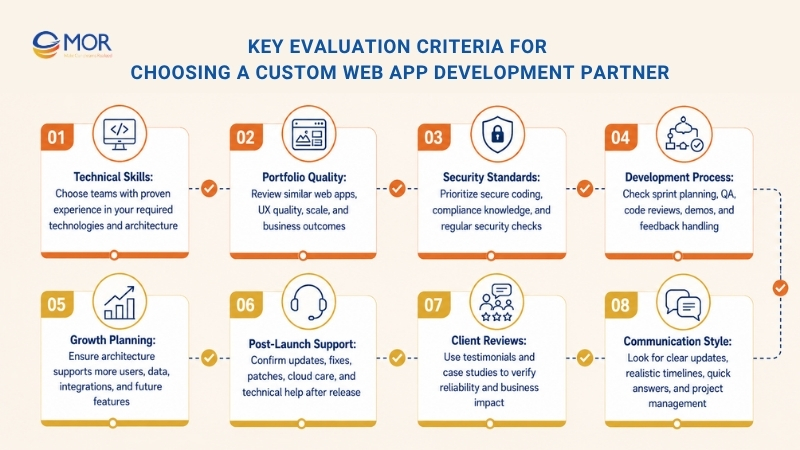
Technical Skills
Choose a team with proven work in the technologies your product needs, including React, Angular, Node.js, Python, .NET, cloud platforms, AI links, or enterprise architecture. Skilled engineers can guide the technology choice and help avoid technical mistakes that raise cost or slow the project.
Portfolio Quality
A strong portfolio shows whether a company can deliver working products in different industries and business models. Check past web apps that match your project size, workflow depth, or user needs. Look at UX quality, system design, scale, and clear business results. Detailed case studies often say more than a simple project list.
Security Standards
Security is a core part of custom web app development services and should be planned from the start. Pick a partner that follows secure coding rules, runs regular security checks, and understands compliance needs like GDPR, HIPAA, PCI DSS, or SOC 2 when they apply. Strong security habits help protect customer data and lower future risk.
Development Process
Professional web application development teams often use Agile methods to keep work clear and flexible. Ask how the team handles sprint planning, progress updates, code reviews, QA, and feedback. Regular demos and clear communication help keep the product aligned with business goals during the build.
Growth Planning
Your web app should work for current needs and still support future growth. An experienced partner designs architecture that can handle more users, larger data sets, extra integrations, and new functions without a full rebuild. Early planning for growth often saves money later.
Post-Launch Support
Launch is only one step in the product life cycle. Your system still needs updates, fixes, performance checks, security patches, cloud care, new functions, and technical help. A dependable partner should support the application after release so it keeps giving value over time.
Client Reviews
Client reviews, testimonials, and case studies help show how reliable a company is. Look for long-term client ties, repeat work, and proof that past projects improved speed, revenue, customer service, or team output. Independent review sites can also help confirm the company’s reputation.
Communication Style
Clear communication can make or break a software project. Your partner should provide a project manager, regular updates, realistic timelines, and quick answers when problems come up. Open communication cuts confusion, speeds up decisions, and helps keep the project on track.
Careful review of these criteria helps businesses choose a partner that brings more than technical skill. The best fit combines engineering strength, business thinking, clear teamwork, and long-term support to build a safe, scalable, and future-ready web application.
Common Pitfalls In Custom Web App Development Services
Even with a solid budget and technology stack, custom web app development services can still miss the mark when planning, build work, or launch steps are weak. Knowing the common mistakes helps businesses lower risk, work better with the development team, and get more value from the project. These are the problems teams face most often, plus practical ways to avoid them.
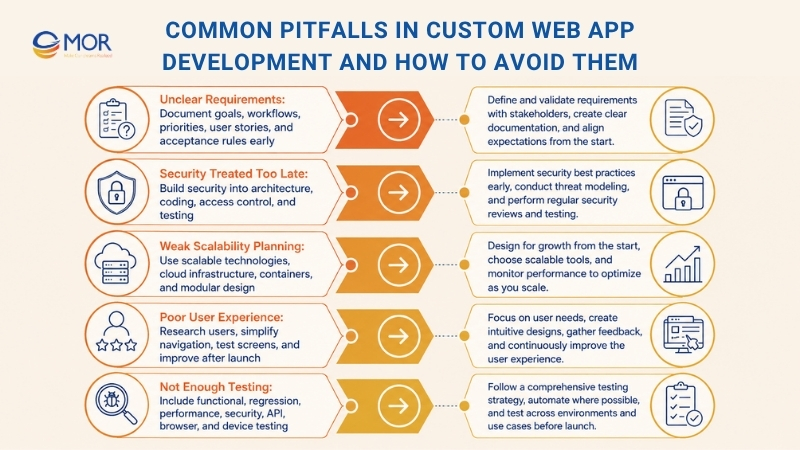
Unclear Requirements
The problem
Many projects struggle when teams begin coding before goals and requirements are clear. Loose specs can cause scope creep, repeated changes, longer timelines, and surprise costs. When stakeholders see the product differently, developers may build functions that do not match real business needs.
How to avoid it
Spend enough time on discovery and planning before build work starts. Work with your web application partner to document business goals, user stories, workflows, function priorities, and acceptance rules. Regular stakeholder reviews and early prototypes also help confirm that everyone shares the same product direction before major development hours are used.
Security Treated Too Late
The problem
Some companies leave security planning until the final phase of the project. This creates risk, since fixing weak points after the app is already built can cost far more than planning for them early. Weak security can expose customer data, stop business work, and harm brand trust.
How to avoid it
Use a security-first mindset across the whole software life cycle. This includes secure coding rules, encrypted storage, multi-factor login, role-based access, vulnerability checks, penetration testing, and constant monitoring. Security built into the architecture from day one lowers long-term risk.
Weak Scalability Planning
The problem
Many teams design for current needs only and forget future growth. When user traffic, data, and product demands rise, a weak architecture may lead to slow speed, downtime, and costly rebuild work.
How to avoid it
Select technologies and system designs that can grow with the business. Cloud-native infrastructure, microservices, containers, load balancing, database tuning, and modular build practices help the app handle rising demand without a full rebuild. Early growth planning protects the long-term value of the product.
Poor User Experience
The problem
A web app can have strong technology and still fail when users find it hard to use. Confusing screens, broken flow, slow pages, and weak mobile support can lead to low adoption and unhappy customers.
How to avoid it
Put user experience at the center of design and development. Research user needs, create simple navigation, build responsive screens, and test the product with real users before launch. User feedback after release also helps the team find better ways to improve the product.
Not Enough Testing
The problem
QA work often gets cut when deadlines are tight. This can lead to bugs, security gaps, speed issues, and device problems that only show up after launch. Those issues can hurt user trust and lead to costly emergency fixes.
How to avoid it
Make testing part of the full development life cycle, not a final task. QA should cover functional testing, regression testing, performance testing, security testing, API testing, browser checks, device checks, and user acceptance testing. Automated tests paired with manual review help the app deliver a stable and high-quality user experience.
Custom Web App Development Services Trends To Watch In 2026
Custom web app development services keep changing as user needs, cloud tools, and AI products move forward. Knowing these trends helps businesses plan systems that stay useful longer.
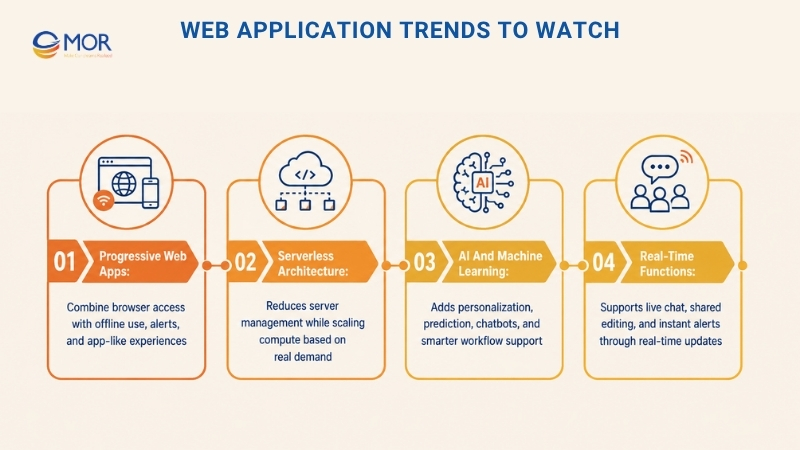
Progressive Web Apps
Progressive Web Apps bring web and mobile-style use into one browser-based experience. They can support offline access, push alerts, and app-like use without app store delivery. Companies like Twitter, Pinterest, and Starbucks have seen strong engagement gains with PWAs.
Serverless Architecture
Serverless computing, including AWS Lambda and Azure Functions, removes much of the server management work. It can scale with demand and can lower cost because businesses pay based on actual compute use.
AI And Machine Learning
Modern web apps are adding AI for personal content, prediction, chatbots, and smart workflow support. TensorFlow.js also allows machine learning to run inside the browser.
Real-Time Functions
WebSockets and Server-Sent Events help apps support live chat, shared editing, and instant alerts without constant polling. Real-time functions now matter more as users expect updates to appear right away.
Conclusion
Custom web app development services help businesses move past scattered tools, slow reporting, and manual work. A well-built web app gives your team clearer workflows, stronger data control, and room to grow. Yet the result depends on the right plan and the right partner. MOR Software builds custom web applications for startups, SMEs, and enterprises across global markets. Contact MOR Software to discuss your project and turn your workflow into a scalable digital platform.
MOR SOFTWARE
Frequently Asked Questions (FAQs)
What are custom web app development services?
Custom web app development services help businesses build browser-based software around their own workflows. These apps can manage users, data, approvals, reports, payments, customer portals, and internal tasks.
How is a custom web app different from a normal website?
A website mainly shares information. A custom web app lets users log in, complete tasks, update records, manage data, and follow set workflows.
When should a business build a custom web app?
A business should consider a custom web app when spreadsheets, plugins, and disconnected tools slow down daily work. Common signs include repeated data entry, slow reports, unclear approvals, and too many manual checks.
What types of businesses need custom web apps?
Custom web apps can fit startups, growing companies, and large firms. They are useful for healthcare, finance, eCommerce, education, logistics, manufacturing, HR, media, and customer service teams.
What are the most common types of custom web applications?
Common types include customer portals, admin dashboards, SaaS platforms, booking systems, inventory tools, reporting apps, eCommerce platforms, HR systems, and business management apps.
How long does it take to build a custom web app?
A simple web app may take 2 to 3 months. A mid-level app may take 4 to 6 months. A complex system with many integrations, user roles, and real-time functions can take 6 months or longer.
How much does custom web app development cost?
Cost depends on app complexity, design needs, user roles, integrations, security, tech stack, and support. A small app may cost around $25,000 to $50,000. Large enterprise systems can cost $300,000 or more.
What technologies are used to build custom web apps?
Common frontend tools include React, Vue.js, Angular, and Next.js. Backend choices often include Node.js, Python, .NET, Ruby on Rails, and Java. Databases may include PostgreSQL, MySQL, MongoDB, or Redis.
What should be included in the development process?
A strong process should include discovery, UX/UI design, technical planning, frontend and backend development, testing, launch, and ongoing support. Each stage helps the team control scope, quality, and risk.
How do I choose the right custom web app development services provider?
Look at technical skills, similar projects, security practices, communication style, QA process, support plan, and client reviews. A good provider should understand your workflow before writing code.
Share


Make Our-Dreams Realized


© 2023 . MOR Software. All Rights Reserved
Sitemap
Privacy Policy
Terms of Use

Rate this article
0
over 5.0 based on 0 reviews
Your rating on this news:
Name
*Email
*Write your comment
*Send your comment
1