


Enterprise AI Architecture Frameworks: 7 Leading Models Compared
Enterprise AI architecture frameworks help businesses connect AI models, data, applications, and governance into a system that works at scale. The right structure prevents disconnected AI projects, weak security controls, and costly integration problems. Each framework serves a different purpose, making selection a complex decision. In this guide, MOR Software will examine seven established models, their architecture layers, implementation approaches, and practical applications to help you plan enterprise AI adoption.
Key Takeaways
- Enterprise AI architecture frameworks address different needs. TOGAF supports enterprise planning, NIST AI RMF focuses on AI risks, and ISO/IEC 42001 establishes AI management requirements.
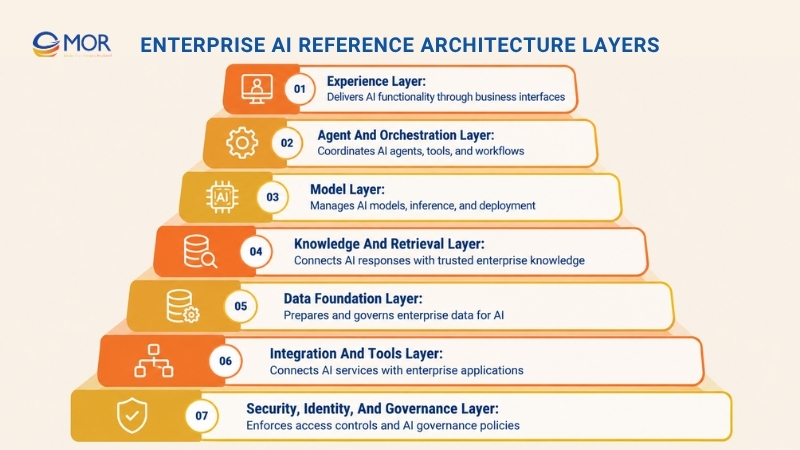
- A production-ready AI architecture connects seven major layers, covering user experience, agents, models, knowledge retrieval, enterprise data, integration, and governance.
- Framework selection should reflect your business goals, existing infrastructure, and security needs. A clear architecture plan also helps control deployment costs and support long-term growth.
What Is Enterprise AI Architecture Framework?
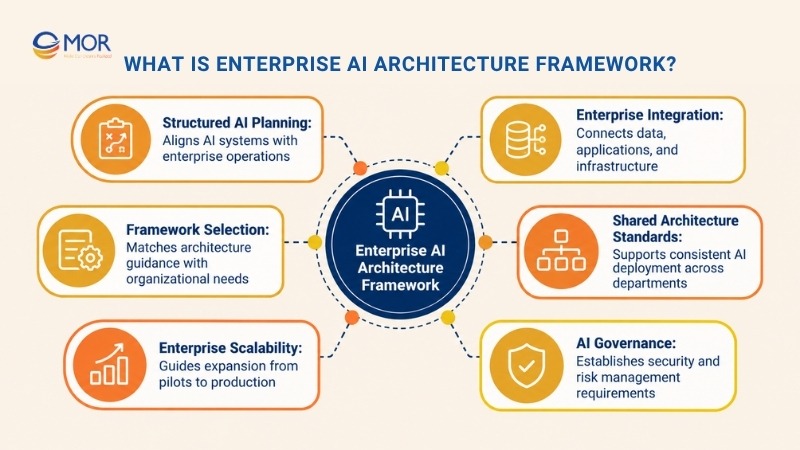
An enterprise AI architecture framework is a structured approach to designing, managing, and governing AI systems across an organization. It defines how business processes, enterprise data, applications, infrastructure, and security requirements should work together.
Unlike a standalone chatbot or machine learning model, enterprise AI architecture frameworks guide decisions that affect entire technology environments. They support shared resources, consistent integration standards, and controlled AI deployment across departments.
According to McKinsey's 2025 State of AI survey, 88% of respondents reported AI use in at least one business function. Yet only about one-third said their organizations had begun scaling AI programs across the enterprise.
The gap reflects the difficulty of connecting separate AI initiatives with existing business systems. Many organizations need structured architecture planning before they can extend successful pilots into daily operations.
Enterprise AI frameworks address different parts of this work. TOGAF guides business and IT architecture, NIST AI RMF addresses risk, and ISO/IEC 42001 sets organizational management requirements.
Technical reference architectures add another layer of guidance for data processing, model deployment, and system integration. The selected framework should match the decisions your organization needs to make.
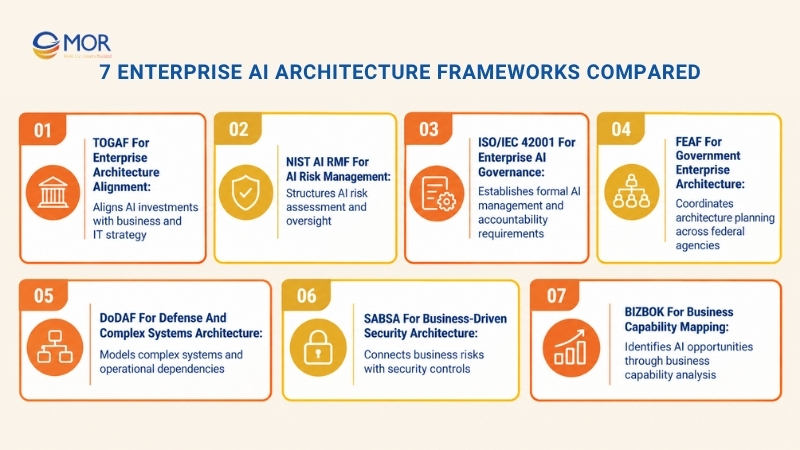
7 Enterprise AI Architecture Frameworks Compared
Enterprise AI architecture frameworks address different organizational needs, including strategic alignment, AI risk management, security, and business capability planning. The following comparison examines seven frameworks based on their primary functions, suitable use cases, and limitations.
Framework | Primary purpose | Best suited for | Key limitation |
TOGAF (The Open Group Architecture Framework) | Align business strategy, processes, data, applications, and technology through a structured enterprise architecture methodology | Large enterprises modernizing complex IT environments and planning organization-wide AI adoption | Does not define AI-specific risk controls or detailed AI implementation patterns |
NIST AI Risk Management Framework (AI RMF) | Identify, assess, and manage AI risks through Govern, Map, Measure, and Manage | Organizations prioritizing trustworthy AI, risk assessment, accountability, and responsible AI development | Provides voluntary risk management guidance rather than a technical architecture blueprint |
ISO/IEC 42001 | Establish an Artificial Intelligence Management System (AIMS) for AI governance, organizational accountability, and continual improvement | Organizations requiring formal AI management processes, governance oversight, and management system certification | Defines AI management requirements without prescribing specific infrastructure or system architectures |
Federal Enterprise Architecture Framework (FEAF) | Standardize enterprise architecture planning, information sharing, and IT investment alignment across federal agencies | U.S. federal agencies coordinating complex systems, shared services, and AI modernization initiatives | Primarily designed for government enterprise architecture rather than AI-specific development |
Department of Defense Architecture Framework (DoDAF) | Model complex systems, operational capabilities, information exchanges, and technical dependencies through standardized architectural viewpoints | Defense organizations and large-scale mission systems requiring detailed architecture descriptions and interoperability | Specialized for defense requirements and does not prescribe AI model development or deployment |
SABSA Enterprise Security Architecture | Develop business-driven security architectures that connect enterprise objectives with risk management and security controls | Security-sensitive enterprises requiring traceable risk controls, information protection, and secure AI integration | Focuses on enterprise security architecture rather than the complete AI application lifecycle |
Business Architecture Body of Knowledge (BIZBOK) | Map business capabilities, value streams, information, and organizational structures to support strategic planning | Enterprises identifying high-value AI opportunities and aligning AI investments with business capabilities | Focuses on business architecture rather than AI infrastructure, model development, or technical deployment |
TOGAF for Enterprise Architecture Alignment
The Open Group Architecture Framework (TOGAF) provides a structured method for aligning business goals with technology investments. Its Architecture Development Method (ADM) guides organizations through architecture planning, design, implementation governance, and change management.
For enterprises introducing AI across departments, TOGAF helps map existing applications, data systems, and business capabilities before selecting new technologies. This approach supports AI in enterprise architecture by connecting AI investment decisions with broader IT modernization plans.
Consider a manufacturer introducing predictive maintenance across several production sites. TOGAF can guide the mapping of equipment data, operational workflows, and existing applications into a shared architecture plan.
The TOGAF Standard, 10th Edition, provides established guidance for this type of enterprise planning. Yet it doesn't prescribe AI model training methods, inference infrastructure, or AI-specific risk controls.
NIST AI RMF for AI Risk Management
The NIST AI Risk Management Framework (AI RMF) helps organizations identify, assess, and manage risks associated with AI systems. Published by the National Institute of Standards and Technology, it provides voluntary guidance that organizations can adapt to their industry and operational needs.
The framework organizes AI risk management into four connected functions: Govern, Map, Measure, and Manage. These functions address organizational accountability, risk identification, assessment methods, and ongoing risk treatment.
For example, a financial institution deploying AI-assisted loan processing needs controls for data access, model performance, and decision review. NIST AI RMF provides a structure for identifying these risks and defining suitable oversight measures.
The NIST AI RMF applies across the AI lifecycle, making it relevant to enterprise AI architecture decisions. Its main limitation is the absence of a prescribed technical system design.
ISO/IEC 42001 for Enterprise AI Governance
ISO/IEC 42001 is an international standard that defines requirements for an Artificial Intelligence Management System (AIMS). It helps organizations establish policies, responsibilities, procedures, and review processes for managing AI systems.
The standard addresses AI management at the organizational level. Companies can use its requirements to assign accountability, document risks, review AI-related decisions, and maintain consistent management practices.
For enterprises operating AI applications across business units, this structure provides a formal basis for internal oversight. It also supports management system certification through an appropriate independent certification process.
The ISO/IEC 42001:2023 standard applies to organizations developing, providing, or using AI-based products and services. It does not prescribe a specific model architecture, cloud platform, or development stack.
FEAF for Government Enterprise Architecture
The Federal Enterprise Architecture Framework (FEAF) supports coordinated enterprise architecture planning across U.S. federal agencies. It provides a common structure for connecting business functions, information systems, technology investments, and government services.
Federal organizations often operate separate systems with different ownership, data formats, and technical requirements. FEAF helps architects examine shared capabilities and identify opportunities for better interoperability.
For AI modernization projects, agencies can apply FEAF principles to map data exchanges, operational responsibilities, and technology dependencies. A public-sector analytics platform, for instance, may require information from several agencies before producing useful results.
The U.S. Office of Management and Budget published the Federal Enterprise Architecture Framework Version 2 as part of its federal architecture guidance. FEAF remains a government-oriented architecture approach rather than a dedicated AI development standard.
DoDAF for Defense and Complex Systems Architecture
The Department of Defense Architecture Framework (DoDAF) provides structured methods for describing complex defense systems and their relationships. It focuses on architecture information needed for operational planning, capability development, interoperability, and technical decision-making.
DoDAF organizes architectural information through viewpoints covering capabilities, operations, services, systems, projects, and data. These viewpoints allow different teams to examine the same environment according to their responsibilities.
For AI-enabled defense systems, DoDAF can describe how data sources, decision-support applications, communication services, and operational workflows interact. Architects can trace system dependencies before new AI capabilities enter an existing environment.
The U.S. Department of Defense maintains DoDAF Version 2.02 as its published architecture guidance. DoDAF does not specify AI algorithms, training pipelines, or model-serving technologies.
SABSA for Business-Driven Security Architecture
SABSA is a business-driven method for designing enterprise security architecture. It connects organizational goals with security requirements, risk management, and the controls needed to protect business systems.
The approach begins with business needs and translates them into security architecture decisions. This creates traceable relationships between business requirements, identified risks, and technical safeguards.
For enterprise AI applications, SABSA can guide security design around sensitive training data, model access, external APIs, and automated actions. A banking assistant accessing customer records, for example, needs permissions that reflect business roles and information sensitivity.
According to the SABSA Institute, the methodology supports enterprise security architecture, information assurance, risk management, and governance. It addresses security requirements rather than defining the entire AI development lifecycle.
BIZBOK for Business Capability Mapping
The Business Architecture Body of Knowledge (BIZBOK) Guide provides methods for understanding how an organization creates value. Its core mapping areas include business capabilities, value streams, organizational structures, and information.
Business architects use these maps to identify operational gaps and determine where technology investments support business priorities. This makes BIZBOK relevant when companies need to select suitable AI use cases before technical development.
For example, a retailer may map inventory planning, purchasing, fulfillment, and customer service capabilities. The analysis can reveal areas where demand forecasting or document automation would address measurable operational problems.
The Business Architecture Guild maintains BIZBOK guidance for business architecture practices. The method supports strategic planning and capability alignment but leaves AI model design and infrastructure selection to technical teams.
Demand for this planning is growing. In its Future of Jobs Report 2025, the World Economic Forum found that 86% of surveyed employers expected AI and information processing technologies to transform their businesses by 2030.
Enterprise AI Reference Architecture Layers
A production-ready enterprise AI architecture connects business applications, AI models, enterprise knowledge, integration services, and governance controls. The seven-layer structure below is a practical reference model synthesized from established architecture guidance, including Microsoft's AI workload architecture patterns.
The model describes logical responsibilities rather than a required physical deployment order. Cloud infrastructure supports the system, and security controls apply across the architecture.
Experience Layer
The experience layer connects users and external applications with enterprise AI services. It includes conversational interfaces, employee portals, dashboards, mobile applications, and API-based access points.
Its main responsibility is delivering AI functionality through interfaces people already use. A customer service agent might access AI-generated response suggestions inside an existing CRM rather than switching to a separate application.
Application design also determines how users submit requests, review results, and approve actions. Authentication, accessibility, and interface performance need attention before a system reaches production.
For larger organizations, shared enterprise AI platforms can support consistent user access across different business applications. The experience layer then connects those applications with common services.
Agent and Orchestration Layer
The agent and orchestration layer coordinates how AI systems process requests and execute workflows. It routes tasks between models, knowledge sources, business tools, and approval steps.
An orchestration engine can manage fixed workflows or coordinate specialized AI agents. Agent-based systems may select tools, retrieve information, and complete several dependent tasks before returning a result.
Take a procurement assistant reviewing a supplier invoice. The system may retrieve purchasing rules, check invoice details, and request approval before updating the ERP.
Conversation memory and execution state help the system track work across individual steps. An agentic AI architect must also define tool permissions, timeout rules, retries, and human escalation paths.
Engineering teams evaluating orchestration technologies can compare available AI agent frameworks before selecting their workflow components.
Model Layer
The model layer manages the AI models responsible for generating responses, making predictions, and processing business information. It may include foundation models, large language models, predictive ML systems, and smaller task-specific models.
A production environment often uses a model gateway to manage requests and route tasks to approved services. Model registries track versions, deployment history, evaluation results, and related metadata.
AI model architecture decisions depend on workload requirements. A document assistant may use an existing language model, whereas a forecasting application may need a model trained on historical transaction data.
For teams planning generative AI enterprise architecture, inference cost, response time, data handling, and model portability shape technology selection. A model-agnostic design also makes future replacements easier.
The underlying AI tech stack determines which languages, libraries, serving tools, and infrastructure components support these workloads.
Knowledge and Retrieval Layer
The knowledge and retrieval layer connects AI applications with relevant business information. Retrieval-Augmented Generation (RAG) is a common approach for grounding model responses in documents, databases, and knowledge repositories.
Embedding models convert content into vector representations that support semantic retrieval. Hybrid search can combine keyword matching with vector search, while reranking improves the order of retrieved results.
A company policy assistant may search internal documents before answering an employee's question. The system must filter results according to the employee's access rights and use current document versions.
Knowledge architecture also includes metadata, source tracking, document updates, and retrieval evaluation. A semantic layer helps define business meaning across systems, while an enterprise data architecture analyst can assess AI readiness and source consistency.
Without these controls, a capable model can still return incorrect or unauthorized information.
Data Foundation Layer
The data foundation layer collects, processes, stores, and governs enterprise information used by AI systems. It includes data warehouses, data lakes, lakehouses, operational databases, and data processing pipelines.
ETL and ELT pipelines move information between source systems and analytical platforms. Data quality checks identify missing records, inconsistent formats, duplicate entries, and outdated information before downstream applications consume the data.
For a machine learning enterprise application, this layer may also support feature engineering and training datasets. Data lineage records where information originated and how processing steps changed it.
Consider a logistics company forecasting shipment delays. The model may depend on warehouse records, transportation events, supplier information, and historical delivery times. Poor synchronization across these sources weakens prediction quality.
Enterprise data architecture teams should define ownership, retention requirements, access policies, and validation rules before deploying AI workloads across departments.
Integration and Tools Layer
The integration and tools layer connects AI services with enterprise applications and external systems. Common components include API gateways, integration middleware, event streams, enterprise connectors, and controlled tool interfaces.
These connections allow AI applications to work with ERP, CRM, HRM, and legacy software. Model Context Protocol (MCP) can also provide a standardized interface for approved data and tool access.
For example, an AI sales assistant may retrieve customer information from Salesforce and create a follow-up task after receiving permission. The integration service manages authentication, data exchange, and the business action.
Reliable AI system architecture requires clear interface contracts, version management, and error handling. Teams also need to consider failed transactions, duplicate requests, and access restrictions when automated workflows modify business records.
Stable integrations make shared AI capabilities easier to reuse across departments.
Security, Identity, and Governance Layer
Security, identity, and governance controls protect data, models, applications, and automated actions throughout the architecture. These controls operate across every system layer rather than functioning as a single isolated service.
An enterprise AI security architecture should apply role-based access control (RBAC), encryption, audit logging, identity management, and least-privilege permissions. It must also manage sensitive information passing through prompts, retrieval systems, and tool calls.
The risks extend beyond standard application security. Prompt injection, excessive agent permissions, and data exposure require dedicated safeguards, especially when AI systems access external tools.
IBM's 2025 Cost of a Data Breach Report found that 97% of organizations reporting breaches of AI models or applications lacked proper AI access controls. Access design deserves attention at the same stage as model and integration planning.
Governance mechanisms can draw on NIST AI RMF, ISO/IEC 42001, and enterprise security requirements. Observability and FinOps practices also track model quality, system behavior, operational spending, and policy compliance.
How to Choose the Right Enterprise AI Architecture Frameworks?
Selecting among enterprise AI architecture frameworks begins with identifying the main problem your organization needs to solve. Some methods guide enterprise planning, while others address AI risks, information security, or business capability analysis.
The table maps common enterprise requirements to a suitable primary framework.
Enterprise requirement | Recommended framework | Why it fits | Key consideration |
Enterprise-wide IT modernization and AI strategy alignment | TOGAF | Structures business, data, application, and technology architecture decisions | Requires additional AI-specific technical guidance |
AI risk identification and responsible AI oversight | NIST AI RMF | Establishes structured AI risk management functions | Voluntary guidance, not a certification standard |
Formal organizational AI management | ISO/IEC 42001 | Defines AI management system requirements and accountability | Requires organizational implementation and ongoing review |
Government architecture and cross-agency interoperability | FEAF | Aligns enterprise architecture across public-sector systems | Primarily applicable to U.S. federal settings |
Defense systems and mission-oriented architecture planning | DoDAF | Supports complex architecture descriptions and stakeholder viewpoints | Specialized architecture method |
Security-driven architecture design | SABSA | Connects business requirements to risk-based security architecture | Does not define a full AI application architecture |
Business capability alignment and AI opportunity assessment | BIZBOK | Supports capability mapping and value stream analysis | Requires complementary technical design practices |
Start by documenting the architectural problem, affected stakeholders, existing systems, and required outcomes. A company struggling with disconnected applications has different needs than a bank establishing AI governance procedures.
Industry requirements also shape the decision. Public-sector teams may prioritize interoperability and shared architecture models, whereas financial institutions often place more weight on security and risk oversight.
Assess your current architecture maturity before making a selection. A team with established enterprise planning methods may need AI-specific controls rather than replacing its existing approach.
The selected primary framework does not need to address every technical concern. Supporting standards and reference architectures can guide requirements outside its scope without changing the main selection decision.
Key Enterprise AI Architecture Frameworks Implementation Approaches
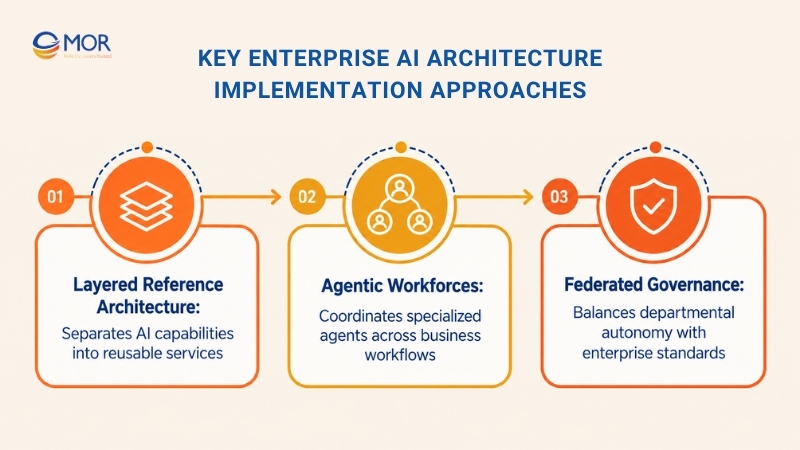
Enterprise AI architecture frameworks guide planning and governance, but implementation approaches determine how organizations structure systems and day-to-day operations. Three approaches deserve attention: layered architecture, agentic workforces, and federated governance.
Layered Reference Architecture
A layered reference architecture divides enterprise AI capabilities into distinct components with defined responsibilities. Data management, retrieval, inference, orchestration, and application integration can operate as reusable services.
This structure helps engineering teams avoid rebuilding the same functions for every project. One identity service or model gateway, for example, may serve several AI applications across the organization.
Loose coupling also supports independent updates. Teams can change a retrieval component without rewriting the user interface, provided its external contracts remain stable.
This approach works well for enterprise AI platform architecture projects that support many use cases. Architects should define service ownership, interface standards, deployment boundaries, and operational dependencies before implementation begins.
A layered design still needs coordination. Shared services require capacity planning, availability controls, and clear responsibilities when problems occur across components.
Agentic Workforces
Agentic workforces use AI agents to coordinate tasks that involve planning, tool selection, and decisions across business systems. Specialized agents may handle information retrieval, document analysis, approval preparation, or workflow execution.
An enterprise agentic AI architecture framework should define how agents communicate, access tools, manage task state, and request human intervention. Unrestricted autonomy creates unnecessary operational risk.
Gartner predicted in June 2025 that more than 40% of agentic AI projects would be canceled by the end of 2027. The firm cited rising costs, unclear business value, and weak risk controls as major causes.
Choose agent-based execution when workflows need flexible decisions. Fixed automation usually suits routine tasks with known steps, which is a useful distinction in agentic AI vs generative AI planning.
For more complex workflows, an agentic AI development solution can combine agent coordination, enterprise tools, and approval controls within a defined architecture.
Federated Governance
Federated governance gives business units responsibility for their AI initiatives while maintaining common enterprise-wide policies. Central teams define standards for security, data access, risk management, and architecture reporting.
Individual departments then make implementation decisions within those rules. A finance team may use a different model or workflow design than a logistics team, yet both follow the same access and audit requirements.
This approach supports large organizations with different operational needs and technology environments. It also gives local teams space to improve AI applications without losing architectural consistency.
Clear ownership matters. Enterprise governance teams should define minimum controls, approval requirements, reporting rules, and escalation procedures, while business units retain responsibility for their systems.
Federated governance requires shared documentation and regular architecture reviews. Without them, separate teams may create incompatible integrations, duplicate services, and conflicting data policies.
Common Framework Adoption Mistakes and Their Fixes
Adopting enterprise AI architecture frameworks without clear requirements can create the same problems organizations intend to solve. Framework selection, data preparation, integration design, and governance need to reflect real operating conditions.
The table identifies common mistakes, their consequences, and practical corrective actions.
Architecture mistake | Business or technical impact | Recommended corrective action |
Selecting a framework without matching its intended purpose to business requirements | Architecture work produces limited operational value or unnecessary documentation | Define the main business and technical requirements before choosing a primary framework |
Treating one framework as a complete AI implementation standard | Gaps appear in model deployment, governance, security, or infrastructure design | Identify the framework's scope and apply suitable technical guidance where needed |
Selecting AI models before assessing enterprise data readiness | Poor data quality leads to unreliable outputs, repeated processing, and project delays | Assess data sources, access rules, pipelines, and ownership before model selection |
Creating tightly coupled AI components | Model updates and integration changes require extensive rework | Separate services through stable APIs and modular architecture patterns |
Granting AI agents excessive permissions | Automated actions can expose sensitive records or modify unauthorized systems | Apply least-privilege access, scoped credentials, and human approval for sensitive actions |
Adding monitoring and governance after deployment | Teams struggle to detect model failures, security incidents, and rising operating costs | Build audit logging, evaluations, and operational controls into the initial design |
Relying heavily on vendor-specific integrations | Provider changes become costly and system portability decreases | Use open interfaces where appropriate and document external dependencies |
Skipping architecture reviews after rollout | Performance, spending, and risk controls fall behind changing requirements | Schedule reviews based on system changes, incidents, and business priorities |
Many of these problems begin when organizations copy a reference diagram without adapting it to their own systems. Architecture decisions should reflect actual data flows, technical dependencies, and operational responsibilities.
Enterprise AI Architecture Frameworks Best Practices
A well-designed enterprise AI architecture needs consistent engineering and operational standards to remain useful after deployment. The practices below focus on long-term system quality, security, maintainability, and business value.
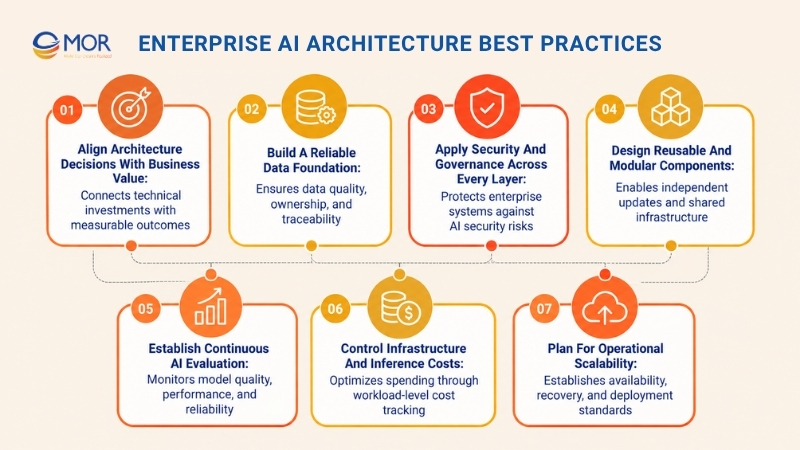
- Align architecture decisions with business value: Start with measurable use cases and connect technical requirements to expected outcomes. Define success through metrics like processing time, task accuracy, employee workload, or cost per completed operation. Architecture reviews should consider these results alongside technical performance.
- Build a reliable data foundation: Establish clear ownership, data validation rules, and lineage tracking before expanding AI workloads. Keep source records current and restrict information according to business roles. Reliable data pipelines support model training, knowledge retrieval, and reporting across departments.
- Apply security and governance across every layer: Design access controls, encryption, audit logging, and approval requirements alongside AI services. Review LLM security vulnerabilities when connecting models to enterprise information or external tools. Security tests should include unauthorized retrieval, prompt injection, and agent permission misuse.
- Design reusable and modular components: Separate data processing, model services, retrieval, orchestration, and enterprise integration. Reusable APIs and shared infrastructure prevent departments from maintaining duplicate implementations. Keep interfaces documented so individual components can change without disrupting the wider system.
- Establish continuous AI evaluation: Track model quality, groundedness, task completion, latency, and production errors. Review changes in model behavior after releases and data updates. Enterprise teams can use AI governance tools to support risk tracking, policy oversight, and model lifecycle monitoring.
- Control infrastructure and inference costs: Measure spending at the workload level rather than reviewing cloud bills alone. According to the Flexera 2026 State of the Cloud Report, organizations estimated that 29% of IaaS and PaaS spending was wasted. Model routing, caching, capacity planning, and cost-per-task tracking help teams identify unnecessary spending.
- Plan for operational scalability: Define availability targets, failure recovery procedures, and deployment standards before extending AI applications to more users. Test service limits and external dependencies under expected demand. Document maintenance responsibilities and establish processes for model updates, system failures, and security incidents.
These practices apply throughout development and operation. Teams should review them as business requirements, AI models, and integration dependencies change.
Enterprise AI Architecture Frameworks by MOR Software
Selecting an architecture approach is one part of enterprise AI adoption. The engineering work involves assessing existing systems, preparing data, developing AI capabilities, and connecting them to business operations.
At MOR Software JSC, we support these requirements through AI consulting, data engineering, custom model development, software integration, and cloud deployment. Our services focus on turning approved architecture requirements into working applications.
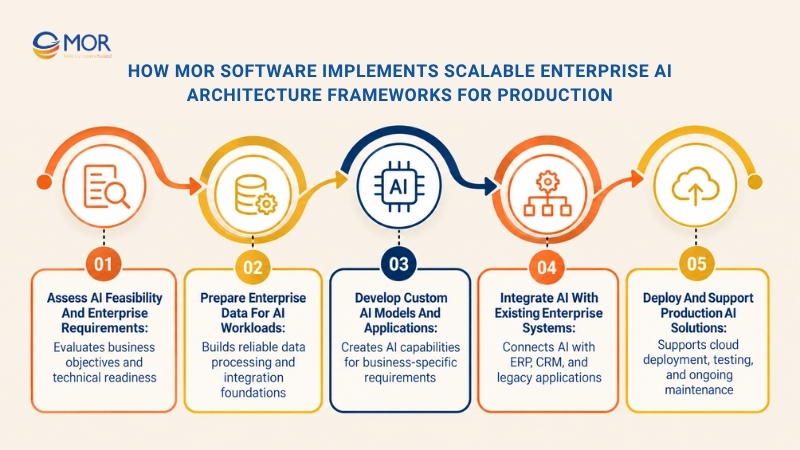
- Assess AI feasibility and enterprise requirements: Our AI Feasibility Assessment and Software Architecture Consulting services help organizations examine business objectives, existing infrastructure, data availability, and technical dependencies. We use these findings to define a practical implementation scope and identify issues that need attention before development.
- Prepare enterprise data for AI workloads: Our Data Engineering services address data acquisition, preparation, processing, and integration. We work on the information foundation that AI models and retrieval applications depend on, particularly when business records come from disconnected systems.
- Develop custom AI models and applications: MOR provides Custom Model Service and Generative AI Integration capabilities for business-specific requirements. Our development teams can connect AI functionality with application logic and enterprise workflows through genAI integration and customization services.
- Integrate AI with existing enterprise systems: Our software development experience includes API integration, data synchronization, and legacy system modernization. These capabilities support AI solutions for enterprises that need to work alongside established ERP, CRM, web, and backend applications.
- Deploy and support production AI solutions: MOR Software's Edge & Cloud Deployment capabilities support the transition into operational environments. Our QA, testing, and software development teams also address deployment validation, software changes, and ongoing maintenance needs.
Enterprise AI delivery also depends on the people responsible for architecture, data, development, and testing. Our dedicated development team model provides an option for companies building an AI native engineering team or extending existing technical resources.
MOR Software applies relevant architecture guidance according to each project's requirements. Framework ownership, formal certification, and regulatory compliance assessments remain distinct from our software implementation services.
Conclusion
Enterprise AI architecture frameworks give organizations a structured basis for AI planning, governance, and system design. Selecting the right approach helps align business requirements with technical delivery and ongoing operations. MOR Software supports this process through feasibility assessment, data engineering, custom AI development, integration, and cloud deployment.
If you're preparing an enterprise AI initiative, contact us to discuss your existing systems, technical requirements, and a practical route to production.
"Evolution is not a destination, it is a disciplined journey of innovation."
Phung Van Tu


CEO MOR AI
MOR SOFTWARE
Frequently Asked Questions (FAQs)
What are enterprise AI architecture frameworks?
Enterprise AI architecture frameworks are structured methods and standards that guide the planning, design, governance, and management of AI systems across organizations. They help businesses coordinate AI investments, existing applications, enterprise data, security requirements, and technical infrastructure.
Which enterprise AI architecture framework is best for large organizations?
TOGAF is a suitable primary choice for large organizations seeking enterprise-wide IT alignment and architecture planning. The best option still depends on the main requirement. NIST AI RMF addresses AI risks, while ISO/IEC 42001 supports formal AI management.
What is the difference between TOGAF and NIST AI RMF?
TOGAF guides enterprise architecture planning across business, data, application, and technology domains. NIST AI RMF focuses on identifying, assessing, and managing risks associated with AI systems. The two serve different purposes and can inform related organizational decisions.
How does ISO/IEC 42001 support enterprise AI governance?
ISO/IEC 42001 defines requirements for an Artificial Intelligence Management System. It establishes a structure for AI policies, organizational responsibilities, risk management, documentation, and continual improvement. Organizations can pursue management system certification through an appropriate certification body.
Can enterprises combine multiple AI architecture frameworks?
Yes. Organizations can adopt one primary architecture method and use complementary guidance for areas it doesn't address. TOGAF may guide enterprise planning, for example, while NIST AI RMF supports AI risk management. Each framework retains its own purpose.
What are the essential layers of an enterprise AI reference architecture?
A practical reference architecture includes experience, orchestration, models, knowledge retrieval, enterprise data, integration, and security governance. Cloud infrastructure supports these components. The exact number of layers varies according to system requirements and the architecture model selected.
How do AI governance frameworks differ from cloud AI reference architectures?
AI governance frameworks guide organizational policies, risk management, and accountability. Cloud reference architectures describe technical components, deployment patterns, and infrastructure decisions. The first addresses how AI should be managed; the second guides how workloads are built and operated.
Which architecture frameworks support generative AI and AI agents?
TOGAF can guide enterprise integration planning, and NIST AI RMF supports risk management for generative AI and agents. Cloud AI reference architectures provide technical guidance for model inference, retrieval, orchestration, and tool connections. A gen AI enterprise architecture should consider these responsibilities separately.
How can organizations evaluate enterprise AI architecture effectiveness?
Organizations can measure task completion, model performance, retrieval accuracy, system availability, security incidents, and operating costs. Architecture reviews should also examine integration quality and business outcomes. ISO/IEC/IEEE 42030 provides general guidance for structured architecture evaluation.
How often should enterprises review and update their AI architecture frameworks?
Review schedules should reflect business changes, AI system releases, incidents, and regulatory requirements. Organizations should reassess architecture decisions after major model updates, new integrations, or changes in operational risk. Regular reviews also help identify unnecessary costs and outdated components.
Share


Make Our-Dreams Realized


© 2023 . MOR Software. All Rights Reserved
Sitemap
Privacy Policy
Terms of Use

Rate this article
0
over 5.0 based on 0 reviews
Your rating on this news:
Name
*Email
*Write your comment
*Send your comment
1