


Top 10 International Payroll Solutions for 2026
Paying a global team gets messy fast when taxes, contracts, currencies, and local rules all move at once. The right international payroll solutions help you pay employees and contractors on time without losing control of compliance or cost. This MOR Software guide will compare the top global payroll solutions, EOR options, and provider fit for remote teams in 2026.
What Are International Payroll Solutions?
International payroll solutions are tools or services that help companies pay workers and contractors in other countries with the right amount and at the right time. They manage automated payroll system across many markets, so your business can follow local tax rules, labor laws, and payment needs. A strong setup does more than move money from one account to another.
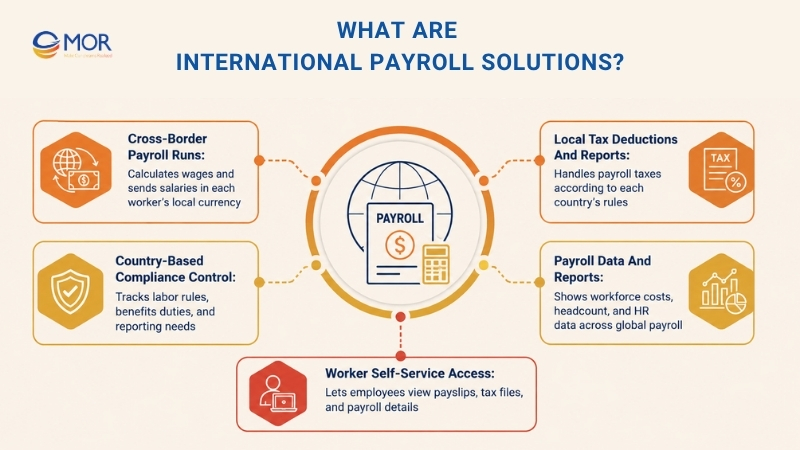
Core parts often include:
- Cross-Border Payroll Runs: Calculating wages and sending salaries in each worker’s local currency.
- Local Tax Deductions And Reports: Handling payroll taxes based on the rules in each country.
- Country-Based Compliance Control: Keeping up with changing labor rules, benefits duties, and reporting needs in each market.
- Payroll Data And Reports: Giving one clear view of workforce costs, headcount, and HR data across global payroll systems.
- Worker Self-Service Access: Letting employees view payslips, tax files, and personal payroll details.
International Payroll Solutions Vs EOR Vs PEO Vs In-House Payroll
Choosing the right model for remote team management starts with knowing how each option works. Each one solves a different business need.
Model | How it Works | Best For | Pros & Cons |
|---|---|---|---|
Internal Payroll Management | Your company handles everything: creating local entities, hiring HR teams, and running payroll using country-specific tools. | Established enterprises with a long-term commitment to a specific country. | Pros: Full control over all processes. Cons: Costly, slow to set up, and complex to manage. |
Global Payroll Platforms | Software that consolidates payroll data across multiple countries where your business already owns legal entities. | Companies with existing foreign entities looking to unify their reporting and payments. | Pros: Streamlines global reporting and data. Cons: Your team is still responsible for local legal and HR compliance. |
Employer Of Record (EOR) | The EOR hires workers under its own legal entity in countries where you don't have one, managing pay, taxes, and benefits. | Startups and companies needing to hire global talent quickly without setting up local entities. | Pros: Fastest path to hiring abroad (150+ countries); handles all compliance. Cons: Less direct control over employment legalities. |
Professional Employer Organization (PEO) | A co-employment model where the PEO shares employment responsibilities and liabilities with your company. | Small to mid-sized businesses primarily operating within a single country (often the US). | Pros: Excellent for shared benefits and compliance risks. Cons: Generally does not support international hiring needs. |
Top 10 International Payroll Solutions For Remote Teams
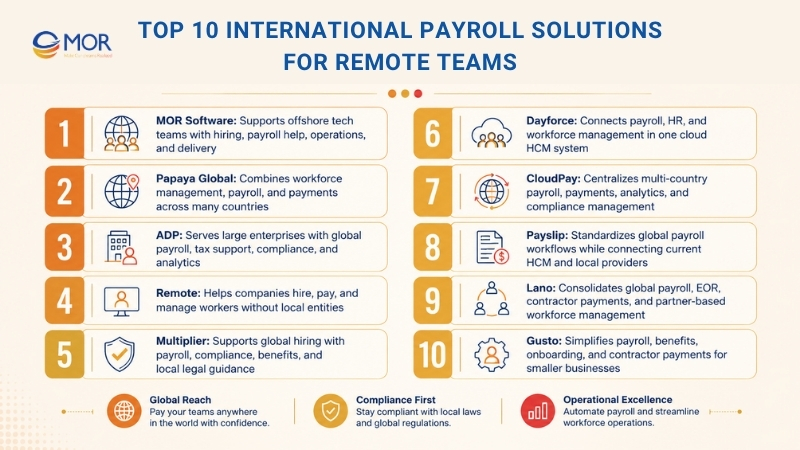
The best international payroll solutions depend on your team size, hiring countries, legal setup, and support needs. Some providers focus on payroll software. Others support EOR, contractor payments, HR case management tools, or offshore team operations.
Agency | Core Strength | Ideal For | Things To Note |
MOR Software | Offshore vs onshore software development and dedicated team setup with hiring, payroll help, operations support, and software delivery | Companies building remote tech teams in Vietnam, Japan, and Asia that need one partner for talent, delivery, and team operations | It is not a pure payroll SaaS tool. It fits companies that need MOR-managed offshore teams with payroll and operations support |
Papaya Global | Wide country reach across 160+ countries, a unified platform, strong privacy, and compliance support | Mid-size and large companies that need payroll, payments, and workforce control in one place | It may cost too much for small teams. The system can take time to learn because it has many functions |
ADP | Enterprise payroll support, long market history, a strong system of record, analytics, and local payroll teams | Large companies with complex payroll needs across many countries | It can feel too large and costly for small firms. Many tools cost extra, and support speed depends on location |
Remote | Strong local compliance, owned entities in many supported countries, and clear pricing | Companies with staff across several countries that need EOR and payroll support | Per-worker cost can be high for small teams. Support often runs through tickets and can feel slow |
Multiplier | Compliance-first hiring support, strong Asia knowledge, and quick local contracts at fair rates | Mid-size firms growing in Asia-Pacific that need legal support without enterprise cost | Reports are basic. Ticket support can slow down replies. It may not fit teams with heavy data needs |
Dayforce | Real-time payroll, HR, and workforce tools across 200+ countries, with local compliance support | Large companies that need one HCM and payroll system | Setup can be costly and hard. Teams may need training, and support may be slow |
CloudPay | Global payroll and payment processing with a central dashboard, strong links, and secure data handling | Mid-size and large firms that need cross-border payment support | Setup can take time. It uses local partners in some places, which may slow support |
Payslip | Central payroll control, automation, and links with HCM and ERP systems | Large companies with current in-country payroll providers that need clearer control and standard rules | It is a software layer, not a payroll service provider. You still manage local payroll partners |
Lano | Payroll consolidation, wide global reach, partner support, and contractor payments | Growing companies that want one view without replacing local providers | It depends on third-party partners, which may slow updates and problem solving |
Gusto | Simple payroll, automated tax filing, and contractor payments across 120+ countries | SMEs and US-based companies that need easy payroll and HR support | It is not built for large enterprises. Analytics are limited, and non-US support has limits |
MOR Software
MOR Software is a top software outsourcing company in Vietnam, helping clients through offshore development, dedicated teams, web development, mobile development, Salesforce work, QC and testing, and IT consulting. For companies that want to build remote tech teams in Vietnam or Japan, MOR Software can support hiring, payroll tasks, team operations, and delivery under one offshore setup.
Main Services:
- Offshore development team setup
- Hiring and candidate review
- Team onboarding and daily management
- Payroll and operations support
- HRM software development
- QC, testing, and maintenance
Why MOR Software Stands Out:
MOR Software is a strong fit when your company needs tech talent, team operations, and software delivery in one place, not a payroll-only tool.
The company helps clients form dedicated offshore teams with defined roles, clear timelines, candidate checks, onboarding, and long-term team care. MOR also manages the operations side, including salary payment support, hiring new members, and scaling the team as project needs change.
MOR Software is not a standard global payroll SaaS platform. Its value comes from combining software outsourcing, offshore team setup, HRM system development, and payroll-related support for dedicated technical teams. This makes MOR a strong choice for companies that want an international HR & payroll solution tied to real delivery work, not only a self-service payroll product.
Pros & Cons
Pros | Cons |
- Strong offshore development and dedicated team setup - Supports hiring, payroll-related tasks, and team operations - Clear path from requirements to onboarding and scaling - Proven software work across HRM, finance, healthcare, eCommerce, and Salesforce - Best for companies that need tech teams, not only payroll processing | - Not a standalone global payroll software platform - Best for companies that need offshore development or dedicated tech teams - Payroll support is linked to MOR-managed team operations, not general payroll across all countries |
Papaya Global
Papaya Global is a global fintech SaaS provider with one platform for workforce management, payroll, and payments. It helps companies hire, onboard, and pay full-time employees, EOR workers, and international contractors through one automated system.
Main Features:
- Global payroll processing
- Built-in payments
- Automated payroll reports and analytics
- Automated salary delivery
Why Papaya Global Stands Out:
Papaya Global works like a fintech business and holds its own payment licenses. This lets it provide a secure payroll wallet that supports fast payments and helps reduce hidden bank fees.
The platform also pulls data from current HCM and ERP systems, so finance teams can see payroll and workforce spending in one place. Yet your internal team may still need to manage part of the payment process.
Since Papaya Global has rich functions and enterprise coverage, it often costs more. Small teams or startups that only need simple payroll may also find it harder to use than other top rated global payroll platforms for HR.
Pros & Cons
Pros | Cons |
- Wide reach across 160+ countries - Unified and automated platform - Strong privacy and compliance controls | - Not cost-friendly for startups and small teams - May feel too complex for basic payroll needs - Can take time to learn |
ADP
ADP is a major provider for international payroll solutions, with services covering payroll processing, tax support, compliance management, and HR tools. Its enterprise platform, ADP GlobalView Payroll, fits large teams spread across many countries.
Main Services:
- Global payroll processing
- Payroll compliance and management
- Employee tax calculation
- Employee benefits administration
- Payment support services
Why ADP Stands Out:
ADP GlobalView Payroll is made for large companies with difficult payroll needs across many countries. The platform gives scale and steady service for enterprise teams.
It also gives HR teams one system of record, which helps them view payroll data and keep processes more consistent across regions. This can make payroll costs easier to track and lower the workload of managing many local systems.
ADP works well for enterprise companies, but smaller teams may feel buried under too many tools. Support quality can also change by region. The pricing matches its focus on large companies and global payroll experts.
Pros & Cons
Pros | Cons |
- Built for large companies - Long history in global payroll and strong market reach - Mobile payroll app adapted for local markets - Strong payroll analytics tools | - Not cost-friendly for small businesses - Many tools are paid add-ons - Support can be slow and limited |
Remote
Remote is a global HR, payroll, and Employer of Record (EOR) provider that helps companies hire, pay, and manage workers in different countries without opening local entities. It supports employees and contractors, including payroll checks, payments, tax filing, and compliance work.
Main Services:
- Global payroll processing
- Global payment gateway integration
- Employee benefits management
- Payroll and tax reports
Why Remote Stands Out:
Remote uses simple pricing with flat fees and no hidden charges, deposits, or extra offboarding costs. This helps companies plan hiring budgets with less guesswork.
But support runs through a ticket system, so replies may take longer. Premium services also cost more, which can be tough for small teams with limited budgets.
Remote is a strong option for overseas payroll services when companies want EOR support and payroll in one place.
Pros & Cons
Pros | Cons |
- Strong compliance support - Remote owns legal entities in many countries it serves - Clear pricing plans | - Higher per-worker cost, mainly for small teams - Customer support can be slow |
Multiplier
Multiplier is a global employment platform that helps companies hire, onboard, and pay talent in other countries. It presents itself as a compliance-first partner and pairs a simple SaaS platform with local legal experts who help manage payroll, taxes, and benefits for employees and contractors.
Main Services:
- Global payroll management and payments
- Payroll compliance and tax administration
- Payroll reports and analytics
- Expense and leave management
- Employee benefits and insurance administration
Why Multiplier Stands Out:
Multiplier does not rely only on automation like some global payroll vendors. It also uses local legal and tax experts to help companies follow country rules and handle regional details.
For growing firms, the reports and third-party links can be useful. Still, they may feel basic for companies that need deeper data control. Customer support mainly works through tickets, so response times can be slower in some countries.
Pros & Cons
Pros | Cons |
- Strong compliance support from local legal and tax experts - Multi-country payment support - Clear and fair pricing for mid-size companies - More personal support than automation-only tools | - Ticket-based support can be slow - Not ideal for companies with complex data needs |
Dayforce
Dayforce, from Ceridian, is a cloud-based global HCM platform that connects payroll, HR, and workforce contingent management in one system. It supports payroll work in many countries and gives companies one clear view while helping them follow local rules.
Main Services:
- Global payroll support
- Payroll compliance and administration
- Employee benefits management
Why Dayforce Stands Out:
Dayforce gives growing companies a scalable way to manage the full employee journey through one connected platform.
Still, setup can be difficult and may require a lot of training. Complex settings often need skilled support. Users may also face slow replies from customer service, and extra help may add unexpected costs.
For large teams, Dayforce can work well as part of wider international payroll solutions that connect payroll with HR and workforce planning.
Pros & Cons
Pros | Cons |
- Wide service coverage by location - Connected HCM platform - Strong local compliance support - Scales well for large or global teams | - High setup cost and complexity - Learning curve due to system depth - Customer support can be slow |
CloudPay
CloudPay is a cloud-based provider for international payroll outsourcing services, payments, and on-demand pay. It brings multi-country payroll into one platform and provides managed services to help companies handle compliance and improve pay experiences for global staff.
Main Services:
- Global payroll services
- Global payment services
- Payroll analytics and reports
- Payroll compliance management
Why CloudPay Stands Out:
CloudPay has a strong platform and payment setup for handling complex cross-border payments in a safe and steady way. It can also lower the need for many local bank links.
The system suits mid-size and large companies with payroll needs across many countries. Smaller startups or lean global teams may find setup slow and complex, and full links with HR and ERP systems can take weeks.
CloudPay gives one operating view, but it works with in-country partners for some local filings. This can sometimes slow support replies for international payroll processing solutions.
Pros & Cons
Pros | Cons |
- Central dashboard for tracking payroll - Strong system links - Strong data security and protection | - Premium pricing for enterprise needs - Not ideal for small teams - Setup and integration can take a long time |
Payslip
Payslip is a global payroll control platform for large companies that already own local entities. It works as a middle layer that standardizes and automates payroll workflows while linking your current HCM or HRIS tools with local payroll providers.
Main Services:
- Pre-payroll data services
- Payroll vendor management
- Global payroll administration
- Global payroll reports and analytics
Why Payslip Stands Out:
Payslip is strongest when large companies want to bring global payroll work into one cleaner process without replacing their current in-country vendors. This works well for companies that trust their local providers but need better control and visibility.
Still, Payslip is built for enterprise payroll needs. Smaller teams may find setup, links, and pricing too heavy. There is also a setup phase for data flows, vendor links, and systems before the platform can deliver full value.
For large companies comparing international payroll solutions, Payslip is a good fit when control and standardization matter more than replacing local partners.
Pros & Cons
Pros | Cons |
- Central payroll control across regions - Strong automation tools - Works with many HCM and ERP systems - Detailed reporting tools for better visibility | - Best for large enterprises only - Costly and complex for startups and SMEs - Setup and integration take time |
Lano
Lano is a cloud-based platform for global payroll, EOR, and workforce management. It helps companies hire, pay, and manage teams in many countries through checked partner networks. Its payment processing and contractor tools help growing businesses manage workforce payments with less manual work.
Main Services:
- Global payroll consolidation
- Payroll reports and analytics
- Contractor management and payment tools
Why Lano Stands Out:
Lano’s main difference is its flexible model. Many providers ask companies to move fully into their setup, but Lano lets businesses keep local payroll partners and connect them to one dashboard.
Yet this also means Lano depends a lot on third-party in-country partners. It does not have the same direct control as a fully owned model. Support chains can move more slowly because requests may pass from the company to Lano, then to the local partner, before a fix happens.
Like Payslip, setup and custom work can take time, mainly for teams with limited tech resources.
Pros & Cons
Pros | Cons |
- Automated platform that adapts to current partners - Wide global coverage - Strong in-country partner network - Personal support | - Harder to learn at first - Slower support and communication - Setup needs more time and resources |
Gusto
Gusto is a payroll and HR platform made mainly for small and mid-size businesses. It brings payroll, benefits, and onboarding into one simple system, helping teams stay compliant without adding too much admin work.
Main Services:
- Employee payroll management
- Global contractor payments
- Automatic tax calculation and filings
- Payroll compliance and support
- Employee benefits administration
Why Gusto Stands Out:
Gusto is built to make payroll and HR simple for SMEs. Its main strengths include an easy interface, automated tax filings, benefits tools, and links with popular accounting software.
But its analytics and dashboards are not as deep as enterprise tools. This can make workforce reporting less useful for larger teams. Also, Gusto works best for US-based companies, and some services are limited for remote teams based outside the US.
Gusto can be a practical choice in international payroll solutions for smaller companies that need simple HR and contractor payment support.
Pros & Cons
Pros | Cons |
- Easy platform for non-technical users - Works with many third-party apps - Good fit for SMEs and US-based companies | - Not ideal for very large companies - Limited personal HR support |
Why A Software Outsourcing Partner Is A Strategic Choice For Payroll?
Payroll software works well when a company already has a fixed team, signed contracts, and local HR support in place. It can help with salary runs, tax work, payslips, and reports. Yet for companies hiring software engineers in Vietnam, payroll is only one piece of the setup.
The real work starts long before salaries are sent. You need to source skilled developers, test their ability, prepare contracts, run onboarding, watch team output, and follow local rules. A payroll app alone cannot carry all of that.
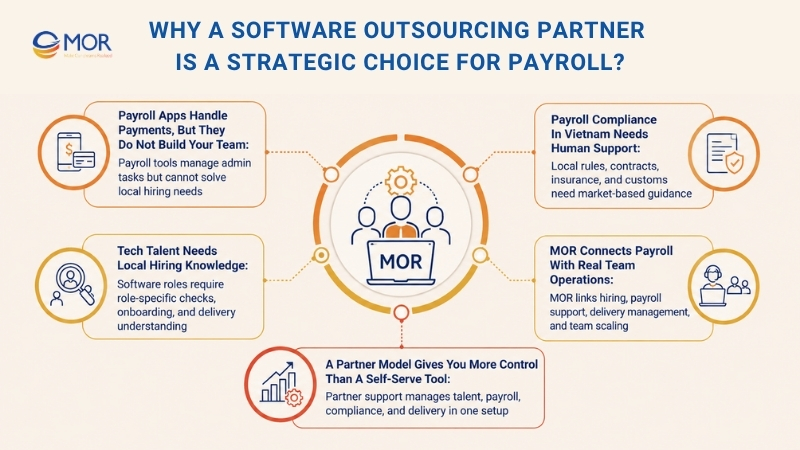
Payroll Apps Handle Payments, But They Do Not Build Your Team
Most payroll systems for global teams are built around salary checks, tax reports, payment logs, and worker records. This works when your company already has legal guidance and clear hiring knowledge in the target country. The shared draft also shows that these platforms often cover multi-country payroll, tax deductions, compliance tracking, reporting, and worker self-service.
But hiring tech staff in Vietnam adds more local detail. You need to know pay bands, notice terms, benefits, work culture, skill levels, and how to keep developers motivated. Without that local support, a company may pay workers correctly yet still lose time through poor hiring or team mismatch.
Tech Talent Needs Local Hiring Knowledge
Software hiring does not work well through a basic platform. A backend engineer, QA specialist, BrSE, mobile developer, or Salesforce consultant all need different test steps. One poor hire can slow a sprint, weaken team trust, and create extra costs.
This is where a software outsourcing partner brings stronger value. MOR Software supports offshore development team setup, candidate checks, onboarding, and team care. Its offshore model helps clients build teams across software roles, including project managers, business analysts, developers, QC staff, and BrSE/Comtor members.
So payroll is connected with real delivery, not just employee data.
Payroll Compliance In Vietnam Needs Human Support
Vietnam has its own labor rules, payroll customs, insurance duties, and contract practices. A global tool may show the workflow, but it may miss the small local details that matter in daily work.
For foreign companies, these details can become hard to manage. A small contract, benefit, or team structure mistake may grow into a larger problem later. A local partner lowers that risk because the team already works inside the market.
MOR has offices in Ho Chi Minh City, Hanoi, Da Nang, Tokyo, and Osaka, giving clients local support across Vietnam and Japan. This helps companies that need Vietnam-based tech teams and clear communication with Japan or other markets.
MOR Connects Payroll With Real Team Operations
A payroll-only app usually ends at admin work. MOR connects hiring, team setup, payroll support, delivery management, and team growth through one offshore model.
In its dedicated team process, MOR studies requirements, prepares proposals, screens candidates, forms the offshore team, manages operations, pays salaries, hires new members, and adjusts team size based on client needs.
This matters because software teams change often. You may need to add QA before launch, bring in a DevOps engineer, replace a developer, or reduce the team after release. A tool can record the change. A partner helps make it happen.
A Partner Model Gives You More Control Than A Self-Serve Tool
An app may look simple at the start. But once hiring grows, the work gets messy. Who checks developer quality? Who runs onboarding? Who handles daily issues? Who watches delivery risk? Who helps when the team must grow fast?
A software outsourcing partner gives you one operating layer for tech talent, payroll, and compliance. MOR fits businesses that want dedicated software teams in Vietnam without building every local process from zero.
For companies hiring developers in Vietnam, the smart choice is not only about choosing an app or a partner. It is about knowing where each one fits. Apps work well for payroll tasks. A partner like MOR helps connect hiring, payroll solutions international buyers need, compliance, and software delivery in one managed setup.
Benefits Of International Payroll Solutions
Not every small business needs global payroll or global hiring support. These services are made for companies that already employ people outside the United States, or plan to do so soon.
When your company fits that need, international payroll solutions can help your small business in several clear ways:
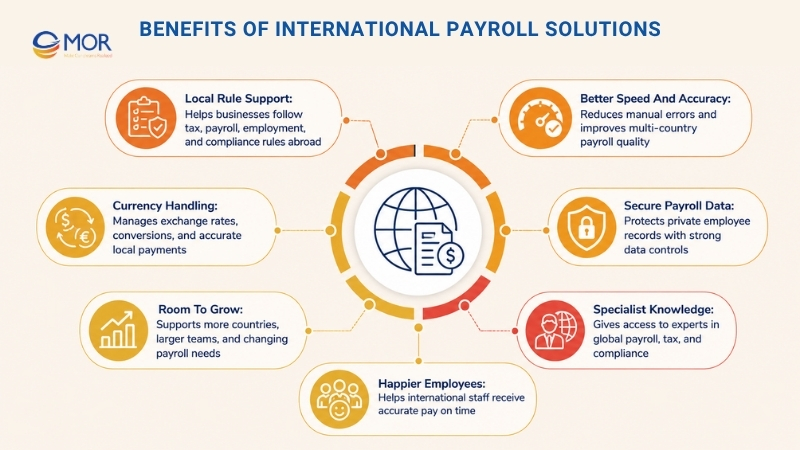
Local Rule Support
Each country has different payroll rules, tax duties, and employment laws. A global payroll provider helps your business follow those rules, lowering the chance of legal problems or fines through local knowledge and entity support.
Better Speed And Accuracy
Running payroll across many countries can take time and create errors. Many providers use automated systems that make the process faster, lower manual mistakes, and improve payroll quality.
Currency Handling
Companies with global teams often deal with several currencies. A provider can manage exchange rates, currency conversion, and accurate local payments, even when rates change.
Secure Payroll Data
Payroll includes private worker details, so safe data handling matters. Global providers often use strong security controls to protect employee records and meet data protection rules.
Room To Grow
As your company enters more countries, in-house payroll can become harder to manage. A global provider can give your business room to grow as team size and country needs change.
Specialist Knowledge
These providers often give access to payroll experts who understand international rules, tax laws, and compliance needs. This knowledge is useful for small firms working across several countries for the first time.
Lower Error And Fine Risk
Global payroll is complex, so mistakes can lead to fines or damage your company’s name. Working with a payroll provider helps lower those risks.
Happier Employees
Staff want to be paid correctly and on time. A global payroll provider helps workers in different countries receive pay on schedule and under local rules, which supports a better work culture.
A global payroll provider gives your small business the knowledge, accuracy, and compliance support needed to manage payroll across countries. The right setup can also work as leading HR software for international payroll, helping you focus on higher-value business work.
Essential Features To Look For In International Payroll Solutions
A few functions separate simple vendors from true cloud-based international payroll solutions.
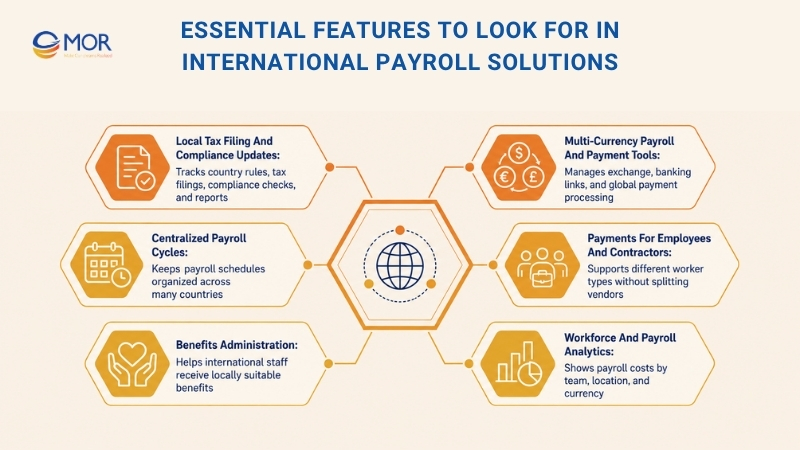
Local Tax Filing And Compliance Updates
Each country has its own payroll and labor laws. If your provider fails to track those rules, your company may carry the risk. Look for payroll partners that manage tax filings, rule updates, compliance checks, and reports through automated workflows.
Multi-Currency Payroll And Payment Tools
Your global workers expect correct pay in the right currency. A payroll provider should manage currency exchange, connect with local banking rails, and include treasury tools that make payment processing easier.
International payroll solutions should also support a smooth global paycheck process, so employees and contractors receive their money without avoidable delays.
Centralized Payroll Cycles
Running payroll in ten countries should not mean using ten separate systems. Your global payroll software should bring payroll schedules into one clear cycle, so workers in each country are paid on time.
Payments For Employees And Contractors
Many global companies work with contractors before hiring full-time staff. Your provider should support both types of workers, so you do not need to split payroll work across several vendors. That split can raise costs and compliance risk.
Benefits Administration
Good benefits help companies hire workers abroad, but benefit rules differ by country. The right payroll partner helps your international staff receive benefits that match local law and market practice.
Workforce And Payroll Analytics
Payroll is one of your largest business costs, so static reports are not enough. Choose one connected system that gives custom analytics by team, location, and currency. This helps link payroll work with workforce planning, HR operations, and your wider HCM strategy.
International Payroll Solutions Cost
The price of global payroll services changes based on the model and level of support your business needs. Clear knowledge of common pricing models helps you plan budgets and avoid surprise costs.
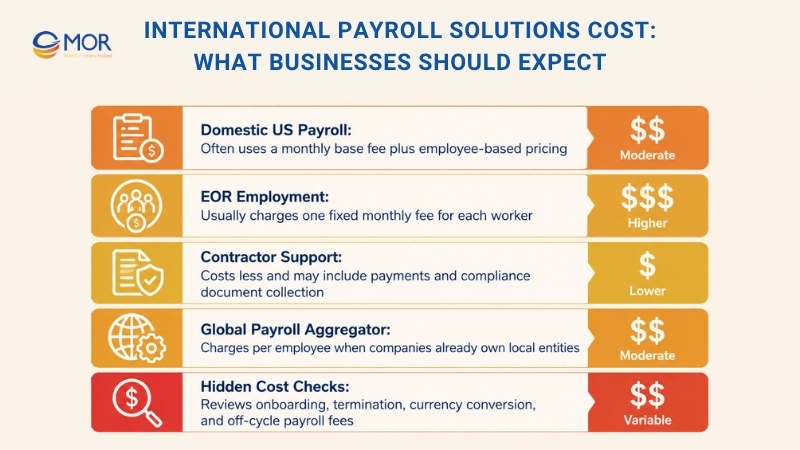
- Domestic US Payroll: For US-based startups, a US payroll platform often uses a monthly base fee plus a fee for each employee. Entry plans may begin near $59 per month, plus about $39 per employee.
- EOR Employment: This model often uses one fixed monthly fee for each worker. Market rates often sit between $500 and $700 per employee. Some providers publish pricing near $599 per month, which gives buyers a clearer cost view.
- Contractor Support: For international contractors, the monthly cost is often lower, usually around $29 to $49 per contractor. This may include payment handling and compliance document collection.
- Global Payroll Aggregator: If your company already has local entities, these platforms often charge a monthly fee per employee. The final cost can change a lot by country.
Always request a full cost list before signing. Ask about onboarding, termination, currency conversion, off-cycle pay runs, and any one-time fees. This is the safest way to compare affordable international payroll solutions available now without missing hidden costs.
>>> Let's break down clearly about payslip vs pay stub so you can make the right call for your team without second-guessing your payroll process.
How To Choose The Right International Payroll Solutions Provider
The market for global payroll providers can feel crowded and hard to compare. A simple buying process can help you make a better choice.
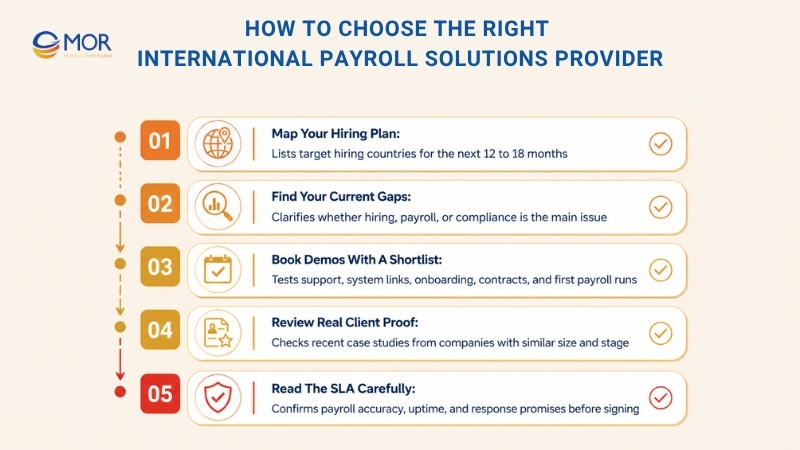
Map Your Hiring Plan
List the countries where you plan to hire during the next 12 to 18 months. This helps you remove providers that do not cover your target markets.
Find Your Current Gaps
Decide whether your main problem is talent hiring or payroll and compliance admin. If you need engineers quickly, international payroll solutions for startups should also support hiring, onboarding, and local employment needs.
Book Demos With A Shortlist
Choose 2 to 3 providers that look like a good match. During each demo, ask about support, system links, and how onboarding works in your target countries. This includes local contracts, statutory benefits, and the first payroll run.
Review Real Client Proof
Look for recent case studies and reviews from companies close to your size and stage. Strong examples should show how the provider helped clients hire, onboard, and pay teams in a short period.
Read The SLA Carefully
The Service Level Agreement (SLA) states what the provider promises for payroll accuracy, uptime, and support response time. Check that it matches your standards before you sign.
Common Mistakes When Choosing International Payroll Solutions
Choosing international payroll solutions takes more than checking prices or the number of countries listed on a website. The wrong provider can cause late payments, surprise costs, compliance trouble, and unhappy employees. Businesses should watch for these mistakes before signing a contract.
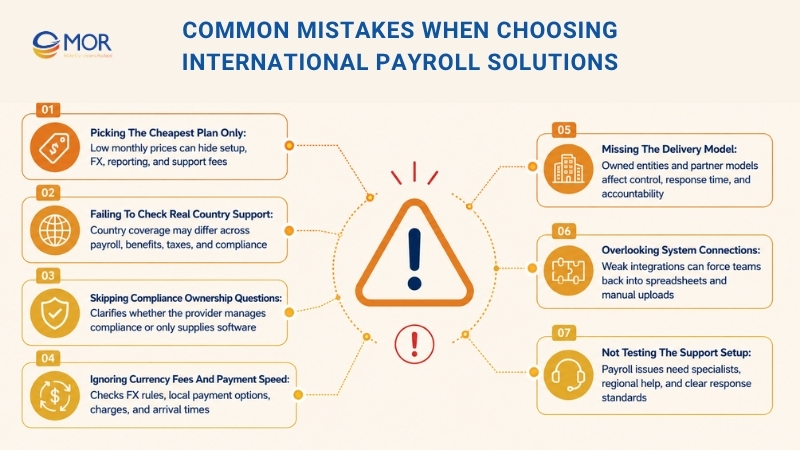
- Picking The Cheapest Plan Only: Low-cost plans can become costly once setup fees, FX charges, off-cycle payroll, reports, tax filing, or support fees appear. Look at total value, not only the monthly price.
- Failing To Check Real Country Support: Some providers show wide coverage, but service depth can change by country. Confirm support for employee payroll, contractor payments, benefits, tax filings, and local compliance in each market.
- Skipping Compliance Ownership Questions: Payroll compliance covers taxes, statutory payments, worker classification, payslips, and labor law updates. Ask whether the provider gives only software or also takes managed compliance responsibility.
- Ignoring Currency Fees And Payment Speed: Global payroll often needs currency exchange and cross-border transfers. Check FX rules, local currency options, bank charges, and payment arrival times.
- Missing The Delivery Model: Some providers use owned entities, while others rely on local partners. This can affect control, response time, service quality, and accountability.
- Overlooking System Connections: Payroll should work well with HRIS integration, accounting, ERP, time tracking, and expense tools. Weak integrations may leave your team stuck with manual uploads and spreadsheets.
- Not Testing The Support Setup: Payroll problems need fast action. Ask whether you receive dedicated payroll specialists, regional help, clear SLAs, or only ticket-based support.
- Forgetting Data Protection: Payroll records include salaries, tax IDs, contracts, and bank details. Check for ISO 27001, SOC 2, GDPR, encryption, and access controls.
- Ignoring Future Growth: Pick a solution that can support new countries, larger teams, contractors, employees, EOR needs, and deeper reports as your company expands.
International Payroll Solutions Trends To Watch In 2026
Global payroll software is changing fast. New tools and new work models are pushing providers beyond simple salary payments.
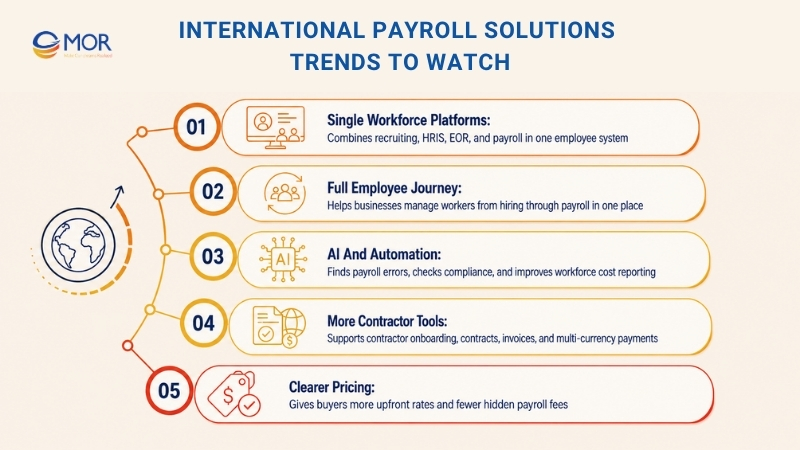
- Single Workforce Platforms: Companies are moving away from separate tools. The main shift is toward one platform for HR work. Instead of using different systems for recruiting, HRIS, EOR, and payroll, businesses want one place to manage the full employee journey.
- AI And Automation: AI applications in various industries 2026 is now used to check compliance, find payroll errors early, and create smarter reports on global workforce costs.
- More Contractor Tools: As companies work with more international contractors, new tools are helping with onboarding, contract creation, invoices, and multi-currency payments. This is useful when teams compare employee hiring with contractor hiring in markets like India.
- Clearer Pricing: After years of unclear quotes and hidden fees, buyers now want upfront pricing. Many modern payroll international solutions now publish rates, with EOR services often priced around $500 to $600 per employee per month.
Conclusion
International payroll solutions can save time, lower payroll risk, and give leaders a clearer view of global workforce costs. The right provider should match your hiring plan, country coverage, support needs, and budget. For tech teams, a Vietnam software development outsourcing partner can add real value beyond payroll alone.
If you plan to build or scale a remote development team, contact MOR Software to discuss the right setup for your business.
MOR SOFTWARE
Frequently Asked Questions (FAQs)
What are international payroll solutions?
International payroll solutions help businesses manage salaries, taxes, compliance, and employee payments across different countries through one centralized system.
What is the difference between global payroll and EOR?
Global payroll helps companies process payroll for employees under their own local entities. An EOR service legally hires employees on behalf of companies that do not have entities in those countries.
How much do international payroll solutions cost?
Costs vary based on the number of employees, countries covered, payroll complexity, and service model. Some providers charge per employee, while others use monthly or custom enterprise pricing.
Can international payroll solutions pay contractors and employees?
Yes. Many international payroll platforms support payments for full-time employees, contractors, freelancers, and mixed global teams through the same system.
How do international payroll solutions handle currency fluctuations?
Most providers support local currency payments and use real-time or pre-agreed exchange rates to help businesses manage international payment accuracy and FX risks.
What countries should a payroll provider support?
A provider should support the countries where your company currently hires employees and the regions you plan to expand into over the next few years.
Do I need a local entity to pay international employees?
In most cases, yes. Companies usually need a local legal entity for standard payroll processing. An EOR provider can help businesses hire internationally without opening local entities.
How long does it take to switch global payroll providers?
The transition timeline depends on company size, payroll complexity, and the number of countries involved. Smaller migrations may take weeks, while larger global rollouts can take months.
What security standards should international payroll providers have?
Businesses should look for providers with standards like ISO 27001, SOC 1, SOC 2, GDPR compliance, encrypted payroll systems, and strong access controls for sensitive employee data.
Which international payroll solution is best for a growing business?
The best solution depends on your hiring plans, budget, compliance needs, and preferred level of support. Growing businesses usually benefit from providers with scalable services, strong integrations, and multi-country support.
Share


Make Our-Dreams Realized


© 2023 . MOR Software. All Rights Reserved
Sitemap
Privacy Policy
Terms of Use

Rate this article
0
over 5.0 based on 0 reviews
Your rating on this news:
Name
*Email
*Write your comment
*Send your comment
1