


Top 15 Manufacturing CRM Software for Businesses in 2026
Managing sales, production, and customer data across disconnected systems often slows teams down and creates costly gaps. The right manufacturing CRM software brings everything into one place, but choosing among so many options can feel overwhelming. In this MOR Software’s guide, we’ll highlight the top tools, key features, and practical criteria to help you select a system that truly fits your operations in 2026.
What Is Manufacturing CRM Software?
A manufacturing CRM software (Customer Relationship Management) system is a digital solution built to help manufacturers handle workflows, documents, and relationships with customers, distributors, and partners across the full production and sales journey. In the broader CRM in manufacturing industry, this type of system connects both customer-facing and operational activities in one place.
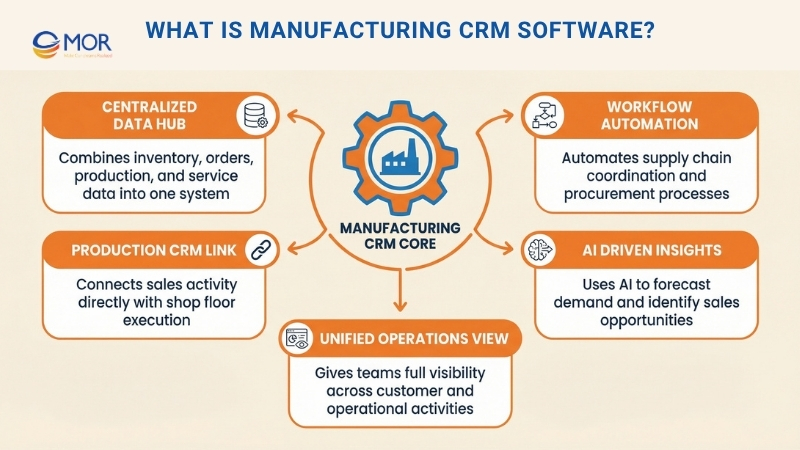
This platform brings together key operational data, including inventory levels, order progress, production timelines, and after-sales service records, into a single environment, giving teams a complete view of operations. It also automates workflows tailored to manufacturing needs, such as supply chain coordination and procurement processes. In many cases, it also acts as a production CRM that links sales activity directly with shop floor execution.
Modern systems now rely more on Artificial Intelligence (AI) to handle repetitive tasks, turn raw data into useful forecasts, and support better decisions. AI in manufacturing allows companies to predict demand, uncover sales opportunities, and improve production planning through pattern detection that teams might otherwise overlook.
15 Best Manufacturing CRM Software To Consider In 2026
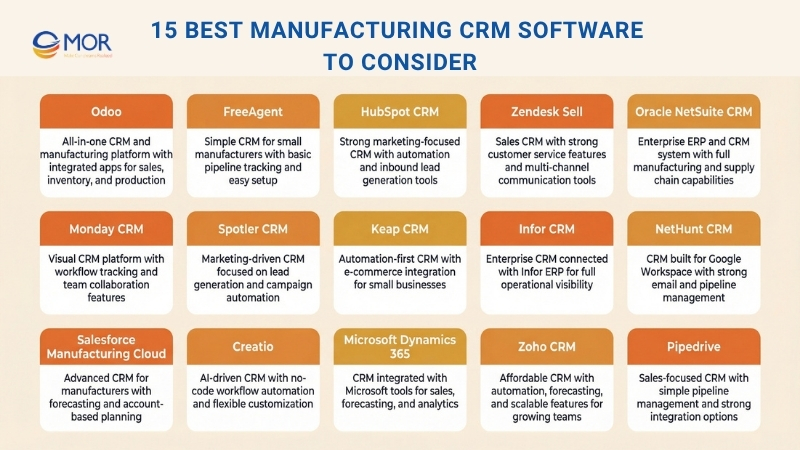
Based on detailed research and feedback from users, we selected 15 manufacturing CRM software options that align well with industry needs and include the key capabilities discussed earlier.
Some of these platforms are built specifically for manufacturers, while others serve a broader audience but include tailored features or modules that support manufacturing workflows alongside their core CRM functionality.
Odoo
Odoo is an open-source CRM manufacturing software and business management platform that combines CRM, sales, inventory, production, accounting, and related functions into a single connected system. Built on a fully integrated app ecosystem, it allows manufacturers to manage customer relationships and internal processes without relying on separate tools or complex handoffs between teams. Its key strength is that it remains simple to use while still allowing companies to expand into wider operational management as they grow.
Odoo includes built-in CRM features that help manufacturers organize leads, monitor opportunities, manage follow-ups, and move deals forward with clear visibility. Sales teams can track their pipeline using a Kanban view, plan calls and meetings, create quotations quickly, and use revenue forecasts and dashboards to support decisions. The system also automates lead creation, team assignment, and scheduled activities, while AI lead scoring helps teams focus on high-value opportunities and reduce manual effort.
Odoo brings together several core applications that support a more connected manufacturing workflow:
- Odoo CRM gives visibility into pipelines, supports lead tracking, manages activities, and uses AI tech stack to prioritize opportunities for sales teams.
- Odoo Sales links opportunities with quotations and sales orders, helping teams move smoothly from initial contact to closed deals.
- Odoo Email Marketing and Events support customer engagement, campaign tracking, and lead generation within the same system.
- Odoo Manufacturing connects CRM activity with production through manufacturing orders, work orders, planning tools, and shop floor controls.
Together, these applications create a unified environment that improves coordination across sales, operations, and production teams. This matters for manufacturers that need demand, inventory, and production plans to stay aligned instead of being handled in separate systems.
In addition, Odoo includes a strong set of manufacturing-focused features, such as manufacturing orders, work orders, barcode-supported shop floor operations, repair orders, planning and rescheduling tools, workcenter capacity control, and multi-level Bills of Materials. It also supports PLM, quality control, preventive and corrective maintenance, tablet-based workcenter interfaces, and third-party apps. With Odoo Studio and flexible hosting options, companies can shape workflows to match their own processes.
At MOR Software, we actively deliver Odoo development services for manufacturers that need a system tailored to real operations. We customize Odoo manufacturing modules, connect Odoo with existing systems, and set up workflows that match how your teams work day to day. Contact us to start building an Odoo solution that fits your business from day one.
Odoo is a strong option for manufacturers looking for the best CRM software for manufacturing that also supports production, inventory, and back-office operations within one scalable system.
Pros:
- Unified CRM, sales, and manufacturing apps within one connected system.
- Strong pipeline tracking with automation, AI lead scoring, and real-time dashboards.
- Wide manufacturing planning coverage, including BoMs, work orders, quality, PLM, and maintenance.
- Flexible customization through Odoo Studio, third-party apps, and various hosting options.
- Free entry plan available for one app with unlimited users.
Cons:
- Setup and configuration may take time at the start.
- Advanced customization can feel complex for non-technical users.
- Data migration may require effort when working with multiple legacy systems.
Pricing
Odoo provides a One App Free plan with unlimited users. Its paid all-app plans are listed at Standard from US$16.90 to US$21.10 per user/month and Custom from US$25.50 to US$31.90 per user/month, depending on billing, with the Custom plan including Odoo Studio, multi-company support, and external API access.
FreeAgent
FreeAgent CRM is a cloud-based CRM platform designed for small businesses. This manufacturing CRM software gives you tools for managing pipelines, tracking leads, and generating reports. It includes ready-made integrations with systems like QuickBooks and Outlook, along with the option to create more connections using Zapier’s no-code tools.
Its clean and simple interface makes it a strong option for manufacturers that want a straightforward system without unnecessary complexity.
Pros:
- Flexible and easy to adjust to your needs
- Fast and responsive customer support
- Simple interface that is easy to learn
Cons:
- Reporting tools are less advanced compared to other systems
- No mobile app available for remote access
Pricing
Pricing for FreeAgent CRM starts at $22 per user/month.
HubSpot CRM
HubSpot CRM is widely known as a marketing automation cloud platform with a strong set of tools for inbound lead generation. It also provides a full CRM solution. It allows you to manage relationships with distributors and retailers, segment leads, and create personalized marketing content powered by AI.
Although its integration library is smaller than some competitors, it still covers the key integrations many manufacturers need. Its automation features simplify lead generation, save time, and support stronger sales and marketing performance.
HubSpot CRM is a good fit for manufacturers that want an easy-to-use platform with strong marketing capabilities.
Pros:
- Advanced marketing automation tools and analytics
- Quick setup process
- Clean and user-friendly interface
Cons:
- Limited customization flexibility
- Pricing is geared toward larger businesses
- CRM modules cannot be purchased separately
- Smaller range of integrations
Pricing
A free version is available. Paid plans for HubSpot CRM start at $1575 per month for 5 users.
Zendesk Sell
Zendesk is best known for its customer service platform, and it also provides Zendesk Sell, a CRM system designed for various industries. This solution focuses on helping customer-facing teams work more efficiently and improving lead conversion with strong sales engagement tools.
Given its background, the platform stands out for its customer service features, including task management, a contact center, and multi-channel communication tools.
Other features include sales engagement tools, customizable data lists for customers, templates for leads and deals, easy-to-read reports, and access to more than 100 integrations.
You may consider Zendesk Sell if you want a simple and cost-effective system with a solid integration marketplace.
Pros:
- Fast onboarding process
- Competitive pricing options
- Strong customer service capabilities
Cons:
- Limited options for customization
- Fewer marketing features
Pricing
Pricing starts at $55 per user/month for the Suite Team plan with AI support.
Oracle NetSuite CRM
Oracle NetSuite CRM combines an ERP (Enterprise Resource Planning) system with a powerful cloud-based manufacturing CRM software.
It includes tools that support core manufacturing needs such as order management, supply chain operations, shop floor control, and procurement. Its CRM features include sales force automation, marketing automation, and customer service management, making it a complete CRM software for manufacturing industry use cases.
NetSuite is best suited for large manufacturers with global operations that need a unified system for analytics and business automation.
Pros:
- Full ERP and CRM suite designed for manufacturing
- Strong analytics capabilities
- Wide range of integrations
Cons:
- Setup can take significant time
- Steep learning curve for new users
- Third-party integrations may require expert support
Pricing
Pricing for this CRM solution is provided on a custom basis depending on business needs.
Monday.com
Monday CRM is a flexible and easy-to-use CRM platform built to simplify workflows and improve teamwork across departments. With customizable options and integrations, this system supports project tracking, task management, and communication, helping businesses stay organized and move work forward.
It includes ready-made manufacturing templates that help you manage production activities and structure your data. Still, more advanced manufacturing functions, like supply management, are not included.
Monday.com works well for companies that want an affordable and user-friendly platform to support sales activities and team productivity.
Pros:
- Simple and easy to use
- Includes manufacturing-focused templates
- Strong collaboration features
Cons:
- Limited reporting capabilities
- Marketing automation tools are not very strong
- Smaller number of integrations
Pricing
Pricing for Monday CRM starts at $12 per user/month for basic features and limited capabilities.
SpotlerCRM
Spotler CRM is a marketing automation platform built to help businesses improve lead generation, customer engagement, and retention. It provides tools for managing leads, running email campaigns, and automating multichannel marketing efforts, allowing manufacturers to create targeted campaigns and nurture prospects more effectively. With its simple interface and built-in analytics, this solution helps teams understand customer behavior, personalize communication, and build stronger long-term relationships.
You may consider SpotlerCRM if you want a clear and easy system to track sales, marketing, and service activities.
Pros:
- Integrations supported through Zapier
- Clean and user-friendly interface
- Strong marketing tools
Cons:
- Limited customization features
- Reporting tools are not very advanced
Pricing
A free trial is available. Pricing for Spotler CRM starts at $520 per month.
Keap CRM
Keap CRM is a strong option for manufacturers that want a complete enterprise platform development solutions with built-in automation.
This platform includes customizable pipelines and stages that help organize sales processes, and its e-commerce integration can support revenue growth. Still, manufacturers should be aware of its limits, including fewer customization options for reports and the lack of a built-in telephony system.
Pros:
- E-commerce integration included
- Strong marketing features
- Advanced reporting and analytics tools
Cons:
- Limited customization options
- No built-in telephony system
- Mobile app performance can be weak
Pricing
Pricing starts at $299 per month, which includes 1500 contacts and 2 users.
Infor
Infor CRM is a full-featured cloud-based system created to simplify different areas of customer management. It includes tools designed for sales, customer support, marketing analytics, and reporting, all brought together within a single platform.
Infor CRM stands out because it connects smoothly with its own manufacturing ERP system built for global manufacturers. This setup gives companies better visibility and automation, helping them react faster to customer needs, supplier demands, and regulatory requirements without heavy customization. The ERP system also includes supply chain tools, a manufacturing execution system, and product lifecycle management features.
This platform is a strong fit for large, global manufacturers that want a complete CRM and ERP solution in one system.
Pros:
- Direct integration with Infor ERP
- Scalable and adaptable CRM platform
Cons:
- Interface design can feel outdated
- Limited CRM integrations outside the Infor ecosystem
- Requires extensive training to use effectively
Pricing
Pricing is available upon request.
NetHunt
NetHunt CRM is a cloud-based platform designed to simplify sales and customer service processes within a manufacturing CRM software environment.
It provides strong tools for managing customer interactions, tracking sales pipelines, and organizing data. Its key advantage is built-in integration with Google Workspace, allowing you to connect easily with tools like email and calendars.
NetHunt CRM supports better communication, personalized outreach, and automated workflows, making it a flexible option for businesses of different sizes that want to improve sales and customer management.
Pros:
- Native integration with Google tools
- Clean and easy-to-use interface
- Fast setup process
Cons:
- Limited integration choices
- Some learning curve during adoption
- No built-in telephony features
Pricing
A free trial is available. Pricing starts at $30 per user/month.
Salesforce Manufacturing Cloud
Salesforce Manufacturing Cloud is a specialized manufacturing CRM software built on Salesforce that helps companies manage sales agreements, account-based forecasting, service operations, and partner relationships in one place. It connects sales, service, operations, and finance teams through a shared view of customers, assets, and revenue commitments. For manufacturers with complex accounts and long sales cycles, this visibility helps improve planning and coordination.
Its key strength comes from its manufacturing layer built on top of the broader Salesforce cloud based ecosystem. Teams can compare actual and expected revenue, manage sales agreements, centralize account and opportunity data, and connect with ERP systems, IoT, and demand planning tools. Salesforce positions this solution as a way to bring sales, service, and partner channels together, making it a strong option for large manufacturers with complex operations.
Salesforce ERP Manufacturing Cloud is best suited for enterprise manufacturers that need advanced forecasting, detailed account planning, and cross-team visibility.
Pros:
- Designed for manufacturing sales and service processes
- Strong forecasting and sales agreement tools
- Works well with the wider Salesforce ecosystem
Cons:
- Higher cost compared to many mid-market solutions
- Setup and management can be complex
- May be too advanced for smaller manufacturers
Pricing
Pricing for Salesforce Manufacturing Cloud starts at $275 per user/month for the Sales Enterprise plan, with higher tiers available for broader functionality.
Creatio
Creatio is an AI-driven CRM platform combined with a no-code workflow system that gives manufacturers a flexible way to manage sales processes, customer information, and daily operations. It stands out because it blends CRM functions with visual workflow automation, making it easier to adjust the system for approval steps, partner processes, and order handling needs. This approach reflects how AI CRM software is shaping modern manufacturing operations.
Its sales module includes AI-based suggestions, forecasting tools, order fulfillment workflows, and features that support partner collaboration. Because Creatio uses a modular pricing and platform structure, manufacturers can build the system around their exact needs instead of buying a fixed package from the start. This makes it a strong option for companies that want CRM functionality along with workflow automation, without heavy development work.
Creatio is best suited for manufacturers that need flexible process control, partner coordination, and no-code automation.
Pros:
- Strong no-code workflow customization
- AI-driven forecasting and sales recommendations
- Flexible for partner workflows and approval-heavy processes
Cons:
- Pricing structure may be harder to understand at first
- Setup can take more effort than simpler SMB solutions
- Not as lightweight as basic pipeline-focused tools
Pricing
Creatio uses a modular pricing model. The platform starts at $25 per user/month, and the Sales module adds $15 per user/month, with higher pricing tiers available for enterprise use.
Microsoft Dynamics 365
Microsoft Dynamics 365 Sales is a CRM platform that helps manufacturers manage accounts, leads, opportunities, forecasting, and collaboration within the broader Microsoft ecosystem. It supports the full lead-to-order process, targeted campaigns, and forecasting, while also connecting with Microsoft 365, Power Platform, and other Dynamics applications.
For manufacturers, its main strength lies in modernizing sales processes while linking CRM data with ERP systems, legacy tools, and analytics platforms. Microsoft also highlights features like AI-based scoring, guided selling, forecasting, and extensibility through the Power Platform, which can be useful for businesses with complex sales structures and existing Microsoft systems.
Microsoft Dynamics 365 is best suited for manufacturers already using Microsoft tools or planning gradual upgrades across sales and operations.
Pros:
- Strong compatibility with Microsoft environments
- Reliable forecasting, AI scoring, and guided selling tools
- Smooth integration with Power Platform and other Dynamics apps
Cons:
- Costs can rise at higher plan levels
- Works best when used with the full Microsoft ecosystem
- Implementation may require expert support
Pricing
Pricing starts at $65 per user/month for Sales Professional, $105 per user/month for Sales Enterprise, and $150 per user/month for Sales Premium.
Zoho CRM
Zoho CRM is a flexible customer management system designed for manufacturers that need lead tracking, deal management, workflow automation, forecasting, and inventory-related tools at a lower starting cost than many enterprise platforms. It is especially attractive for smaller or growing companies that want useful automation without a long and complex setup process, making it a strong option as the best CRM for small manufacturing business environments.
The platform includes workflows, sales cadences, dashboards, forecasting tools, and inventory features in higher plans, along with AI support through Zia in enterprise editions. Zoho also provides flexible pricing and a free version for up to three users, allowing teams to begin with a small setup and scale over time.
Zoho CRM works well for small to mid-sized manufacturers that want affordability, automation, and room to grow.
Pros:
- Lower starting cost compared to many enterprise systems
- Useful automation and forecasting tools
- Free version available for small teams
Cons:
- Manufacturing features are less advanced than ERP-based platforms
- Advanced tools are only available in higher plans
- Pricing display may vary by region and currency
Pricing
Zoho CRM includes a free version for up to 3 users. The Standard plan is currently listed from ₹800 per user/month, with pricing depending on billing cycle and region.
Pipedrive
Pipedrive is a simple and user-friendly sales CRM focused on pipeline management, deal tracking, scheduling, and sales activity visibility. For manufacturers that want a clean system to manage leads, quotes, and follow-ups without the complexity of a larger platform, it provides a practical starting point.
Its plans include lead and pipeline tracking, calendar tools, AI-based report creation, email integration, automation features, forecasting reports, and access to more than 500 integrations, depending on the selected plan. While Pipedrive does not include deep manufacturing features, it works well for sales teams that need clear pipeline control and flexible integrations.
Pipedrive is best suited for small and mid-sized manufacturers that want a simple, sales-focused system with quick onboarding.
Pros:
- Very easy to learn and implement
- Strong pipeline visibility and activity tracking
- Wide integration options for a lightweight CRM
Cons:
- Limited built-in manufacturing functionality
- Advanced features require higher-tier plans
- Better suited for sales teams than full operational use
Pricing
Pricing for Pipedrive starts at US$14 per seat/month, billed annually.
Quick Comparison Of Leading Manufacturing CRM Software
This table gives a side-by-side view of top customer management software used by manufacturers, helping you compare strengths, pricing, and ideal use cases quickly. It highlights how each manufacturing CRM software fits different business sizes and operational needs.
Manufacturing CRM | Key strengths | Pricing | Best for |
Odoo | Integrated CRM and manufacturing suite with CRM, sales, MRP, inventory, PLM, quality, maintenance, and flexible customization options. | One App Free, paid plans from $16.90/user/month | Manufacturers seeking one connected platform for sales, operations, and production. |
FreeAgent | Simple, flexible CRM ideal for small manufacturers. | From $22/user/month | Small manufacturers looking for simplicity and affordability. |
HubSpot CRM | All-in-one marketing, sales, and service platform with inbound automation. | From $1575/month/5 users | Mid-size to large manufacturers focused on inbound marketing. |
Zendesk Sell | CRM built on Zendesk’s support expertise. | From $55/user/month | Manufacturers prioritizing customer support and simplicity. |
NetSuite | ERP + CRM hybrid with extensive manufacturing management tools. | Custom pricing | Enterprise manufacturers with global operations. |
Monday CRM | Highly visual, collaborative CRM for workflow and task tracking. | From $12/3 users/month | Teams seeking project-oriented CRM and collaboration. |
SpotlerCRM | Simple CRM with strong marketing automation and campaign tracking. | From $520/month | Manufacturers focusing on lead nurturing and marketing campaigns. |
Keap CRM | Automation-first CRM for SMBs with e-commerce features. | From $299/month/2 users | Small manufacturers focused on automated sales and e-commerce. |
Infor CRM | Enterprise-grade CRM integrated with Infor ERP for full manufacturing control. | Custom pricing | Large manufacturers seeking full CRM + ERP integration. |
NetHunt CRM | CRM for Google Workspace users, seamless Gmail integration. | From $30/user/month | Businesses already using Google tools. |
Salesforce Manufacturing Cloud | Manufacturing-specific CRM with sales agreements, account forecasting, and cross-team visibility. | From $275/user/month. | Enterprise manufacturers needing advanced forecasting and unified customer data. |
Creatio | AI-native CRM with no-code workflow automation, forecasting, and partner coordination. | Composable pricing, from $25 platform + $15 Sales/user/month. | Manufacturers needing process customization and no-code automation. |
Microsoft Dynamics 365 | CRM with forecasting, AI sales guidance, and strong Microsoft ecosystem integration. | From $65/user/month. | Manufacturers already using Microsoft tools or modernizing legacy sales systems. |
Zoho CRM | Affordable CRM with automation, forecasting, inventory-related tools, and flexible scaling. | Free for 3 users, paid plans vary by region, Standard currently listed from ₹800/user/month. | Small to mid-sized manufacturers seeking affordability and easy adoption. |
Pipedrive | Sales-focused CRM with clean pipeline management, automations, scheduling, and broad integrations. | From $14/user/month, billed annually. | Small and mid-sized manufacturers that want a simple pipeline-first CRM. |
Key Features To Look For In Manufacturing CRM Software
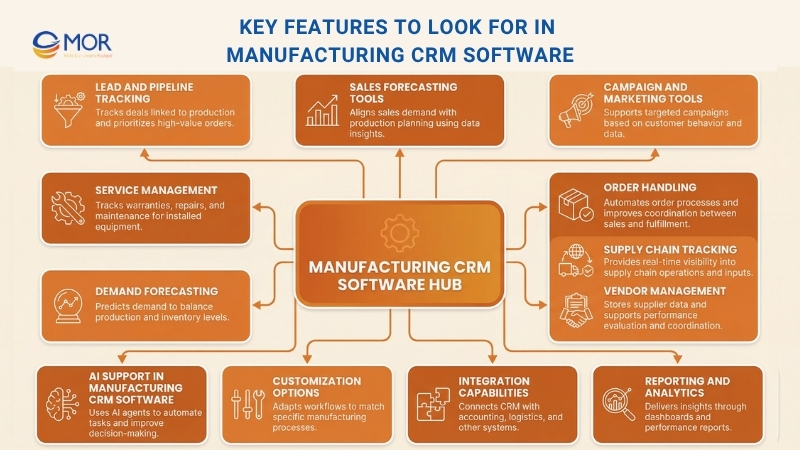
There is a core group of features that most CRM providers include to support sales, marketing, and service teams. This section focuses on both general functions and manufacturing-specific capabilities that help you get the most value from CRM software for manufacturing.
Lead And Pipeline Tracking
A CRM system should give your sales team full visibility and control over the pipeline, while also automating how leads are tracked, scored, and assigned to the right sales reps. This helps improve conversion rates and makes it easier to find gaps in your current sales approach.
Purpose for Manufacturers: Helps sales teams track deals linked to production timelines and prioritize high-value orders.
Sales Forecasting Tools
This feature allows users to build sales forecasts using pipeline data, past performance, and market trends. The best systems let manufacturing teams adjust forecasting models and choose the right data sources for more accurate planning.
Purpose for Manufacturers: Supports better alignment between sales demand and production planning.
Campaign And Marketing Tools
A strong manufacturing CRM software should include campaign management tools that allow you to create, automate, and monitor personalized marketing campaigns across different channels. These tools help your team reach the right audience using insights from customer data and engagement history. With built-in dashboards and analytics, you can track results, measure ROI, and adjust campaigns quickly.
Purpose for Manufacturers: Helps attract and nurture leads that match production capacity and target markets.
Service Management
For manufacturers, service management includes more than basic support requests. This feature tracks warranty claims, handles repair tasks, and schedules preventive maintenance for installed equipment. Keeping service records and asset data in one place allows your team to respond faster, reduce downtime, and maintain product quality. It also helps field teams stay organized with clear schedules, parts details, and job information before arriving on-site.
Purpose for Manufacturers: Improves after-sales service quality and extends product lifecycle value.
Customer Service Tools
Features like a complete 360-degree customer view, contact center support, and task management are often included in service-focused CRM platforms. You should choose a system that supports contact management and allows communication across channels such as phone, email, and social media.
Purpose for Manufacturers: Ensures consistent communication with distributors, partners, and end customers across all touchpoints.
Order Handling
As a manufacturer, you can gain clear advantages from automating order creation and validation within your CRM. This reduces the time spent on manual processing and lowers the risk of errors. Some businesses may still rely on separate tools for order management, but integrating this function into one platform makes it easier to connect with customer service teams when issues happen during fulfillment.
Purpose for Manufacturers: Helps process orders faster, reduce manual errors, and improve coordination between sales and fulfillment teams.
Demand Forecasting
Demand forecasting helps manufacturers match production plans with real market demand. This feature uses past sales data, seasonal trends, and customer buying patterns to estimate future demand more accurately. With better forecasts, production teams can adjust output, avoid excess stock, and reduce waste. It also improves procurement planning, so materials are available when needed without tying up too much capital.
Purpose for Manufacturers: Supports accurate production planning and prevents overstock or stock shortages.
Supply Chain Tracking
This function allows you to monitor all inputs used in production, automate shipment scheduling, and reduce downtime through planned delivery processes. You can also synchronize product data across different departments and receive updates on supply and shipments in real time. Since this feature is designed for manufacturing workflows, it may not exist in standard CRM tools, so it is important to confirm availability with vendors.
Purpose for Manufacturers: Provides real-time visibility across supply chains to keep production running smoothly.
Vendor Management
A CRM platform helps manufacturers manage supplier and partner relationships more effectively. It stores vendor details such as contracts, pricing, performance data, and communication records in one system. With this feature, you can evaluate vendor performance, monitor deliveries, compare supplier quotes, and maintain compliance with procurement rules.
Purpose for Manufacturers: Improves supplier coordination and helps maintain stable and reliable sourcing.
AI Support In Manufacturing CRM Software
One of the most notable improvements in modern manufacturing CRM software is the rise of AI Agents, which act as smart assistants that handle repetitive work, automate workflows, and deliver useful insights. These AI-driven tools go further than basic automation, as they can understand context, learn from data over time, and take action on their own to support both your team and your customers.
Within this system, AI agents can support many different tasks:
- Sales workflow support: AI agents for sales can qualify leads automatically, suggest suitable offers, and even prepare personalized proposals using past data and customer preferences. This improves sales results and reduces manual effort, so your team can spend more time building relationships and focusing on key deals.
- Supply chain coordination: These agents can track production and supply chain data in real time, alert your team to delays, shortages, or inventory risks, and suggest ways to fix problems. In some cases, autonomous agents can act directly, such as reallocating resources, placing orders for missing materials, adjusting schedules, or notifying suppliers to avoid disruptions.
- Customer service support: AI agents for customer service use natural language processing to interact with customers through chat, email, or social channels. They can answer common questions, handle service requests, and pass complex issues to human agents when needed, helping you deliver fast and consistent support at any time.
- Marketing performance improvement: AI agents for marketing help your team create personalized campaigns based on real customer data. They can analyze behavior, choose the best channels and timing, adjust budgets automatically, and suggest next steps to improve conversion rates while building stronger customer loyalty.
- Predictive analytics support: Using machine learning, these agents analyze CRM data to forecast demand, detect unusual patterns, and recommend better production or maintenance plans. This helps you plan resources, avoid disruptions, and make better business decisions with data you can trust.
Purpose for Manufacturers: Reduces manual work, improves forecasting accuracy, and supports faster, data-driven decisions across sales, operations, and service.
Customization Options
The best CRM platforms for manufacturers provide flexible customization options that allow you to design workflows that match your exact business needs. This flexibility helps your system grow with your team, so you do not need to move data or rebuild processes when your operations expand.
Purpose for Manufacturers: Allows you to adapt the system to unique production workflows and scale without disruption.
Integration Capabilities
The ability to connect with other systems is one of the most important features in a manufacturing CRM. You should choose a platform that works smoothly with your existing tools, including accounting systems, logistics software, and communication platforms.
Purpose for Manufacturers: Keeps data consistent across systems and improves coordination between departments.
Reporting And Analytics
Many advantages of a CRM system come from its ability to analyze data effectively. A strong platform should provide customizable dashboards and detailed reports that combine data from different sources, helping you understand performance and trends clearly.
Purpose for Manufacturers: Provides clear insights to monitor performance, identify issues, and support better decision-making.
Top Benefits Of Manufacturing CRM Software For Business
The main advantage of manufacturing CRM software is that it acts as a single source of truth, bringing together sales, marketing, customer service, distribution, partner management, and other core activities. This system helps you manage operations more clearly without dealing with duplicate processes or scattered data, making all customer-facing work more organized and productive across manufacturing CRM systems.
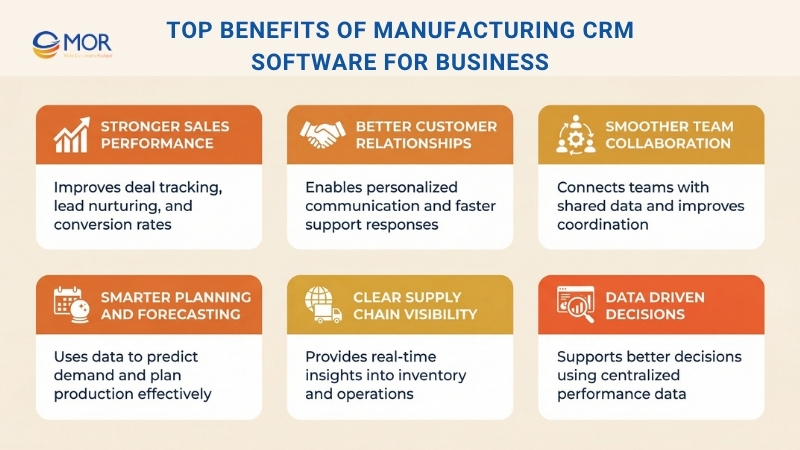
Key benefits of CRM tools for manufacturers include:
Stronger Sales Performance
A CRM platform brings all your sales activities into one place. This allows your sales team to manage communication across different channels more easily, without switching between multiple systems.
Centralized data also gives both sales and marketing teams a complete view of the customer journey. This helps them nurture leads, build stronger relationships, and respond faster to customer needs. With built-in marketing automation, you can run automated yet personalized campaigns that feed more qualified leads into your pipeline.
These improvements increase your chances of closing new deals and finding more upsell and cross-sell opportunities with existing customers. A well-structured pipeline and organized team lead to better sales results and higher deal closure rates.
Better Customer Relationships
Having one reliable source of customer data allows you to create more personalized communication and build stronger connections. CRM tools for manufacturers help you keep track of existing customers and use past interactions to support retention campaigns that drive repeat business.
This system also helps your support team respond quickly to customer requests. All key information is stored in one place, and requests can be sorted and prioritized automatically for faster handling.
With full visibility and smart automation, manufacturers can deliver consistent and high-quality experiences across every interaction. This leads to better satisfaction, stronger loyalty, and higher retention, turning one-time buyers into long-term partners.
Smoother Team Collaboration
CRM systems designed for manufacturing connect different front-office teams and support the sharing of customer data across the entire organization. For instance, service teams can check which communication channels a customer preferred during the sales stage and continue using them when handling support requests.
When data from multiple departments is stored in one place and shared easily, collaboration between teams becomes simpler and more effective, which improves overall productivity.
In addition, CRM platforms include task management tools that help managers organize workloads and monitor team performance, leading to better operational control.
Automation within the system also reduces time spent on routine tasks like follow-ups and approvals, so teams can focus on work that drives higher value.
Smarter Planning And Forecasting
A CRM system helps your sales team estimate revenue growth using current pipeline data and past order history. These sales forecasts allow you to plan schedules and allocate resources more effectively, instead of waiting for orders to arrive.
The platform collects customer data and analyzes audience behavior, then uses this information to predict future demand more accurately. This helps manufacturers plan production levels better and avoid both overproduction and delivery delays.
Clear Supply Chain Visibility
CRM in manufacturing industry supports supply chain processes by giving you access to real-time data from operations, inventory, order handling, warehousing, and distribution.
With better visibility across these areas, you can manage production schedules more effectively, control inventory levels, and make smarter purchasing decisions.
Data-Driven Decisions
A CRM platform gives managers access to actionable data and insights that support better business decisions and process improvements. When key performance metrics are displayed in one dashboard, leaders can quickly identify growth opportunities and potential risks, then take action based on those findings.
How To Choose The Right Manufacturing CRM Software
Selecting the right manufacturing CRM software takes more than reviewing feature lists. You need to look at your internal challenges, technical needs, and long-term plans to choose a system that truly fits your operations. A careful and structured evaluation helps you confirm that the platform can support both your current workflows and future growth.
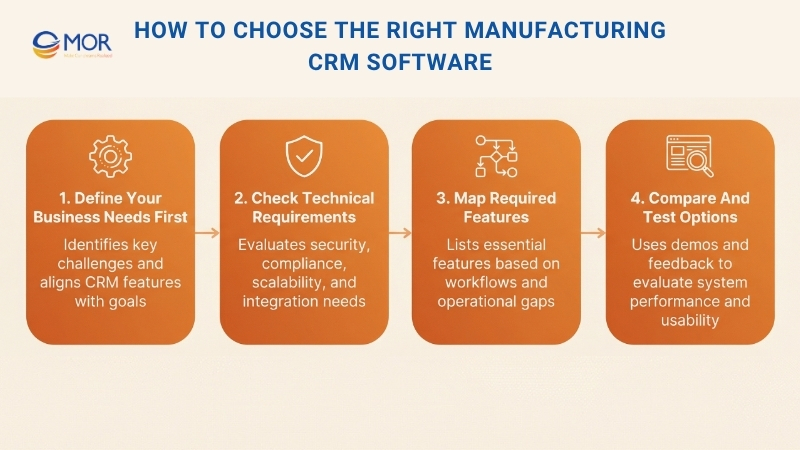
Define Your Business Needs First
Start by identifying your main challenges, such as poor visibility into distributor performance, slow quoting cycles, or gaps between sales and production. Understanding these issues helps you focus on CRM features that solve real problems, like partner management tools, automated quoting, or ERP integration. You should also define your goals and assess CRM platforms based on their ability to support long-term growth, not just their basic functions.
Check Technical Requirements
Before adopting a new system, you should clearly understand your technical needs, compliance rules, scalability expectations, integration requirements, and budget limits. Setting these criteria early helps your team make better decisions during the selection process:
Data security and privacy needs
Important features include user access control, multi-factor authentication, data encryption, and secure cloud environments. Certifications like SOC 2 and ISO/IEC 27001 help confirm that the platform meets recognized security standards. Audit logs and tracking tools also improve monitoring and simplify how your team handles security incidents.
Regulatory compliance standards
For manufacturers in regulated sectors, the system should support compliance with frameworks like GDPR, ITAR, and ISO 9001. Tools for document control, audit tracking, and automated reporting help reduce the effort required to stay compliant. Some platforms also monitor deadlines and certification renewals to simplify ongoing compliance work.
System scalability expectations
A scalable system can support more users, larger data volumes, and more complex workflows without slowing down. Cloud-based platforms are especially useful here, as they allow you to expand features without major system changes. It is also important that the system can support new products, markets, and sales channels as your business grows.
Integration and system compatibility
The system should connect easily with your existing tools to avoid disruption during setup. Strong APIs and ready-made connectors can speed up implementation and make long-term maintenance easier. You should evaluate each platform based on how well it supports your workflows and data needs, and compare options using a checklist if needed.
Total cost considerations
In addition to license fees, you should consider costs for setup, customization, training, and ongoing support. It is important to understand how pricing grows with more users and features. Cloud-based systems with flexible pricing can help you control costs over time. You should also estimate potential returns from faster sales cycles and better customer retention to judge long-term value.
Map Required Features
Before choosing a CRM platform, you should document your internal workflows and review how teams handle sales, customer service, inventory, and production planning. Make note of any inefficiencies, missing steps, or repeated problems, such as inconsistent customer records or delays in order handling, and then identify which features are needed to fix them. These findings help you build a clear and prioritized list of CRM requirements.
You should include industry-specific needs like inventory tracking, order management, and integration with ERP and manufacturing execution systems, along with broader features such as pipeline visibility, marketing automation, and advanced analytics. It is also important to separate must-have features from secondary ones, so your selection stays focused on the most important business needs instead of being distracted by extra functions that look useful but are not essential. Including stakeholders from different teams helps make sure the chosen system can support daily operations as well as long-term growth.
Compare And Test Options
You should carefully evaluate each potential system based on its features, ease of use, vendor support, and market reputation. Training, setup support, and related services are especially important for a smooth onboarding process. Demos and trial periods can help you test the interface and core functions in real use. You should also collect feedback from the main teams that will use the system every day, including sales, marketing, customer service, and IT. In addition, review case studies, testimonials, and third-party review platforms to understand how well each solution performs in real manufacturing environments.
Future Trends Of Manufacturing CRM Software
Manufacturing CRM software is moving toward smarter, more automated, and customer-focused operations. AI plays a key role by turning scattered and unused data into useful insights that support predictive analytics, demand forecasting, and real-time production improvements. It also strengthens personalized communication through email, phone, and messaging, helping businesses engage customers in a more relevant way. At the same time, low-code and no-code tools make it easier for teams to build AI-driven workflows without needing developers, which improves both productivity and collaboration.
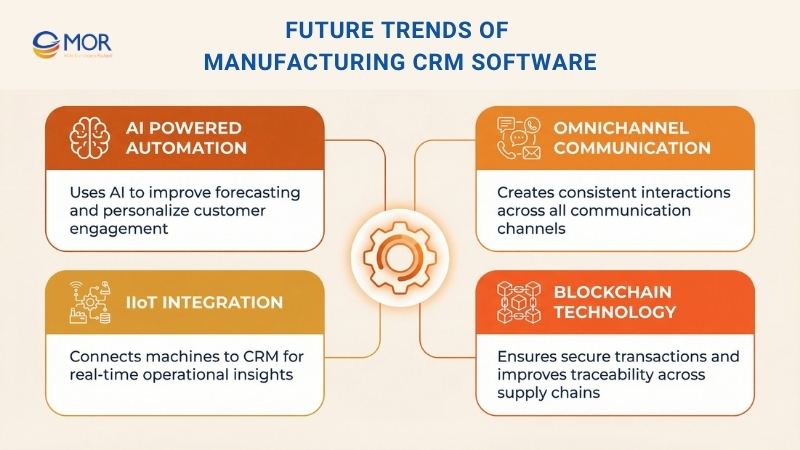
Omnichannel capabilities build on these AI-driven features by making communication more consistent across email, phone, chat, and social media. Instead of fragmented interactions, manufacturers can create a unified customer experience across all channels and teams. Social CRM tools add another layer by collecting engagement data from online platforms, giving teams better context when planning marketing and sales activities.
IIoT (Industrial Internet of Things) integration is also changing how manufacturers use CRM data. When production equipment and systems connect to CRM platforms, companies gain real-time visibility into machine status, product usage, and supply chain activity. These insights support preventive maintenance, reduce downtime, and improve service quality. Data from connected devices can also guide product development and allow teams to service equipment earlier, which helps prevent issues and improve customer satisfaction.
Blockchain works alongside these technologies by providing secure and transparent transaction records across the value chain. It improves traceability for quality control and product recalls, and supports smart contracts that automate processes like order fulfillment and compliance checks. These capabilities help maintain operational reliability and build stronger trust with partners and customers.
MOR Software Helps Businesses Get Full Value From Manufacturing CRM Software
Choosing the right manufacturing CRM software is only the first step. Getting it to work smoothly in your daily operations is where many teams struggle. That is where MOR Software comes in, especially when you choose Odoo as your platform.
We work directly with your sales, production, and operations teams to build a system that reflects how your business actually runs. From CRM pipelines to production planning, each workflow is connected in a way your team can follow easily. There is no confusion and no ‘overbuilt’ setup that slows people down.
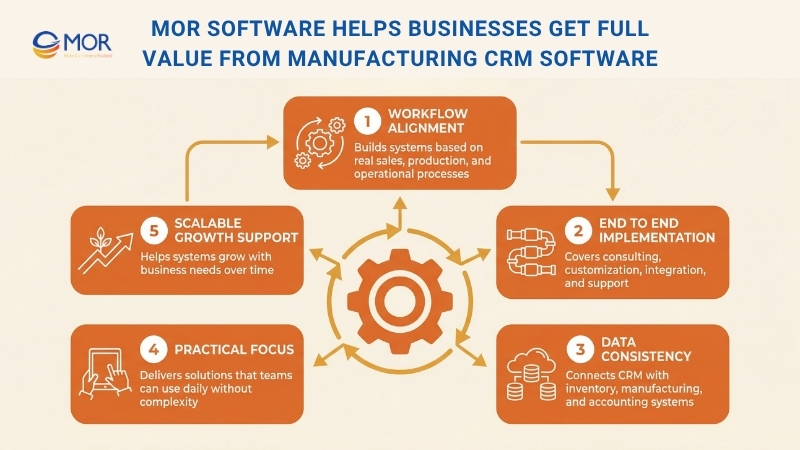
Our team manages the full process from start to finish. This includes consulting, Odoo customization, system integration, and long-term support. We connect CRM with manufacturing, inventory, and accounting so your data stays consistent instead of being spread across different tools.
Many clients choose MOR Software for a clear reason. We focus on what works in real operations. You get a system your team can use every day, grow with over time, and rely on when workloads increase.
If you need a solution that works well on the shop floor and supports your team in real conditions, this is where we begin.
Conclusion
The right manufacturing CRM software gives your team a clear view of customers, orders, and production in one place, making daily work easier to manage. A system that fits your processes can support growth without adding complexity. MOR Software can help manufacturers turn that plan into a working solution. Contact us to build a setup that connects your operations and supports your team long term.
MOR SOFTWARE
Frequently Asked Questions (FAQs)
What is manufacturing CRM software?
Manufacturing CRM software helps you manage customer relationships alongside production, orders, and supply data. It connects sales, operations, and service teams in one system so information stays consistent across the business.
How is manufacturing CRM different from a standard CRM?
A standard CRM focuses on sales and customer data. Manufacturing CRM software also links production planning, inventory, and order workflows, which makes it more suitable for factory operations.
Who should use manufacturing CRM software?
It fits manufacturers of all sizes, especially those dealing with complex sales cycles, distributors, or custom orders. Teams that need visibility across sales and production benefit the most.
What are the key features to look for?
Look for pipeline tracking, order management, forecasting tools, integration with ERP or MRP systems, and reporting dashboards. Some platforms also include AI support and automation.
Can manufacturing CRM software integrate with ERP systems?
Yes. Many solutions connect with ERP, accounting, and inventory systems. This helps your teams avoid working in separate tools and keeps data aligned.
How does it improve sales performance?
It gives your sales team a clear view of leads, deals, and customer history. That makes it easier to follow up, personalize communication, and close deals faster.
Does manufacturing CRM software support supply chain visibility?
Yes. Many platforms track inventory, orders, and supplier data in real time. This helps you plan production and avoid delays.
Is manufacturing CRM software suitable for small businesses?
Yes. Some tools are simple and affordable for small teams, while others scale for larger operations. You can start small and expand as your business grows.
What challenges should you expect during implementation?
Common challenges include data migration, system setup, and user training. Planning ahead and working with experienced teams can help reduce these issues.
How long does it take to implement manufacturing CRM software?
It depends on your business size and system complexity. Small setups may take a few weeks, while larger projects can take several months.
Share


Make Our-Dreams Realized


© 2023 . MOR Software. All Rights Reserved
Sitemap
Privacy Policy
Terms of Use

Rate this article
0
over 5.0 based on 0 reviews
Your rating on this news:
Name
*Email
*Write your comment
*Send your comment
1