


Semantic Search vs Vector Search: Key Differences and Use Cases
Semantic search vs vector search is a common comparison in AI-powered information retrieval. Semantic search focuses on understanding user intent and meaning, while vector search retrieves similar data through numerical embeddings. The two often work together, but their roles differ in search architecture, accuracy, speed, and scalability. In this guide, MOR Software will break down their underlying technologies, strengths, limitations, and real-world use cases to help you choose a suitable approach for your business.
Key Takeaways
- Semantic search aims to understand the meaning and intent behind queries. Vector search retrieves items based on mathematical similarity and often serves as the retrieval layer for semantic search.
- Vector search supports fast similarity matching across text, images, audio, and other data types. Semantic search focuses on meaningful results, with performance depending on the models and ranking methods used.
- Hybrid search combines keyword matching and vector-based retrieval. It works well for enterprise applications that need exact terms, natural-language understanding, and reliable search results.
Semantic Search vs Vector Search: A Side-by-Side Comparison
The main difference in semantic search vs vector search lies in their purpose. Semantic search aims to return results that match user intent, while vector search provides a method for finding related content through numerical similarity.
Comparison factor | Semantic search | Vector search | Practical implication |
Primary purpose | Retrieve information based on meaning and intent | Find data with similar vector representations | Semantic search defines relevance goals; vector search provides a retrieval method |
Core technology | NLP, embedding models, entity recognition, and ranking methods | Embedding models, similarity metrics, and vector indexes | Semantic search may use vector search as a core component |
Query understanding | Interprets meaning, relationships, and user intent | Compares vectors generated from query features | Relevance depends on embedding quality and added ranking signals |
Data compatibility | Mainly natural-language content, with multimodal extensions | Text, images, audio, video, and other embedded data | Vector search suits a wider range of similarity tasks |
Indexing | May combine lexical indexes, vector indexes, and entity data | Uses specialized vector indexes | Index design depends on retrieval goals |
Result ranking | Uses meaning-based relevance signals and optional reranking | Ranks results by vector similarity or distance | Additional ranking stages may improve result quality |
Retrieval speed | Depends on the full search pipeline | ANN indexes support low-latency similarity retrieval | Model inference and reranking affect total response time |
Scalability | Depends on the underlying retrieval infrastructure | Supports large vector collections through specialized indexing | Storage, memory, and update costs require planning |
Implementation | May involve NLP, query analysis, retrieval, and reranking | Requires embeddings, indexing, and similarity search | Production systems often combine these components |
Common applications | Enterprise search, knowledge bases, conversational AI | Recommendations, image search, similarity retrieval | Many AI applications use overlapping techniques |
The vector search vs semantic search distinction becomes easier to understand when you treat vector retrieval as a technical mechanism. A semantic search system may use that mechanism alongside language processing, filters, and other signals to return results that better match what users need.
What Do Semantic Search and Vector Search Actually Mean?
Semantic search and vector search often appear together in AI systems, yet each describes a different part of information retrieval. Understanding their definitions makes it easier to see where they overlap and how they contribute to accurate search results.
What Is Semantic Search?
Semantic search is an information retrieval approach that identifies relevant content based on the meaning of a query. It uses natural language processing (NLP), language models, and other relevance signals to interpret user intent beyond exact keyword matches.
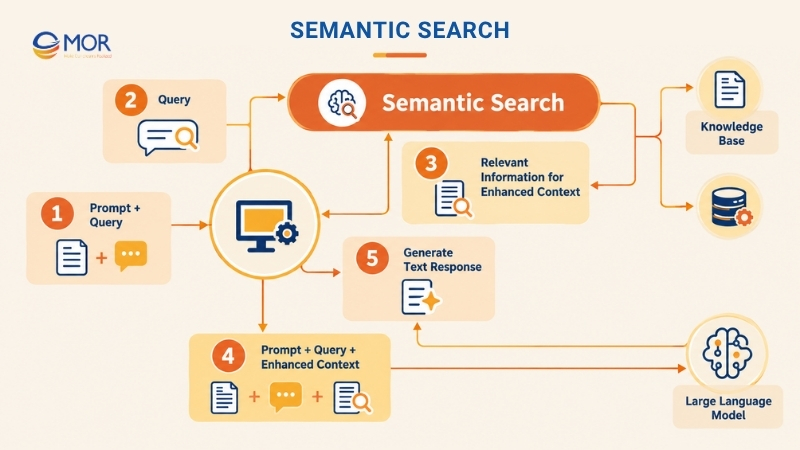
For example, a customer searching for "software to track employee hours" may receive results about workforce management and time attendance systems. The search engine recognizes related concepts even when the documents use different terms.
Semantic search can also interpret synonyms, relationships between entities, and ambiguous language when enough information is available. These capabilities support more natural interactions across enterprise knowledge bases, support platforms, and AI applications.
If you’re new to NLP and embeddings, check out our guide to essential AI terminology.
What Is Vector Search?
Vector search is a retrieval method that represents information as numerical vectors and finds items with similar representations. An embedding model converts text, images, audio, or other data into points within a multidimensional space.
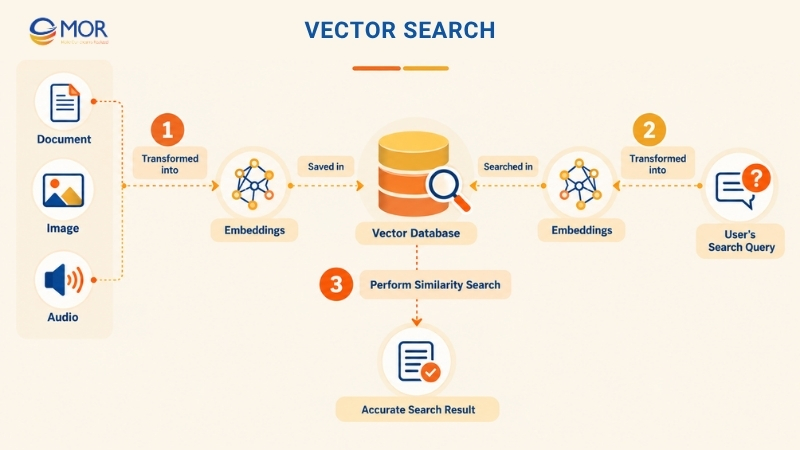
Vectors with similar characteristics tend to appear close together according to the model's representation. Search systems then calculate similarity using cosine similarity, dot product, or Euclidean distance.
For example, a product recommendation engine may retrieve shoes with similar visual characteristics even when product titles differ. This process uses numerical similarity rather than direct keyword matching.
The relationship between vector embeddings and AI becomes easier to follow once you understand how neural networks work.
How Are Semantic and Vector Search Related?
The semantic vs vector search distinction describes a retrieval goal and a retrieval technique. Semantic search aims to identify meaningful results, and vector search often performs the underlying similarity matching.
The difference between semantic search vs similarity search also depends on what the vectors represent. Similarity search can compare colors, shapes, or transaction patterns without interpreting language.
Vector retrieval becomes part of semantic search when the model represents linguistic meaning and the system uses those representations to find relevant information.
How Do Semantic Search and Vector Search Work?
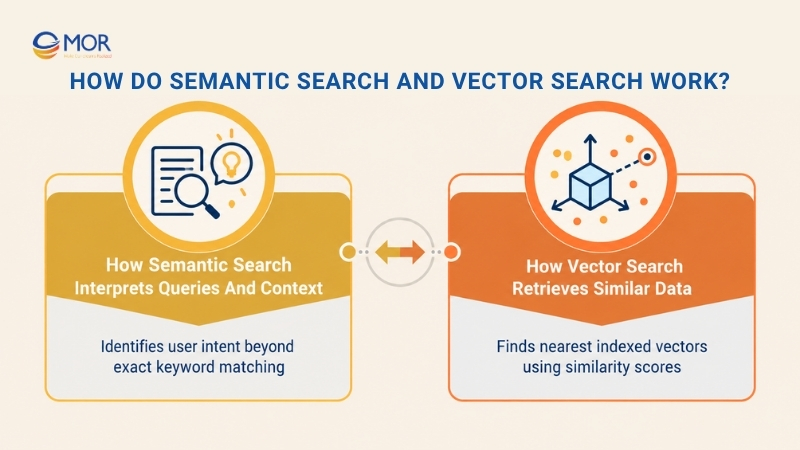
Semantic and vector search frequently share embedding technology, but their pipelines can include different stages. Understanding those stages helps explain why retrieval quality and response time vary between implementations.
How Semantic Search Interprets Queries and Context
Semantic search processes a query to identify its meaning before selecting and ranking relevant content. Modern implementations often use language embeddings, lexical retrieval, and additional relevance signals.
A search for "how to prevent customer account fraud" may retrieve documents about suspicious login detection, identity verification, and account security. These topics share a common intent without using identical wording.
A typical semantic search pipeline includes:
- Analyze query meaning: NLP models identify key terms, entities, and relationships. Domain-specific rules may help distinguish ambiguous terms and technical expressions.
- Build semantic representations: Embedding models encode text into numerical representations that capture language relationships. This supports semantic matching between queries and documents with different wording.
- Retrieve candidate documents: The system searches indexed content through vector similarity, lexical matching, or a combination of methods. Metadata filters can narrow the results to relevant records.
- Refine relevance rankings: Rerankers and business rules review candidate results. They may consider query intent, document content, access permissions, and other application requirements.
For instance, an employee asking "Where can I find our leave policy?" should receive relevant HR documents even if their titles refer to annual leave or time-off requests.
How Vector Search Retrieves Similar Data
Vector search works through numerical representation and nearest-neighbor retrieval. Its performance depends on embedding models, vector indexes, similarity measures, and the size of the search collection.
The process typically follows five stages:
- Generate vector embeddings: An embedding model converts documents, images, or other records into numerical arrays. The quality of these vector search embeddings determines which relationships the system can represent.
- Store and index vectors: The system stores embeddings in a vector database or compatible search index. Common indexing methods include Hierarchical Navigable Small World (HNSW) and other Approximate Nearest Neighbor (ANN) algorithms.
- Encode the search query: The query passes through a compatible embedding model to create a vector representation. Query and document embeddings must use compatible vector spaces.
- Calculate similarity: The system compares the query vector against indexed vectors using cosine similarity, dot product, or Euclidean distance, depending on the model and index configuration.
- Return nearest matches: The index retrieves the closest candidates and ranks them using similarity scores. Additional filters or reranking can refine the final results.
Large-scale retrieval becomes costly when every query requires comparison against every stored vector. ANN methods limit the search space to achieve faster responses, with a possible trade-off in recall.
Research on billion-scale similarity search with GPUs demonstrated the construction of a nearest-neighbor graph covering 95 million images in 35 minutes. The study illustrates how specialized algorithms and hardware support large vector workloads.
Where Does Each Approach Deliver the Most Value?
Semantic and vector search support different retrieval needs, although many benefits overlap. The strongest advantage depends on the data being searched, the type of query, and how the system measures relevance.
Advantage | Semantic search | Vector search | Business value |
Synonym handling | Connects related expressions and concepts | Finds semantically similar embeddings when trained for language | Users can find information without exact wording |
Contextual relevance | Interprets intent through language models and ranking signals | Captures relationships represented by the embedding model | More relevant results for natural-language requests |
Complex queries | Supports conversational questions and domain-specific interpretation | Retrieves related records through vector proximity | Better access to detailed knowledge |
Similarity retrieval | Uses similarity search within broader retrieval pipelines | Supports fast nearest-neighbor matching through ANN indexes | Faster discovery across large collections |
Large datasets | Scales through suitable indexing and retrieval systems | Handles extensive vector collections using specialized infrastructure | Search capacity can grow with stored data |
Multimodal retrieval | Can connect meaning across data types through suitable models | Compares representations of images, audio, text, and video | Users can find related media without relying on filenames |
Recommendations | Identifies intent and relevant concepts | Finds similar products, documents, or content | More relevant product and content suggestions |
Model selection remains a major factor behind these capabilities. The Massive Text Embedding Benchmark (MTEB) evaluated 33 models across 58 datasets and 8 embedding tasks, finding that no single embedding method led across every task.
For businesses, this means a strong model for product similarity may not perform equally well for legal document retrieval. Search quality must be tested against your actual data and query patterns.
What Are the Main Drawbacks of Each Approach?
The semantic search vs vector search pros and cons comparison requires attention to model quality, infrastructure costs, and retrieval errors. Neither approach guarantees accurate results without suitable data and testing.
Limitation | Affected approach | Practical consequence | Recommended mitigation |
Weak embedding quality | Both | Related documents may receive poor similarity scores | Test embedding models using representative queries |
Specialized terminology | Both | Technical terms and domain language may be misinterpreted | Use domain-specific models and lexical matching |
Ambiguous queries | Semantic search | The system may select the wrong meaning | Apply entity recognition, query refinement, and reranking |
Semantic drift | Embedding-based retrieval | Changed terminology may weaken retrieval relevance | Review model performance and update embeddings when necessary |
Embedding generation costs | Vector search and embedding-based semantic search | Indexing large collections requires processing resources | Use batching, caching, and suitable model sizes |
Vector index memory | Vector search | Large indexes consume RAM and storage | Consider quantization, partitioning, and index tuning |
Frequent data updates | Both | Stale indexes may return outdated information | Establish incremental indexing and update workflows |
Reranking latency | Multi-stage semantic search | Additional ranking models increase response time | Limit candidate sets and measure p95 latency |
False positives | Both | Similar-looking or related documents may be irrelevant | Add metadata filters, rerankers, and relevance evaluation |
The vector vs semantic search trade-off becomes harder in specialized industries. Healthcare records, legal documents, and financial data contain codes and terminology that general-purpose language models may not interpret correctly.
The BEIR research benchmark tested 10 retrieval systems across 18 datasets. Its findings identified BM25 as a strong baseline, while reranking and late-interaction methods delivered strong average zero-shot results at higher computational costs.
Poor search results also require careful diagnosis. Research into machine learning interpretability can help teams investigate model behavior, although retrieval evaluation still requires labeled relevance judgments and real query testing.
Where Are Semantic and Vector Search Used in Practice?
Real applications provide useful semantic search vs vector search examples because search requirements vary across industries. Some systems prioritize natural-language understanding, while others focus on finding similar records or media.
Application | Search requirement | Suitable approach | Practical example |
Enterprise knowledge search | Find relevant content across internal documents | Semantic search with vector retrieval | Employees retrieve policies using everyday questions |
Customer support chatbots | Match customer problems to support information | Semantic retrieval with reranking | An assistant finds troubleshooting steps from support articles |
E-commerce product discovery | Match product needs, descriptions, and filters | Hybrid search | Shoppers find suitable products using descriptive phrases |
Product recommendations | Find items with similar attributes or behavior patterns | Vector search | A retail platform recommends products related to viewed items |
Image and video search | Retrieve visually similar media | Vector search | A content team finds similar images without exact tags |
Legal document retrieval | Interpret legal questions and preserve exact references | Hybrid search with semantic ranking | Legal teams search clauses using questions and case identifiers |
RAG-powered assistants | Retrieve source passages for language model responses | Semantic or hybrid retrieval | An assistant accesses relevant company documents before answering |
Enterprise knowledge retrieval is one of the clearest applications. Employees frequently describe a problem in different words than those appearing in company documents.
Large document collections also require suitable retrieval infrastructure. Microsoft's MS MARCO passage ranking dataset contains 8,841,823 passages and 1,010,916 queries, providing a large-scale research resource for evaluating passage retrieval methods.
Multimedia applications follow a different pattern. Vector search can compare visual or audio embeddings directly, while multimodal AI supports applications that process and connect information across several data formats.
The comparison semantic search vs vector search vs rag also requires a distinction between retrieval and generation. Retrieval-Augmented Generation (RAG) uses retrieved information to support an LLM's response. Semantic and vector search are possible retrieval components inside that architecture.
Better retrieval improves the information supplied to an assistant, but the final response still depends on the language model and its instructions. Teams building these applications should also study prompt engineering techniques to control how retrieved information is used.
How Do Vector Retrieval and Semantic Understanding Work Together?
Semantic and vector retrieval often operate inside the same search system. Modern architectures can combine embeddings, keyword matching, metadata filters, and reranking to improve result relevance.
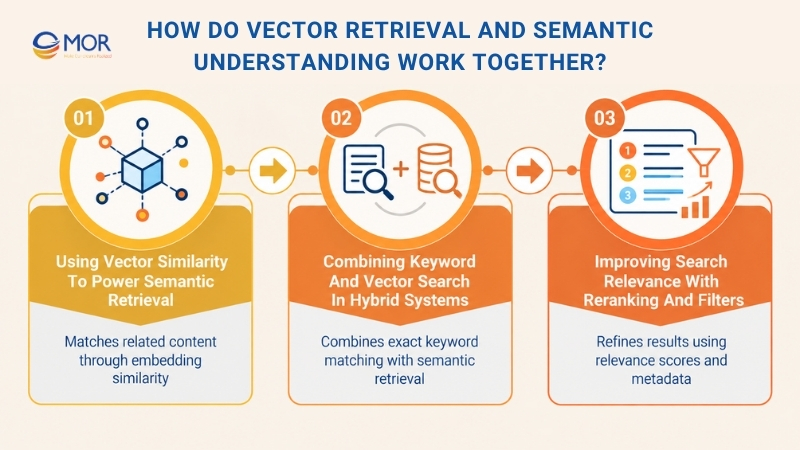
Using Vector Similarity to Power Semantic Retrieval
Embedding-based semantic search uses vector similarity to identify documents related to a user's question. The embedding model encodes meaning, and the vector index retrieves nearby representations.
For example, an employee asking about "remote work approval" may receive a policy document discussing work-from-home authorization. A suitable embedding model represents the relationship between those expressions.
The broader semantic search vs vector search vs keyword search comparison becomes more useful when each component has a clear role. Vector similarity provides related candidates, semantic ranking evaluates relevance, and lexical methods handle exact terms.
A production system can combine these stages without requiring users to understand how the retrieval process works.
Combining Keyword and Vector Search in Hybrid Systems
Hybrid search combines lexical retrieval and vector-based retrieval to find documents through complementary signals. Lexical methods such as BM25 rank documents according to term matching, while vector search uses embedding similarity.
The keyword search vs semantic search vs vector search comparison is especially relevant for enterprise systems containing product codes, technical identifiers, and natural-language documents.
For example, a query containing a specific product identifier and a description of its fault needs accurate identifier matching and related troubleshooting information. Hybrid retrieval can bring those results together.
The semantic search vs vector search vs hybrid search distinction also affects system design. Hybrid search commonly combines keyword retrieval with vector-based semantic retrieval, then merges their rankings into one result set.
Improving Search Relevance With Reranking and Filters
Initial retrieval often returns a larger candidate set than the user needs. Reranking models review those candidates and assign relevance scores based on the query and document content.
Metadata filters add another layer of control. Enterprise systems may restrict results by department, document type, publication date, or user permissions before displaying them.
A real implementation appears in Microsoft Azure AI Search's hybrid retrieval documentation. Its search engine executes full-text and vector queries in parallel, then merges rankings through Reciprocal Rank Fusion (RRF).
That approach helps preserve exact-match relevance while retrieving related content through vector similarity. Teams can then apply semantic ranking to refine the combined results.
How Should You Choose and Evaluate a Search Architecture?
Choosing between semantic search vs vector search requires an assessment of retrieval goals, available data, and application requirements. The right design should meet defined quality targets without exceeding the project's latency or infrastructure budget.
Decision criterion | Recommended approach | Evaluation metric |
Complex natural-language queries | Semantic retrieval with suitable embeddings and reranking | nDCG@10, MRR |
Exact product codes or identifiers | Keyword search or hybrid retrieval | Precision@k, exact-match success rate |
Large unstructured datasets | Vector search with ANN indexing | Recall@k, p95 latency |
Mixed natural-language and exact-term queries | Hybrid lexical and vector search | nDCG@10, Recall@k |
High query volume | Tuned indexing and retrieval pipeline | Requests per second, p95 latency |
Limited infrastructure budget | Start with lexical search and test added retrieval stages | Cost per query, infrastructure usage |
Frequent document updates | Incremental indexing and embedding update pipeline | Indexing throughput, update lag |
Image, audio, or video retrieval | Vector search with suitable multimodal embeddings | Recall@k, retrieval latency |
High relevance requirements | Candidate retrieval followed by reranking | nDCG@10, MRR, p95 latency |
Start with a collection of real queries and documents that have known relevance judgments. Compare lexical search, embedding-based retrieval, and hybrid configurations against the same evaluation set.
The vector search vs. semantic search decision should also account for the software already in use. An existing search platform may support the required vector indexes and ranking methods without adding a separate database.
For teams considering Elasticsearch vector search vs semantic search, check the available lexical indexing, vector similarity, filtering, and reranking capabilities. Elasticsearch supports architectures that combine these methods, so the comparison should focus on the desired retrieval behavior.
Another practical decision involves vector database vs managed search engine for semantic search. Dedicated vector databases can suit similarity-heavy workloads, while managed search platforms may provide combined lexical, vector, filtering, and operational functions.
Evaluate the system's complete cost, including embedding generation, storage, queries, infrastructure, and maintenance. A retrieval design that performs well on a small test collection may need further work before handling production traffic.
Build Smarter Enterprise Search With MOR Software's AI Services
Businesses implementing semantic or vector search often face fragmented data, uncertain architecture requirements, and difficulties connecting AI retrieval with existing applications. MOR Software JSC addresses these problems through our AI development services, covering feasibility assessment, data engineering, custom models, generative AI integration, and deployment.
Our work focuses on the technical requirements behind enterprise search, including data readiness, model selection, application integration, and long-term system performance.
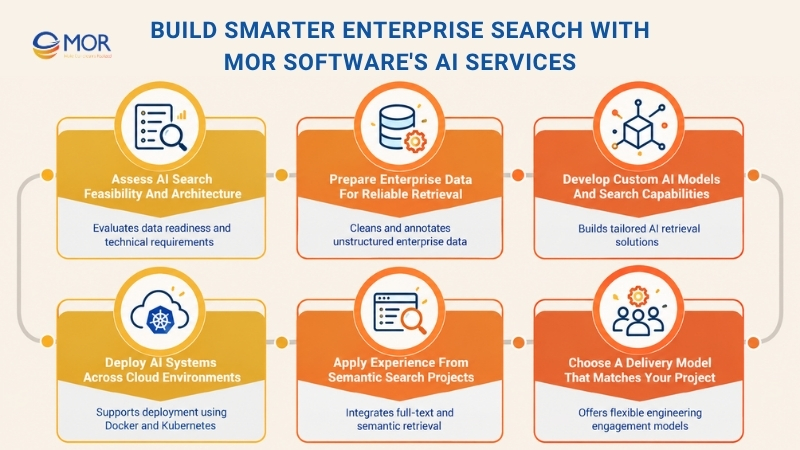
- Assess AI search feasibility and architecture: Our AI Feasibility Assessment service reviews data availability, technical dependencies, and project goals before development begins. We help companies assess the suitability of AI-powered retrieval and define practical requirements for the proposed system.
- Prepare enterprise data for reliable retrieval: MOR Software's Data Engineering capabilities cover data acquisition, cleaning, and annotation services. We address inconsistent records and unstructured information that require preparation before businesses can build dependable AI search functions.
- Develop custom AI models and search capabilities: Our Custom Model Service and genAI integration services support tailored AI applications and language-based retrieval. Our documented technology stack includes Python, FastAPI, Qdrant, and vLLM for relevant AI development and integration requirements.
- Deploy AI systems across cloud environments: We support Edge & Cloud Deployment, including technologies such as Docker and Kubernetes. Our teams work on deployment architecture and system integration to support AI applications beyond the initial development stage.
- Apply experience from semantic search projects: One relevant example is an AI-powered semantic search transformation we delivered for a Japanese enterprise. The project combined full-text and semantic retrieval, using Python, FastAPI, text embeddings, Elasticsearch, and PySpark to improve search relevance across large product catalogs. Specialized Japanese-language filters addressed the client's linguistic requirements.
- Choose a delivery model that matches your project: MOR supports Staff Augmentation, Fixed-Price projects, and Dedicated Teams. Our AI delivery process covers Audit, Strategy, Development, and Integration, allowing clients to select an engagement structure that matches their technical scope and engineering capacity.
Our services fit enterprises, SaaS development providers, and product teams developing AI-powered search, internal knowledge retrieval, or custom AI applications. These projects often require specialist engineering skills and integration with established business systems.
If your company is planning an AI search project, contact MOR Software to discuss your data sources, retrieval requirements, technical infrastructure, and development goals. Our team can assess the technical scope and recommend a suitable delivery approach.
Conclusion
The semantic search vs vector search comparison shows how meaning-based retrieval and numerical similarity serve different roles in AI search systems. Vector indexes support related-content discovery, while semantic methods help connect user intent to relevant information. Hybrid designs can address requirements that involve exact terms and natural-language queries. MOR Software supports businesses evaluating these architectures and integrating AI into existing platforms.
Contact us to discuss your search requirements, data readiness, and development plans.
"Evolution is not a destination, it is a disciplined journey of innovation."
Phung Van Tu


CEO MOR AI
MOR SOFTWARE
Frequently Asked Questions (FAQs)
Is vector search the same as semantic search?
No. Vector search retrieves information through numerical similarity, while semantic search aims to identify content based on meaning and user intent. Many semantic search systems use vector retrieval as their underlying mechanism, sometimes alongside lexical search, filters, and reranking models.
Can semantic search work without vector embeddings?
Yes. Semantic search can use knowledge graphs, entity relationships, query expansion, and rule-based methods without dense vector embeddings. Modern systems frequently use embeddings because they represent language relationships numerically and support retrieval across documents that use different expressions.
Does vector search understand the meaning of text?
Vector search itself compares numerical representations rather than interpreting language. Meaning comes from the embedding model used to generate those representations. A well-trained language embedding model can capture synonyms and related concepts, allowing vector retrieval to support semantic search.
Which is faster, semantic search or vector search?
Vector search can retrieve nearest-neighbor matches quickly through ANN indexes. Semantic search may introduce extra processing through query analysis or reranking. Total response time depends on the full system, including model inference, index size, filtering, and hardware configuration.
Which approach provides more accurate search results?
Accuracy depends on the query type, embedding quality, dataset, and ranking methods. Semantic retrieval can perform well for natural-language questions, while vector similarity supports related-item discovery. Exact identifiers often benefit from lexical matching. Testing each approach against real queries provides a better answer.
Can vector search handle images, audio, and videos?
Yes. Suitable embedding models can represent images, audio, videos, and text as numerical vectors. Search engines then compare those representations to retrieve related content. Cross-modal retrieval also becomes possible when compatible models map different data types into a shared embedding space.
What is the difference between semantic and vector indexing?
A vector index organizes numerical embeddings for similarity retrieval. A semantic index is a broader concept involving representations and signals designed to support meaning-based search. Semantic retrieval may use vector indexes, lexical indexes, entity data, or a combination of these components.
Is vector search necessary for RAG applications?
No. RAG systems require a retrieval method, but they don't always need vector search. Keyword retrieval, SQL queries, knowledge graphs, and hybrid search can provide source information. Vector retrieval remains a common choice for applications searching large collections of unstructured documents.
How does hybrid search combine keywords and vectors?
Hybrid search runs lexical and vector retrieval against the same query or search request. It then merges the ranked results through methods such as Reciprocal Rank Fusion. This approach supports exact keyword matching and related-content discovery within one retrieval pipeline.
Which approach is better for enterprise search?
Enterprise search often benefits from semantic retrieval supported by vector similarity and lexical matching. The exact architecture depends on document types, user permissions, query patterns, and infrastructure requirements. A tested hybrid system is often a suitable starting point for mixed enterprise data.
Share


Make Our-Dreams Realized


© 2023 . MOR Software. All Rights Reserved
Sitemap
Privacy Policy
Terms of Use

Rate this article
0
over 5.0 based on 0 reviews
Your rating on this news:
Name
*Email
*Write your comment
*Send your comment
1