


Top 10 Software Outsourcing Companies in Malaysia in 2026
Choosing among software outsourcing companies in Malaysia comes down to delivery fit, technical depth, cost, and who will actually own the work after signing. In this guide, MOR Software will compare ten vendors across project type, published scale, delivery model, and buyer fit, then break down Malaysia's real outsourcing rates and the checks worth making before you commit.
Key Takeaways
- Malaysia combines strong English proficiency, an established enterprise IT sector, and close working-hour overlap across APAC, which makes it practical for product discovery and distributed engineering.
- The top 10 vendors are MOR Software, HeiTech Padu, Mesiniaga, Infomina, Agmo Studio, Snappymob, Lizard Global, Advisory Apps, VeecoTech, and Upstack Studio.
- Malaysia isn't the lowest-cost Asian outsourcing market. Mid-level freelance developers run around 32-75 per hour, and agency rates can reach 80-135 per hour, so buyer value depends heavily on team structure and delivery ownership.
Why Outsource Software Development to Malaysia?
Malaysia has built a technology market that supports enterprise systems, product engineering, cloud infrastructure, financial technology, and public-sector IT. That breadth makes software outsourcing companies in Malaysia relevant to buyers that need more than low-cost coding capacity.
The Department of Statistics Malaysia reported that ICT and e-commerce contributed 23.4% of Malaysia's economy, equal to RM451.3 billion, in 2024. ICT industry employment also reached 1.25 million people that year.
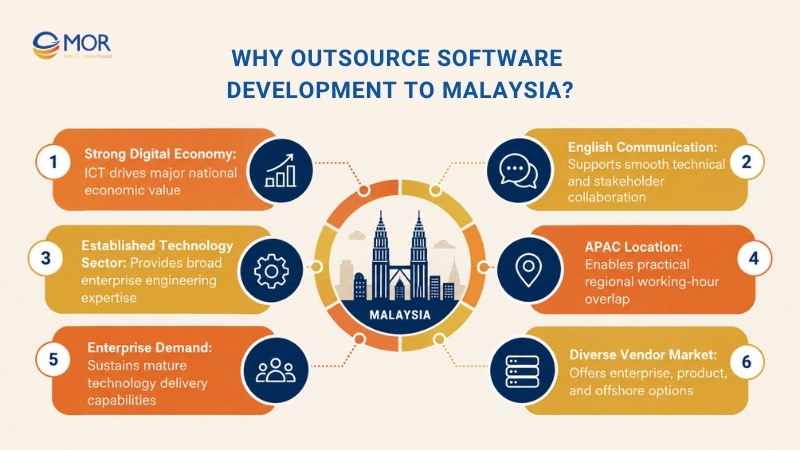
- English communication: Product discovery, business analysis, architecture workshops, and stakeholder meetings depend on communication as much as code. Malaysia scored 581 in the EF English Proficiency Index 2025, ranking 24th globally and highest among the Asian markets listed in the report.
- Established technology sector: Malaysian engineering teams have worked around banking, telecommunications, government systems, cloud infrastructure, manufacturing, and consumer applications for years. That history has built useful capability in Java, .NET, mobile development, cybersecurity, data platforms, and enterprise integrations.
- APAC location: Kuala Lumpur works within practical business-hour overlap for Singapore, Vietnam, Thailand, Indonesia, Australia, and much of East Asia. Buyers coordinating teams across the region can often run planning sessions and sprint discussions without late-night meetings.
- Enterprise and government demand: Local banks, regulators, government agencies, large consumer brands, and infrastructure operators buy substantial technology services. That demand has created one group of large enterprise providers and another group of product studios focused on web, mobile, AI, and custom applications.
- Range of vendor types: The software Malaysia market isn't one uniform outsourcing category. You can shortlist Bursa-listed enterprise providers, smaller product studios, regional offshore partners, or an IT support company based on the ownership model your project needs.
Malaysia also sits inside a wider Southeast Asian sourcing market. If location is still open, our guide to the best countries to outsource software development can help you compare Malaysia against Vietnam and other delivery hubs.
Top 10 Software Outsourcing Companies in Malaysia
The top software outsourcing companies in Malaysia serve very different buyers. A public-sector infrastructure provider and a 30-person product studio may appear in the same search results, yet their pricing, governance, team access, and delivery speed can differ sharply.
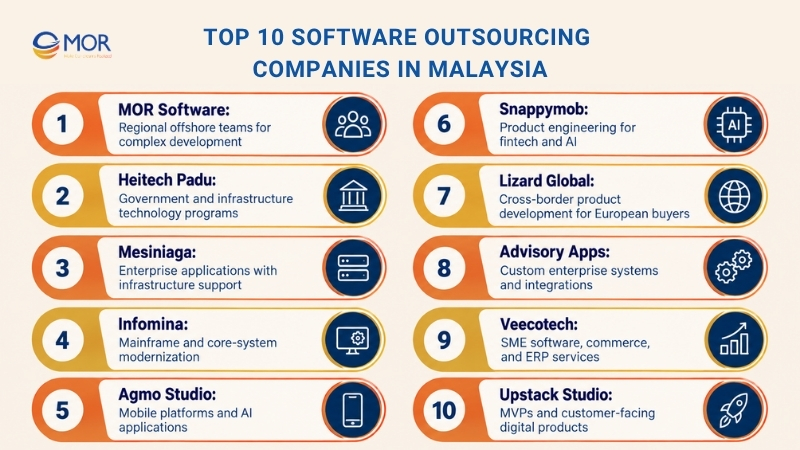
This comparison focuses on ten software outsourcing companies in Malaysia and regional alternatives that give buyers distinct reasons to shortlist them.
Company | Base | Published scale | Strongest fit | Delivery profile |
MOR Software | Vietnam, serving APAC | 850+ projects, clients across 10+ nations | Offshore teams, custom software, enterprise development | Regional outsourcing partner |
HeiTech Padu | Subang Jaya | 1,239 employees at Dec. 2025 | Government and infrastructure programs | Large listed IT group |
Mesiniaga | Subang Jaya | 40+ years, 1,482+ customers, 800+ projects | Enterprise apps plus infrastructure | Listed enterprise provider |
Infomina | Kuala Lumpur | About 200 staff, RM196.7m FY2025 revenue | Mainframe and core-system modernization | Enterprise technology provider |
Agmo Studio | Petaling Jaya | 100+ complex applications | Super-apps, mobile, AI agents | Listed software house |
Snappymob | Kuala Lumpur | 100+ projects since 2012 | Product engineering, fintech, applied AI | Product-focused consultancy |
Lizard Global | Kuala Lumpur, Rotterdam, Bali | 100+ products in production | European buyers needing Asian delivery | Cross-border product partner |
Advisory Apps | Kuala Lumpur | 200+ projects since 2012 | Enterprise systems and integrations | Custom software developer |
VeecoTech | Penang and Kuala Lumpur | Nearly 100 staff reported | SMEs, commerce, ERP and e-invoicing | Full-service technology agency |
Upstack Studio | Kuala Lumpur | Small product studio | MVPs and customer-facing apps | Founder-oriented development team |
Malaysia's ability to export technology services also supports the depth behind this vendor market. MDEC reported RM6.8 billion in digital exports between 2024 and the first half of 2025, including RM4.2 billion generated by 325 companies during 2024.
1. MOR Software
- Founded: 2016
- Headquarters: Ho Chi Minh City, Vietnam
- Published scale: 850+ projects, clients across 10+ nations
- Primary focus: Software outsourcing, custom software, web, mobile, Salesforce, offshore development
- Industries: Finance and banking, healthcare, manufacturing, HRM, media, food and beverage
- Engagement model: Project-based development, offshore development center, dedicated team
MOR Software is a Vietnam software development outsourcing company serving clients across Asia and other international markets. Our service scope covers custom software, mobile development, web platforms, Salesforce, offshore engineering, QA, cloud, AI, and related technology work.
For Malaysian buyers, MOR should be viewed as a regional engineering partner rather than a Malaysia-headquartered vendor. Our model fits companies that want Southeast Asian development capacity but don't need every engineer to sit inside Malaysia.
The distinction matters when cost and team scale drive the sourcing decision. A Malaysian business can retain product ownership locally and run engineering through an offshore development center in Vietnam, particularly when the roadmap calls for several developers over a long period.
Key services:
- Custom software development: Build business systems around defined workflows, user roles, data rules, integrations, and operational requirements.
- Offshore development: Form engineering teams containing developers, QA engineers, business analysts, project managers, and other required roles.
- Web application development: Develop enterprise portals, SaaS products, internal systems, dashboards, and customer platforms.
- Mobile app development: Build native and cross-platform applications connected to APIs, cloud infrastructure, and backend systems.
- Salesforce development: Cover consulting, implementation, custom development, integration, administration, and maintenance.
- AI and innovation services: Add AI, IoT, blockchain, and cloud components to new products or existing systems.
- QA and testing: Test functionality, integrations, performance, security, and user flows before release.
Our offshore software development company guide covers this model in more detail for teams comparing regional delivery options.
Notable projects or proof points: MOR Software developed a media application through a 10-person team using Swift, Kotlin, .NET, and Python. Another Secure Healthcare Management System ran for 24 months using Java Spring, ReactJS, and AWS to automate hospital and clinic operations.
Those projects show the type of work that benefits from cross-role delivery. Mobile engineers, backend developers, QA, business analysis, cloud infrastructure, and integration work can remain inside one engineering relationship.
Best fit: MOR fits companies seeking a long-term Southeast Asian engineering partner, particularly when the roadmap covers several technologies or requires a dedicated development team.
What to check before hiring: Confirm delivery location, working-hour overlap, engineering seniority, data-access rules, IP ownership, repository control, handover terms, and Malaysia-specific requirements before kickoff.
2. HeiTech Padu
- Founded: 25+ years of published delivery history
- Headquarters: Subang Jaya, Malaysia
- Company size: 1,239 employees at the end of 2025
- Primary focus: Government IT, data centers, networks, mainframes
- Industries: Public sector, national infrastructure, large enterprises
- Engagement model: Large-scale projects and managed technology services
HeiTech Padu sits at the large-enterprise end of Malaysian IT delivery. Its published headcount reached 1,239 employees at the end of 2025, and Bursa Malaysia reporting gives procurement teams access to corporate and financial information that private studios rarely disclose.
The company is strongest where software connects to infrastructure. Its published capability areas include mainframe services, data-center operations, business recovery, networks, and government technology programs.
That profile makes HeiTech different from a mobile app studio. Buyers dealing with government workloads, national systems, or infrastructure that must stay inside Malaysia may value procurement discipline and local operating depth more than startup-style development speed.
Key services:
- Enterprise systems: Support operational platforms built for long-term institutional use.
- Mainframe services: Maintain and modernize established systems that still run key business processes.
- Data-center services: Support controlled infrastructure and business continuity requirements.
- Network services: Manage connectivity and related enterprise network operations.
- Business recovery: Build continuity processes around systems where downtime carries a high business cost.
Notable projects or proof points: Published references include i-Sentrix data-center capabilities and PaduNet. Bursa Main Market status also gives buyers an additional due-diligence path through public filings.
Best fit: HeiTech belongs on a shortlist for Malaysian government programs, national infrastructure, large institutional systems, or technology environments where in-country delivery matters.
What to check before hiring: Ask how enterprise governance affects sprint cadence, scope changes, development access, and approval times. Large governance structures work well for some programs but can slow a six-person product team.
3. Mesiniaga
- Founded: 40+ years in enterprise technology
- Headquarters: Subang Jaya, Malaysia
- Published scale: 1,482+ customers and 800+ projects
- Primary focus: Enterprise applications, cybersecurity, infrastructure, managed services
- Industries: Large enterprises and organizations running mission-sensitive IT
- Engagement model: Integrated application and infrastructure delivery
Mesiniaga combines application engineering with infrastructure, security, networking, and continuing support. That structure suits enterprises that prefer one accountable provider across software delivery and the production environment underneath it.
The company reports more than four decades of enterprise technology work, over 1,482 customers, and more than 800 projects. Bursa Malaysia listing gives buyers another source of corporate information before procurement begins.
Mesiniaga's service mix is broader than pure development. A company replacing a large internal system can place application work, operations, security, and infrastructure under one commercial relationship.
Key services:
- Application development: Build and maintain enterprise systems linked to business operations.
- Application support: Maintain production applications under continuing service arrangements.
- Cybersecurity: Add security operations and governance around business systems.
- Network and infrastructure: Manage the environment supporting production applications.
- Cloud services: Move or rebuild enterprise workloads around cloud platforms.
Notable projects or proof points: Its scale is the strongest public proof point: 40+ years of operation, 1,482+ customers, 800+ projects, and Bursa Main Market status.
Best fit: Mesiniaga suits companies that want application engineering, security, infrastructure, and post-launch operations under one provider.
What to check before hiring: Ask the vendor to separate application-development costs from infrastructure and managed-service fees. Confirm who owns architecture decisions and which technical roles will actually work inside your project team.
4. Infomina
- Founded: 15+ years of published enterprise technology work
- Headquarters: Kuala Lumpur, Malaysia
- Company size: Around 200 staff
- Primary focus: Mainframe, enterprise infrastructure, core-system modernization
- Industries: Banking, finance, large enterprise, regional organizations
- Engagement model: Turnkey enterprise programs
Infomina serves a narrower technical need than most vendors on this list. The company reported RM196.7 million in FY2025 revenue and describes an ASEAN workforce of around 200 people.
Its mainframe capability is the bigger differentiator. Many web and mobile agencies can build a React application, but fewer teams can work confidently around older core systems that still process valuable financial or operational workloads.
For banks and large enterprises, replacing those systems outright can introduce more risk than modernizing them in stages. Infomina's profile makes sense when a project includes long-life infrastructure, legacy platforms, or regional rollouts.
Key services:
- Mainframe modernization: Update existing core systems without forcing an immediate full replacement.
- Core-system services: Work around software tied directly to financial or operational transactions.
- Enterprise infrastructure: Build and maintain the underlying environment needed by large systems.
- Regional technology delivery: Support programs extending across several Asian markets.
- Maintenance and support: Keep established systems operational after deployment.
Notable projects or proof points: Bursa ACE Market status, RM196.7 million FY2025 revenue, and its roughly 200-person regional workforce provide measurable business evidence.
Best fit: Infomina suits core banking work, mainframe modernization, regulated enterprise systems, and regional programs that need specialist legacy skills.
What to check before hiring: Separate software engineering, hardware, licenses, infrastructure, and support in the proposal. Enterprise turnkey pricing can hide a very different cost structure from standard developer day rates.
5. Agmo Studio
- Founded: 2012
- Headquarters: Petaling Jaya, Malaysia
- Primary focus: Mobile products, digital platforms, AI agents
- Industries: Consumer services, retail, automotive, public initiatives
- Engagement model: Product and application development
- Published scale: 100+ complex applications
Agmo Studio is the software delivery arm of Agmo Holdings Berhad, which joined Bursa Malaysia's ACE Market in 2022. Its published product history includes more than 100 complex applications.
Mobile development formed much of Agmo's earlier reputation. Its newer positioning places far more attention on AI agents and AI-backed business systems, creating a wider service mix for buyers pursuing new automation projects.
The named client work gives procurement teams something concrete to examine. Published references include Perodua P-Circle, Golden Screen Cinemas, Baskin-Robbins, Alpro Pharmacy, MyMahir for TalentCorp, and MYStartup.
Key services:
- Mobile app development: Build mobile applications for consumers and enterprise users.
- Web platform development: Create customer-facing and internal platforms connected to business systems.
- AI agent development: Build task-based AI workflows and conversational applications.
- E-invoicing solutions: Support Malaysian digital invoicing processes and related system connections.
- Enterprise digital platforms: Develop larger systems carrying user, transaction, or operational workflows.
Notable projects or proof points: Agmo's work across automotive, entertainment, pharmacy, government-linked programs, and consumer services gives buyers several local reference points to examine.
Best fit: Agmo is relevant for Malaysian mobile platforms, consumer applications, super-app projects, and newer AI agent programs.
What to check before hiring: Treat its mobile history and AI practice as separate proof sets. Ask which AI projects are already live, what models they depend on, and which engineers from those projects would join your account.
6. Snappymob
- Founded: 2012
- Headquarters: Kuala Lumpur, Malaysia
- Primary focus: Product engineering, mobile, web, applied AI
- Industries: Fintech, consumer technology, enterprise digital products
- Engagement model: Product squads and engineering engagements
- Published scale: 100+ projects
Snappymob works closer to an external product team than a conventional project agency. Its service mix brings product design, technical leadership, systems engineering, mobile development, web engineering, and applied AI into the same engagement.
The company reports more than 100 projects since 2012. Its published client work includes MoneyLion, CIMB, Honeywell, and CoinGecko, giving it a mix of Malaysian and international references.
That structure fits companies where requirements will change as users test the product. Design decisions and architecture decisions can move alongside engineering rather than passing through separate suppliers.
Key services:
- Mobile engineering: Build iOS and Android applications around product requirements.
- Web engineering: Develop web platforms and connected backend systems.
- Applied AI: Add AI functions to existing products or new applications.
- Product and UX design: Connect interface decisions with product goals and technical constraints.
- Technical leadership: Support architecture and engineering practices inside client teams.
Notable projects or proof points: MoneyLion, CIMB, Honeywell, and CoinGecko provide stronger evidence than anonymous portfolio claims. Buyers can ask for the exact scope, assigned team, and technical ownership behind each reference.
Best fit: Snappymob suits venture-backed product teams, fintech platforms, consumer products, and companies adding AI to an existing application.
What to check before hiring: Capacity deserves attention. Ask for named engineers, current allocation, replacement rules, and realistic limits on the number of parallel squads the company can staff.
7. Lizard Global
- Founded: 13-year track record reported in the supplied reference
- Operations: Kuala Lumpur, Rotterdam, and Bali
- Company size: 50-99 employees in the DesignRush reference
- Primary focus: Digital products, enterprise modernization, AI integration
- Industries: E-commerce, healthcare, logistics, education
- Engagement model: Cross-border product development
Lizard Global combines Southeast Asian development capacity with a European commercial presence. Its reported footprint covers Kuala Lumpur, Rotterdam, and Bali, and the company states that more than 100 products are in production.
That setup has a practical use for European buyers. Procurement teams can work through a European-facing entity, yet the engineering structure still includes Asian delivery capacity.
This arrangement may carry a higher price than a Malaysia-only contract. For some buyers, the legal structure, communication model, and European client-facing presence justify that difference.
Key services:
- Mobile app development: Build customer applications across common mobile platforms.
- Web application development: Develop customer and internal web products.
- Enterprise modernization: Update existing software in stages rather than force a full replacement.
- AI integration: Add AI functions to current applications and workflows.
- UI/UX design: Connect interface design with development and product planning.
Notable projects or proof points: Published evidence includes more than 100 products in production plus operations across Europe and Southeast Asia.
Best fit: Lizard Global fits European and UK buyers that want Asian engineering capacity through a European-facing commercial structure.
What to check before hiring: Confirm the contracting entity, actual developer locations, data-access locations, rate differences between offices, and which product roles sit in Europe.
8. Advisory Apps
- Founded: 2012
- Headquarters: Kuala Lumpur, Malaysia
- Primary focus: Custom software, enterprise systems, mobile applications, integrations
- Industries: Automotive, government, healthcare, fintech, IoT, logistics
- Engagement model: Full-cycle custom software development
- Published scale: 200+ projects
Advisory Apps reports more than 200 projects since 2012. Its portfolio focuses heavily on custom systems where business workflows and external integrations matter as much as frontend development.
Published examples include Perodua Sales Advisor, MyJPJ-related work, SolarooEV, and MedicalMet. That range covers automotive, government services, EV charging, and healthcare systems.
Among custom software outsourcing companies in Malaysia, Advisory Apps is relevant when a buyer wants one team to handle application logic, interfaces, API connections, mobile components, and enterprise integrations.
Key services:
- Custom system development: Build applications around company processes and operational rules.
- Mobile app development: Develop iOS, Android, and Flutter products.
- Enterprise software: Connect applications to Oracle, legacy systems, and internal platforms.
- AI solutions: Add document processing, chat interfaces, voice functions, and related AI components.
- Web and commerce development: Build browser-based platforms and digital sales applications.
Notable projects or proof points: Published work includes systems used across more than 225 Perodua dealerships, MyJPJ modules, SolarooEV, and MedicalMet. The company also reports Malaysia Digital status and MOF approval.
Best fit: Advisory Apps suits businesses that need Malaysia-based custom development tied closely to local workflows and integrations.
What to check before hiring: Confirm that the case study shown during sales matches your project type. Ask about assigned developers, architecture ownership, support terms, source-code ownership, and extra capacity if scope grows.
9. VeecoTech
- Founded: 2011
- Headquarters: Penang, with Kuala Lumpur operations
- Company size: Around 70 to nearly 100 across published references
- Primary focus: Custom systems, web, commerce, mobile, AI
- Industries: SMEs, commerce, manufacturing, general business technology
- Engagement model: Project-based full-service technology delivery
VeecoTech combines software engineering with web, e-commerce, mobile, and broader digital services. Its operating history dates to 2011, and published references place its team between roughly 70 and nearly 100 people across the region.
This broad service mix can suit an SME that wants one provider for its website, commerce platform, internal system, and continuing support. A buyer sourcing a larger core application should inspect the engineering team separately from the wider agency operation.
Malaysia's e-invoicing program also creates a practical role for local system vendors. ERP connections, invoice workflows, internal business systems, and accounting interfaces often need changes as companies move through compliance phases.
Key services:
- Custom business systems: Build software around internal processes and operational requirements.
- Web development: Develop websites and browser-based business applications.
- E-commerce development: Build commerce systems and connect them to surrounding business tools.
- Mobile development: Develop mobile interfaces tied to backend applications.
- AI integration: Add automation and AI functions to current software.
Notable projects or proof points: Its longer operating history, Penang and Kuala Lumpur presence, SME100 recognition cited in the supplied references, and broad business-system service mix give buyers several areas to verify.
Best fit: VeecoTech suits SMEs seeking software, e-commerce, web, ERP-related work, and ongoing technical support through one vendor.
What to check before hiring: Ask which engineering unit will own your work. Confirm architecture responsibility, subcontracting rules, maintenance fees, and the split between technical staff and marketing-service staff.
10. Upstack Studio
- Headquarters: Kuala Lumpur, Malaysia
- Company size: Under 49 employees in the supplied DesignRush reference
- Primary focus: Mobile apps, web products, MVP development
- Industries: Startups, SMEs, founder-led digital products
- Engagement model: End-to-end product development
Upstack Studio targets founders and product teams that need to turn a product concept into a usable application. Its work covers planning, UI/UX, development, testing, launch, and later product updates.
That positioning differs sharply from vendors focused on mainframes, government infrastructure, or managed networks. Upstack is easier to place when the requirement is a first mobile application, MVP, customer portal, or new digital service.
The smaller team can also create closer access to designers and developers. The trade-off is capacity, so larger roadmaps should include a clear staffing and growth plan before signing.
Key services:
- Cross-platform mobile development: Build mobile products through frameworks including React Native and Flutter.
- MVP development: Turn a defined product concept into an initial market-ready release.
- Product planning: Convert business requirements into user flows, scope, and development priorities.
- UI/UX design: Design interfaces and customer journeys alongside product planning.
- Maintenance and iteration: Continue product updates after the first release.
Notable projects or proof points: The supplied references position Upstack strongly around first-time founders and cross-platform product work, though they publish fewer named enterprise references than Snappymob, Agmo, or Advisory Apps.
Best fit: Upstack Studio suits startups, SMEs, and non-technical founders building a first customer-facing product.
What to check before hiring: Request several comparable projects and talk through what the team actually delivered. Confirm product-management ownership, scope-change terms, repository access, cloud-account ownership, app-store ownership, warranty, and post-launch support.
A ranking can narrow the search, but the vendor still needs to match the project. Buyers comparing the global outsourcing company market or broader lists of IT outsourcing companies should apply the same rule: compare delivery teams, not brand names alone.
Software Outsourcing Costs in Malaysia
Malaysia sits above many Asian outsourcing destinations on engineering price. Buyers comparing software outsourcing companies in Malaysia should budget for the engagement model as well as developer seniority because an agency rate includes delivery overhead that an individual freelancer rate doesn't.
Second Talent's September 2026 Malaysia rate card places a mid-level full-stack freelancer at 32-75 per hour. A Malaysian agency or development shop sits at 80-135 per hour for the same mid-level reference role.
Software outsourcing option | 2026 cost in Malaysia ($) | Estimated monthly cost ($) | Best suited for |
Freelance mid-level developer | 32-75/hour | 5,120-12,000/month | Individual development tasks and short engagements |
Malaysian software agency | 80-135/hour | 12,800-21,600/month per developer equivalent | Managed development with QA, PM, and delivery support |
Small software project | 1,000-10,000+ | Project-based | Prototypes, simple web apps, integrations, small business systems |
Mid-sized software project | 10,000-25,000+ | Project-based | Mobile apps, SaaS products, custom business applications |
Larger custom software project | 25,000-50,000+ | Project-based | Complex applications, system integrations, enterprise products |
Dedicated 5-person agency team | About 64,000-108,000/month | Monthly | Long-term product development and enterprise programs |
At 160 hours per month, the 32-75 freelancer range becomes roughly 5,120-12,000. Agency pricing reaches about 12,800-21,600 per mid-level developer equivalent because the commercial rate can also cover PM, QA, administration, bench capacity, replacement risk, and vendor margin.
Project scope can move the number further. The same Second Talent rate card estimates a simple MVP or internal tool at roughly 5,000-19,000, a medium-complexity product at 13,000-45,000, and a complex platform at 29,000-113,000+.
Don't compare an $80 agency quote directly with a $50 freelancer quote and assume the first is 60% more expensive. Check the roles included. An agency contract may already carry QA, project oversight, backup capacity, and operational management that you would otherwise fund separately.
Buyers benchmarking regional alternatives can compare our breakdown of offshore development rates before locking the budget.
How to Choose a Software Outsourcing Company in Malaysia
A shortlist of software outsourcing companies in Malaysia becomes useful only after every vendor answers the same technical and commercial questions. Keep the scope consistent so differences in cost, team composition, and delivery responsibility stay visible.
The strongest procurement process tests what happens after the sales call.
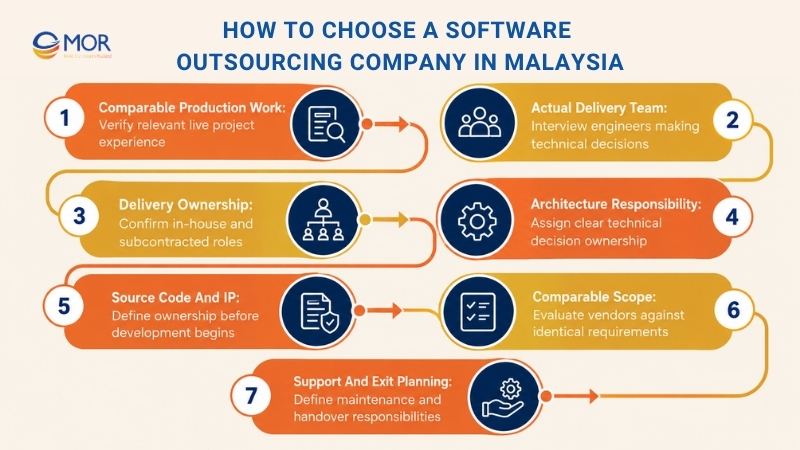
- Check comparable production work: Ask for software that is already live under conditions close to your project. A mobile commerce app doesn't prove experience with core banking modernization, and a government portal doesn't automatically prove SaaS product capability.
- Meet the actual delivery team: Interview the proposed tech lead, business analyst, and senior developers. Account managers can explain the company, but your delivery quality depends on the people writing code and making technical decisions.
- Verify in-house vs subcontracted delivery: Put team composition and substitution terms in the statement of work. Ask which roles are employees, which are contractors, and whether external specialists can receive repository or production access.
- Review architecture ownership: Name the person responsible for system architecture, integrations, performance, and technical debt. Shared responsibility sounds flexible during sales but creates slow decisions once delivery begins.
- Confirm source-code and IP ownership: Define ownership of repositories, code, design files, cloud accounts, CI/CD, documentation, API credentials, and newly created IP. Your contract should also explain when ownership transfers.
- Compare the same scope: Give each shortlisted vendor one requirement set. Ask for assumptions, team structure, exclusions, timeline, and change rules instead of accepting one headline project price.
- Define support before signing: Agree on warranty coverage, SLA, incident response, maintenance pricing, security patches, release support, and knowledge transfer. Post-launch support can become a separate cost center if the contract leaves it vague.
- Test the exit plan: Document handover requirements before kickoff. Repository transfer, credentials, architecture notes, deployment scripts, database documentation, and transition support should already have an owner.
An attractive rate means little if switching vendors later requires rebuilding deployment pipelines and rediscovering undocumented business rules. Our guide to IT outsourcing benefits explains where external delivery creates value when responsibilities are set properly.
Malaysia Outsourcing Risks, Security, and Compliance
Security review should happen before developers receive access. For software outsourcing companies in Malaysia, procurement teams need to map developer location, data access, subcontractors, AI tools, repository ownership, and sector-specific obligations before development starts.
Malaysia's Cyber Security Act 2024 took effect on 26 August 2024 and sets duties around National Critical Information Infrastructure, cyber threats, incidents, and licensing for cyber security service providers. NACSA lists banking and finance, healthcare, government, transportation, energy, communications, and several other areas among NCII sectors.
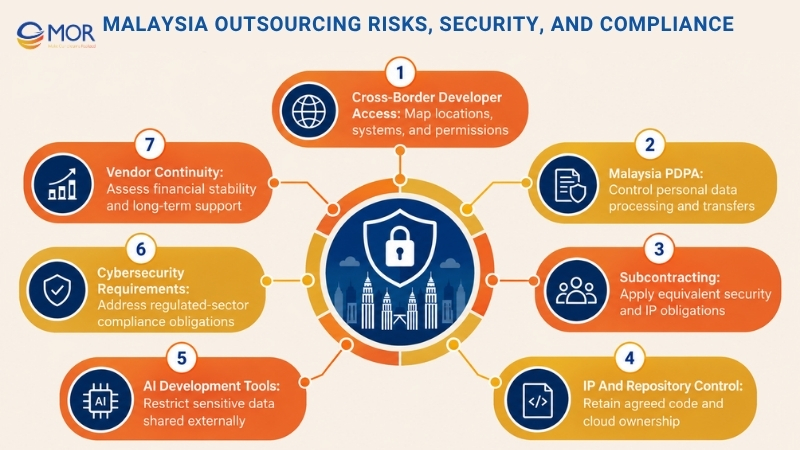
- Cross-border developer access: Record where engineers work, where backups sit, who can access production, and where subprocessors operate. A Kuala Lumpur sales office doesn't prove that every developer or system remains inside Malaysia.
- Malaysia PDPA: Review how personal data is processed, transferred, retained, deleted, and accessed. Malaysia's Personal Data Protection Act has also been amended, so contracts based on old policy templates deserve another legal review before a new project begins.
- Subcontracting: Require written disclosure of external developers and specialist vendors. Apply the same NDA, access-control, security, and IP obligations to them that apply to the primary supplier.
- IP and repository control: Keep the production repository and core cloud accounts under agreed ownership. Vendor access can be granted through roles and removed during transition without moving the entire technical estate.
- AI development tools: State what developers may send to coding assistants, external models, or other AI services. Source code, production logs, client data, credentials, and proprietary documents need separate rules rather than one broad AI clause.
- NCII and cybersecurity requirements: Projects in regulated or security-sensitive sectors need deeper checks around incident reporting, audit rights, cyber services, access logs, and local compliance responsibilities.
- Vendor continuity: Check financial condition, recent releases, hiring activity, team turnover, and active client references. Awards and old case studies don't tell you who will still support the product three years later.
Companies researching HR outsourcing services Malaysia should keep workforce administration separate from software delivery. Payroll, recruitment, and HR operations follow a different buying process, which we cover in our guide to top HR solutions companies.
Which Software Outsourcing Company Should You Choose?
The best software outsourcing companies in Malaysia aren't interchangeable. Project type should drive the shortlist before hourly price, awards, or company size enter the final comparison.
Buyer need | Companies to compare |
Offshore development team and regional APAC delivery | MOR Software |
Malaysian government or infrastructure program | HeiTech Padu |
Application plus infrastructure under one provider | Mesiniaga |
Mainframe or core-system modernization | Infomina |
Malaysian super-app or AI-agent project | Agmo Studio |
Embedded product engineering squad | Snappymob |
European contract with Asian delivery | Lizard Global |
Custom enterprise system and integrations | Advisory Apps |
SME software, commerce, ERP support | VeecoTech |
Startup MVP or first mobile product | Upstack Studio |
For long-term product development, MOR Software is a strong fit for businesses that need dedicated offshore engineers, custom software development, and flexible team scaling. Compare the proposed team, ownership model, timeline, support scope, and total cost before signing.
Conclusion
Choosing among software outsourcing companies in Malaysia requires a close look at project fit, real team capacity, security, cost, and ownership after launch. MOR Software gives Malaysian and APAC businesses another option through Vietnam-based offshore engineering and full-cycle development. If your roadmap needs a dedicated team, custom product, or enterprise system, contact us to review your scope, technology stack, delivery model, and expected budget.
MOR SOFTWARE
Frequently Asked Questions (FAQs)
What are the best software outsourcing companies in Malaysia in 2026?
The software outsourcing companies in Malaysia worth comparing include HeiTech Padu, Mesiniaga, Infomina, Agmo Studio, Snappymob, Lizard Global, Advisory Apps, VeecoTech, and Upstack Studio. MOR Software is also included as a Vietnam-based regional outsourcing option for Malaysian and APAC buyers.
How much does software outsourcing cost in Malaysia?
A mid-level freelance full-stack developer runs around 32-75 per hour. Mid-level agency pricing can reach 80-135 per hour. Small projects may begin around $5,000, while larger enterprise platforms can move beyond $100,000 depending on integrations, security, architecture, and team size.
Is Malaysia a good destination for software outsourcing?
Yes, particularly for buyers who value English communication, APAC working-hour overlap, enterprise IT experience, and access to established Malaysian product studios. The market generally costs more than Vietnam, Indonesia, the Philippines, and India at comparable mid-level developer bands.
How do I choose a software outsourcing company in Malaysia?
Compare live projects, assigned engineers, architecture ownership, QA, security controls, source-code ownership, support terms, subcontracting, and exit conditions. Ask each vendor to quote against the same project scope so commercial differences remain easy to compare.
What software development services can companies outsource in Malaysia?
Common scopes include custom software, mobile apps, SaaS products, enterprise web systems, ERP integration, AI development, cloud work, cybersecurity, QA, application maintenance, and dedicated engineering teams. Demand for software in Malaysia also spans government and regulated enterprise systems.
Malaysia vs Vietnam: which location is better for software outsourcing?
Malaysia usually gives buyers stronger English proficiency and deep enterprise financial-services experience. Vietnam tends to provide lower engineering rates and a large offshore delivery market. The right choice depends on role mix, working model, budget, domain knowledge, and client-facing communication needs.
What engagement models do software outsourcing companies use?
Common options include fixed-price projects, time and materials, dedicated teams, staff augmentation, managed services, and offshore development centers. Fixed price works best when scope is stable. Dedicated teams fit longer roadmaps where requirements will change across releases.
How can I protect source code and intellectual property when outsourcing?
Put IP transfer, repository ownership, credentials, cloud accounts, documentation, subcontracting, and confidentiality terms into the contract. Keep access role-based and record what must be returned or deleted once a developer or vendor leaves the project.
Does Malaysia's PDPA affect outsourced software development?
Yes, when the project processes personal data covered by Malaysia's Personal Data Protection Act. Buyers should review developer access, subprocessors, storage locations, cross-border transfers, breach handling, retention, and deletion before production data enters the development workflow.
Why is MOR Software included if it is headquartered in Vietnam?
MOR Software is included as a regional outsourcing alternative for Malaysian and APAC buyers, not as a Malaysia-headquartered company. Our offshore model suits companies that want Southeast Asian engineering capacity, dedicated teams, and broader delivery options beyond a Malaysia-only vendor.
Share


Make Our-Dreams Realized


© 2023 . MOR Software. All Rights Reserved
Sitemap
Privacy Policy
Terms of Use

Rate this article
0
over 5.0 based on 0 reviews
Your rating on this news:
Name
*Email
*Write your comment
*Send your comment
1