


Agentic AI development in Vietnam: B2B Strategy Guide
Vietnam is gaining attention as an offshore hub for agentic AI development in Vietnam, supported by experienced software teams, competitive engineering costs, and growing AI infrastructure. Unlike basic chatbots, agentic AI systems can plan tasks, connect to business tools, and carry out controlled workflows. Choosing a development partner still takes careful research. This MOR Software guide will compare 10 companies, their technical strengths, industry applications, development costs, and the factors that matter when selecting a vendor.
Key Takeaways
- Vietnam has become a practical destination for enterprise AI engineering, combining custom software expertise, data engineering skills, and competitive offshore development rates.
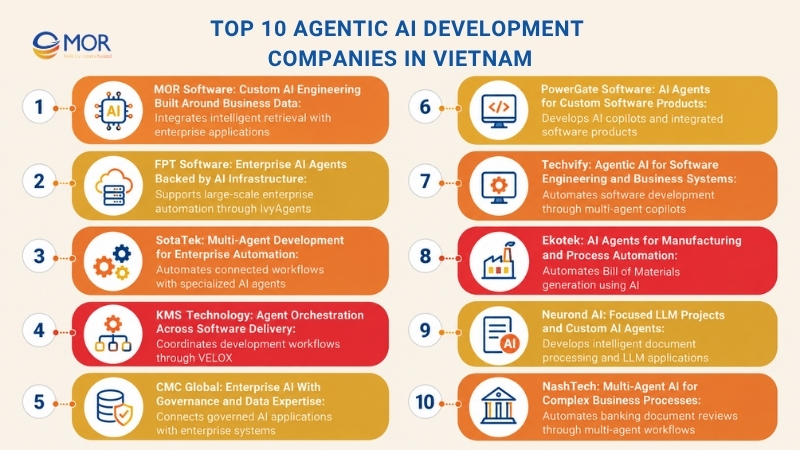
- The 10 companies covered are MOR Software, FPT Software, SotaTek, KMS Technology, CMC Global, PowerGate Software, Techvify, Ekotek, Neurond AI, and NashTech.
- A suitable AI development partner needs proven integration skills, reliable data pipelines, controlled agent execution, and measurable project outcomes. Company size alone doesn't establish agentic AI expertise.
Why Choose Vietnam for Agentic AI Development?
Vietnam's software outsourcing market provides access to engineers experienced in backend development, cloud systems, and enterprise integration. These skills form the technical base for agentic AI development in Vietnam, where AI agents must interact with real business applications. Several factors make the country worth considering.
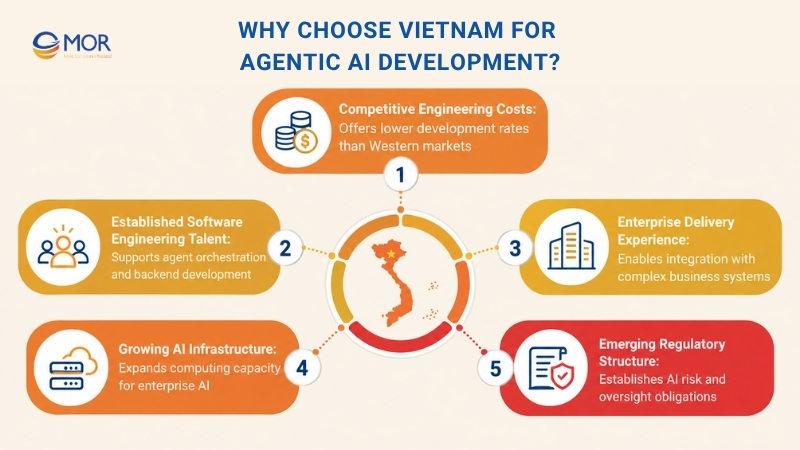
- Competitive engineering costs: Vietnam-based development teams generally charge less than comparable US or Western European providers. A 2026 outsourcing rate analysis places senior Vietnamese developers at $30–55 per hour, compared with $90–160 in the US and UK. Agentic AI specialists may command higher rates.
- Established software engineering talent: Vietnam has engineering teams experienced in Python, Java, cloud platforms, API development, and data processing. These skills support agent orchestration, retrieval-augmented generation (RAG), and the backend systems needed for AI agents.
- Enterprise delivery experience: Many Vietnamese outsourcing companies already work with international clients in banking, healthcare, manufacturing, and retail. Agile delivery, quality assurance, user acceptance testing, and long-term support can be adapted to AI projects involving connected business systems.
- Growing AI infrastructure: FPT's $200 million AI Factory investment with NVIDIA reflects growing interest in local AI computing capacity. Access to GPU resources, cloud services, and agentic AI infrastructure supports model deployment and enterprise workloads.
- An emerging regulatory structure: Vietnam's Law on Artificial Intelligence took effect on March 1, 2026. Organizations developing or deploying AI systems in Vietnam need to assess applicable risk, transparency, oversight, and data-related obligations.
The business case goes beyond hourly rates. Your development partner must understand the applications, data permissions, and operating rules that determine whether an AI agent can work reliably after deployment.
Top 10 Agentic AI Development Companies in Vietnam
Vietnam has several software companies developing AI agents, enterprise AI applications, and automated workflows. Their strengths vary across model development, system integration, intelligent automation, and multi-agent orchestration.
The following shortlist draws on published services, documented projects, technical capabilities, and available delivery information as of October 2026. It is an editorial comparison rather than an independently audited performance ranking.
Company | Agentic AI focus | Supporting evidence | Suitable projects |
MOR Software | Custom AI and business system integration | Enterprise semantic search and AI deployment | Data-intensive AI applications |
FPT Software | Enterprise agent platforms | IvyAgents, enterprise deployments | Large-scale automation |
SotaTek | Multi-agent development and workflow automation | Vendor onboarding agents, enterprise AI services | Enterprise process automation |
KMS Technology | Agent orchestration | VELOX, Addepto implementation | Software engineering agents |
CMC Global | Enterprise AI platforms | Google Agentspace partnership | Governed enterprise AI |
PowerGate Software | AI product development | AI tax copilot, agent services | SaaS and custom products |
Techvify | Agentic software engineering and AI integration | Multi-agent fintech development project | AI-assisted software delivery |
Ekotek | AI agents for manufacturing automation | AI-powered Bill of Materials generation | Manufacturing workflows |
Neurond AI | Custom AI and LLM applications | Document processing, AI assistant projects | Focused AI deployments |
NashTech | Enterprise multi-agent systems | United Trust Bank multi-agent PoC | Banking and legacy systems |
The shortlist of top AI agents development companies in Vietnam includes large enterprise providers and smaller specialist teams. The best match depends on your workflow, technical requirements, and the level of autonomy you intend to deploy.
MOR Software: Custom AI Engineering Built Around Business Data
- Employees: 500+ professionals, including 20+ AI engineers
- AI specialization: Enterprise AI integration, data engineering, and intelligent retrieval, backed by 50+ AI projects
- Notable AI project: Enterprise semantic search for a Japanese client, built with Python, FastAPI, Elasticsearch, and Databricks
MOR Software JSC is a Vietnam-based software development partner that builds custom AI solutions connected to enterprise data and existing applications. Our work combines AI engineering, custom software development, backend integration, and offshore delivery services.
Our AI capabilities cover feasibility assessments, data engineering, custom model development, generative AI integration, and cloud deployment. These services support businesses preparing for agentic AI systems that need access to trusted data and operational tools.
The technical stack includes Python, FastAPI, TensorFlow, PyTorch, Qdrant, Databricks, AWS, Docker, and Kubernetes. Each technology supports part of the development process, including data preparation, information retrieval, application APIs, model execution, and deployment.
We also support data audits, technical planning, model development, integration, user acceptance testing, and maintenance. Clients can choose fixed-price engagements, staff augmentation, or dedicated development teams based on project size and delivery needs.
One relevant project is our AI-Powered Semantic Search Transformation for a Japanese enterprise. Over 12 months and 40 man-months of engineering work, the team developed an intelligent search system using text embeddings, Python, FastAPI, Elasticsearch, and Databricks.
The solution addressed limitations in traditional keyword searches across extensive Japanese-language product catalogs. It demonstrates our experience handling enterprise information, search logic, and application integration.
Our broader AI portfolio also includes computer vision and sentiment analysis projects. These systems reflect practical experience preparing data, developing models, and connecting AI capabilities to business applications.
For companies considering agentic AI development solution in Vietnam, MOR's strength lies in the engineering work surrounding AI agents. Reliable data pipelines, business APIs, backend services, and deployment controls provide the foundation for controlled AI workflows.
The published case studies establish custom AI engineering expertise. Buyers seeking autonomous multi-agent applications should request a project-specific demonstration of agent planning, tool execution, and approval controls.
- Ideal clients: Enterprises and product teams seeking custom AI development, data engineering, intelligent retrieval, and integration with existing business systems.
- What to verify: Request an agentic architecture proposal, working tool-use demonstration, evaluation plan, and confirmed AI team allocation.
- Published footprint: MOR Software reports 500+ company-wide employees, 20+ AI engineers, 5+ years of AI market presence, and 50+ AI projects delivered.
FPT Software
- Employees: 33,000+
- AI specialization: Enterprise AI agents, intelligent automation, and AI infrastructure
- Notable AI project: IvyAgents deployment for a Japanese trading company
FPT Software is a Vietnamese technology services company serving enterprises with large software, cloud, and AI requirements. Its global engineering network and investment in AI infrastructure make it relevant for complex enterprise automation programs.
The broader FPT ecosystem includes generative AI, intelligent process automation, conversational AI, and infrastructure for model development. FPT Software connects these capabilities to enterprise applications, integration projects, and ongoing technology operations.
FPT's AI infrastructure includes the AI Factory, developed around NVIDIA computing technology. The group has also expanded its investment in enterprise AI services and computing resources serving Vietnam and international markets.
Its agent-related products include IvyAgents and AI-powered digital workers. These systems support document analysis, internal knowledge retrieval, multilingual information processing, and workflows connected to business tools.
A published FPT case study describes IvyAgents deployment for a multinational trading company. The solution addressed manual translation, document processing, and fragmented information access across business operations.
FPT reports up to 90% shorter processing time, 33% lower human-related costs, and 80% fewer errors. These outcomes reflect the vendor's published project results and may not apply to other enterprise environments.
The wider FPT ecosystem has also supported public-sector AI initiatives in Vietnam, including work connected to the Ministry of Finance. These engagements indicate experience handling document-heavy processes and institutional technology requirements.
FPT's engineering scale supports systems integration, testing, infrastructure management, and long-term operations. Enterprises should still establish which FPT entity handles development, licensing, deployment, and technical support.
For buyers assessing agentic AI development in Vietnam, FPT is worth considering when an AI rollout involves several departments and a large application estate.
Ideal clients: Large enterprises, manufacturers, financial institutions, and public-sector organizations planning broad AI automation programs.
What to verify: Confirm product licensing, infrastructure costs, delivery responsibilities, implementation team allocation, and governance requirements.
Published footprint: FPT Software reports 33,000+ global employees and more than 1,100 customers. These figures describe its wider business, not its dedicated AI agent workforce.
SotaTek
- Employees: 1,300+ technology professionals reported by its regional website
- AI specialization: Multi-agent systems, agentic RAG, and enterprise workflow automation
- Notable AI project: Multi-agent vendor onboarding automation for a Southeast Asian logistics company
SotaTek is a Vietnam-based software engineering company with delivery teams serving international customers. Its services include AI development, enterprise applications, system integration, cloud engineering, and data-related solutions.
The company develops AI agents that retrieve information, interact with business tools, and perform connected tasks. Its published AI services include document intelligence, large language models, natural language processing, and enterprise workflow automation.
SotaTek's agent development work covers single-agent and multi-agent systems. Its approach includes permissions, human escalation, approval rules, and integration with existing enterprise software.
The company also supports RAG pipelines and enterprise knowledge applications. These capabilities help AI agents retrieve business records and use information beyond their original model training.
A reported logistics project involved a Southeast Asian company facing lengthy vendor onboarding cycles. According to a July 2026 project account, SotaTek developed four agents responsible for contract extraction, ERP checks, compliance review, and executive reporting.
The project reportedly shortened vendor onboarding from five days to under four hours and reached 99.8% data-entry accuracy. These are published project claims rather than independently audited benchmarks.
Its wider engineering services include API development, software maintenance, and data platform integration. This matters for businesses whose agents must exchange information across purchasing systems, document stores, and operational databases.
SotaTek is a relevant candidate for agentic AI development in Vietnam when the target process requires several connected tasks and clear employee approval points. Buyers should request production evidence and technical details rather than relying solely on the project summary.
Ideal clients: Logistics providers, manufacturers, financial services companies, and enterprises automating document-heavy business processes.
What to verify: Review agent execution logs, ERP integration methods, security permissions, failure recovery, and project-specific results.
Published footprint: SotaTek's regional website reports 1,300+ technology experts and a global delivery network. Company-wide figures should not be interpreted as dedicated agentic AI staffing numbers.
KMS Technology
- Employees: 1,100+
- AI specialization: Agent orchestration, software engineering automation, and AI consulting
- Notable AI project: Meeting Tomorrow presales automation through Addepto
KMS Technology is a US-headquartered software engineering company with a substantial delivery presence in Vietnam. Its AI services focus on product engineering, intelligent workflows, data systems, and software development operations.
The company expanded its specialist AI capabilities through its acquisition of Addepto, a Poland-based AI and data consultancy, in December 2025. This brings additional experience in enterprise data platforms and applied AI development.
KMS develops VELOX, an agentic orchestration platform designed for software delivery teams. It connects specialized agents, development tools, project information, and human approval processes.
The platform supports requirements analysis, test preparation, development tasks, and shared project knowledge. Its design focuses on coordinated execution and traceability across the software development lifecycle.
A published KMS and Addepto case study describes work for Meeting Tomorrow, an American event production business. The team built AI agents to assist with equipment selection, quotation preparation, and repetitive presales activities.
KMS reports that the pilot automated 50–70% of standard equipment selection workflows. Draft orders could also be prepared in minutes rather than hours, according to the project account.
The company's AI consulting services include readiness reviews, proof-of-concept work, data assessment, and technical planning. These services support teams evaluating agent adoption before committing to a wider software engineering rollout.
KMS is particularly relevant to agentic AI development in Vietnam for businesses seeking agent coordination inside existing development tools. Teams should confirm whether the proposed work will be delivered by Vietnam-based engineers, international specialists, or a combined group.
Ideal clients: SaaS companies, enterprise IT teams, and software businesses seeking governed AI workflows across development and testing.
What to verify: Confirm VELOX licensing, production capabilities, team location, code access controls, and integration requirements.
Published footprint: KMS reports 1,100+ employees and five offices across Vietnam, Mexico, Poland, and the United States.
CMC Global
- Employees: 3,000+ certified engineers
- AI specialization: Enterprise AI, data engineering, and governed automation
- Notable AI project: AI-powered data platform for a banking client
CMC Global provides software engineering and enterprise technology services to international customers. Its work includes AI development, cloud solutions, data engineering, and integration with established enterprise platforms.
The company supports AI consulting, machine learning, NLP, computer vision, and intelligent applications. Its wider technical services include Salesforce, SAP, and cloud development, which matter when AI must work across different business systems.
CMC Global also addresses data preparation, access controls, application deployment, and operational support. These capabilities help enterprises manage the information and system permissions used by AI agents.
In August 2025, the company announced its Google Agentspace partnership. The arrangement supports enterprise AI applications connected to knowledge sources and tools including Google Drive, Jira, and SharePoint.
Its engineering experience also includes an AI-powered banking data platform. The project addressed manual reporting, fragmented data sources, and complex access management across the customer's information systems.
CMC reported 80% digitalization and 50% less manual work in that project. The results establish experience in enterprise data automation, though the case study doesn't confirm autonomous multi-agent execution.
CMC Global also publishes enterprise delivery credentials and international cloud partnerships. Its combination of software integration and data engineering may suit regulated businesses with established IT environments.
For companies planning agentic AI development in Vietnam, CMC Global's main selling point is its enterprise systems knowledge. Buyers should request agent-specific deployment references and confirm the division responsible for delivery.
Ideal clients: Banks, insurers, large enterprises, and organizations seeking AI applications connected to existing corporate systems.
What to verify: Request production agent references, data protection controls, model access rules, licensing terms, and long-term maintenance responsibilities.
Published footprint: CMC Global reports more than 3,000 certified engineers, 300+ global clients, and services reaching over 30 countries.
PowerGate Software
- Employees: 250+ technology specialists
- AI specialization: Custom AI agents, generative AI integration, and AI-powered product development
- Notable AI project: AI tax copilot for Australian tax professionals
PowerGate Software is a Vietnam-based software product development company serving startups and enterprises. Its engineering services combine custom applications, SaaS development, AI integration, and business process automation.
The company develops AI-enabled products that connect user interfaces, application logic, APIs, and proprietary data. This approach is relevant for businesses adding intelligent functions to existing software.
PowerGate discusses agent development using technologies including LangChain, CrewAI, and vector databases. These tools support information retrieval, task coordination, and agent interaction with external systems.
Its wider development capabilities span backend systems, web applications, mobile products, and cloud deployment. Clients can work with one engineering provider across the AI and application layers.
One relevant project is an AI tax copilot for Australian professionals. PowerGate developed the frontend, backend, and API system for a product that assists with tax research and complex financial questions.
The copilot can direct users to relevant legislation and supporting references. PowerGate also reports that the product placed third in Australia's inaugural AI Sprint in 2024, competing against more than 250 startups.
These capabilities demonstrate applied generative AI engineering. The public project description doesn't establish a fully autonomous multi-agent system, so prospective clients should verify the planned level of independent tool execution.
PowerGate is suited to organizations that want AI development handled alongside the wider software product. Procurement teams should test permissions, monitoring, recovery from failed tool calls, and the conditions requiring human approval.
Ideal clients: Startups, SaaS businesses, and enterprises developing AI-powered products or internal applications.
What to verify: Review deployed agent examples, application architecture, access controls, maintenance arrangements, and relevant engineering experience.
Published footprint: Founded in 2011, PowerGate reports 250+ technology specialists and publishes ISO 9001 and ISO 27001 credentials. Dedicated agentic AI team figures require confirmation.
Techvify
- Employees: 500+ AI-augmented engineers
- AI specialization: Multi-agent copilots, agentic software development, and enterprise AI integration
- Notable AI project: Multi-agent software development system for an Australian fintech company
Techvify is a Vietnamese software engineering company headquartered in Hanoi, with delivery operations in other major Vietnamese cities. Its services cover AI development, enterprise applications, cloud engineering, and software delivery.
The company develops AI agent solutions and intelligent development tools connected to existing applications. Its agentic engineering approach focuses on coordinating technical tasks while retaining developer review and approval.
Techvify's AI-powered software development services address requirements analysis, coding, test generation, documentation, and release preparation. These workflows connect AI tools to normal engineering activities.
Its technical capabilities include LLM integration, automated testing, orchestration, and business application development. This combination supports organizations seeking AI-assisted engineering across their development lifecycle.
A published Techvify case study describes an Australian fintech company seeking faster releases and less engineering rework. The implementation used an LLM gateway and multi-agent copilot architecture to coordinate software development tasks.
Techvify reports three times faster development, more than 90% automated code coverage, and 50% faster time to market. These are vendor-published results, and buyers should review the measurement method before applying them to other projects.
The case provides evidence of AI agent coordination in software delivery. It doesn't automatically establish that the company has deployed autonomous agents operating within a customer's financial transaction systems.
Techvify is relevant to agentic AI development in Vietnam when a business wants intelligent development workflows or custom applications connected to its existing software. Code security and evaluation methods deserve close attention.
Ideal clients: Fintech businesses, SaaS companies, enterprise IT teams, and organizations planning AI-assisted software development.
What to verify: Assess agent architecture, source-code controls, benchmark methods, developer oversight, and maintenance plans.
Published footprint: Techvify reports more than 500 AI-augmented engineers. This company-wide figure doesn't represent an independently verified agentic AI team count.
Ekotek
- Employees: Approximately 200 professionals
- AI specialization: AI workflow automation, computer vision, and intelligent document processing
- Notable AI project: AI-powered Bill of Materials automation for a global footwear manufacturer
Ekotek is a Vietnamese software development and AI engineering company established in 2018. Its services include custom software, AI applications, enterprise integration, and business process automation.
The company works on generative AI integration, computer vision, NLP, and machine learning. These technologies support applications that interpret documents, extract structured data, and automate operational activities.
Ekotek combines AI development with application engineering, cloud services, and system maintenance. This is relevant for businesses connecting AI-generated outputs to production or inventory software.
A published manufacturing case study describes a global footwear manufacturer struggling with manual Bill of Materials creation. Employees had to examine technical drawings, review supplier documents, and combine material details across production departments.
Ekotek built an AI agent that uses computer vision and NLP to analyze shoe drawings and supplier records. The system identifies components, extracts material information, and generates structured BOM data.
The technical stack includes Python, OpenCV, Next.js, and MySQL. Ekotek reports that the project took about six months and decreased manual processing effort, though it doesn't publish independently verified percentage improvements.
The example demonstrates intelligent document and image processing within manufacturing operations. Buyers comparing traditional computer vision pipelines and multimodal AI models should ask how each approach handles ambiguous inputs and output validation.
Ekotek suits focused manufacturing automation projects where business documents and technical drawings drive daily decisions. Its published materials don't fully establish the use of autonomous planning or cooperating specialized agents in the BOM project.
Ideal clients: Manufacturers, supply chain companies, and enterprises automating technical document processing.
What to verify: Request agent architecture details, BOM accuracy tests, ERP integration evidence, approval rules, and model maintenance plans.
Published footprint: Ekotek reports approximately 200 group-wide employees, over 400 delivered projects, and experience across international markets. Dedicated agentic AI staffing figures aren't publicly established.
Neurond AI
- Employees: 11–50, based on its published LinkedIn company-size band
- AI specialization: LLM development, custom AI agents, and document intelligence
- Notable AI project: AI-powered invoice processing for Plenti
Neurond AI specializes in custom artificial intelligence and data-focused solutions. Its focused service model is relevant for businesses seeking an AI prototype, a specialist model, or an application that handles complex business information.
The company works on AI consulting, LLM development, document intelligence, data engineering, and model deployment. It also develops custom AI agents that connect to enterprise applications and information sources.
Neurond's published projects cover document processing, predictive analytics, computer vision, and AI assistants. These applications depend on reliable data preparation and well-defined business requirements.
Its engineering process includes data assessment, model development, integration, deployment, and support. This makes Neurond a candidate for businesses whose main obstacle is preparing proprietary data for AI applications.
A published Neurond case study describes document processing work for fintech company Plenti. The company reports an 80% decrease in manual invoice extraction and 99% extraction accuracy.
Another Neurond project involved Fishwell, where computer vision supported fish counting and welfare monitoring. The company reports accuracy above 95% for the targeted tasks.
These results support Neurond's applied AI development credentials. Document extraction and computer vision systems still differ from autonomous AI agents that plan actions and use external tools.
Neurond providing access to a wider software development background. Businesses considering agentic AI development in Vietnam should confirm which technical roles and responsibilities belong to each team.
Ideal clients: Startups and mid-sized enterprises needing custom LLM applications, document automation, AI prototypes, and specialist model development.
What to verify: Confirm agent orchestration experience, prototype acceptance criteria, technical staffing, and responsibility for production support.
Published footprint: Neurond reports 50+ AI implementations and a 15-day average period to an initial prototype. Its LinkedIn employee band isn't an independently verified headcount.
NashTech
- Employees: 2,000+ engineering experts
- AI specialization: Enterprise multi-agent systems, data engineering, and intelligent automation
- Notable AI project: United Trust Bank multi-agent lending review proof of concept
NashTech is a UK-headquartered technology services company with major engineering operations in Vietnam. Its services include custom software development, data engineering, AI implementation, and enterprise modernization.
The company works with organizations that need to connect new applications to established business systems. Its experience includes financial services, data platforms, legacy software, and intelligent automation.
NashTech's data engineering capabilities support AI systems that retrieve documents, apply business rules, and work with structured or unstructured information. These functions are central to enterprise agent deployments.
A published multi-agent AI case study describes work for United Trust Bank in the UK. The bank needed to assess detailed quantity surveyor reports used in property development lending.
NashTech developed a five-week proof of concept that combined Gemini, Azure OpenAI, n8n, and SharePoint. The solution processed documents, checked information, and prepared outputs for specialist review.
According to the case study, report analysis time dropped from 30–60 minutes to around 5–6 minutes. The project also identified discrepancies and supported more consistent document reviews.
This case provides concrete evidence of coordinated AI components and workflow orchestration. Its reported results remain proof-of-concept outcomes rather than verified performance across a full production rollout.
For enterprises considering agentic AI development in Vietnam, NashTech is relevant when agent workflows must operate inside financial or document-heavy systems. Buyers should confirm the Vietnam delivery allocation and the work required to move a pilot into production.
Ideal clients: Banks, financial institutions, and established enterprises seeking agent-based document and process automation.
What to verify: Ask for production follow-up evidence, security testing, Vietnam-based staffing, system integration details, and maintenance commitments.
Published footprint: NashTech reports more than 2,000 engineering specialists across five delivery centers. These are international staffing figures rather than Vietnam-specific AI headcounts.
Key Industries Pioneering Agentic AI Development in Vietnam
Banking, telecommunications, and software engineering are among the sectors testing or adopting AI agents in Vietnam. Retail, manufacturing, logistics, healthcare, and public services also have practical applications, but deployment maturity varies between industries.
The examples below distinguish verified projects and pilots from potential agentic use cases.
Industry | Agentic AI applications | Evidence or market example | Business value |
Banking and financial services | Loan document review, fraud investigation, compliance checks, payment coordination | Vietnamese banks participated in controlled agentic payment pilots | Faster reviews, stronger transaction controls |
Telecommunications | Contact center assistance, ticket handling, network incident analysis | Vietnamese AI providers have built telecom support tools for overseas clients | Shorter support cycles, consistent responses |
Software and IT services | Coding agents, testing, DevOps assistance, requirements analysis | TCBS adopted AWS Kiro across its engineering organization | Faster releases, less repetitive engineering work |
Retail and eCommerce | Product discovery, customer support, order handling, AI-assisted checkout | Agentic payment trials involving Vietnamese banks | Faster purchases, improved service |
Manufacturing and logistics | BOM generation, supplier validation, shipment exception handling | Ekotek and SotaTek have published relevant automation projects | Less manual processing, improved data accuracy |
Healthcare | Patient registration, document handling, scheduling, follow-up support | Vietnamese vendors develop healthcare AI and process automation solutions | Lower administrative workloads |
Government and public services | Document retrieval, report generation, citizen support, case routing | FPT has supported AI application development for Vietnam's Ministry of Finance | Faster information access, simpler administrative work |
One example of measurable adoption comes from Techcom Securities (TCBS). In September 2026, AWS reported that TCBS had deployed Kiro across more than 460 users and shortened feature delivery time by 25%.
The financial sector is also testing AI-initiated payments. In April 2026, Mastercard completed a controlled agentic payment pilot in Vietnam involving VPBank and MB Bank, demonstrating agent-initiated transactions with customer authentication.
Manufacturing provides a different path to adoption. AI agents can process drawings, material lists, and supplier records before sending outputs to production systems, though human validation remains necessary for high-cost decisions.
Healthcare and public-sector applications require extra attention to access rights, records, and approval procedures. Businesses entering agentic AI development in Vietnam should match agent autonomy to the operational risk of each industry.
Agentic AI Use Cases Vietnamese Teams Can Develop
The strongest agentic AI applications solve a defined workflow problem and connect to the systems employees already use. A successful project needs clear task boundaries, reliable data access, and a way to measure the results.
For businesses assessing agentic AI development in Vietnam, the following use cases provide a practical starting point.
Industry | Agentic AI use case | Connected systems | Business outcome to measure |
Banking and finance | Lending document review and exception analysis | Document storage, risk platforms, core banking systems | Review time, missed exceptions |
Retail and eCommerce | Order support and returns coordination | CRM, ERP, inventory, help desk | Resolution rate, cost per request |
Healthcare | Patient follow-up and workflow coordination | EHR, scheduling, notification services | Follow-up completion, escalation accuracy |
Logistics | Shipment exception management | TMS, WMS, IoT data | Resolution time, delivery exceptions |
Enterprise IT | Software testing and development agents | Git, Jira, CI/CD platforms | Development cycle time, defect leakage |
HR and recruitment | Candidate screening and interview coordination | ATS, HRIS, calendar APIs | Processing time, review accuracy |
For example, an order support agent may retrieve a customer's purchase details, check stock availability, and prepare a return request. A governed workflow then asks for approval before issuing a refund or changing inventory records.
Retail companies already investing in cloud marketing automation can examine how AI agents might coordinate customer follow-ups across existing CRM and campaign systems.
The distinction between an assistant and an agent depends on execution rights. A chatbot may suggest an action, but an authorized agent can call an API or update a record under defined rules.
Our guide to business workflow automation AI provides further background on connecting AI-driven tasks to normal business processes.
Enterprise IT is another suitable area. Teams can combine AI agents with AI regression testing to support test preparation, failure analysis, and release reviews, while keeping approval authority with developers.
The real measure is completed work. Count successful tasks, exceptions, human interventions, and errors rather than the number of AI-generated responses.
How to Choose an Agentic AI Development Company in Vietnam
The top agentic AI development company in Vietnam for your business is the one that can demonstrate the required workflow, not simply the largest engineering team. Review technical evidence, integration experience, delivery responsibilities, and operating costs before making a shortlist.
A vendor evaluation matrix makes these differences easier to compare.
Evaluation criterion | What to verify | Evidence to request |
Agentic AI experience | Agent planning, tool execution, orchestration | Architecture demonstration, relevant case study |
Data engineering | RAG, data permissions, retrieval accuracy | Pipeline design, evaluation results |
System integration | CRM, ERP, APIs, database access | Integration references, API design |
Governance and security | Identity, RBAC, audit logs, approval controls | Security documentation, test reports |
Production readiness | Monitoring, retries, failure recovery | Deployment runbook, monitoring demonstration |
Commercial fit | Team structure, IP ownership, ongoing costs | Statement of work, SLA, ownership terms |
Measurable outcomes | Task success, accuracy, cycle time | Baseline KPIs, acceptance criteria |
Start by defining one business process and its existing performance. Then ask two or three shortlisted providers to propose a design covering data inputs, agent actions, connected systems, and approval rules.
For example, a finance team may need an agent to classify documents and prepare exception reports. The vendor should demonstrate how the system retrieves information, handles missing records, and escalates uncertain decisions.
Technical architecture deserves equal attention. Assess the proposed agentic AI technology for tool execution, state management, observability, and integration with your cloud environment.
A team's deployment process also affects long-term costs. Providers experienced in enterprise devops consulting services should be able to discuss release controls, monitoring, incident response, and environment management.
Model expenses are another part of the business case. Stanford's 2025 AI Index reported that the cost of querying a model with GPT-3.5-level performance fell more than 280-fold between November 2022 and October 2024.
Yet model price alone doesn't determine operating cost. Agent workflows may make several model calls, retrieve data, run tools, and retry failed tasks.
Ask vendors to estimate the cost per completed workflow, including model usage, cloud resources, integration maintenance, and employee review. For top AI agent development in Vietnam, this cost model provides a more useful basis for comparison than an advertised hourly rate.
A short paid discovery project should end with a technical design, a tested workflow, measurable acceptance criteria, and a realistic production budget.
Common Agentic AI Development Risks and How to Avoid Them
Agentic systems introduce technical risks when AI models can access business records and perform actions through software tools. Teams must control those actions and test failure conditions before production release.
Risk management deserves attention during agentic AI development in Vietnam, especially when workflows span several enterprise applications.
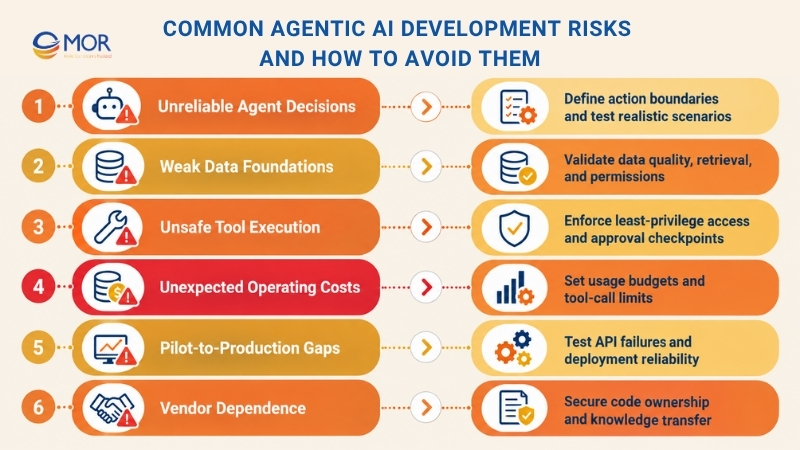
- Unreliable agent decisions: Define permitted actions and measurable success criteria. Test the system against real business cases, incomplete records, conflicting instructions, and uncertain model outputs.
- Weak data foundations: Check data quality, document freshness, retrieval accuracy, and user permissions. An agent connected to outdated or poorly structured records can generate incorrect reports and take unsuitable actions.
- Unsafe tool execution: Apply least-privilege access, approval checkpoints, and action logs. For Salesforce-connected workflows, established salesforce release management practices can help teams control changes before production deployment.
- Unexpected operating costs: Set model usage budgets, tool-call limits, monitoring thresholds, and routing rules. Complex workflows can create substantial costs when agents repeat tasks or enter unnecessary execution loops.
- Pilot-to-production gaps: Test performance, failed API calls, rollback procedures, and deployment reliability. Teams building agentic AI devops processes must track model changes and application releases together.
- Vendor dependence: Confirm source-code ownership, deployment access, documentation, and knowledge transfer. Keep credentials, data, and operational records under agreed customer control.
Software teams should also examine vibe coding security when using AI-generated code in agent workflows. Review generated code and dependencies before allowing them to interact with production systems.
Gartner predicted in June 2025 that more than 40% of agentic AI projects would be canceled by the end of 2027. The forecast cited rising costs, unclear business value, and weak risk controls among the concerns.
A narrow, measurable production workflow gives you a better test of agent value than a demonstration built around ideal inputs.
Conclusion
Vietnam provides several development partners capable of building AI-powered workflows, custom applications, and enterprise integrations. Selecting a partner for agentic AI development in Vietnam requires evidence of technical delivery, secure data access, and measurable business results. MOR Software brings custom AI engineering, data services, and software integration experience to these projects.
If you're planning an AI agent for your business, Contact us to discuss your requirements, technical options, and development roadmap.
"Evolution is not a destination, it is a disciplined journey of innovation."
Phung Van Tu


CEO MOR AI
MOR SOFTWARE
Frequently Asked Questions (FAQs)
What is agentic AI development?
Agentic AI development involves building systems that can plan tasks, retrieve information, call software tools, and carry out defined actions. Unlike basic chatbots, AI agents can work across connected applications. Businesses still need to establish permissions, approval points, monitoring, and recovery procedures before deployment.
Why outsource agentic AI development to Vietnam?
Vietnam provides access to software engineers experienced in AI, backend systems, data engineering, cloud platforms, and application integration. Offshore delivery rates are generally lower than those in Western markets. The right partner should also demonstrate production experience and a clear method for testing agent behavior.
Which companies in Vietnam develop custom AI agents?
Companies active in agentic AI development in Vietnam include MOR Software, FPT Software, SotaTek, KMS Technology, CMC Global, PowerGate Software, Techvify, Ekotek, Neurond AI, and NashTech. Their published strengths differ, so buyers should compare relevant projects and verify the actual level of agent autonomy.
How much does it cost to develop an AI agent in Vietnam?
Costs depend on complexity, data readiness, integrations, and deployment requirements. An early proof of concept may cost roughly 5,000–20,000, and an enterprise MVP may reach 15,000–50,000 or more. These are indicative planning ranges, not verified vendor quotations or fixed market prices.
How long does it take to build an enterprise AI agent?
A focused proof of concept may take four to eight weeks. A production system involving enterprise data, API integrations, user permissions, and monitoring often needs several months. Projects become longer when legacy systems require changes or the agent must handle regulated business decisions.
What is the difference between generative AI and agentic AI?
Generative AI produces content, including text, code, and images, based on supplied instructions. Agentic AI uses models as part of a system that can plan and carry out tasks through connected tools. Many agentic systems use generative AI, but a content-generating assistant isn't automatically an autonomous agent.
Can Vietnamese developers build multi-agent AI systems?
Yes. Vietnamese software companies publish examples involving agent orchestration, enterprise data retrieval, and coordinated workflows. Teams can work with Python, LLM APIs, LangGraph, RAG systems, and cloud infrastructure. Buyers should still request execution demonstrations and production evidence for their intended business processes.
Which technologies are commonly used for agentic AI development?
Common technologies include Python, FastAPI, LLM APIs, LangGraph, LangChain, vector databases, and cloud services. Enterprise solutions may also use PostgreSQL, Redis, Docker, Kubernetes, and API gateways. The technology stack depends on the agent's tasks, data sources, required permissions, and deployment environment.
What security and compliance requirements apply to AI agents in Vietnam?
Vietnam's AI Law took effect on March 1, 2026, with transitional rules for certain existing systems. Applicable requirements depend on risk, industry, and deployment arrangements. Financial, healthcare, and public-service systems also face sector-specific obligations. Aviation-related agents must account for Vietnam aviation regulations when their operations fall within that sector.
How should businesses evaluate the success of an agentic AI project?
Measure completed tasks, accuracy, processing time, error rates, human intervention, and cost per successful workflow. Compare results against a baseline recorded before development. For higher-risk operations, review escalation quality, unauthorized actions, and audit records alongside productivity measurements.
Share


Make Our-Dreams Realized


© 2023 . MOR Software. All Rights Reserved
Sitemap
Privacy Policy
Terms of Use

Rate this article
0
over 5.0 based on 0 reviews
Your rating on this news:
Name
*Email
*Write your comment
*Send your comment
1