


Odoo Consulting Services: Guide to Customize ERP Solutions 2026
Many businesses choose Odoo expecting one smooth system, then run into messy workflows, weak adoption, and costly delays. Odoo consulting services help fix that gap, especially when you need the right Odoo consulting partner to align setup, customization, and growth goals. In this guide, MOR Software will walk you through what these services cover, how the process works, what it may cost, and how to choose the right team in the U.S. market.
What Odoo Consulting Services Mean For Businesses In 2026
Odoo projects are no longer just about turning on modules and hoping teams adapt. In 2026, Odoo consulting services help businesses connect the platform to real workflows, reduce rollout risk, and make sure the system supports growth instead of slowing it down.
What Are Odoo Consulting Services?
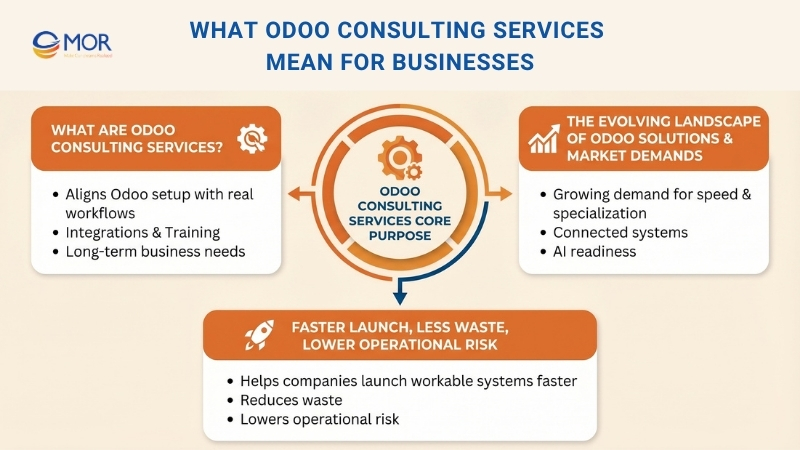
Odoo consulting helps businesses map, launch, adjust, integrate, and maintain Odoo in line with real daily work. An experienced Odoo specialist works between the system and your operations. They turn finance policies, warehouse tasks, approval paths, sales coordination, and reporting demands into a setup your people can use with confidence.
That may sound straightforward. It is not. A large number of ERP projects go off track when teams jump into module configuration before they settle data standards, ownership, workflow gaps, or user training. Success Pack guidance from Odoo reflects this issue too, since it includes review, setup, coaching, training, and customization help within implementation support.
In day-to-day terms, odoo consulting can include requirement review, solution planning, Odoo manufacturing module configuration, custom features, integrations, migration work, testing, launch support, and ongoing update requests. Some firms stay close to standard Odoo flows. Others handle deeper customization, industry-specific requirements, or multi-company structures.
Its real benefit goes beyond technical delivery. What matters most is sound judgment. A capable Odoo advisor knows when standard workflows are enough, when a custom module makes sense, when a process should change, and when to tell a client, “do not rebuild the old system inside the new one.”
Odoo Consulting Services Core Purpose In 2026
In 2026, the main goal is clear. It is to help companies put working systems in place sooner, with less waste, less uncertainty, and fewer problems after launch.
That goal has grown over the years. In the past, many Odoo projects focused mostly on setup and support. Now, buyers want more than that. They expect finance workflows that match local reporting rules. They want sales and operations working from the same records. They want eCommerce, CRM, manufacturing, purchasing, inventory, accounting, and service tasks to stop sitting in disconnected tools.
They also expect a provider that understands business exposure. A poor rollout can delay billing, disrupt replenishment, create payroll confusion, or damage reporting. A strong team reduces that risk because it keeps the project tied to business results instead of a list of features. That is why an odoo consultation now carries more weight than it did a few years ago.
Odoo’s own message shows this shift. It promotes one connected platform, one pricing structure across apps, and one network of official partners and implementation support. Because of that, the hard part is no longer finding a system with enough modules. The real challenge is shaping those modules around daily work without adding new friction.
The Evolving Landscape Of Odoo Solutions And Market Demands
The Odoo market is changing in several visible ways.
To start, companies want tighter links between teams and functions. They do not want sales in one platform, inventory in another, and accounting somewhere else. Odoo’s all-in-one model only strengthens that demand, which is one reason more buyers are exploring Odoo consultancy options.
Another change is the push for quicker delivery. Many businesses now assess ERP platforms the same way they assess SaaS products. They still know implementation takes real work, but they do not want to spend a full year in meetings before they see useful results.
A third shift is specialization. Projects led by finance teams, manufacturing rollouts, field service builds, and work in regulated sectors now call for stronger experience from the delivery side. The old idea of a broad “general ERP team” does not carry the same weight anymore.
A fourth change comes from AI. Odoo is already adding autonomous AI agents in newer releases, and Odoo 20 is expected at Odoo Experience 2026, which points to another round of workflow changes. Because of that, consulting teams now need to advise on setup, data readiness, permissions, and practical ways to use AI in day-to-day operations. That wider market pressure also affects how buyers judge Odoo as one of the best open-source software options.
Because of all this, companies are becoming more selective. They are no longer asking only, “Can this provider roll out Odoo?” They are asking, “Can this team shape Odoo around the way we sell, buy, build, report, and grow?”
Comprehensive Odoo Consulting Services
A reliable Odoo provider rarely handles just one small task. The strongest teams support the whole journey, from the first workshop through long-term support.
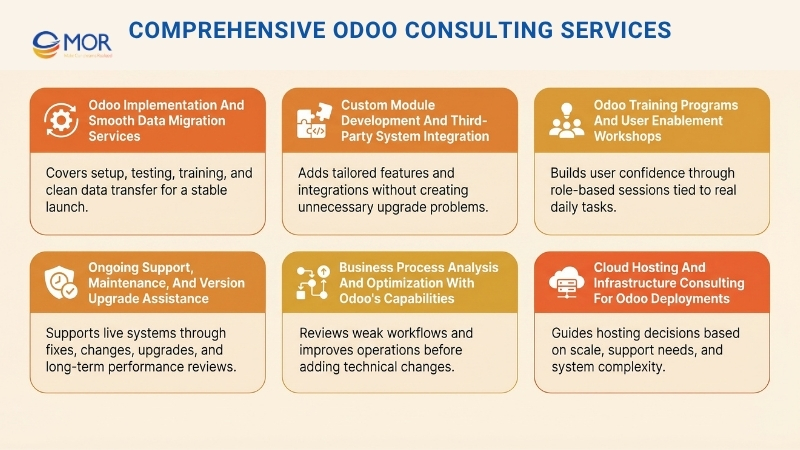
Odoo Implementation And Smooth Data Migration Services
Implementation is usually the first thing people notice. It includes app selection, environment setup, role design, business rules, configuration, testing, training, and go-live planning. That is why many businesses begin with Odoo implementation services when they first move to the platform.
Data migration often decides whether the project feels smooth or stressful. You need accurate customer records, a clear chart of accounts, products, vendors, bills of materials, stock balances, open transactions, and past records loaded correctly. When that work is rushed, users can lose trust in the system during the first week.
Strong consultants do more than transfer information. They remove duplicates, clean naming rules, close outdated records, and decide which data is worth bringing over. Old clutter only creates fresh issues.
Custom Module Development And Third-Party System Integration
Odoo delivers a lot as a standard platform. Even so, growing companies often need tailored work in certain areas.
That can include approval logic, role-based dashboards, warehouse flows, MRP rules, industry-specific forms, finance reporting, commission structures, or custom customer portals. It may also involve linking Odoo with Shopify, QuickBooks, bank feeds, shipping systems, BI tools, PLM platforms, tax software, payment integration development services, or internal applications. In projects like these, businesses often rely on odoo integration consultants and an odoo technical consultant to keep the build stable and practical.
This is the point where judgment really matters. Too little custom work can leave major gaps in the process. Too much code can make future upgrades harder. A skilled consulting team keeps custom development tied to business value, not unnecessary complexity.
Odoo Training Programs And User Enablement Workshops
A lot of ERP projects do not struggle because the platform is wrong. They struggle because the team never learned how to use it well.
Training needs to go further than one big demo before launch. Each role needs its own sessions. Sales teams need workflows built for them. Buyers need the same. Warehouse staff need practical steps they can follow. Finance teams need guidance on controls, posting rules, period closing, and reporting. This is where experienced odoo consultants add real value.
The strongest training programs connect directly to real tasks instead of generic slide decks. People remember what helps them complete actual work.
Ongoing Support, Maintenance, And Version Upgrade Assistance
Go-live is not the end of the project. It is only the first stable stage.
Once the system is live, teams still need help with bugs, access settings, report adjustments, workflow changes, new users, module growth, and performance reviews. As time passes, they also need planning for future upgrades. A good consultant odoo resource stays useful well after launch.
Odoo includes support and upgrade paths within its plan structure, and official partners still play a major role in that support model for businesses that need custom work, integrations, or broader operational guidance.
Business Process Analysis And Optimization With Odoo's Capabilities
This is the part many buyers overlook, then later wish they had included.
A strong Odoo team looks closely at where work slows down. Orders may sit too long in approvals. Inventory may drift because receiving rules are weak. Reporting may break when teams use free-text fields in different ways. Customer service may miss handoffs because ownership is unclear. That is why odoo erp consulting often starts with process review, especially in companies that depend on accounting erp alignment across teams.
The answer is not always technical. In some cases, the process needs to be cleaned up first, and Odoo should come after that. Good advisors make that clear from the start.
Cloud Hosting And Infrastructure Consulting For Odoo Deployments
Some companies can work well with standard cloud hosting. Others need Odoo.sh, staging environments, added workers, more storage, or dedicated server options. In cases like that, Odoo consulting services often extend into infrastructure decisions, and an odoo erp consultant can help shape the right setup.
Odoo’s pricing configurator shows that hosting choices can quickly affect cost and support requirements, especially when custom work or larger user counts are involved. For that reason, infrastructure guidance should stay inside the consulting scope, not outside it.
A strong partner should guide you toward the right hosting option based on user volume, integration demand, uptime expectations, deployment model, and the level of internal IT support you already have.
Key Benefits Of Engaging Professional Odoo Consulting Services
The right Odoo team can change how the entire project unfolds. The platform itself is important, of course. Still, whether it becomes a real business asset or a daily problem often depends on the people guiding the work. That is why choosing an Odoo consulting partner matters so much, especially for firms exploring small business ERP solutions that must stay practical and easy to manage.
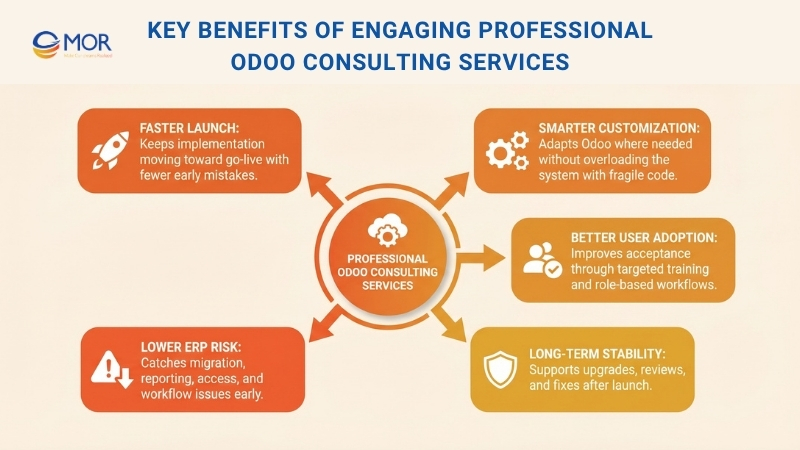
- Quicker launch and faster return: An experienced team prevents early mistakes, steers the project away from poor choices, and keeps progress aimed at a workable go-live instead of repeated corrections.
- Customization that matches your operation: Skilled advisors adapt the system to the areas of your business that really need it, without turning the platform into a fragile web of custom code.
- Stronger user adoption: Targeted training, hands-on workshops, and role-based configuration make it easier for teams to accept the system and use it with less resistance.
- Ongoing support and long-term stability: Help after launch, upgrade planning, and routine system reviews allow the platform to stay effective well beyond the first stage of the project.
- Better control of ERP risk: A knowledgeable team can catch migration trouble, reporting gaps, weak access settings, and broken workflow points before they become costly issues.
Odoo presents the same idea in a slightly different way on its service pages. The company describes implementation as a guided service that covers analysis, setup, training, and coaching, rather than a simple software delivery.
The Strategic Odoo Consulting Services Process
A well-run project tends to move through a defined sequence. The labels may differ from one provider to another, but the overall flow is usually much the same.
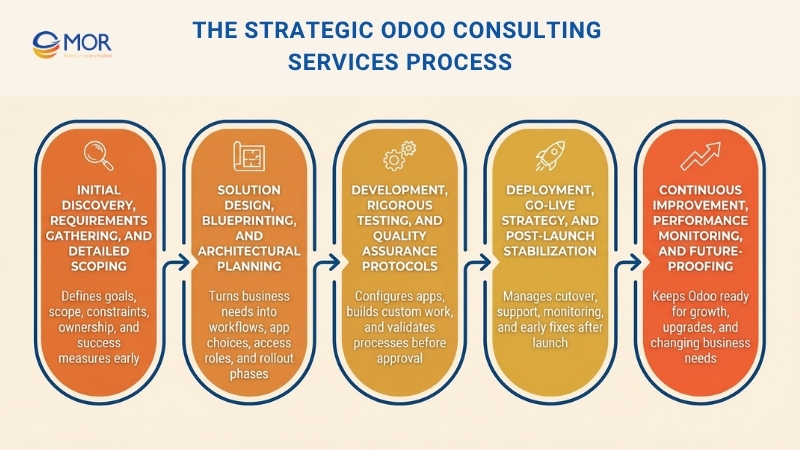
Initial Discovery, Requirements Gathering, And Detailed Scoping
This is the point where the project becomes real.
The team reviews business goals, existing tools, workaround habits, pain points, and technical constraints. They identify what the business wants to solve first, what can wait until later, which data is available, and what rules must remain compliant. This stage also defines scope limits, timeline expectations, team responsibilities, and success criteria.
Poor discovery leads to plans that look solid at first and fail afterward.
Solution Design, Blueprinting, And Architectural Planning
After the facts are understood, the partner turns that information into a working design for the system.
This includes choosing apps, outlining workflows, defining reporting needs, planning integration logic, identifying custom requirements, shaping the data model, and setting access roles. When the project is larger, the team may also break the rollout into phases so the business can launch step by step instead of trying to do everything at once.
A strong design stage removes a great deal of rework later.
Development, Rigorous Testing, And Quality Assurance Protocols
This is the stage where the platform begins to come together.
Standard apps are configured first. Custom modules are then developed where needed. Integrations are connected. Reports are prepared. Sample data is brought in. After that, the work goes through functional testing, user review, bug resolution, and sign-off rounds.
Testing is the point where teams find out whether their process ideas were accurate or only sounded good on paper. It is also the stage many weaker providers rush through. Good teams do not.
Deployment, Go-Live Strategy, And Post-Launch Stabilization
A go-live should feel organized, not chaotic.
That includes cutover checklists, data freeze steps, rollback preparation, staff availability, user assistance, and close monitoring during the first days after launch. Most companies also need a short stabilization period after go-live to catch unusual cases, retrain users, clean up permissions, and refine reports.
This is the stage that draws the line between “the system is live” and “the business can truly run on it.”
Continuous Improvement, Performance Monitoring, And Future-Proofing
Odoo needs to keep developing as the business moves forward.
New teams join. New branches open. Reporting needs change. A company may add eCommerce, field service, subscriptions, or manufacturing after the first rollout. In some cases, it has to clean up old custom code. In others, it introduces completely new modules.
That is why the strongest consultants plan beyond the first release. They keep the system structured well enough to grow, upgrade, and stay manageable over time.
Top 10 Odoo Consulting Firms In The US 2026
This list is an editorial selection for buyers looking for reliable Odoo consulting services in the U.S. market in 2026. To build it, we reviewed current visibility among Odoo partners, service range, fit for U.S. companies, industry background, and the type of Odoo work each provider seems best equipped to deliver, while also checking official partner listings and public company claims where possible.
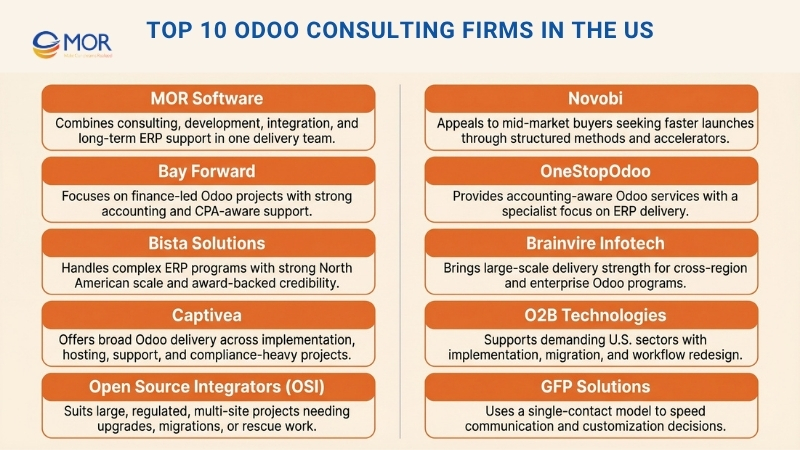
MOR Software
Leading this list is MOR Software, a global Odoo development company that has expanded further into ERP after announcing its strategic partnership with Odoo on January 22, 2026. We are a strong option for businesses that need more than a simple setup. Our position sits where consulting, custom Odoo ERP development, integrations, and long-term product support come together.
We combine business analysis, implementation, tailored development, and product delivery inside one team. That makes a real difference when an Odoo rollout must align with finance rules, field operations, mobile experiences, cloud platforms, or external systems. We also bring wider enterprise delivery experience across media, healthcare, construction, workforce management, Odoo for food and beverage distribution and other business software areas.
Many businesses want an ERP provider that can continue supporting them after launch. That is one reason we stand out. Our partnership announcement makes it clear that we cover consulting, implementation, AMS, dedicated resources, custom module delivery, and long-term system support.
Here is a quick overview of the services from MOR Software:
- Odoo Consulting
- Odoo Implementation Services
- Odoo Module Development
- Odoo Customization
- Odoo ERP Integration
- Odoo Migration Services
- Application Management Services (AMS)
- Dedicated Odoo Developers Teams
We help companies shape ERP systems around real operations, which makes us a dependable choice for businesses planning long-term upgrades and steady digital growth.
Bay Forward
Bay Forward has built a strong reputation for finance-focused Odoo work in the U.S. Odoo lists the company as a Ready implementation partner, and Bay Forward presents itself around Odoo ERP, accounting support, CPA-driven workflows, and U.S.-based service from offices that include Miami Lakes, Florida.
The firm fits companies that place a high value on financial control, accurate bookkeeping, payroll awareness, and ERP work with a clear finance focus. That makes Bay Forward especially relevant for organizations searching for an odoo business accounting consultant instead of a provider that treats Odoo like a general software rollout.
Here is a closer look at the services delivered by Bay Forward:
- Odoo Implementation
- Odoo Development and Customization
- Odoo Accounting Services
- Odoo Digital Marketing
- Odoo E-commerce
Their team is a solid option for businesses that want Odoo support combined with strong finance knowledge.
Cudio Inc.
Cudio Inc. appears in Odoo’s partner directory as a Gold partner based in Boston, Massachusetts. Odoo lists the company with 80 references, 96% customer retention, and a strong base of work across manufacturing, wholesale, retail, healthcare, education, technology, finance, logistics, and construction-related categories.
Cudio has a clear Odoo consulting profile and a strong message for complex ERP change. Its official Odoo profile says the company supports businesses through evaluation, system architecture, migration, customization, integrations, maintenance, and version upgrades.
The company is a good fit for businesses moving away from older ERP, accounting, or operational systems. Its focus on manufacturing, omnichannel distribution, and retail also makes it useful for buyers with more connected sales, inventory, and finance needs.
Cudio is worth considering when a company wants practical Odoo guidance, careful migration planning, and support that can continue after the first launch.
Captivea
Captivea USA appears on Odoo’s directory as a Gold partner and presents itself as a major Odoo-focused integrator with 18+ years of ERP experience, 600+ clients worldwide, and a U.S. office in Orlando, Florida.
Captivea suits U.S. businesses that want wide delivery coverage, from implementation and development through hosting, maintenance, and ongoing support. The company also speaks clearly to regulated sectors and multi-company structures, which makes it useful for buyers with heavier compliance needs or more layered business setups.
Here is a closer look at the services delivered by Captivea:
- Odoo Implementation
- Odoo Integration
- Odoo Development
- Odoo Maintenance
- Odoo Hosting
Their team is a reliable choice for organizations that want an established Odoo provider with broad service coverage and strong U.S. delivery capability.
Open Source Integrators (OSI)
Open Source Integrators, better known as OSI, is another Gold partner with a clear U.S. presence. Odoo lists the company in Chandler, Arizona, shows 144 references, and highlights strong experience in manufacturing, finance, healthcare, construction, logistics, aerospace, and defense-related projects.
OSI is especially relevant for buyers who need a consulting team for large or difficult projects, including rescue work, version upgrades, migrations, and environments with more than one location or tighter compliance pressure. Its message focuses less on flashy promotion and more on long-term fit and business process alignment.
Here is a closer look at the services delivered by Open Source Integrators:
- Odoo Implementations
- Odoo Migrations
- Version Upgrades
- Rescue Projects
- Functional and Technical Support
Their team is a strong match for businesses that need structured advice around large, regulated, or multi-site ERP work.
OBS Solutions Inc.
OBS Solutions Inc. is listed by Odoo as a Silver partner with a U.S. location and a long track record in Odoo implementation. Its official Odoo customer page states that OBS Solutions has completed 500+ Odoo projects, brings 10+ years of real-world Odoo experience, and works with 50+ consultants across core business areas.
OBS Solutions has a proven track record in Odoo consulting and project delivery. The company is also part of the wider OBS group, which gives it a broader delivery base for companies with U.S. and international operations.
The firm’s service scope covers consultation, project start, implementation, and support. Its message also favors using Odoo standard functions where possible, which can help buyers avoid too much custom work and lower upgrade risk later.
OBS Solutions is a good fit for companies that want an Odoo partner with cross-border experience, stable consulting coverage, and a practical delivery style.
OneStopOdoo
OneStopOdoo is closely connected to Bay Forward LLC within Odoo’s partner ecosystem and presents itself as a specialist brand dedicated entirely to Odoo work. Its website focuses heavily on accounting-led ERP, CPA-backed financial setup, server management, support, hosting, mobile app connections, and custom development.
That narrow positioning is exactly what makes the company appealing. It is designed for buyers who want Odoo-first help, not a wider IT provider that happens to offer ERP as one service among many. The company is especially relevant for firms that care about financial reporting accuracy, multi-entity accounting, and U.S.-friendly compliance thinking.
Here is a closer look at the services delivered by OneStopOdoo:
- Odoo Development and Customization
- Odoo Implementation
- Odoo Hosting and Server Management
- Odoo Accounting Services
- Odoo Functional and Technical Support
Their team is a good fit for companies that want accounting-aware Odoo work with a tighter specialist focus.
Brainvire Infotech
Brainvire Infotech is listed in Odoo’s directory as a Gold partner and operates on a much larger scale than many niche Odoo firms. Its partner page says Brainvire has 4,500+ digital professionals worldwide and has supported 2,500+ businesses across 20+ countries, with strong experience in retail, manufacturing, logistics, real estate, healthcare, and education.
This is not the smallest or most narrowly focused provider on the list. Brainvire is usually a better fit when a company wants enterprise reach, a large delivery team, and cross-border support for more complex Odoo programs.
Here is a closer look at the services delivered by Brainvire Infotech:
- Odoo ERP Consulting
- Odoo Implementation
- Odoo Custom Development
- Retail and Manufacturing Odoo Projects
- Cross-Region Odoo Delivery
Their team is a strong choice for businesses that need scale, industry range, and a provider comfortable with large delivery groups.
O2B Technologies
O2B Technologies describes itself as a certified Odoo partner in Austin, Texas, and says it has completed 500+ implementations for U.S. businesses. Its industry emphasis includes HVAC, aerospace, manufacturing, defense, and other operationally demanding sectors.
O2B is worth paying attention to because it presents itself around practical ERP change rather than broad digital services. That keeps its message focused. It is built for buyers who want implementation, migration, workflow cleanup, and scaling help in one track.
Here is a closer look at the services delivered by O2B Technologies:
- Odoo ERP Implementation
- Odoo Migration
- Workflow Design
- Odoo Scaling Support
- U.S.-Focused ERP Advisory
Their team is a good option for firms that want a U.S.-market provider with clear ERP specialization and hands-on implementation depth.
GFP Solutions
GFP Solutions appears on Odoo’s directory as a Ready partner based in San Francisco, California. The directory lists 23 references, 100% customer retention, and a delivery model based on consultant-developer hybrids who remain the main point of contact through implementation and customization work. That structure also makes GFP relevant for buyers still weighing Odoo consulting services against other provider models.
That delivery setup is a real point of difference. Many ERP projects slow down when business consultants and developers work too far apart. GFP tries to remove that gap, which makes the company attractive for businesses that want quicker decisions and less internal translation between teams.
Here is a closer look at the services delivered by GFP Solutions:
- Odoo Implementation
- Odoo Customization
- Single-Contact Project Delivery
- Manufacturing and Tech-Sector Odoo Work
- Ongoing Odoo Maintenance
Their team is a smart choice for companies that want direct communication, shorter response times, and a provider with a strong West Coast presence.
>>> Learn more:
Odoo for eCommerce Guide | Build, Manage & Grow Your Online Store
How To Choose The Best Odoo Consulting Services Partner In The US Market
Many buyers assess providers the wrong way. They compare certifications, hourly pricing, and product screenshots, then ignore the harder questions. A better method is to understand how the firm thinks, how it manages projects, and how it handles difficult moments when data, people, or process design become messy. That is where Odoo consulting services show their real value.
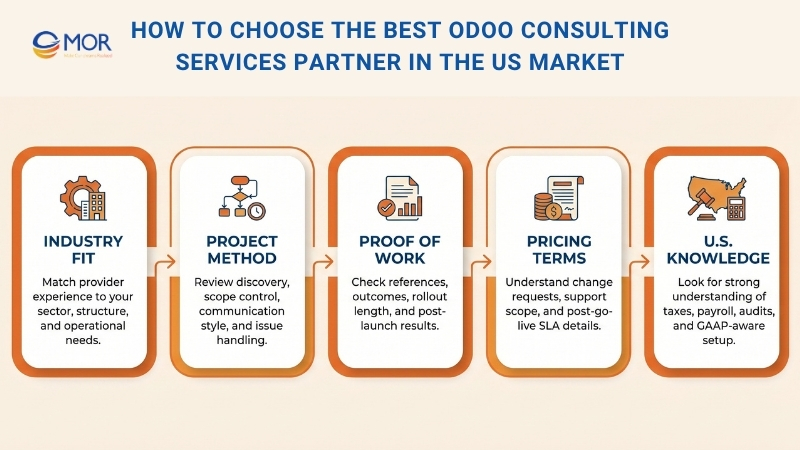
- Check experience, certifications, and industry fit: A provider can know Odoo well and still be the wrong match for your business. Look for evidence in your type of work, whether that means manufacturing, retail, services, distribution, healthcare, or multi-company finance.
- Study methodology and communication habits: Ask how discovery is handled, how scope changes are managed, how bugs are prioritized, how often demos are shared, and who owns daily project activity.
- Review testimonials, references, and case work: Do not stop at logos. Ask what changed after launch, how long the rollout lasted, what went wrong, and how the provider dealt with it.
- Understand pricing logic and support terms: Low implementation pricing can lead to expensive support later. Ask what is included, what counts as a change request, and what the SLA looks like after go-live.
- Check U.S. business understanding: The strongest U.S.-market provider should understand GAAP aware accounting setup, payroll effects, taxes, multi-state issues, audit trails, and local reporting pressure.
The right team is rarely the one with the loudest sales message. It is the one that understands your business clearly, pushes back when needed, and can show how it will move you from current problems to a cleaner operating model.
Costs & Engagement Models Of Odoo Consulting Services
Odoo consulting costs vary by scope, modules, data quality, custom logic, integrations, user training, and partner location. A small CRM or accounting setup may stay under $10,000. A multi-location rollout with manufacturing, inventory, accounting, ecommerce, and external systems can move past $100,000.
These costs usually refer to consulting and implementation services. Odoo license fees, hosting, Odoo.sh, extra apps, and long-term support may sit outside the first quote.
Engagement Model | Best For | Typical Cost Range In USD | What To Watch |
Hourly Consulting | Discovery, fixes, workflow advice, small setup tasks | $100 to $300/hour for many certified Odoo partners in the U.S. | Good for short work, but unclear scope can run up the bill fast |
Odoo Success Packs | Official Odoo guidance for smaller teams and standard setup work | New customers: $390 for 4 hours, $2,040 for 25 hours, $3,570 for 50 hours, $6,375 for 100 hours, $12,750 for 200 hours | Best for lighter work. These hours expire after one year |
Returning-Customer Success Packs | Existing Odoo customers buying more official service hours | $458.82 for 4 hours, $2,400 for 25 hours, $4,200 for 50 hours, $7,500 for 100 hours, $15,000 for 200 hours | Useful for added training, configuration, or minor workflow changes |
Fixed-Scope Implementation | Clear rollout with defined modules, users, data, and timeline | Small projects: $5,000 to $20,000. Mid-market projects: $20,000 to $100,000. Large projects: $100,000+ | Works best when the team has mapped processes before signing |
Custom Development And Integration | Custom modules, reports, API work, ecommerce, warehouse, payment, or legacy system links | Often $10,000 to $75,000+, depending on code volume and testing needs | Custom code can raise upgrade and maintenance costs later |
Dedicated Odoo Team | Long-term buildout, custom apps, integrations, AMS, and post-launch change requests | Often $8,000 to $30,000+ per month, based on team size and seniority | Best when the business expects steady changes after go-live |
Managed Support / Retainer | User support, bug fixes, report changes, small improvements, and admin help | Often $1,000 to $10,000+ per month | Ask what response time, unused hours, and after-hours support mean in the contract |
A lean Odoo consulting project may start with workshops, fit-gap review, configuration, data import, and user training. That type of work often fits within a Success Pack or a small fixed-scope project.
Larger projects need more care. Data migration, third-party connections, custom reports, user acceptance testing, and rollout support can add weeks of work. For that reason, buyers should ask each partner for a clear split between discovery, setup, customization, migration, training, support, and change requests.
The safest budget also includes a buffer. For most mid-sized Odoo projects, keeping 10% to 20% aside for data cleanup, extra testing, or small scope changes is a smart move.
Driving Business Growth And Innovation With Odoo Consulting Services
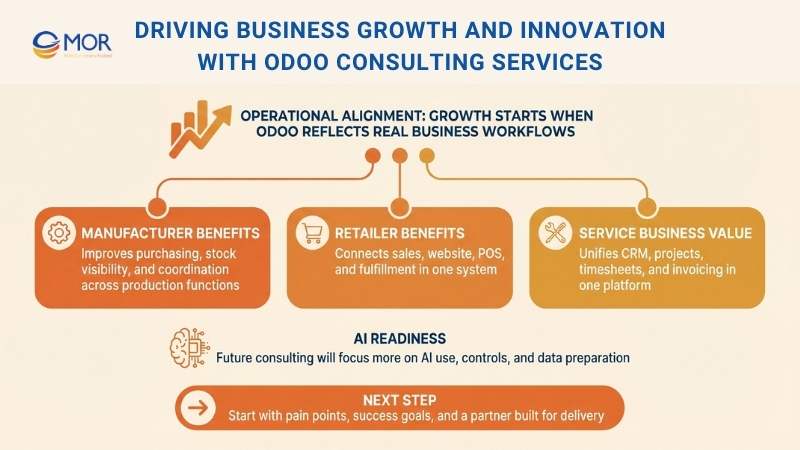
The biggest advantage of Odoo consulting services is not the software on its own. The real gain appears when the platform begins to match the way the business actually runs.
A manufacturer gets cleaner stock data, less confusion in purchasing, and clearer visibility across MRP, inventory, and quality. A retailer gets sales, website, POS, and fulfillment connected through one source of truth. A service company gets CRM, projects, timesheets, and invoicing working in one platform instead of spread across five disconnected tools. That is when business growth starts to feel practical.
We see the same pattern in software projects beyond standard ERP as well. MOR Software’s case work covers media platforms, healthcare systems, construction apps, workforce tools, and enterprise operations. The sectors may differ. The pattern stays the same. When the platform reflects real operations, teams move faster and trust the data more.
Looking ahead, Odoo advisory work will keep moving toward cleaner data, stronger cross-system design, better industry fit, and readiness for AI. Odoo is already promoting AI in its current product message, and the company has publicly previewed Odoo 20 for release during Odoo Experience 2026. That means future consulting work will go beyond setup. It will also cover where AI should act, which data it can use, and what controls a business needs around it.
The next move is not complex. Start with a focused discussion. Map your business pain points. Decide what should remain standard, what needs to change, and what success should look like after go-live. Then choose a partner that can carry that plan from workshop to launch and beyond.
If your team is preparing for an Odoo rollout, migration, rescue project, or long-term support model, contact us now.
Conclusion
The right Odoo project can bring finance, operations, inventory, sales, and reporting into one clear flow. The wrong one can create more friction than progress. That is why strong Odoo consulting services matter. With the right strategy, partner, and rollout plan, businesses can move faster and scale with fewer setbacks. MOR Software helps companies build Odoo systems that match real operations and long-term goals. Contact us to discuss your Odoo roadmap.
"Mr. Cong’s guiding philosophy is simplicity, believing that the simplest solutions are often the most powerful. He sees trust, empowerment, and the opportunity to demonstrate one’s abilities as the key elements that set MOR apart from traditional IT companies."
Mac Tien Cong


Division Manager (Hanoi Branch)
MOR SOFTWARE
Frequently Asked Questions (FAQs)
What do Odoo consulting services usually include?
They often cover discovery workshops, process mapping, module selection, system setup, data migration planning, customization advice, integration planning, user training, testing, go-live support, and post-launch improvement. Some providers also help with hosting, upgrades, and long-term support.
When should a business hire an Odoo consultant?
The best time is before implementation starts. Early guidance helps you avoid weak process design, poor data structure, and expensive rework later. It also makes it easier to choose the right modules and project scope from the start.
How are Odoo consulting services different from Odoo development?
Consulting focuses on business needs, system design, process alignment, and rollout strategy. Development focuses on coding, custom modules, technical integrations, and advanced changes. In many projects, both are needed, but they solve different problems.
How much do Odoo consulting services cost?
Pricing depends on project size, number of modules, level of customization, integration complexity, and support needs. A small rollout may cost far less than a multi-company or multi-region project. Some firms charge hourly, while others work with fixed-scope proposals or support retainers.
How long does an Odoo implementation project usually take?
A simple setup may take a few weeks or a few months. A mid-size rollout often needs several months, while a large project with custom workflows and integrations can take much longer. The timeline usually depends on scope, data quality, internal decision speed, and training readiness.
Can Odoo work for small and mid-sized businesses?
Yes. It can work well for smaller firms because they can start with the modules they need now and add more later. That flexibility is one reason many teams consider it when comparing ERP options.
Do businesses always need customization in Odoo?
Not always. Many companies can run well with standard features plus light configuration. Customization becomes more useful when you have unique workflows, industry-specific requirements, or systems that must connect with Odoo in a certain way.
What should you look for in an Odoo consulting partner?
Look for proven industry experience, a clear project method, honest scope advice, good communication, and real examples of similar work. It also helps to choose a team that can support you after go-live, not just during setup.
What are the biggest risks in an Odoo project?
Common risks include unclear scope, poor data migration, weak user training, too much customization, and limited testing before launch. These issues can delay adoption and make the system harder to manage later.
What happens after the system goes live?
After launch, most businesses still need support for bug fixes, user questions, report updates, workflow changes, access control, and future upgrades. Odoo consulting services often continue after go-live because real improvement usually happens in phases, not in one single launch.
Share


Make Our-Dreams Realized


© 2023 . MOR Software. All Rights Reserved
Sitemap
Privacy Policy
Terms of Use

Rate this article
0
over 5.0 based on 0 reviews
Your rating on this news:
Name
*Email
*Write your comment
*Send your comment
1