


What Is Agentic AI Data Management? A Complete Enterprise Guide
Agentic AI data management helps enterprises automate data discovery, quality checks, pipeline operations, and governance through AI agents. Traditional ETL processes and manual reviews struggle to keep up as data spreads across more systems and cloud platforms. AI agents can detect problems, plan corrective actions, and execute approved tasks under human-defined rules. In this guide, MOR Software will explain how this approach works, its architecture, enterprise use cases, business benefits, risks, and implementation requirements.
Key Takeaways
- Agentic AI data management uses goal-driven autonomous AI agents to monitor, process, and govern enterprise data within defined security and operational boundaries.
- Its main applications include automated data discovery, anomaly detection, data cleansing, pipeline repair, lineage tracking, and policy enforcement.
- Successful adoption depends on trusted data, clear business rules, controlled agent permissions, measurable performance, and human oversight for high-risk actions.
What Is Agentic AI Data Management?
Agentic AI data management (ADM) applies autonomous, goal-driven AI agents to manage enterprise data throughout its lifecycle. These agents interpret business objectives, plan tasks, use approved tools, and check their results without requiring people to direct every action.
Unlike standard automation, which follows fixed instructions, an agentic system can choose between approved actions when conditions change. Large language models (LLMs), metadata, business rules, and specialized agents support this decision process.
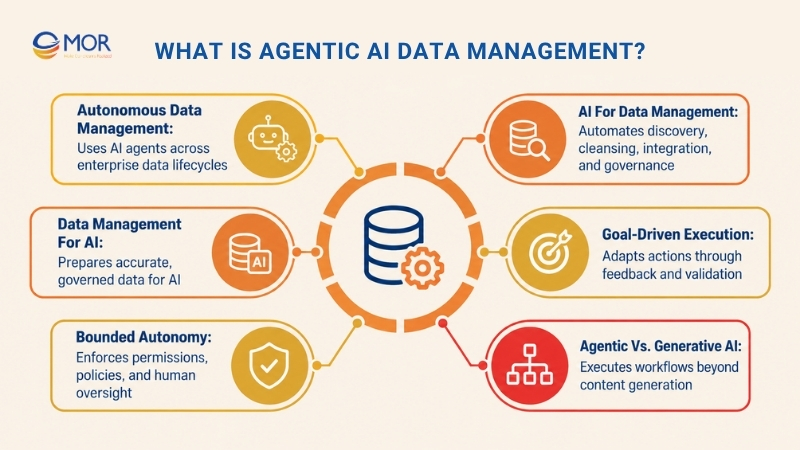
The approach covers two connected areas:
- AI for data management: AI agents handle tasks like data discovery, cleansing, integration, monitoring, and governance. They identify problems and propose or execute permitted corrections.
- Data management for AI: Enterprises prepare accurate, governed, and well-documented data that other AI agents need for analysis and business operations.
- Goal-driven execution: Agents work toward a defined outcome, using feedback and validation to adjust their actions when an initial attempt fails.
- Bounded autonomy: Human teams set policies, permissions, and acceptable risks. Agents operate within these limits and escalate decisions when approval is required.
The distinction between agentic AI vs generative AI matters here. Generative AI produces content based on prompts, whereas agentic systems can plan and carry out connected tasks through external tools.
Enterprise readiness remains a concern. A Gartner survey found that 63% of organizations either lacked the right data management practices for AI or were uncertain about their readiness. Reliable data and governance must support greater agent autonomy.
How Does Agentic AI Data Management Work?
Agentic AI data management follows a continuous operating cycle in which specialized agents detect changes, examine information, select actions, and verify outcomes. Each action remains subject to business policies and technical controls.
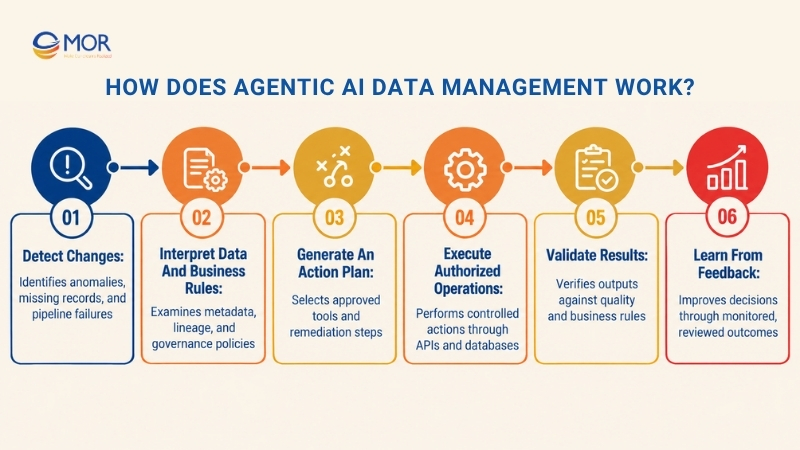
The workflow typically includes six stages:
- Detect changes: Monitoring agents inspect datasets, schemas, pipeline logs, and quality indicators. They identify unusual patterns, missing records, delayed updates, and failures that require attention.
- Interpret data and business rules: Agents consult metadata catalogs, lineage records, semantic definitions, and governance policies. This information helps them understand which assets are affected and what actions are permitted.
- Generate an action plan: A planning agent determines the required steps, selects approved tools, and identifies dependencies. The plan may involve data cleansing, transformation changes, record matching, or human approval.
- Execute authorized operations: Specialized agents carry out approved actions through APIs, databases, or data processing tools. Permissions and policy checks determine whether an agent may write changes, request approval, or only prepare recommendations.
- Validate results: Independent checks compare outputs against data contracts, business rules, and quality thresholds. Failed validation can trigger a controlled retry, rollback, quarantine, or escalation.
- Learn from feedback: Monitoring signals and reviewed outcomes help teams improve future decisions. Any changes to agent behavior must remain within approved policies and undergo testing where required.
Consider an enterprise CRM receiving customer records from several sales channels. Some records contain incomplete addresses, inconsistent phone formats, or duplicate account identifiers.
A monitoring agent detects these issues and checks the approved customer-data rules. It identifies records suitable for automatic formatting corrections and sends uncertain duplicate matches to a data steward.
Once corrections pass validation, the system updates the approved records and records the changes for review. Downstream reports can then work with more consistent customer information.
This is how agentic AI in data management turns a manually managed exception process into a monitored workflow. Production changes still require valid authorization, sufficient evidence, and successful verification.
Core Components of an Agentic Data Management Architecture
An enterprise agentic AI data management architecture combines AI reasoning with data infrastructure, shared business definitions, and independent execution controls. Its design determines how agents access information, select actions, and operate safely across connected systems.
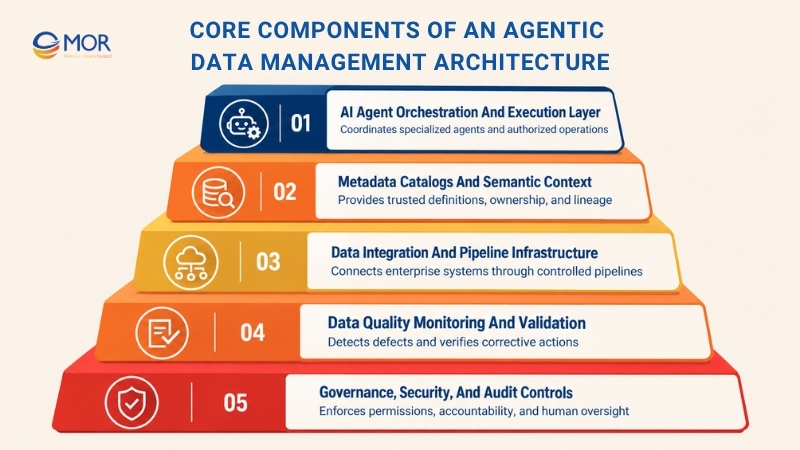
AI Agent Orchestration and Execution Layer
The orchestration layer coordinates specialized AI agents responsible for data ingestion, profiling, transformation, and remediation. A planning agent receives an objective, divides it into tasks, and sends each task to the appropriate agent or software service.
LLMs help interpret requests and select actions. State management records task progress, and controlled memory can retain useful information about past results.
Execution should remain separate from language-model reasoning. Approved SQL engines, APIs, and processing services carry out actual operations, particularly when changes affect production databases.
An enterprise may assign one agent to detect schema drift and another to assess affected transformations. A supervisor component then reviews their outputs against the active policies before authorizing further work.
Metadata Catalogs and Semantic Context
Metadata tells agents where enterprise data lives, what it means, and how systems use it. Catalogs store schemas, ownership information, descriptions, sensitivity labels, and lineage records.
Semantic layers add approved business definitions for metrics, entities, dimensions, and relationships. For example, an agent calculating revenue must know whether the company includes tax, discounts, or refunded orders.
An AI agents metadata-first data management approach makes those definitions available before an agent generates queries or changes records. This limits decisions based on ambiguous field names or incomplete database schemas.
Some teams describe metadata discovery and enrichment as agentic AI meta data management. Its practical value comes from keeping business definitions, ownership details, and technical records accurate as enterprise systems change.
Data Integration and Pipeline Infrastructure
Enterprise agents need controlled connections to operational databases, CRM platforms, ERP systems, data warehouses, and cloud applications. ETL/ELT pipelines and streaming services continue handling large-scale data movement.
Agents can work around this infrastructure to detect errors, propose new mappings, and coordinate approved transformations. This approach also supports agentic AI for data engineering, particularly for tasks involving pipeline monitoring and exception handling.
APIs and the Model Context Protocol (MCP) can expose tools and information to agents. Yet access to a tool doesn't automatically give an agent permission to execute every operation it supports.
For instance, a purchasing agent may have permission to read supplier records but require approval to change payment details. Similar controls apply to business intelligence solution integration, where data accuracy and controlled access directly affect reporting.
Data Quality Monitoring and Validation
Data quality controls examine six common dimensions: accuracy, completeness, consistency, timeliness, uniqueness, and validity. Agents use these measures to detect unexpected changes and identify records requiring correction.
Data contracts define accepted schemas, required fields, and business rules. Pre-execution checks inspect proposed operations, and post-execution checks confirm that completed actions produced acceptable results.
For agentic AI for data quality, monitoring alone isn't sufficient. The system also needs a reliable process for isolating incorrect records, controlling retries, recording changes, and restoring previous states when corrections fail.
Tools including Databricks and Informatica Cloud Data Quality can support different parts of this work through data quality monitoring, validation, and governed data services.
Governance, Security, and Audit Controls
The governance layer determines what agents can access, which actions they can perform, and when people must intervene. Policy engines, role-based access control (RBAC), and least-privilege permissions enforce these decisions.
Each agent should operate under an identifiable service identity with access limited to its assigned tasks. Execution logs must record relevant inputs, tool calls, affected data, validation results, and approvals.
Human oversight remains necessary for actions involving sensitive information, disputed business definitions, or changes that are difficult to reverse.
Data provenance also matters. It connects outputs to their sources, transformations, and execution history, allowing teams to investigate incidents and explain how an agent reached a result.
Agentic Data Management vs Traditional Automation and MDM
Agentic AI data management extends existing data operations through reasoning, planning, and controlled autonomy. Traditional ETL automation and master data management (MDM) still perform distinct jobs within an enterprise data architecture.
Comparison factor | Traditional automation | Master data management | Agentic data management |
Primary objective | Execute predefined data tasks | Maintain authoritative business records | Coordinate goal-driven data operations |
Decision-making | Fixed logic and rules | Defined matching and stewardship policies | Reasoning within approved boundaries |
Adaptability | Requires updates when workflows change | Adjusts through governed configurations | Can select approved responses to new conditions |
Data quality management | Scheduled checks and validation rules | Matching, standardization, and golden records | Continuous monitoring and controlled remediation |
Governance enforcement | Preconfigured technical controls | Domain ownership and master data policies | Policy-aware execution with validation |
Human involvement | Development and exception handling | Stewardship and policy approval | Supervision, escalation, and high-risk approval |
Best-fit workflows | Stable, repetitive processing | Customer, supplier, and product master data | Exception-heavy, changing data workflows |
Traditional ETL remains useful for reliable, predictable data transfers. MDM defines authoritative records and rules, while agents can apply these standards to new situations.
For example, agentic AI master data management can support duplicate detection and record matching across CRM and billing systems. The MDM platform still holds the approved golden-record definitions and survivorship policies.
The strongest design assigns each technology a clear responsibility. Agents manage appropriate exceptions, deterministic pipelines process established workloads, and human stewards retain authority over business definitions.
6 Agentic AI Data Management Use Cases
Agentic AI data management supports enterprise workflows that involve changing data, repeated investigation, or complex coordination. The following agentic AI data management examples show where agents can perform useful tasks under defined controls.
These applications also connect to broader agentic AI use cases involving business systems, analytics, and process automation.
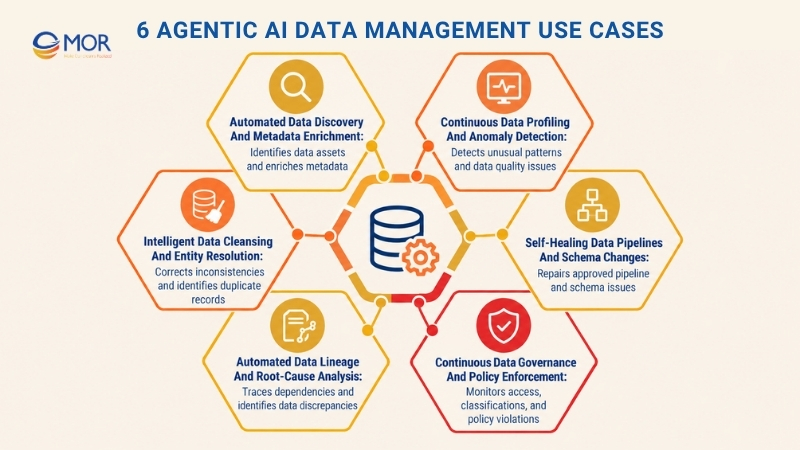
Automated Data Discovery and Metadata Enrichment
Enterprise data catalogs often fall behind as departments add databases, applications, and cloud services. Agents can scan approved sources, identify tables and columns, examine relationships, and generate draft descriptions based on available metadata.
A metadata agent might identify customer identifiers shared across a newly connected ERP and CRM system. It can suggest relationships and classifications, then request review before publishing business-sensitive definitions.
The process can also flag missing data owners and potentially sensitive attributes. Verified descriptions give analysts and downstream agents a clearer understanding of available enterprise information.
Continuous Data Profiling and Anomaly Detection
Data profiling agents monitor record counts, null values, distributions, freshness, and changes in expected patterns. They can compare recent observations against established baselines and alert the correct team when unusual behavior appears.
For example, a retail transaction dataset may suddenly report fewer completed orders than its usual daily range. An agent checks upstream ingestion logs and related feeds to investigate the discrepancy.
Seasonal demand changes and planned system maintenance can also affect data patterns. Agents need these signals before deciding that an unusual result represents a real failure.
Intelligent Data Cleansing and Entity Resolution
Duplicate and inconsistent records create problems for sales, finance, procurement, and customer service. Agentic systems can suggest corrections based on approved matching policies, reference sources, and confidence thresholds.
A CRM agentic AI workflow might compare customer names, email addresses, billing identifiers, and transaction histories. High-confidence formatting corrections can follow automated rules, whereas uncertain record merges remain subject to review.
The same pattern works for supplier and product information. Trusted master records support more accurate segmentation, reporting, and downstream analytics.
Self-Healing Data Pipelines and Schema Changes
Pipeline failures can begin with small upstream changes. A renamed column, changed data type, or missing field may break transformations and leave downstream reports outdated.
Agents can examine execution logs, inspect lineage records, and identify which transformations depend on the affected field. They may then propose a compatible mapping or transformation adjustment.
A low-risk correction can proceed after automated testing if the system grants permission. Changes affecting business calculations, sensitive information, or shared production schemas should require engineering approval.
'Self-healing' still needs boundaries. Every automated correction must pass tests before the modified pipeline resumes normal operation.
Automated Data Lineage and Root-Cause Analysis
When a financial KPI changes unexpectedly, engineers often investigate several datasets and transformation jobs to find the source. Agentic lineage analysis can trace dependencies, examine SQL logic, and identify probable causes.
Agents may also inspect code repositories and pipeline configurations to reconstruct missing lineage information. Inferred connections require validation before teams use them as formal audit evidence.
A finance team investigating inconsistent revenue figures might discover that one downstream transformation applies an outdated discount rule. The lineage record helps identify affected reports and related data products.
Continuous Data Governance and Policy Enforcement
Governance agents can examine sensitive-data classifications, permission changes, retention requirements, and policy violations across connected systems.
For instance, a customer-data integration workflow may attempt to copy restricted personal information into an analytics environment. A policy service can block the transfer and record the attempted action.
Agents can prepare remediation recommendations and supporting evidence for data stewards. They should not independently rewrite corporate policies or grant themselves additional permissions.
This supports continuous oversight without requiring governance teams to review every routine data operation manually.
Business Benefits and Performance Metrics
Agentic AI data management can improve operational performance when agents handle suitable tasks accurately and at a sustainable cost. Enterprises should measure these improvements against their existing data operations rather than relying on vendor projections.
Business benefit | Operational improvement | KPI to measure |
Less manual work | Fewer repetitive profiling and correction tasks | Human hours per data issue |
Faster incident response | Earlier detection and approved remediation | MTTD and MTTR |
Better data accuracy | Fewer invalid, incomplete, and duplicate records | Quality score and defect rate |
Higher pipeline reliability | Fewer recurring failures and stalled jobs | Pipeline success rate |
Stronger compliance readiness | More consistent evidence and policy checks | Audit coverage and violation rate |
Faster data availability | Shorter delays in preparing trusted datasets | Data delivery time and freshness |
Lower operating overhead | Less repeated investigation and rework | Cost per resolved issue |
Data access remains a measurable business problem. An IBM analysis, citing Sisense research, reports that 76% of businesses have made decisions without consulting data because accessing it was too difficult.
Agents can help address delays linked to discovery, validation, and routine data preparation. Their actual value depends on how often they complete tasks correctly without creating new review work.
Start with baseline measures for incident frequency, manual labor, data delivery time, and recurring defects. Then compare them with pilot results.
Track model inference expenses, infrastructure consumption, monitoring, and human approvals alongside those gains. A faster workflow has limited business value if repeated agent calls and failed corrections make it more expensive to operate.
Data Governance and Security Risks of Agentic AI
Agentic AI data management introduces new risks when agents receive permission to modify records, invoke tools, or coordinate actions across enterprise applications. Incorrect decisions can spread across connected systems before anyone notices.
Security policies and independent validation need to operate outside the LLM's decision process.
Risk | Potential consequence | Required control | Human approval requirement |
Incorrect semantic interpretation | Wrong calculations or data mappings | Approved semantic definitions and validation tests | Required for disputed business rules |
Unauthorized data access | Exposure of sensitive records | Least-privilege permissions and policy enforcement | Required for access exceptions |
Inaccurate remediation | Damaged or incorrectly merged records | Data contracts, version control, and rollback | Required for uncertain or irreversible changes |
Cascading pipeline failures | Errors spread to downstream systems | Dependency checks and staged deployment | Required for high-risk production changes |
Missing provenance records | Incomplete audit evidence | Execution logging and trace retention | Required to approve policy exceptions |
Prompt injection and tool misuse | Unauthorized commands or data transfer | Tool allowlists and independent authorization | Required for restricted operations |
Uncontrolled operational costs | Excessive inference and processing expenses | Token budgets, retry limits, and cost monitoring | Required for budget exceptions |
The distinction between successful execution and correct data use deserves attention. An agent may generate valid SQL that calculates the wrong business metric or joins tables at incompatible levels of detail.
A 2026 research paper in Applied Sciences evaluated a proposed agentic data engineering design through 10 controlled cases and 40 executions. The results highlighted the value of independent validation but also exposed incorrect approvals and unsuccessful repairs. The authors caution that their findings don't establish general production reliability.
Enterprises should apply three levels of autonomy according to task risk:
- Shadow mode: Agents inspect data and recommend changes without executing them.
- Supervised execution: Agents prepare actions, but designated reviewers approve sensitive operations.
- Constrained autonomy: Agents execute tested, low-risk actions within fixed permissions and validation rules.
For cloud data access governance, organizations also need clear rules for identities, data residency, access logging, and cross-system transfers.
Independent policy services should enforce those rules. Dedicated AI governance tools can support monitoring and oversight, but businesses must still assign ownership to the teams responsible for data, infrastructure, and security.
How to Implement Agentic AI Data Management in 6 Steps
Implementing agentic AI data management works best through controlled, measurable stages. A narrow pilot gives teams evidence of technical reliability and business value before expanding agent permissions.
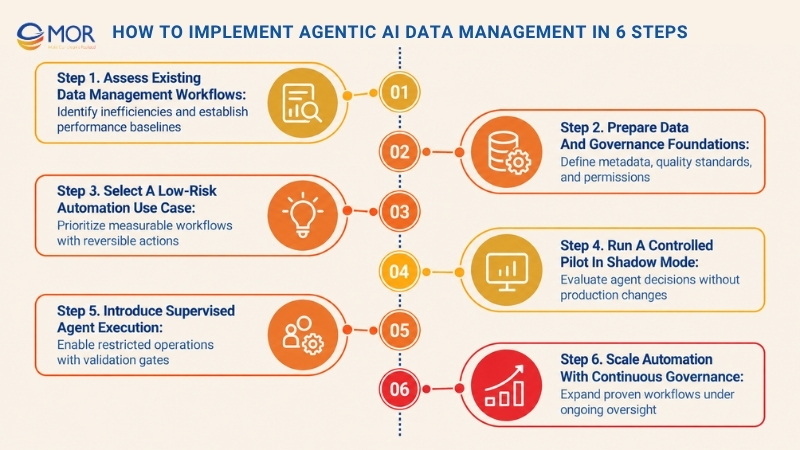
Step 1. Assess Existing Data Management Workflows
Start by reviewing your current databases, data integration processes, quality checks, and governance operations. Identify tasks that repeatedly consume engineering time or delay business reporting.
Map where errors occur and how employees resolve them today. A reliable baseline helps distinguish actual improvements from activity generated by an AI system.
- Inventory data assets: Record key systems, pipelines, owners, and dependencies.
- Identify repetitive tasks: Review recurring validation, mapping, and incident investigation work.
- Measure baseline performance: Capture defect rates, resolution time, manual effort, and operating costs.
Step 2. Prepare Data and Governance Foundations
Agents need clear descriptions of enterprise information and the rules governing its use. Inconsistent definitions, incomplete lineage, and unclear ownership create risks that model reasoning can't reliably resolve.
Prepare approved data contracts and define which operations are allowed for each task category.
- Improve metadata coverage: Document important fields, datasets, relationships, and business definitions.
- Establish quality standards: Define validation rules, accepted values, and failure thresholds.
- Assign permissions: Specify agent identities, restricted operations, data ownership, and approval responsibilities.
Step 3. Select a Low-Risk Automation Use Case
Choose a workflow where the business can measure results and reverse incorrect actions. Metadata enrichment, document classification, and product attribute standardization provide practical starting points.
A complex financial reconciliation process usually requires more controls than a product catalog cleanup task.
- Assess business value: Estimate current labor costs, error frequency, and expected savings.
- Evaluate risk: Review data sensitivity, reversibility, and dependencies.
- Define pilot boundaries: Limit the participating systems, records, action types, and permissions.
Teams planning custom development should also review how to hire agentic AI developers, especially when data engineering, API integration, and AI execution need to work together.
Step 4. Run a Controlled Pilot in Shadow Mode
Shadow mode lets agents inspect live conditions and propose actions without writing changes to production records. Reviewers compare the recommendations against approved reference outputs.
Include normal operations, ambiguous cases, and deliberately incorrect inputs in the test set. This exposes failure patterns before the agents receive execution authority.
- Create evaluation cases: Define expected results, valid data sources, and prohibited actions.
- Test agent decisions: Measure task accuracy, false approvals, false blocks, and policy compliance.
- Record operating costs: Track inference charges, execution time, review hours, and retry frequency.
- Set acceptance thresholds: Agree on performance requirements before supervised deployment.
Step 5. Introduce Supervised Agent Execution
Once a pilot meets its acceptance criteria, grant limited write access to approved operations. Keep uncertain record merges, sensitive changes, and high-risk transformations behind human approval gates.
Every executed action needs a traceable record and a tested recovery method.
- Control execution rights: Restrict agents to approved operations and environments.
- Apply validation gates: Check proposed actions before execution and verify completed results.
- Prepare rollback procedures: Maintain versioned changes and recovery instructions.
- Review incidents: Investigate rejected actions, failed repairs, and unexpected outcomes.
Step 6. Scale Automation with Continuous Governance
Expand successful workflows to other data domains using the same testing and approval standards. Review whether new datasets introduce different definitions, access rules, or failure conditions.
Monitoring should continue after deployment because source systems and business requirements change.
- Extend proven workflows: Add new domains only after completing their own risk assessment.
- Reuse control services: Maintain shared logging, policy enforcement, and validation components.
- Review agent performance: Track changes in accuracy, escalation volume, cost, and recovery time.
- Update approved behavior: Test new prompts, models, tools, and rules before releasing them.
A staged rollout creates a clearer basis for deciding where greater autonomy is justified.
How to Evaluate Agentic Data Management Platforms
Choosing agentic AI data management technology requires evaluating the full operating environment. A single platform may handle governance or MDM well but still need other services for agent orchestration, data integration, and execution.
Evaluation criterion | Capabilities to assess | Questions to ask vendors |
AI agent orchestration | Planning, routing, tool calling, and task tracking | Can agents complete governed multi-step workflows? |
Enterprise data integration | APIs, ETL/ELT, database and cloud connections | Will it work with our existing applications? |
Metadata and semantic support | Catalogs, lineage, business definitions | Can agents access approved business meanings? |
Data quality automation | Profiling, anomaly detection, validation | Can it detect and verify proposed corrections? |
Governance and permissions | Identity, policy enforcement, restricted tools | How are unauthorized actions blocked? |
Auditability and rollback | Execution logs, versioning, recovery | Can we reconstruct and reverse an agent action? |
Scalability and performance | Workload handling, latency, monitoring | What happens as usage and data volume grow? |
Integration and pricing | Deployment models, licenses, consumption fees | What is the total cost of a production workflow? |
Different products cover different responsibilities. Databricks Unity Catalog supports data discovery, lineage, access policies, and governance, while Profisee focuses on MDM and Alation AIOS connects governed business information with AI applications.
According to a June 2026 Databricks announcement, more than 14,000 organizations use Unity Catalog to govern their data and AI. This is a vendor-reported adoption figure, not a measure of agentic data management performance.
Informatica's Intelligent Data Management Cloud also connects data quality, cataloging, integration, and governance capabilities. These products serve different needs and shouldn't be treated as identical agent platforms.
For organizations comparing platforms for managing ai agent data access, delegated identity and tool authorization deserve close attention. The same applies to platforms for managing data access multiple AI agents, where permissions must remain valid across shared tools and coordinated actions.
A procurement brief titled enterprise platforms AI agents data management UK should additionally examine data residency, local privacy obligations, hosting locations, and support arrangements.
Consult suitable enterprise ai infrastructure providers when evaluating deployment requirements. Request a proof of concept based on your own datasets, workflows, and security rules before committing to a platform.
How MOR Software Approaches Innovation in Agentic Data Management
MOR Software supports enterprise AI initiatives through data engineering, custom model development, generative AI integration, and software development services. Our approach focuses on identifying practical AI opportunities, preparing reliable data, and connecting new capabilities to existing business systems.
These services provide building blocks for organizations exploring agentic AI data management and related automation projects.
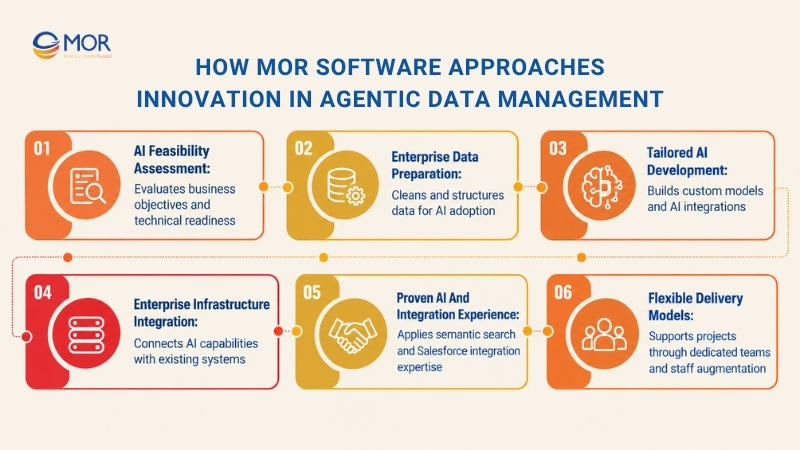
- Identify opportunities for AI-driven data management: Our AI Feasibility Assessment service reviews business goals, data availability, technical dependencies, and potential applications. We use the findings to help define a suitable project scope and development direction before implementation.
- Prepare enterprise data for AI adoption: MOR's Data Engineering services cover data acquisition, cleaning, and annotation. This work addresses fragmented information, inconsistent records, and data preparation needs that can limit the reliability of enterprise AI applications.
- Develop tailored AI capabilities: Our Custom Model Service and Generative AI Integration services support projects involving AI-powered information retrieval, business data analysis, and workflow automation. Our documented AI technology stack includes TensorFlow, PyTorch, FastAPI, and related development tools. Businesses considering a tailored agentic ai development solution can assess which components fit their goals.
- Integrate AI with enterprise infrastructure: We build software and integration components that connect new applications with existing data sources and business platforms. Databricks, Docker, and Kubernetes are among the technologies documented in our AI services portfolio for relevant data and deployment needs.
- Apply experience from relevant AI and integration projects: MOR Software's AI-Powered Semantic Search Transformation project used NLP, text embeddings, and Elasticsearch to improve enterprise search for a Japanese client. Our Salesforce legacy system integration project involved 18 team members over 15 months, using API Gateway and ETL workflows to support real-time data synchronization. These projects demonstrate our experience in AI-powered information retrieval and enterprise data integration, providing relevant technical foundations for agentic data management initiatives.
- Support innovation through flexible delivery models: Our development approach covers audit, strategy, development, and integration. Staff augmentation, fixed-price projects, and dedicated teams support different engagement needs. The services fit enterprises in manufacturing, retail, fintech, and other sectors seeking AI development or enterprise data integration support.
Organizations planning agentic data operations should start with a defined business problem and a realistic assessment of their existing systems. Contact MOR Software JSC to discuss your requirements and examine how an AI feasibility assessment can shape a suitable pilot project.
Conclusion
Agentic AI data management gives enterprises a practical way to automate data operations while keeping security, quality, and governance under control. Successful adoption requires trusted information, clear permissions, independent validation, and a measured rollout. MOR Software supports the underlying AI development, data engineering, and integration work needed for these initiatives. If your business is evaluating its readiness or planning an AI pilot, contact us to review your technical needs and discuss a suitable development approach.
"Evolution is not a destination, it is a disciplined journey of innovation."
Phung Van Tu


CEO MOR AI
MOR SOFTWARE
Frequently Asked Questions (FAQs)
What is agentic AI in data management?
Agentic AI in data management uses autonomous agents to perform data discovery, cleansing, monitoring, integration, and governance tasks. These agents interpret objectives and choose approved actions based on business rules. Human teams retain control over policies, sensitive operations, and high-risk decisions.
How is agentic data management different from generative AI?
Generative AI primarily creates content, code, or responses from prompts. Agentic data management uses AI models alongside planning, tools, and validation services to execute workflows. Agents can monitor changes and act on approved tasks without a person initiating each individual step.
What is the difference between agentic data management and MDM?
Master data management creates and maintains authoritative business records, including customer and supplier golden records. Agentic data management adds goal-driven automation across data operations. Agents can apply MDM rules to detect duplicates, suggest corrections, and coordinate approved updates.
How does agentic AI improve data quality?
Agents continuously monitor data for missing values, duplicates, inconsistencies, and unusual changes. They investigate probable causes and prepare corrective actions. Automated validation checks the results, while data stewards review uncertain or sensitive changes before they affect downstream systems.
Can agentic AI automatically repair broken data pipelines?
Yes, agents can repair selected pipeline problems when changes fall within approved permissions and pass validation. They can detect schema changes, propose transformation updates, and test corrections. Complex or high-risk repairs should require engineering approval before production deployment.
Does agentic data management require a semantic layer?
A semantic layer isn't technically mandatory for every task, but it becomes valuable when agents interpret enterprise metrics and business definitions. It supplies approved meanings, relationships, and calculation rules, lowering the risk of agents producing technically valid but incorrect results.
How do companies secure sensitive data accessed by AI agents?
Companies use restricted agent identities, least-privilege access, policy engines, encryption, and execution logging. Sensitive operations should pass independent authorization checks. Human approval, data masking, and audit trails provide additional controls for regulated information and production changes.
Will agentic AI replace data engineers and data stewards?
Agentic AI can automate parts of routine monitoring, documentation, cleansing, and incident investigation. Engineers remain responsible for architecture, reliable integrations, and production systems. Data stewards continue defining business rules, resolving uncertain cases, and supervising governed data operations.
What KPIs should enterprises track during an agentic AI pilot?
Track task accuracy, data quality scores, incident detection time, resolution time, pipeline success rates, and manual review hours. Include policy violations, false approvals, retry frequency, and cost per successful task. Compare results against the existing process before expanding agent permissions.
How much does agentic AI data management cost to implement?
Costs depend on system complexity, data preparation, integrations, model usage, governance requirements, and deployment scope. A small pilot requires a different investment than enterprise-wide automation. Estimate development, infrastructure, inference, testing, human oversight, and ongoing maintenance before calculating expected ROI.
Share


Make Our-Dreams Realized


© 2023 . MOR Software. All Rights Reserved
Sitemap
Privacy Policy
Terms of Use

Rate this article
0
over 5.0 based on 0 reviews
Your rating on this news:
Name
*Email
*Write your comment
*Send your comment
1