


10 Leading AI Compliance Solutions for Model Orchestration in 2026
Managing AI models across different providers creates new risks around data access, security policies, and regulatory compliance. Businesses need clear oversight as AI agents gain access to more systems and sensitive information. The leading AI compliance solutions for model orchestration help organizations control model usage, track activities, and document compliance. In this guide, MOR Software will compare 10 platforms, examining their governance capabilities, security controls, pricing, and suitability for enterprise AI operations.
Key Takeaways
- AI compliance for model orchestration covers model access, runtime policy enforcement, risk assessment, audit logging, and regulatory oversight. Organizations often need separate tools for AI traffic control and enterprise governance.
- The 10 solutions are TrueFoundry, Portkey, IBM watsonx.governance, Credo AI, OneTrust AI Governance, Holistic AI, Microsoft Purview, Kong AI Gateway, LiteLLM, and ModelOp. Each addresses different compliance and orchestration requirements.
- Platform selection should begin with your existing AI infrastructure, regulatory exposure, and operational needs. Test policy enforcement, integration coverage, and audit evidence before committing to enterprise deployment.
What Is AI Compliance in Model Orchestration?
AI model orchestration coordinates different AI models, agents, data sources, and software systems through connected workflows. An AI orchestration platform manages how requests move between these components, which models handle specific tasks, and when external tools are called.
So, what does orchestration mean when AI systems operate across an enterprise? It means coordinating the execution of related AI tasks through defined rules and technical connections. An AI orchestrator manages these interactions, including task routing, information sharing, and execution order.
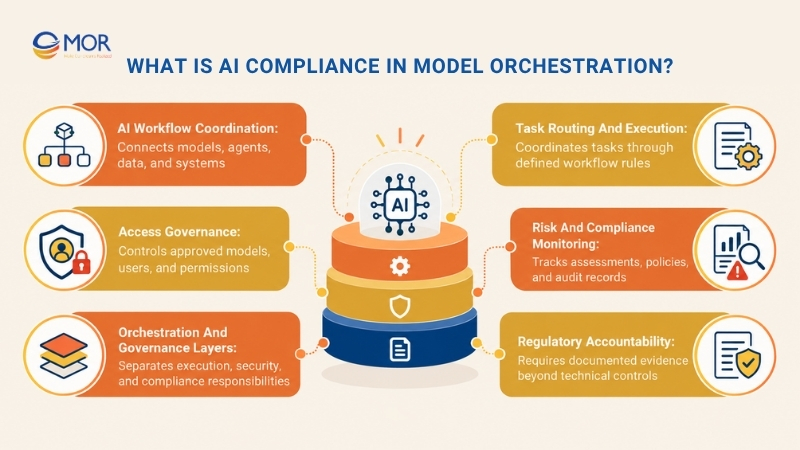
Compliance adds another layer of responsibility. Organizations need to know which models are approved, who can access them, what information they process, and how decisions are recorded. The leading AI compliance solutions for model orchestration address these requirements through access controls, risk assessments, monitoring, and audit documentation.
Enterprise adoption has increased the need for this oversight. McKinsey's 2025 State of AI survey found that 88% of respondents reported regular AI use in at least one business function. Yet many organizations were still testing AI or running limited deployments rather than operating at enterprise scale.
Three technical categories serve different purposes. Orchestration engines coordinate tasks, AI gateways manage traffic and enforce runtime rules, and governance platforms document risks, approvals, and compliance evidence.
A gateway can block an unauthorized request, for example, but that action alone doesn't prove compliance with the EU AI Act or GDPR. Organizations must establish the relevant obligations and demonstrate how their controls meet them.
How AI Orchestration Works
AI orchestration works through a connected process that receives requests, selects models, retrieves data, executes tasks, and checks the results. Organizations apply security policies throughout this process to control how models and agents interact with enterprise systems.
For businesses implementing agentic AI orchestration, each stage needs defined permissions and a clear execution record.
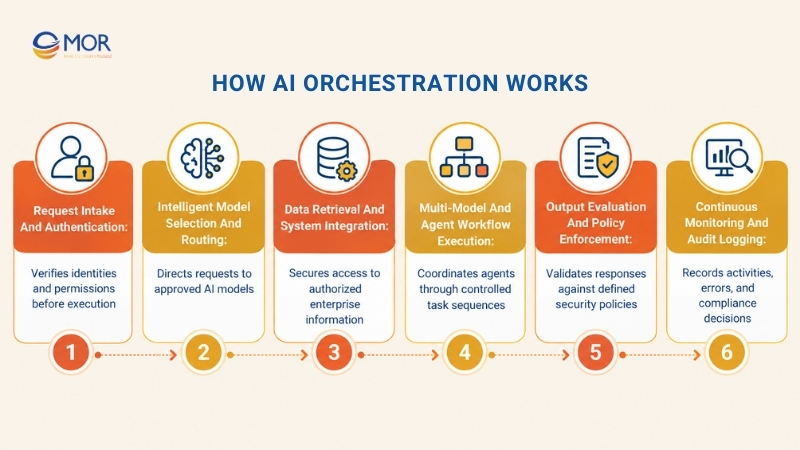
- Request intake and authentication: An application, user, or AI agent sends a request through an API or gateway. The system verifies identity, checks permissions, and validates the request before allowing execution. Unauthorized requests can be rejected at this stage.
- Intelligent model selection and routing: The orchestration layer selects a model according to task requirements, availability, response time, and cost. Routing policies can restrict requests to approved models or providers. If a provider becomes unavailable, configured fallback rules may redirect traffic to another permitted service.
- Data retrieval and system integration: The selected model receives relevant information through databases, enterprise applications, APIs, or retrieval systems. Data access rules determine which records each request may retrieve. Encryption, authentication, and sensitive-data filtering add protection around these exchanges.
- Multi-model and agent workflow execution: The system coordinates tasks between models, agents, and external tools. In multi-agent orchestration, different agents may retrieve information, analyze results, and request actions through an agent orchestration framework. Execution limits and human approval checkpoints prevent certain actions from proceeding without authorization.
- Output evaluation and policy enforcement: Generated responses pass through validation checks before reaching users or triggering further actions. Depending on the platform, these checks may inspect sensitive information, harmful content, or application-specific rules. Failed checks can trigger blocking, redaction, or human review.
- Continuous monitoring and audit logging: The platform records model requests, tool calls, execution results, errors, and relevant policy decisions. Technical teams use this information to investigate failures and review operational behavior. Compliance teams can connect these records to risk assessments and approved governance controls.
Microsoft's 2025 Work Trend Index found that 46% of surveyed leaders said their organizations were using agents to fully automate workstreams or business processes. This level of automation calls for clear limits on what agents may access and execute.
Companies planning business workflow automation AI should establish those limits before expanding AI access across departments.
Runtime controls operate within the workflow, where gateways can inspect requests and restrict actions. Governance platforms support the broader process through policy mapping, risk reviews, approval records, and compliance reporting.
10 Leading AI Compliance Solutions for Model Orchestration
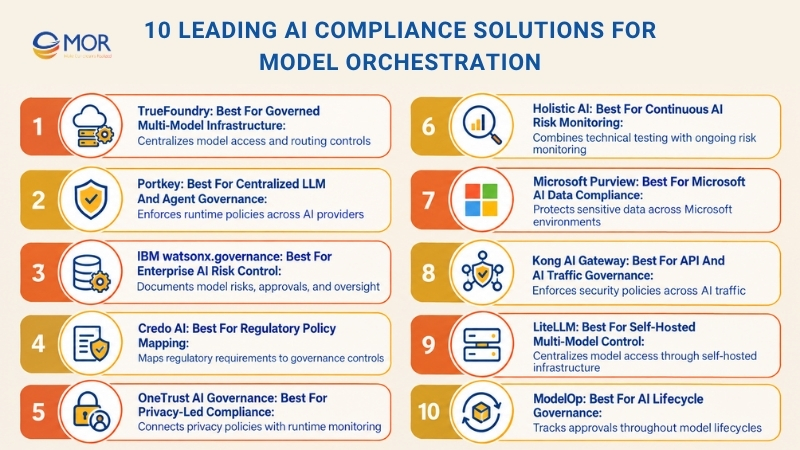
Our review of leading AI compliance solutions for model orchestration 2026 covers AI gateways, governance platforms, and model lifecycle management software. The comparison focuses on each platform's main compliance capabilities, practical use cases, and limitations.
Solution | Primary category | Main compliance strength | Best for | Key limitation |
TrueFoundry | AI gateway | Centralized model and tool access controls | Multi-model infrastructure | Regulatory evidence may require integration |
Portkey (Prisma AIRS) | AI and agent gateway | Runtime policies and guardrails | Multi-provider AI applications | Licensing and regional availability |
IBM watsonx.governance | AI governance | Lifecycle risk oversight | Regulated enterprises | Implementation and licensing complexity |
Credo AI | AI governance | Regulatory policy mapping | Enterprise compliance programs | Some enforcement integrations are planned |
OneTrust AI Governance | AI governance | Risk, privacy, and runtime controls | Privacy-led enterprises | Integration coverage varies |
Holistic AI | AI governance and assurance | Continuous assessment and enforcement | High-risk AI deployments | Supported integrations require validation |
Microsoft Purview | Data governance and security | Sensitive-data protection | Microsoft environments | Not a general-purpose model router |
Kong AI Gateway | AI gateway | AI traffic policy enforcement | API-centric enterprises | Deployment and licensing dependencies |
LiteLLM | LLM gateway | Self-hosted model access controls | Engineering-led teams | Requires operational ownership |
ModelOp | AI lifecycle governance | Model inventory and approval workflows | Enterprise AI lifecycle management | General model routing may require another tool |
The table reflects each product's documented positioning, not an independent performance ranking. Actual control coverage depends on subscription plans, deployment methods, and integrations.
1. TrueFoundry: Best for Governed Multi-Model Infrastructure
Platform overview
TrueFoundry provides enterprise AI infrastructure for connecting applications to language models, agents, and tools. Its AI Gateway creates a central access point where engineering teams manage routing, authentication, usage, and security policies.
Organizations running different models across cloud environments can manage common controls through this gateway instead of maintaining separate configurations in every application.
Why it stands out
TrueFoundry focuses on governance at the infrastructure layer. It helps organizations apply technical restrictions to model traffic and monitor AI operations through a shared management environment.
Its architecture is useful for enterprises that need consistent access rules across production AI applications.
Key capabilities
- Central model connectivity: Route requests to supported AI providers through a common interface. Configure fallback behavior, traffic distribution, and model access rules.
- Access management: Apply role-based access control (RBAC), authentication, and user permissions to restrict model and tool usage.
- Runtime safety controls: Configure guardrails and supported integrations for content checks, sensitive-data protection, and AI request validation.
- Operational visibility: Track model activity, request volumes, costs, and system behavior through monitoring and reporting capabilities.
Advantages
TrueFoundry provides engineering teams with a shared place to manage model access and traffic policies. Common gateway controls also help avoid different security configurations across applications that use the same AI providers.
Its enterprise deployment options support organizations that need greater control over infrastructure and data handling.
Limitations
TrueFoundry focuses on infrastructure governance, so businesses may need separate software for regulatory assessments, formal policy approvals, and compliance documentation. Certain deployment and security capabilities are reserved for higher subscription tiers.
Organizations should also confirm the available integrations before replacing existing model gateways.
Pricing
TrueFoundry provides a free Developer plan for small teams. Its published Pro pricing starts at $25 per user per month, with additional usage charges beyond included requests.
Enterprise plans use custom pricing, and external model-provider charges are separate.
Ideal customers
TrueFoundry suits enterprises managing numerous AI providers, internal AI applications, and production agent workflows. It is most relevant when consistent model access controls and infrastructure-level monitoring are the main requirements.
2. Portkey: Best for Centralized LLM and Agent Governance
Platform overview
Portkey is an AI gateway technology that centralizes LLM traffic, model routing, observability, and runtime controls. Palo Alto Networks completed its acquisition of Portkey in May 2026, incorporating the technology into its Prisma AIRS AI security portfolio.
The platform targets enterprises managing AI requests across different providers, applications, and agents.
Why it stands out
Portkey connects gateway operations with security policy enforcement. Organizations can manage model credentials, traffic rules, guardrails, and usage restrictions without rebuilding the same controls in every application.
Its broader Prisma AIRS integration also makes AI traffic governance relevant to enterprise cybersecurity teams.
Key capabilities
- Multi-provider request routing: Manage model connections, retry policies, fallback routes, and workload distribution across supported providers.
- Inline security checks: Inspect prompts and responses for threats, sensitive information, and policy violations through configured guardrails.
- Access and consumption rules: Control permitted models, credentials, request limits, and application-specific usage policies.
- Runtime activity records: Track AI requests, policy actions, model usage, and operational events for investigations and reviews.
Advantages
Portkey provides a centralized approach to traffic control for organizations operating different LLM applications. Its security capabilities help technical teams apply consistent restrictions across supported model providers.
Connection to Palo Alto Networks' security products is another consideration for enterprises already using that ecosystem.
Limitations
Portkey's gateway controls do not cover every activity required for regulatory compliance. Formal risk assessments, governance approvals, and regulatory reporting may still depend on separate systems.
Product availability, licensing, deployment methods, and supported controls should be checked under the current Prisma AIRS portfolio.
Pricing
Prisma AIRS AI Gateway uses consumption-based licensing linked to Software NGFW credits. Buyers should request a quote based on expected traffic, supported agent protocols, deployment requirements, and security controls.
Ideal customers
Portkey fits enterprises managing several LLM providers or autonomous agent applications. It is particularly suitable when centralized traffic inspection and runtime security enforcement are stronger priorities than model lifecycle documentation.
3. IBM watsonx.governance: Best for Enterprise AI Risk Control
Platform overview
IBM watsonx.governance is designed to manage AI risk, compliance processes, and model oversight across enterprise applications. It supports governance activities for traditional machine learning, generative AI, and related AI systems.
The platform tracks ownership, lifecycle information, risk assessments, and ongoing monitoring records across an organization's AI portfolio.
Why it stands out
IBM watsonx.governance connects formal governance procedures with model-level monitoring and evaluation. It helps enterprises document which systems have been reviewed, who approved their use, and what risks remain after deployment.
This approach suits organizations that must provide structured evidence to internal risk teams, auditors, or regulators.
Key capabilities
- AI asset registration: Maintain inventories of models, use cases, owners, deployment details, and lifecycle status.
- Risk assessment management: Apply enterprise policies and regulatory requirements through defined review and assessment workflows.
- Model oversight: Monitor supported systems for performance changes, quality concerns, and selected responsible AI risks.
- Compliance documentation: Maintain assessment results, model records, approval histories, and supporting governance evidence.
Advantages
IBM watsonx.governance supports structured oversight across large AI portfolios. Its documentation and review capabilities help organizations apply consistent assessment procedures rather than relying on separate spreadsheets or team-specific records.
Existing IBM customers may also benefit from integration with related IBM AI products.
Limitations
Enterprise adoption requires clear governance policies and collaboration between compliance, engineering, data science, and security teams. Smaller organizations may find the platform's management requirements excessive for a limited AI portfolio.
IBM watsonx.governance should also be distinguished from IBM watsonx Orchestrate, which focuses on AI agents and business workflow execution.
Pricing
IBM publishes Risk & Compliance Basic pricing starting at $3,500 per month. Its Advanced plan starts at $6,450 per month, with additional charges possible for modules, users, instances, and other requirements.
The published prices are indicative and vary by location and product availability.
Ideal customers
IBM watsonx.governance fits large businesses establishing formal AI governance across departments. Financial services, healthcare, and other regulated industries are suitable candidates when AI risk assessment and ongoing oversight are purchasing priorities.
4. Credo AI: Best for Regulatory Policy Mapping
Platform overview
Credo AI provides enterprise software for managing AI inventories, policies, risk assessments, and governance evidence. It helps organizations coordinate compliance work across models, agents, business applications, and external AI vendors.
The platform connects AI systems to governance requirements through structured assessment and approval processes.
Why it stands out
Credo AI concentrates on regulatory policy management and responsible AI oversight. Enterprises can connect AI use cases to applicable control requirements and maintain records of how those controls are reviewed.
Among the leading AI compliance solutions for model orchestration, Credo AI is relevant to companies that need formal compliance management across several technology environments.
Key capabilities
- AI asset inventory: Register AI applications, agents, models, vendors, responsible owners, and business use cases.
- Regulatory control mapping: Associate governance policies with the EU AI Act, NIST AI Risk Management Framework, ISO/IEC 42001, and internal standards.
- Approval and review processes: Assign responsibilities, collect supporting records, manage assessments, and document decisions.
- Risk reporting: Monitor governance status, policy coverage, unresolved findings, and outstanding review activities.
Advantages
Credo AI gives compliance specialists a shared system for recording AI risks and tracking governance decisions. Its policy-focused approach helps align legal, security, business, and engineering teams around consistent requirements.
Organizations managing different AI technologies can assess those systems through a common governance process.
Limitations
Credo AI needs accurate asset information and well-defined internal policies to work effectively. Some direct enforcement integrations, including selected CI/CD and gateway connections, have appeared in vendor roadmap materials rather than confirmed production coverage.
Buyers should verify which controls are currently available in their planned environment.
Pricing
Credo AI uses enterprise-oriented pricing. Organizations should request quotes covering governed AI systems, policy packages, integrations, implementation support, and required user access.
Ideal customers
Credo AI suits mid-sized and large enterprises preparing formal AI compliance programs. It is particularly relevant when regulatory mapping, accountability, and consistent approval workflows are the main requirements.
5. OneTrust AI Governance: Best for Privacy-Led Compliance
Platform overview
OneTrust AI Governance helps enterprises identify AI systems, assess risks, manage policies, and govern supported runtime activity. The platform connects AI oversight with privacy management, third-party risk, and corporate compliance procedures.
Organizations can use it to document the ownership and approved purpose of models, agents, datasets, and AI applications.
Why it stands out
OneTrust combines governance processes with technical runtime controls. Its platform can connect written policies to approved actions, sensitive-data restrictions, and monitored AI behavior across supported environments.
This gives privacy and security teams a way to examine whether defined policies are operating as intended.
Key capabilities
- AI discovery and ownership: Create inventories of models, agents, datasets, vendors, and use cases, then assign responsible teams and risk levels.
- Privacy policy controls: Detect or restrict sensitive information through supported classifications, guardrails, and enforcement mechanisms.
- Runtime monitoring: Collect AI activity signals, identify policy violations, and track approved or blocked actions where integrations permit.
- Evidence collection: Connect assessments, approvals, policy changes, and enforcement records to enterprise governance reports.
Advantages
OneTrust fits organizations with established privacy and compliance functions. Its platform helps connect policy owners with the teams responsible for AI operations.
Runtime monitoring also gives governance teams information beyond initial approval documents.
Limitations
Implementation requires careful configuration of enterprise policies, approval procedures, and risk classifications. Runtime coverage depends on supported cloud services, SDKs, and other technical integrations.
Enterprises should test the controls that matter to their own AI applications rather than relying on a general product description.
Pricing
OneTrust AI Governance uses custom enterprise pricing. Quotes should separate the main platform subscription, runtime controls, implementation services, support, and connected compliance modules.
Ideal customers
OneTrust AI Governance suits privacy-led enterprises and organizations handling confidential business or customer information. It is particularly relevant when AI policies need to connect with existing privacy and regulatory compliance operations.
6. Holistic AI: Best for Continuous AI Risk Monitoring
Platform overview
Holistic AI provides AI governance and assurance software for discovering, assessing, testing, and monitoring enterprise AI systems. Its coverage includes internal models, external AI applications, and supported agent workflows.
The platform helps organizations examine risks across their AI inventory and maintain records as those systems change.
Why it stands out
Holistic AI combines organizational governance with technical testing and monitoring. This allows enterprises to assess risks before deployment and continue reviewing AI behavior during operation.
It is useful for businesses whose AI systems handle sensitive information or perform tasks that need ongoing oversight.
Key capabilities
- AI system discovery: Identify models, applications, agents, and third-party AI usage across supported environments.
- Technical risk testing: Evaluate AI behavior for fairness, privacy, security, reliability, and other defined risk areas.
- Active policy intervention: Apply supported controls and Guardian Agent mechanisms to flag, block, or escalate certain agent actions.
- Compliance tracking: Maintain risk assessments, monitoring results, control records, and governance documentation.
Advantages
Holistic AI connects compliance work with information about actual AI behavior. Its testing and monitoring capabilities can identify issues that static approval records may miss.
Centralized discovery also helps organizations identify AI usage outside their formal governance processes.
Limitations
The depth of monitoring and intervention depends on the supported models, agents, and integrations. Organizations still need staff who can interpret evaluation results, set acceptable risk thresholds, and approve corrective actions.
Smaller deployments may not require the full range of enterprise governance capabilities.
Pricing
Holistic AI generally uses custom enterprise pricing. Buyers should request estimates based on AI asset volume, assessment needs, runtime integrations, reporting, and support.
Ideal customers
Holistic AI is suitable for organizations operating high-risk AI systems or large AI portfolios. Enterprises that require continuous testing and governance evidence should evaluate its integration coverage closely.
7. Microsoft Purview: Best for Microsoft AI Data Compliance
Platform overview
Microsoft Purview provides data governance, information protection, and compliance management across Microsoft environments. Its AI-related capabilities help organizations examine sensitive-data risks linked to Microsoft Copilot, supported agents, and connected applications.
Purview is mainly a data security and compliance platform rather than a general LLM routing service.
Why it stands out
Microsoft Purview connects AI-related information protection with security policies already used across Microsoft 365 and Azure. Organizations can extend existing controls to supported AI interactions without creating an entirely separate data protection process.
Key capabilities
- AI activity visibility: Identify supported AI applications, user activity, and potential sensitive-data exposure.
- Information protection: Apply data loss prevention (DLP), sensitivity labels, and access policies to protected enterprise information.
- Audit and investigation support: Review available activity records and investigate data-related incidents through supported Microsoft compliance capabilities.
- Policy administration: Manage relevant AI data controls alongside Microsoft identity, information security, and compliance settings.
Advantages
Microsoft Purview is a practical option for businesses already invested in Microsoft's security ecosystem. Existing data classification rules and information protection policies can support AI-related controls across compatible services.
Its investigation capabilities also help organizations examine how sensitive information is accessed and used.
Limitations
Purview does not provide a complete replacement for model orchestration engines or dedicated AI lifecycle governance platforms. Its coverage differs across Microsoft services, third-party AI tools, and license types.
Organizations with diverse AI providers should assess gaps in model evaluation and cross-platform governance.
Pricing
Microsoft Purview pricing depends on Microsoft 365 licensing, selected compliance capabilities, additional security plans, and usage-based services. Buyers should review their current agreements before purchasing new modules.
Ideal customers
Microsoft Purview fits enterprises that use Microsoft 365, Azure, and Copilot extensively. It is particularly relevant when data leakage prevention, employee AI usage visibility, and compliance investigations are the main concerns.
8. Kong AI Gateway: Best for API and AI Traffic Governance
Platform overview
Kong AI Gateway extends API management capabilities to AI models, agents, and connected tools. It provides a gateway layer for handling authentication, traffic routing, security policies, and monitoring across supported AI requests.
Organizations already using API gateways can apply similar management practices to new AI services.
Why it stands out
Kong connects model traffic governance with enterprise API infrastructure. Engineering teams can configure common access and request policies rather than maintaining separate controls inside every application.
Its support for AI-related protocols also matters as organizations expand agent-to-agent and MCP-based integrations.
Key capabilities
- Model traffic routing: Manage model connections, request distribution, rate limits, and supported fallback configurations.
- AI security policies: Apply compatible prompt guards, content safety checks, and sensitive-data controls.
- Agent connectivity: Control supported LLM, Model Context Protocol (MCP), and agent-to-agent interactions through gateway policies.
- Traffic reporting: Track requests, token usage, errors, and operational activity to support monitoring and investigation.
Advantages
Kong fits enterprises that already understand API gateway operations and want to extend existing practices to AI systems. Its centralized approach supports consistent traffic controls and operational reporting.
Engineering teams can also connect gateway records to supported monitoring systems.
Limitations
Capabilities and pricing vary across Kong's cloud and self-hosted products. Some controls apply to specific AI traffic types, so support for LLM requests doesn't automatically mean identical protection for MCP tool calls.
Formal governance assessments and regulatory reporting may still require separate applications.
Pricing
Kong's published AI Management pricing starts at $25 per month plus usage for the Plus tier. Listed charges include $100 per proxied model per month under specified conditions, while Enterprise and fully self-hosted options require custom quotations.
Ideal customers
Kong AI Gateway suits businesses operating established API infrastructure, distributed applications, and several AI services. It is a practical choice when traffic security and consistent access management lead the platform requirements.
9. LiteLLM: Best for Self-Hosted Multi-Model Control
Platform overview
LiteLLM is an open-source LLM gateway that connects applications to different model providers through a common API interface. Teams can manage routing, credentials, usage, and gateway-level access policies in a self-hosted environment.
Its design appeals to organizations that prefer direct control over deployment and technical configuration.
Why it stands out
LiteLLM gives engineering teams flexibility in how they operate AI gateway infrastructure. It supports centralized model connectivity without requiring every application to implement provider-specific APIs independently.
Organizations can also manage usage and access rules through a shared proxy.
Key capabilities
- Unified API access: Connect supported language models through a standard interface and configure routing, retries, or provider fallbacks.
- Credential management: Create virtual API keys and apply supported user, team, and model access restrictions.
- Usage controls: Track consumption, assign budgets, and configure request limits across applications or teams.
- Logging integrations: Send gateway activity to supported monitoring services, with expanded administrative capabilities available through Enterprise licensing.
Advantages
LiteLLM gives developers flexibility over the gateway's deployment, configuration, and integrations. Its open-source model supports customization, and the shared API makes it easier to work across different providers.
For engineering teams that already manage cloud infrastructure, this approach can fit existing operating practices.
Limitations
Self-hosting creates responsibilities for availability, upgrades, security configuration, and monitoring. Some enterprise security controls require paid licensing, and budget management needs suitable supporting infrastructure.
LiteLLM also lacks the full governance processes found in dedicated regulatory compliance platforms.
Pricing
LiteLLM's open-source proxy has no software license fee, though hosting and maintenance costs remain. Enterprise licensing is quote-based and covers additional identity, administrative, and support capabilities.
Ideal customers
LiteLLM suits AI engineering teams that need self-hosted model access and flexible integration. Businesses seeking a ready-made regulatory governance program may need another platform alongside it.
10. ModelOp: Best for AI Lifecycle Governance
Platform overview
ModelOp supports enterprise AI governance across model registration, review, deployment, monitoring, and retirement. It manages lifecycle records for traditional machine learning, generative AI, and supported agent systems.
The platform focuses on tracking ownership, governance decisions, and compliance work across a company's AI portfolio.
Why it stands out
ModelOp connects formal risk management processes to AI lifecycle activities. Organizations can maintain a record of model approvals, assessments, required controls, and later changes.
This supports enterprises that need consistent oversight across different AI technologies and business teams.
Key capabilities
- AI inventory management: Register models, applications, agents, owners, versions, and associated business use cases.
- Governance workflows: Coordinate risk reviews, required approvals, control checks, and documented exceptions.
- Lifecycle documentation: Maintain model cards, assessment results, validation records, and other governance evidence.
- Ongoing oversight: Connect governance requirements with deployment status, monitoring information, and review activities.
Advantages
ModelOp helps enterprises manage AI governance through repeatable lifecycle procedures. Its centralized records provide a clearer way to track responsibility for model reviews and decisions.
The platform is suitable for organizations managing different AI technologies under a common governance program.
Limitations
Implementation depends on clearly defined risk policies, business ownership, and connections to existing AI systems. ModelOp's governance capabilities do not remove the need for separate model routing infrastructure in every deployment.
Organizations should evaluate the specific agent and runtime integrations available to them.
Pricing
ModelOp uses enterprise sales pricing. Buyers should request estimates covering AI portfolio size, supported systems, lifecycle workflows, deployment needs, integration services, and ongoing support.
Ideal customers
ModelOp fits large enterprises that require structured lifecycle governance across numerous AI systems. It is particularly relevant when formal approvals, model records, and traceable compliance decisions are central requirements.
How We Evaluated AI Compliance and Orchestration Tools
The comparison examines six criteria that affect how organizations select and deploy enterprise AI governance products. We focus on documented capabilities, integration requirements, and practical buying considerations rather than claiming results from independent performance tests.
This approach also distinguishes a compliance software solution focused on governance records from a technical gateway responsible for live model traffic.
Evaluation criterion | What to examine | Why it matters |
Compliance capabilities | Risk workflows, policy mapping, regulatory support | Connects business obligations with AI systems |
Policy enforcement | Guardrails, approval gates, access restrictions | Shows where rules can be enforced |
Orchestration compatibility | Models, agents, APIs, MCP integrations | Identifies technical integration requirements |
Auditability | Logs, traces, records, evidence exports | Supports investigations and compliance reviews |
Deployment flexibility | SaaS, VPC, hybrid, self-hosted | Affects data control and operational ownership |
Commercial fit | Licenses, support, usage, implementation | Determines total cost and long-term suitability |
Organizations should examine these criteria together rather than select products based on the largest number of advertised capabilities. For example, an AI gateway with strong routing and access controls may still need another system for regulatory assessment and approval records.
The need for formal governance is growing. Stanford University's 2026 AI Index reports that AI-specific governance roles grew by 17% in 2025. Yet staffing alone doesn't resolve inconsistent policies or disconnected evidence.
We recommend testing one representative AI application against the vendor's documented controls. Check access restrictions, policy violations, evidence exports, and integration effort before expanding the evaluation.
Essential Compliance Features for AI Model Orchestration
The leading AI compliance solutions for model orchestration address different parts of enterprise AI risk. Buyers should identify the controls their systems need, then confirm which platform delivers them directly and which require external integrations.
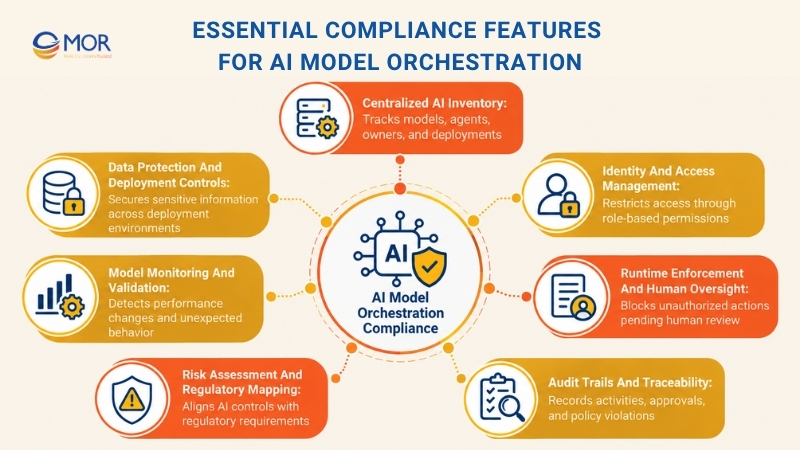
Eight capabilities deserve attention during evaluation:
- Centralized AI inventory: Maintain records of models, agents, providers, approved applications, owners, versions, and deployment environments. An inventory gives compliance teams a reliable starting point for assessments and reviews.
- Identity and access management: Restrict model usage through RBAC, single sign-on, and least-privilege permissions. Apply separate access rights to users, service accounts, and autonomous agents where supported.
- Runtime policy enforcement: Inspect model requests, outputs, and agent actions against defined security rules. Supported gateways and guardrails can reject requests, mask information, or escalate events.
- Audit trails and traceability: Record requests, tool executions, approvals, configuration changes, and policy violations. Logs should preserve enough information to support investigations without storing unnecessary sensitive data.
- Risk assessment and regulatory mapping: Connect AI systems with relevant obligations under the EU AI Act, GDPR, NIST AI RMF, and ISO/IEC 42001. Governance teams should document applicable requirements and control ownership.
- Model monitoring and validation: Track performance, output quality, drift, and unexpected behavior. Businesses using multimodal AI models may also require tests covering image, audio, or other supported inputs.
- Human oversight and approval workflows: Require qualified reviewers to approve high-risk deployments or sensitive agent actions. Escalation rules should identify who can authorize an exception.
- Data protection and deployment controls: Check encryption, retention policies, regional hosting, tenant isolation, and private deployment options. Confirm where logs and model inputs are stored.
Effective AI compliance monitoring connects these technical signals to business risk and governance records. A blocked request is useful operational evidence, but an audit may also require the applicable policy, responsible owner, investigation, and corrective action.
A marketing orchestration platform, for example, may coordinate campaigns through a cloud marketing automation system. That business automation function does not replace the controls required to govern AI model access and sensitive-data processing.
How to Choose the Right AI Compliance Solution
Choosing among the leading AI compliance solutions for model orchestration starts with the systems your company already operates. The right fit depends on your regulatory obligations, technical architecture, and the type of evidence your compliance team needs.
Business requirement | Suitable solutions | What to verify before selecting |
Centralize security across LLM providers | Portkey, TrueFoundry, Kong AI Gateway | Runtime controls and provider compatibility |
Manage regulatory AI risk | Credo AI, IBM watsonx.governance, OneTrust | Risk workflows, policies, evidence exports |
Monitor AI systems continuously | Holistic AI, IBM watsonx.governance | Model coverage and enforcement scope |
Govern Microsoft AI data usage | Microsoft Purview | Licensing, application visibility, DLP coverage |
Maintain self-hosted AI routing | LiteLLM, Kong AI Gateway | Infrastructure, access controls, logging |
Track models across their lifecycle | ModelOp, IBM watsonx.governance | Asset discovery, versioning, approvals |
A company running Microsoft Copilot across its workforce may prioritize Purview's data protection controls. A software company routing customer requests across several LLM providers may need TrueFoundry, Portkey, or Kong.
Regulated businesses often need governance capabilities beyond a request gateway. Risk classification, documented model approvals, and regulatory evidence may require dedicated platforms.
Agent autonomy adds another selection requirement. Gartner predicted in May 2026 that 40% of enterprises would demote or decommission autonomous AI agents by 2027 due to governance failures identified after production incidents. The forecast highlights why buyers should evaluate an agent's permitted actions and access scope before deployment.
For a shortlist, request a demonstration using your actual architecture. Ask vendors to show how their platform handles an unauthorized tool call, a sensitive-data request, and a model change that requires renewed approval.
Some organizations will need two connected products: an AI gateway for runtime enforcement and a governance platform for risk assessments and audit evidence. Their controls should form a consistent process with clear ownership.
How to Implement Compliance in AI Model Orchestration
Deploying AI compliance controls requires coordination between engineering, security, legal, and business teams. A workable process connects the policies governing AI usage to the technical systems that execute model and agent requests.
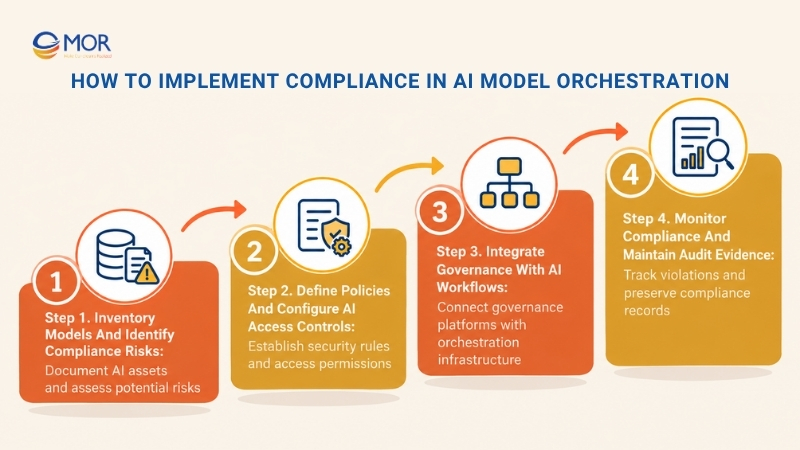
Step 1. Inventory Models and Identify Compliance Risks
Start by documenting the AI models, agents, gateways, APIs, tools, and datasets currently used across your organization. Record each system's owner, business purpose, deployment environment, provider, and permitted data access.
Assess risk according to the intended use, sensitive information involved, affected users, and possible consequences of errors. A document summarization tool and an agent authorized to update financial records require different levels of oversight and approval.
Step 2. Define Policies and Configure AI Access Controls
Set rules for model access, acceptable AI usage, data protection, human approval, and incident handling. Each policy needs a responsible owner and conditions that determine when a request or deployment should be restricted.
Translate these requirements into gateway policies, identity permissions, guardrails, and release checkpoints. The approach resembles Salesforce release management, where changes pass through defined testing and approval stages before production.
Step 3. Integrate Governance With AI Workflows
Connect your governance platform with model gateways, registries, orchestration engines, and monitoring services. Map the information exchanged between systems, including model identifiers, user permissions, policy decisions, and execution records.
Test these connections using a limited production-like workflow. Organizations working with external development teams can also assess enterprise DevOps consulting services to plan CI/CD processes, environment controls, and release procedures around the implementation.
Step 4. Monitor Compliance and Maintain Audit Evidence
Review deployed models for performance changes, unauthorized access, policy violations, and unexpected agent actions. Configure alerts that route incidents to the responsible engineering, security, or compliance team.
Regular AI regression testing can check whether application changes affect expected behavior or approved safeguards. Retain assessment records, relevant logs, remediation actions, and review decisions according to applicable policies.
Common Mistakes in AI Orchestration Compliance
Organizations often discover compliance gaps after AI workflows reach production. The most common problems arise when policy ownership, runtime security, and audit documentation remain disconnected.
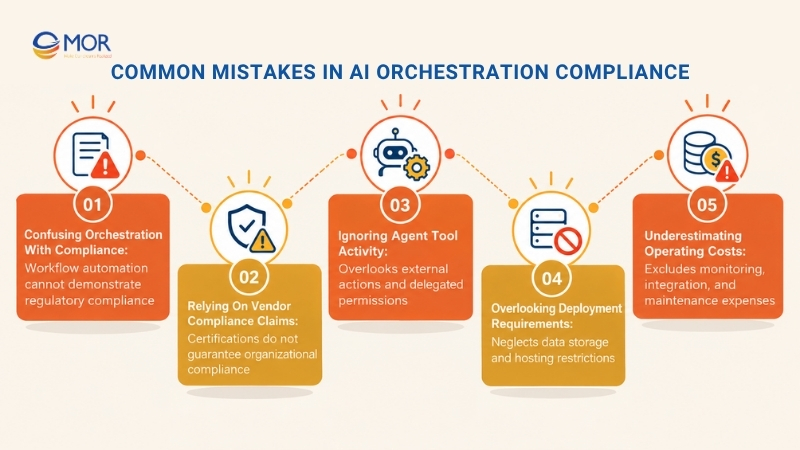
- Confusing orchestration with compliance: Model routing and workflow automation do not automatically provide regulatory assessments or approval records. Verify what each product actually governs.
- Relying on vendor compliance claims: A vendor's security certification does not establish your organization's regulatory compliance. Review the applicable controls, deployment settings, and shared responsibilities.
- Ignoring agent tool activity: Model-call logs may miss actions taken through external tools or delegated credentials. Record agent permissions, tool invocations, and high-risk operations.
- Overlooking deployment requirements: Check regional data storage, retention settings, private hosting, and logging restrictions before onboarding sensitive information.
- Underestimating operating costs: Account for monitoring, evidence storage, integration work, ongoing support, and security maintenance.
The financial risk is substantial. IBM's 2025 Cost of a Data Breach Report found that 63% of breached organizations lacked an AI governance policy or were still developing one.
Security gaps can also arise during software development. Teams adopting AI-generated code should review access permissions and the safeguards discussed in vibe coding security before releasing applications that connect to sensitive enterprise systems.
Integrate Governed AI Workflows With MOR Software
Managing AI model compliance becomes more complex when enterprises connect different models, data sources, and business applications. MOR Software provides AI development services, including Generative AI Integration, to help organizations design and integrate AI capabilities within their existing systems.
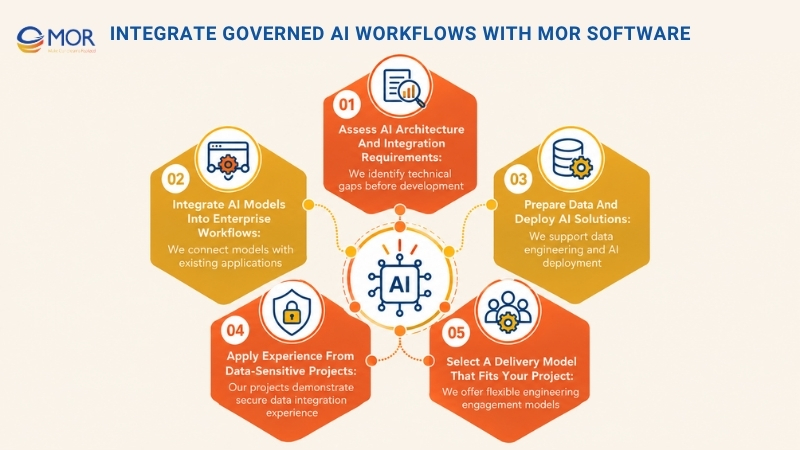
- Assess AI architecture and integration requirements: Our AI Feasibility Assessment service examines business objectives, available data, and technical requirements before development. This gives enterprises a starting point for identifying integration gaps and defining requirements for model access, security, and oversight.
- Integrate AI models into enterprise workflows: Our Generative AI Integration service focuses on incorporating AI capabilities into business applications. We support custom software development and system integration, helping organizations connect models with existing workflows, APIs, and enterprise infrastructure.
- Prepare data and deploy AI solutions: MOR Software provides Data Engineering, Custom Model Services, and Edge & Cloud Deployment. Our documented technology stack includes FastAPI, TensorFlow, Amazon SageMaker, Docker, Kubernetes, vLLM, and Qdrant, supporting different AI development and deployment requirements.
- Apply experience from data-sensitive projects: Our portfolio includes an AI-Powered Semantic Search Transformation project for a Japanese enterprise. Our Medical Management System (Procuratio) project used C#, Java, and Node.js to support CDISC-aligned data management and controlled information sharing. These projects demonstrate relevant integration and data security experience, rather than certification of a dedicated AI compliance product.
- Select a delivery model that fits your project: We provide staff augmentation, fixed-price development, and dedicated teams. These models suit businesses that need additional AI engineering expertise, a defined integration project, or ongoing technical support.
MOR Software is a suitable partner for enterprises planning custom AI app generator, integrating generative AI into existing systems, or modernizing their AI infrastructure. Contact us to discuss your architecture, security requirements, and integration scope with our development team.
Conclusion
The leading AI compliance solutions for model orchestration address different needs across runtime security, regulatory governance, and model lifecycle management. Your choice should reflect your existing infrastructure, compliance obligations, and required controls. Start by assessing current AI workflows and identifying gaps in access management, monitoring, and audit evidence. MOR Software supports AI feasibility assessment and enterprise integration planning.
Contact MOR Software to discuss your project requirements and implementation options.
"Evolution is not a destination, it is a disciplined journey of innovation."
Phung Van Tu


CEO MOR AI
MOR SOFTWARE
Frequently Asked Questions (FAQs)
What are AI compliance solutions for model orchestration?
AI compliance solutions help organizations control, monitor, and document how AI models, agents, and applications operate. Their capabilities include access restrictions, risk assessments, runtime controls, and audit records. The exact coverage depends on whether the product focuses on gateway security, AI governance, or lifecycle management.
Which AI compliance platforms are best for enterprises?
The best choice depends on your systems and regulatory requirements. IBM watsonx.governance, Credo AI, OneTrust, Holistic AI, and ModelOp focus on governance processes. TrueFoundry, Portkey, and Kong emphasize runtime infrastructure controls, while Microsoft Purview addresses AI-related data security.
How do AI governance tools differ from AI orchestration platforms?
Governance tools manage AI inventories, assessments, policies, approvals, and compliance evidence. Orchestration systems coordinate models, agents, and workflow execution. Some products combine elements of these functions, but organizations should verify where technical policy enforcement occurs and which governance activities require separate software.
Can AI model orchestration tools support EU AI Act compliance?
Yes. AI orchestration tools can support relevant requirements through logging, access restrictions, monitoring, and human approval mechanisms. Their contribution depends on the organization's role, AI system classification, and applicable obligations. A tool cannot independently guarantee EU AI Act compliance without the required organizational processes and evidence.
What security controls are essential for multi-model AI orchestration?
Organizations should examine authentication, RBAC, approved model lists, encryption, sensitive-data protection, runtime guardrails, and audit logging. Agent permissions and external tool access also require control. Higher-risk actions may need human approval before the orchestration system proceeds.
How do AI compliance platforms monitor autonomous AI agents?
Supported platforms collect information about agent activity, model requests, tool calls, access permissions, and policy events. Monitoring rules can identify unexpected behavior or unauthorized actions. Some systems can block requests or escalate incidents, while governance platforms record assessments and remediation decisions.
What is the difference between AI compliance software and an LLM gateway?
An LLM gateway manages AI traffic, provider connections, credentials, and runtime policies. AI compliance software typically supports risk management, policy documentation, regulatory mapping, and audit evidence. Organizations may connect the two when operational security records need to feed broader governance processes.
Can open-source AI orchestration tools meet enterprise compliance requirements?
Open-source tools can contribute to compliant AI operations when properly configured and maintained. LiteLLM, for example, supports model access controls and usage management. Enterprises still need suitable security settings, monitoring, documentation, testing, and governance procedures based on their regulatory obligations.
How much do AI compliance solutions for model orchestration cost?
Prices vary considerably. TrueFoundry publishes a Pro plan starting at $25 per user per month, while IBM watsonx.governance lists a Risk & Compliance Basic plan starting at $3,500 per month. Many governance vendors require custom quotes. Self-hosted gateways also involve infrastructure and maintenance expenses.
How should organizations evaluate AI compliance solutions before deployment?
Start with one representative AI system and document its data access, model connections, user permissions, and compliance requirements. Test the platform's integration, runtime restrictions, logging, approval process, and evidence exports. Compare total costs and operational responsibilities before expanding deployment across departments.
Share


Make Our-Dreams Realized


© 2023 . MOR Software. All Rights Reserved
Sitemap
Privacy Policy
Terms of Use

Rate this article
0
over 5.0 based on 0 reviews
Your rating on this news:
Name
*Email
*Write your comment
*Send your comment
1